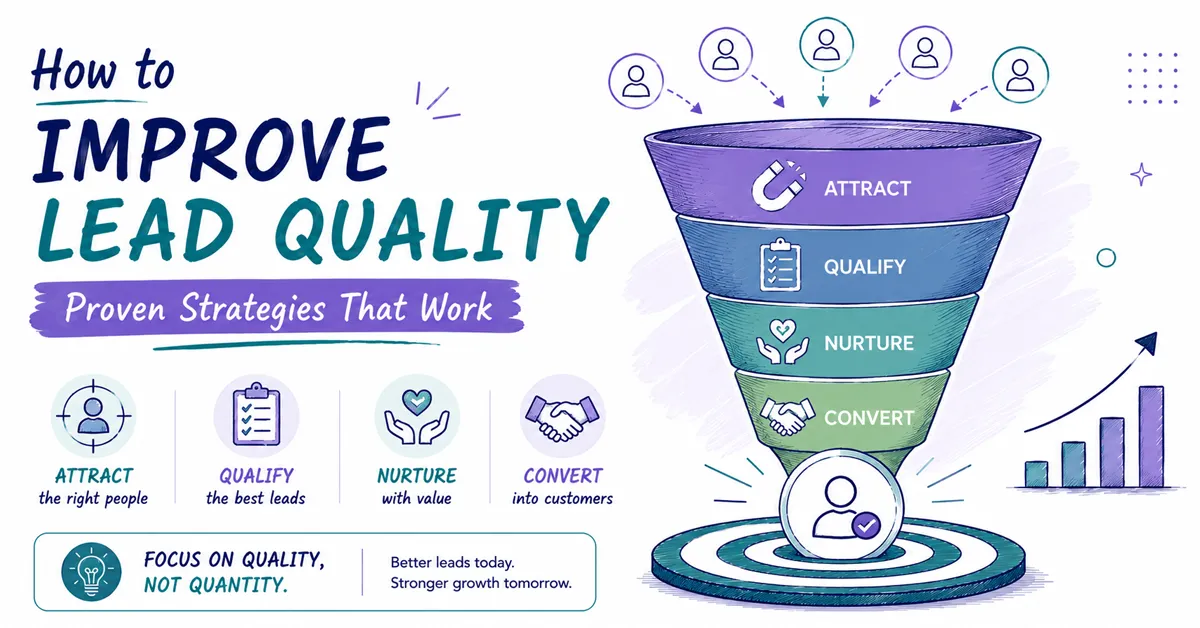
It always feels like the right move, doesn’t it? Chasing more leads. But focusing on volume over value is one of the most expensive mistakes a business can make.
The real solution isn’t generating more enquiries; it’s about attracting better ones. This means building a system that starts filtering for quality from the very first click.
For too many UK businesses, lead generation has become a simple numbers game. The more form fills, the better. Right?
Wrong. This mindset is a trap. It leads to a frantic chase for quantity that completely ignores the huge, hidden costs of poor-quality leads. And those costs go far beyond your ad spend.
Think about a typical service business in the UK. You launch a new Google Ads campaign, and the leads start rolling in. The numbers on your weekly report look fantastic. But then the sales team starts complaining. They’re spending all day calling people who have the wrong budget, aren’t the decision-maker, or completely misunderstood what you even do.
This isn’t just inefficient. It’s destructive.
The real damage from low-quality leads isn’t just the wasted marketing budget. It’s the sales team burnout, the polluted CRM data, and the slow erosion of your brand as you chase people who were never a good fit.
This cycle is incredibly damaging. Here’s what’s really happening:
Fixing this demands a fundamental shift in how you think about marketing. You need a system that combines targeted SEO and Paid Ads with intelligent website design to attract and convert the right customers from the start.
For anyone looking to sharpen their paid campaigns, a deeper dive can help you improve your Google Ads lead generation and stop wasting money on the wrong clicks.
Ultimately, you have to understand your true cost per acquisition to measure what actually matters. At Gilkes Media, this strategic alignment is at the core of our marketing consultancy, ensuring your efforts translate directly into profitable growth.
Before you can fix poor lead quality, you need to diagnose where the problem actually lies. A vague feeling that "the leads are bad" isn't enough. You need to get specific about where and why the breakdown is happening, and this almost always starts by digging into your data.
Your first stop should be your CRM. Don't just glance at the total number of leads; get granular and analyse them by their source. Is one particular Google Ads campaign sending a high volume of leads that never make it past the first call? Is organic traffic from a certain blog post attracting people who are just looking for information, not a real solution? Spotting these patterns is the first step to a proper diagnosis.
Let's be honest: your sales team knows which leads are good and which are a complete waste of time. They’re on the front line dealing with them every single day. Creating a direct, structured feedback loop with sales is the single most powerful diagnostic tool you have.
Forget about new, complex software. A simple shared document, like a Google Sheet, is often all it takes to turn their daily frustrations into actionable data. This is how you move the conversation from anecdotal complaints to a clear, data-backed diagnosis.
Here are the essential questions you need your sales team to answer for the leads they get:
This simple process quickly shines a light on the true financial impact of poor lead quality. It shows you exactly where money, time, and team morale are being drained.
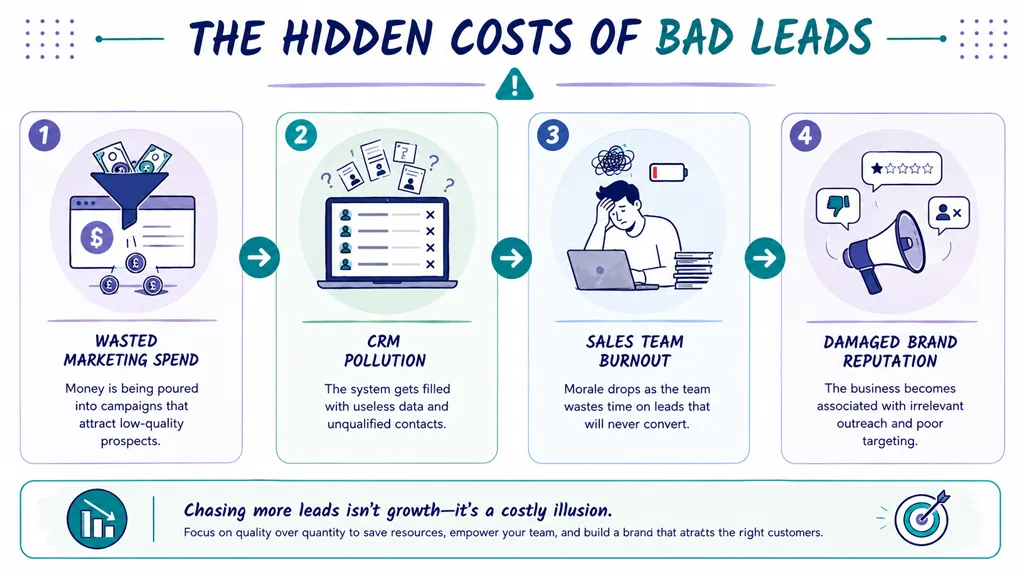
As you can see, the negative effects cascade right through the business, from wasted ad spend and marketing effort through to sales team burnout. To get to the root of these issues, you need a thorough approach.
Ultimately, improving lead quality starts with measuring it properly. That means looking beyond the raw number of leads and tracking the entire journey from Lead → Qualified → Opportunity → Sale, then comparing how each channel performs. The biggest lesson here is that sales teams spot these quality issues first, making their structured feedback absolutely essential to any real improvement.
Improving lead quality starts by being ruthless about who you attract in the first place. You have to stop casting a wide, hopeful net and start filtering at the source. This means refining your marketing targeting to focus obsessively on high-intent prospects across both your paid advertising and your organic search efforts.
For paid advertising on platforms like Google Ads and Meta, this means moving beyond the broad, top-of-funnel keywords that attract researchers and tyre-kickers. Instead, you need to laser-focus on long-tail, commercial-intent phrases that signal someone is close to making a decision. Think "emergency commercial plumber Manchester," not just "plumber."
A crucial step in attracting high-intent prospects is thoroughly understanding your ideal customer.
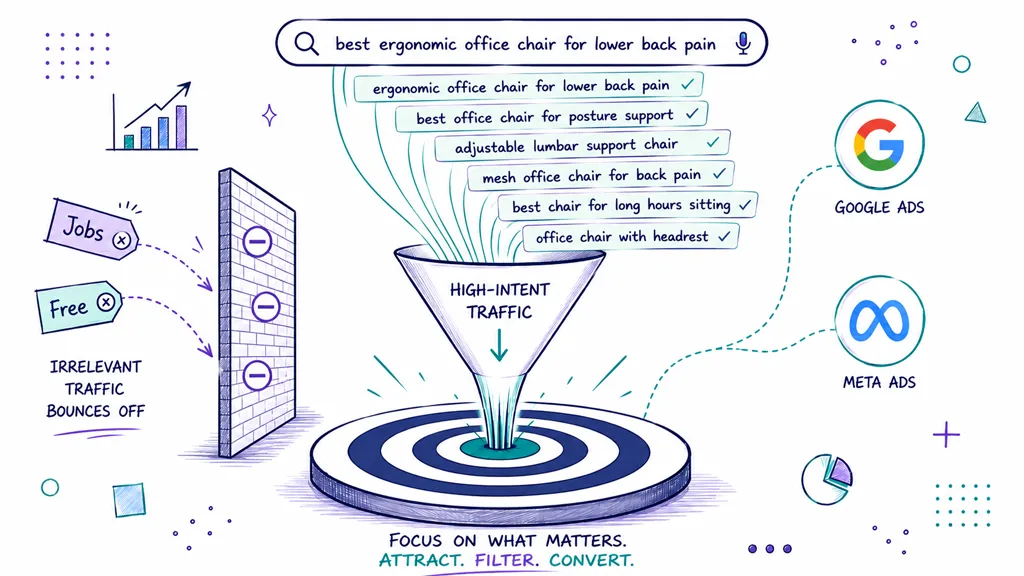
An aggressive negative keyword strategy is just as important. You must actively block search terms related to jobs, free services, DIY guides, or any other query that screams "not a customer." Every pound spent on a click from someone looking for a "plumbing course" is a pound wasted.
The UK’s internet advertising market was valued at £36.6 billion in 2023. In such a crowded space, even small improvements in your targeting efficiency can save you thousands in wasted ad spend and instantly improve your lead quality.
This is where Gilkes Media’s Paid Ads Management service delivers real value. We don't just run ads; we build ROI-focused campaigns designed to attract high-intent buyers and filter out time-wasters, ensuring your budget works as hard as possible. Below is a quick summary of high-impact adjustments you can make right away.
| Channel | Action to Improve Lead Quality | Example for a UK B2B Service |
|---|---|---|
| Google Ads | Add negative keywords for "free," "jobs," "course," "training." | A London-based IT support company adds "-free IT support," "-IT support jobs," and "-DIY computer repair" to its campaigns. |
| Meta Ads | Layer detailed targeting with custom audiences (e.g., website visitors). | A software firm targets users interested in "Project Management" but excludes those who have visited their "Careers" page. |
| LinkedIn Ads | Use job title and company size filters to narrow your audience. | A financial consultancy targets "Finance Directors" at companies with 50-200 employees in the UK, excluding junior titles. |
| Organic Search (SEO) | Create content targeting long-tail, problem-aware keywords. | Instead of "accountant," an accounting firm writes a guide titled "How to Switch Accountants for Your UK Limited Company." |
These aren't one-time fixes; they require constant monitoring. But by implementing them, you immediately shift your focus from chasing every possible click to attracting only the right ones.
For organic search, the principle is the same. As an SEO consultancy, Gilkes Media focuses on building out topic clusters around the specific problems your ideal clients are trying to solve. This isn't about ranking for vanity keywords; it’s about attracting commercial-intent traffic by answering the specific, urgent questions that buyers ask right before they make a purchase.
This strategic approach across both paid and organic channels acts as your first and most powerful quality filter. It's a clear example of where understanding the difference between demand generation vs lead generation becomes critical, a topic we cover in more detail elsewhere.
Your website should be your hardest-working salesperson, not just a digital brochure. It’s the perfect tool for automatically filtering prospects, making sure only the most promising enquiries land in your sales team’s inbox. This means strategically designing your pages to convert the right kind of customer.
At Gilkes Media, our Website Design and Development service is built on this very principle. We build high-performing, bespoke business websites designed specifically for lead generation. We use clear, benefit-driven copy that speaks directly to your ideal client while gently pushing away those who aren't a good fit. It’s about attracting and qualifying in one smooth motion.
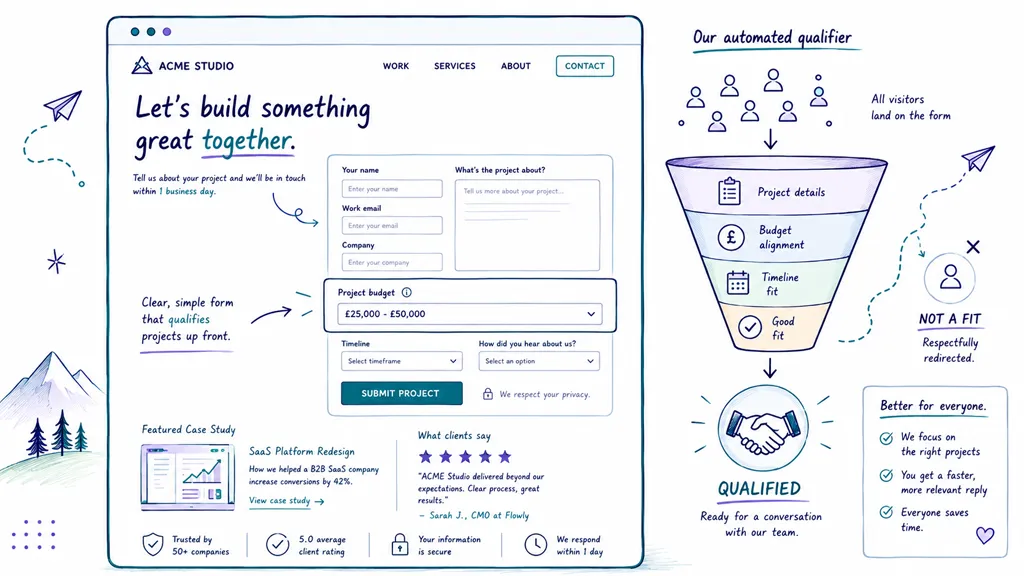
There’s a persistent myth that shorter contact forms are always better. While you don’t want to overwhelm visitors with a 20-question survey, adding just one or two strategic qualifying questions can have a huge impact on your lead quality.
These questions act as a powerful, yet simple, filter. Think about adding fields like:
By asking these questions upfront, you encourage prospects to pause and consider if they are a serious buyer. Those who aren’t a good fit will often self-select out, saving your sales team hours of wasted time. To dig deeper into this, check out our full guide on how to qualify sales leads effectively.
A high-quality website isn’t just about looking good. It’s a machine designed to attract, educate, and pre-qualify prospects, turning your marketing spend into genuine sales opportunities.
This pre-qualification is strengthened by building trust. When your landing pages are filled with social proof like client testimonials, detailed case studies, and industry accreditations, you build immense confidence. Good-fit prospects see you as a credible expert, while poor-fit prospects often realise you operate at a professional level they might not be ready for.
Lead quality also jumps when you combine this trust with smart data hygiene in your acquisition strategy. In practice, this means validating email addresses on submission and pushing leads instantly into your CRM for a rapid sales response. Lead quality, speed and accuracy are two sides of the same coin. How quickly you actually respond once that lead lands matters just as much as the data hygiene — see our full breakdown of why response time is costing UK businesses sales.
Even with a clear plan, it’s normal to have a few nagging questions. Based on our work with UK businesses, these are the most common queries that come up when tackling lead quality.
You can see the first signs of improvement surprisingly fast. Simple tweaks, like adding specific negative keywords to your Google Ads campaigns or placing one extra qualifying question on your website’s contact form, can begin filtering out poor-fit enquiries in a matter of weeks.
However, making a deep, systemic change takes a bit more time. For instance, refining your SEO strategy to attract higher-intent organic traffic is a longer game. You might need 3-6 months to see the full effect as your rankings improve and the right kind of visitors start to find you.
The trick is to have a solid measurement framework in place from day one. This lets you track progress, connect improvements to specific actions, and prove the return on your efforts over time.
Quite possibly, and that’s usually a good thing. The immediate goal is to cut down on the low-value, time-wasting enquiries. This will almost certainly lower your total lead count in the short term.
But here's what really matters: the number of sales-qualified leads (SQLs) and, ultimately, actual customers should go up. Success isn’t about the raw number of form submissions; it's about the revenue they generate.
A campaign that delivers 10 high-quality leads resulting in 3 new customers is infinitely better than one that brings in 50 poor leads and zero sales.
Talk to your sales team. Right now. The alignment between marketing and sales is the absolute bedrock of better lead quality. Your salespeople are on the front line every day; they know instinctively which leads are gold and which are a complete waste of their time.
Book a meeting. Ask them to describe their perfect customer. Listen to their frustrations about recent enquiries.
This single conversation provides all the clarity you need to fix everything else. The insights from your sales team should directly inform your ad targeting, your website messaging, and your on-page qualification criteria.
No. Technology like CRMs and marketing automation platforms are fantastic enablers, but they are not a strategy. They can help you implement lead scoring, automate follow-ups, and track data far more efficiently, but they can't fix a broken foundation.
If your core strategy is flawed-if you're targeting the wrong audience with the wrong message-then technology will only help you process bad leads at a faster pace.
Strategy always comes first. At Gilkes Media, we combine expert SEO consultancy and growth strategy with meticulous execution, ensuring your technology supports a solid, commercially-focused plan.
Ready to stop wasting time on low-quality leads and build a predictable engine for growth? Gilkes Media combines expert marketing consultancy with hands-on execution across SEO, Paid Ads, and Website Design to attract and convert the customers you actually want. Book a free, no-obligation consultation today to see how we can improve your lead quality and drive real revenue.
