Referrals still matter in construction. They also create one of the worst operating models in the trade when they're your only source of work.
One month the diary is full, the phone won't stop, and you're turning down small jobs. A few weeks later, quotes are out, decisions are dragging, and the pipeline feels thin enough to make payroll look uncomfortably close. Most firms don't have a lead problem. They have a systems problem.
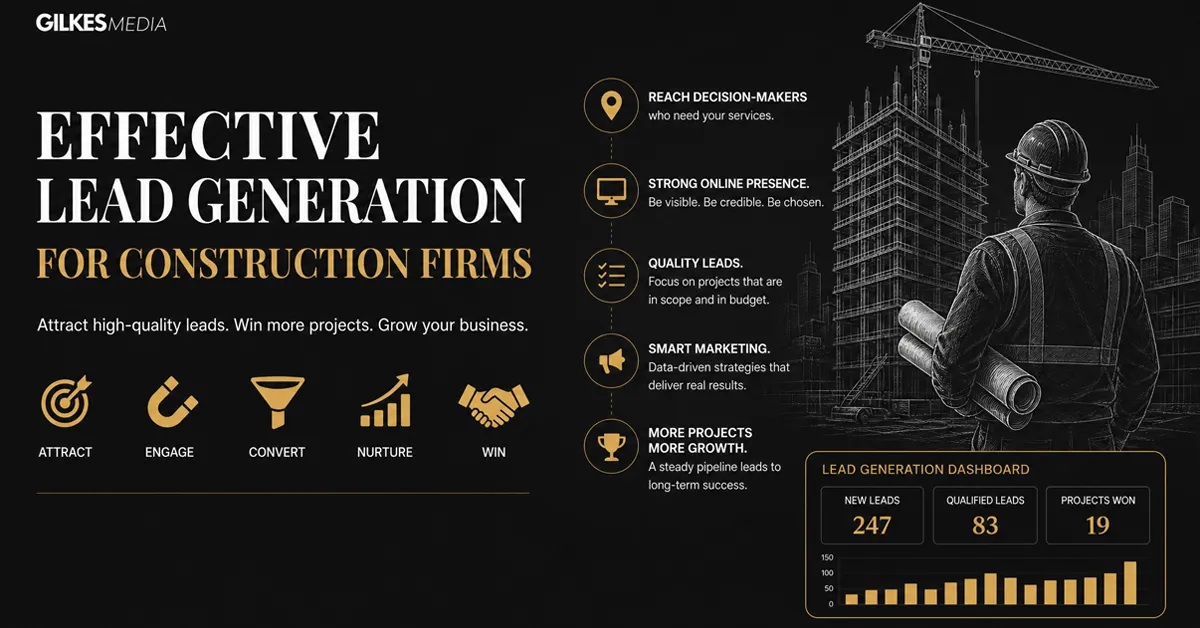
Lead generation for construction works best when it's treated like a business system, not a bag of disconnected tactics. That means knowing which projects you want, building channels that bring in those enquiries consistently, and tracking what turns into profitable jobs rather than celebrating raw lead counts.
The feast or famine cycle usually starts with good intentions. A firm does strong work, gets a run of referrals, stays busy, and assumes the pipeline will look after itself. Then a key referrer goes quiet, a few larger projects stall, or competitors become more visible in local search. Suddenly the business is reacting instead of choosing.
That approach is risky in a market as large and scattered as UK construction. The industry had around 342,000 businesses in 2024, and construction output in Great Britain was about £38.5 billion per month in 2024, according to UK construction market data referenced here. For lead generation, that matters because there isn't one single market. There are thousands of local micro-markets, specialist niches, and buyer types moving at different speeds.
Broad advertising usually performs badly in that environment. It catches too many poor-fit enquiries and misses the local intent that drives real buying behaviour. Focused outreach works better. So does local SEO. So does spotting projects early and getting in front of the right buyer before everyone else piles in.
Practical rule: If your pipeline depends on luck, your growth depends on luck too.
The firms that build steadier revenue usually do three things well:
That's the shift. Stop asking, “How do we get more leads?” Start asking, “How do we build a predictable flow of profitable enquiries in the areas and project types we want?”
Most construction marketing fails before the campaign even starts. The problem isn't usually Google Ads, SEO, or the website platform. The problem is that the business hasn't decided what it wants to attract.
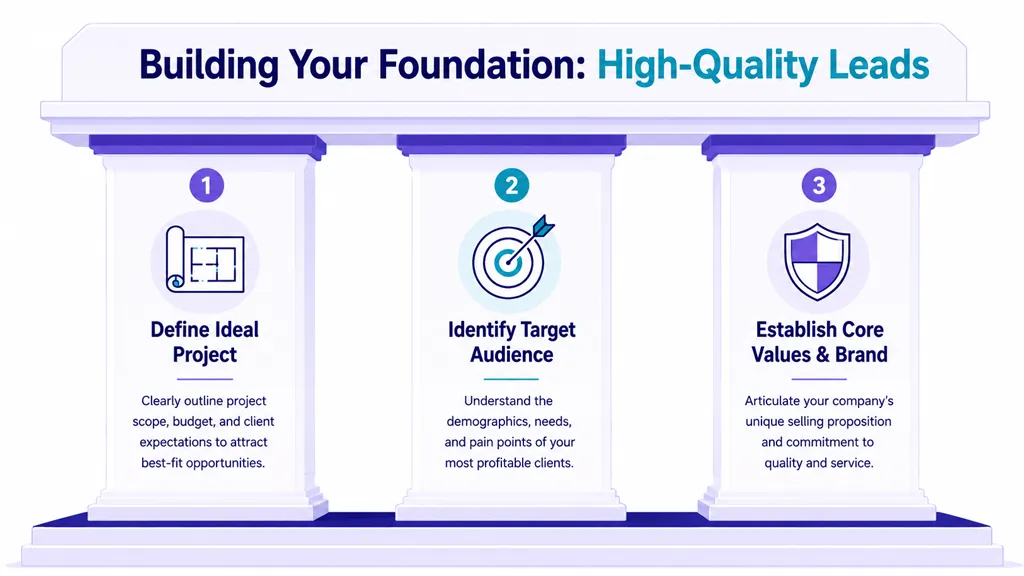
Too many firms say yes to “more enquiries” when they should be filtering for profitable work. Extension projects in one postcode may be ideal. Small reactive jobs spread across a wide radius may look busy but drain margin. Commercial fit-out leads may sound attractive but move slowly and consume estimating time.
A useful way to think about this is through cost per won job, not just cost per lead. The strongest lead generation strategies focus on quality over volume, and practitioners recommend comparing channels by the cost required to win actual work rather than the cost to generate an enquiry.
Write down your ideal project profile. Keep it practical:
Construction buyers don't respond to vague claims. “High quality service” means nothing. “Loft conversions for occupied family homes in Surrey with clear scheduling and one point of contact” means something.
Your messaging should make three things obvious within seconds:
That doesn't require clever branding language. It requires specificity. Buyers need to see that you understand their job, their location, and the concerns around cost, timing, disruption, compliance, and finish quality.
A surprising number of construction websites still behave like digital brochures. They look fine, but they don't help a buyer take the next step.
Your website should make it easy for the right visitor to enquire and easy for your team to qualify them. That means clear service pages, local relevance, visible calls to action, proof of work, and forms that collect enough detail without creating friction.
A strong site usually includes:
For firms that want sector-specific strategic input before spending on traffic, this guide to marketing for construction companies is a sensible next step.
Inbound works when someone already has intent. They're searching for a contractor, a specialist, a quote, or a local firm they can trust. That's why inbound usually outperforms broad awareness activity for construction businesses that need enquiries tied to real jobs.
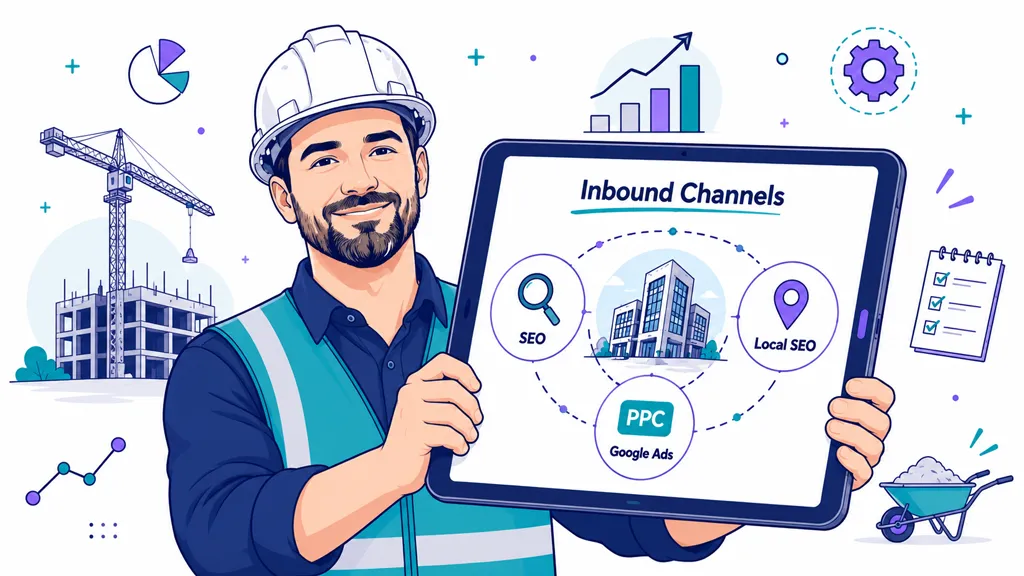
Google Ads is the fastest way to test demand in a defined area. It's also one of the easiest ways to burn money if the setup is sloppy.
The mistake I see most often is simple. Contractors bid on broad keywords, send everyone to the homepage, and judge success by call volume. That creates wasted clicks, irrelevant leads, and no real picture of which campaign produced worthwhile work.
Google Ads is strongest when you keep it tight:
| Channel use | Works well when | Fails when |
|---|---|---|
| Search campaigns | You target specific services and locations | You use broad terms with weak intent |
| Landing pages | Each service has its own page and CTA | All traffic goes to a general homepage |
| Tracking | Calls and form leads are tied to source | Enquiries aren't matched back to jobs |
For firms trying to build a more disciplined acquisition engine, this resource on digital marketing for lead generation shows how paid traffic, landing pages, and follow-up should connect.
SEO is slower than paid search, but it compounds. If you build useful service pages, location pages, and supporting content around real search intent, you reduce dependency on paid enquiries over time.
Construction SEO works best when it answers the practical questions buyers ask before they enquire. Not fluffy blogs. Pages that help a buyer decide whether to contact you.
Good examples include:
A useful crossover here comes from property marketing. Buyers don't only respond to visibility. They respond to relevance, timing, and confidence in delivery.
For many contractors, Local SEO is the engine room. Google Business Profile, map visibility, reviews, categories, service areas, and recent project photos often influence who gets the call in the first place.
There's another layer to this. Visibility only matters if someone follows up quickly. One construction-focused coaching source says teams should aim to reply within one hour, noting that 37% of companies already do so, while also setting a clear internal standard of acknowledgement within 24 hours, according to this guidance on response speed and local trust signals in construction lead generation.
The lead doesn't go cold because the buyer lost interest. It usually goes cold because another contractor replied first.
That means your local presence and your follow-up process need to work together:
Waiting for inbound alone leaves too much to chance. Some of the best construction lead generation happens before a buyer ever searches Google.
One of the most underused methods in the UK is watching planning activity properly. Local planning authorities in England and Wales decided roughly 380,000 to 400,000 planning applications in 2023-24, and those milestones often sit well ahead of procurement and contractor selection.
A practical workflow looks like this:
Early-stage outreach faces less competition. You're not one of six contractors pricing the same job after it's already spread through the market. You're one of the few firms that spotted movement before the project became obvious.
The old-school side of construction still works. It just needs structure.
Architects, planning consultants, structural engineers, kitchen designers, surveyors, and key suppliers can all become repeat lead sources. The mistake is treating that as casual networking. Good firms build a referral process around it.
That usually means:
A referral source isn't a lead source because they know your name. They become a lead source when they trust you not to damage their reputation.
The strongest network-based leads often convert better because the trust transfer has already happened. But they still need handling properly. If you respond slowly, send vague quotes, or fail to follow up, even warm introductions die.
Generating the enquiry is the easy part compared with turning it into signed work. A lot of construction businesses think they have a traffic problem when they really have a conversion problem.
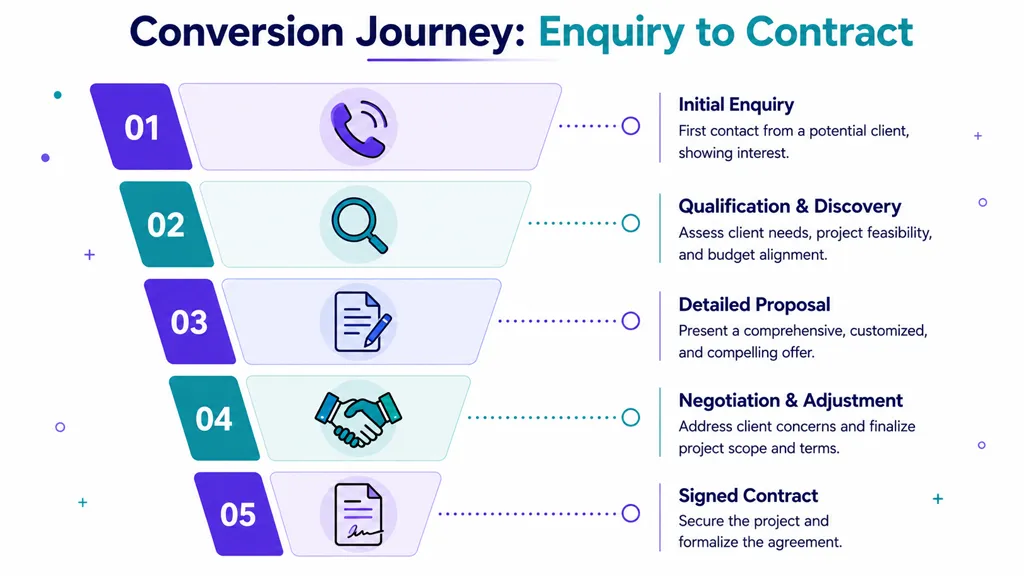
If someone clicks an ad for loft conversions in Leeds and lands on a generic homepage, you've created unnecessary work for the buyer. They now have to figure out whether you do that service, whether you cover the area, and how to contact you.
Dedicated landing pages solve that. Lead generation guidance for construction notes that dedicated landing pages can achieve conversion rates around 23%, and recommends tracking source, value, and outcome for at least 90 days.
A good landing page for construction usually includes:
There's always tension in form design. Sales wants more detail. Buyers want less effort.
The answer is not a giant form. It's a smart one.
Ask for what your team needs to triage the lead:
| Form field | Why it matters | Keep or cut |
|---|---|---|
| Name and contact details | Needed for response | Keep |
| Postcode or project location | Confirms service area fit | Keep |
| Project type | Helps qualification | Keep |
| Short description | Gives context before the call | Keep |
| Full specification | Better handled later | Cut initially |
If you need more detail, get it during the follow-up call or site survey.
Most lost opportunities don't disappear in dramatic fashion. They get forgotten, delayed, or mishandled. A form fill sits in an inbox. A missed call never gets logged. An estimate goes out and nobody chases it.
That's why even simple systems beat good intentions. A spreadsheet is better than memory. A CRM is better than a spreadsheet if the team will use it.
The minimum process should include:
If your current tools feel clunky, it can help to review things holistically, especially if you're trying to connect forms, CRM actions, notifications, and follow-up automations without building a messy stack.
The sales process in construction doesn't need to be complicated. It needs to be visible, fast, and repeatable.
Clicks, impressions, and traffic can be useful diagnostic metrics. They are not the numbers that should drive budget decisions in a construction business.
If you want better lead generation for construction, measure the commercial journey from source to signed job. That changes how you judge every channel.
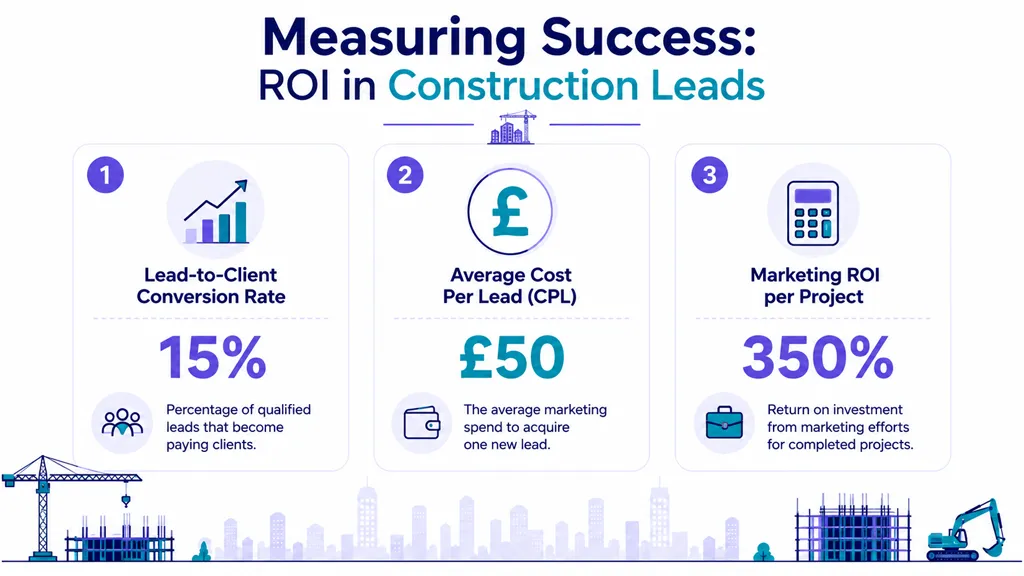
Start with a basic lead log. For every enquiry, record source, date, estimated job value, stage reached, and final outcome. That gives you enough to compare channels properly.
The three commercial metrics I'd watch first are:
That final metric is the one that usually changes behaviour. Some channels look cheap at lead level and expensive at job level. Others look expensive upfront but produce better-fit enquiries that close more cleanly.
Use this kind of comparison when reviewing channels:
| Metric | Google Ads | SEO | Referrals | Planning-led outreach |
|---|---|---|---|---|
| Lead volume | Can be strong quickly | Builds over time | Usually variable | Usually selective |
| Lead quality | Depends on targeting | Often strong if intent is right | Often high | Often high |
| Control | High | Medium | Low | Medium |
| Measurement | Clear if tracked well | Clear if tracked well | Often poorly tracked | Often poorly tracked |
The point isn't to pick one winner. It's to understand the role each channel plays and whether it produces profitable work.
Lead-gen guidance for contractors recommends recording lead name, date, source, estimated value, and outcome for at least 90 days before making major decisions. That's long enough to spot patterns and short enough to act on them. It also stops you from killing a channel just because a few recent leads were weak.
If you want a more detailed finance view, this guide on calculating customer acquisition cost is helpful because it pushes the conversation beyond vanity metrics and into actual commercial return.
Don't ask which channel generates the most leads. Ask which channel wins the right jobs at a cost your margin can support.
Sometimes, but only with caution. Bought leads can fill gaps quickly, but they often create three problems. Shared competition, weaker intent, and poor fit.
The better question isn't whether the lead was cheap. It's whether that source produces profitable work after sales time, quoting effort, and close rate are factored in. If you do use third-party leads, track them separately from your own channels so you can judge them fairly.
If speed matters, focus on existing demand first. Tight Google Ads campaigns, a properly optimised Google Business Profile, and fast response handling usually create the quickest movement because they capture buyers who are already looking.
That said, quick doesn't always mean efficient. Fast lead flow with weak qualification can overload the team and still produce poor revenue quality. The fastest useful route is the one that brings in enquiries your business can convert and deliver profitably.
Long enough to see the full sales journey, not just the first enquiry. For most firms, that means tracking enquiries, quotes, and outcomes over a meaningful window rather than making decisions after a handful of leads.
Paid search can produce signals relatively quickly. SEO, local visibility work, and relationship-led channels usually need longer to show their real value. What matters is consistency in tracking. If one channel is measured properly and another isn't, the comparison will always be distorted.
Enough to help your team qualify the opportunity without putting people off. In most cases, name, contact details, location, project type, and a short description are enough for first contact.
If you ask for too much upfront, completion rates often fall and mobile users abandon the form. The detailed discovery should happen after the enquiry comes in, not before.
Neither wins in every case. Google Ads is useful when you need immediate visibility and tight geographic control. SEO is stronger for building long-term demand capture and reducing dependence on paid traffic.
Most firms don't need an either-or answer. They need a balanced system. Paid search can generate near-term opportunities while SEO and Local SEO build a steadier pipeline over time.
Slow follow-up is near the top of the list. After that, I'd include poor landing pages, unclear messaging, weak qualification, and a lack of process once an estimate has gone out.
A lot of firms think they need more top-of-funnel activity when the underlying issue is basic sales handling. Better response speed and cleaner follow-up often improve results before any extra traffic is needed.
If your construction firm wants a lead generation system that produces better enquiries, clearer attribution, and stronger ROI, speak to Gilkes Media. Gilkes Media helps UK businesses turn SEO, paid advertising, website design and marketing strategy into commercially useful growth, with a practical focus on enquiries, revenue, and what converts.
