Let's cut through the jargon. Performance marketing is any marketing where you only pay when you get a measurable result. That result could be a click, a lead, or best of all, a sale. It’s a purely commercial approach that ties every pound you spend directly to a tangible outcome.
Imagine you're hiring a new salesperson. You have two options.
Option one is to hire them on a fixed salary. You pay them the same amount every month, whether they close ten deals or zero. This is like traditional advertising. You pay for a billboard or a magazine ad and hope it brings in customers, but there's no direct link between your spend and the sales that come in.
Option two is to hire them on a pure commission model. You only pay them when they bring in revenue. That’s the essence of performance marketing. Instead of paying for views or impressions, you’re investing directly in the actions that actually grow your business.
This model completely flips the risk. Instead of hoping your marketing budget works, you make sure it does. Every pound is tracked, accountable, and optimised to deliver the highest possible return on your investment.
The real difference is what you're buying. Traditional marketing often chases broad, fuzzy goals like "brand awareness." While important, it’s almost impossible to connect the £5,000 you spent on a print ad directly to this month's sales figures. Performance marketing closes that gap.
Performance marketing is about moving from "I think my marketing is working" to "I know my marketing generated a £5 return for every £1 I spent". It replaces ambiguity with certainty and financial accountability.
This forces a laser focus on what truly matters for growth:
Ultimately, understanding performance marketing means adopting a mindset of measurement and accountability. It’s not about just running ads. It’s about building a predictable and profitable engine for winning new customers.
Performance marketing isn’t a single tactic. It’s a mindset applied across different digital channels. Understanding where it all happens is the first step to building a strategy that actually makes money. Each channel works differently, serves a different audience, and helps you hit specific business goals. The right mix depends entirely on your business, your customers, and your commercial objectives.
This diagram shows where performance marketing sits. It’s a world away from traditional advertising because it’s all about measurable results.
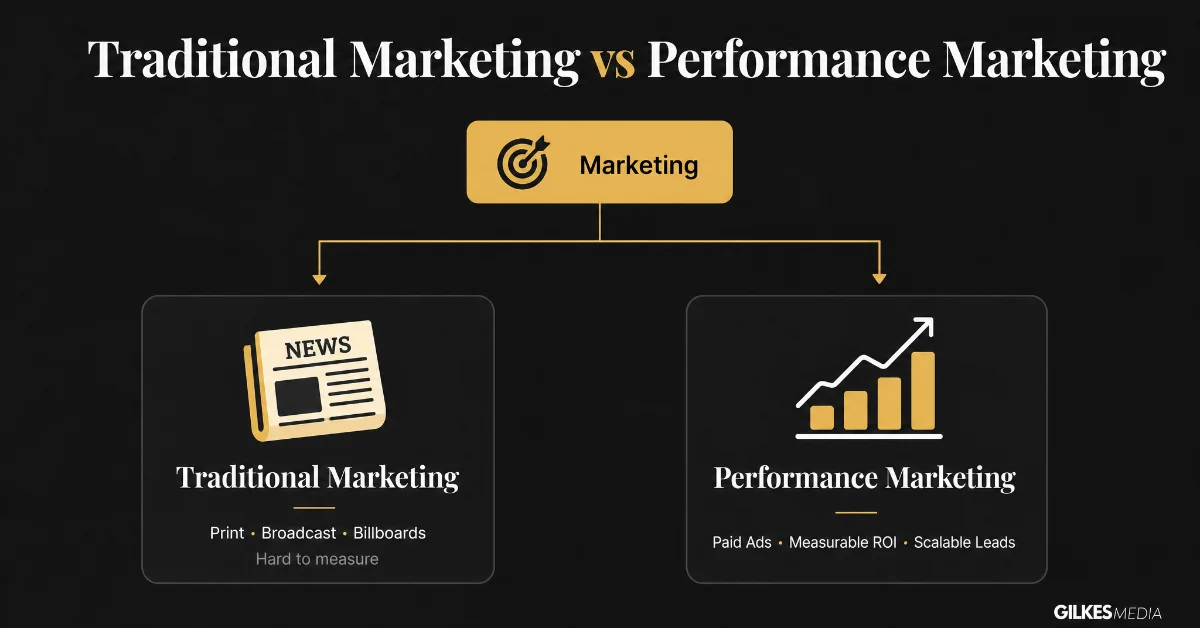
As you can see, it’s a shift towards total accountability. Every pound you spend is tracked against a specific, tangible outcome. No guesswork is allowed.
Paid Search, or Pay-Per-Click (PPC), is all about capturing active demand. When a potential customer heads to Google or Bing searching for exactly what you sell, your ad can show up at the top of the results. The key benefit? You only pay when someone is interested enough to click.
This channel is incredibly powerful for businesses whose customers already know what they need and are actively looking for a solution. You are not interrupting their day. You are providing the answer to their problem at the perfect moment.
It boils down to three key steps:
A London-based accountancy firm, for example, might bid on the phrase "small business accountant in London." This puts them directly in front of potential clients at the precise moment they need help, making it a hyper-efficient way to generate high-quality leads. To see how this works in practice, you can learn more about our specific approach to PPC ad services for growing your business exponentially.
While Paid Search captures existing demand, Paid Social is brilliant at creating it. Platforms like Meta (Facebook and Instagram), LinkedIn, and TikTok let you put your ads directly into the feeds of very specific groups of people.
You are not waiting for them to come to you. Instead, you proactively reach them based on their interests, demographics, online behaviour, or even their job title. You typically pay per click (CPC) or for every thousand people who see your ad (CPM).
Paid Social excels at finding customers who might not even know your brand exists but are a perfect fit for what you offer. It’s about sparking interest and building awareness that you can convert into revenue down the line.
This makes it perfect for brands with visually compelling products, B2B companies targeting niche professional roles, or any business looking to build a community and increase its market presence.
Affiliate marketing is performance marketing in its purest form. Here, you partner with other people or companies (your "affiliates") to promote your products for you. These affiliates, such as bloggers, influencers, or review sites, earn a commission, but only for the sales they actually generate.
You provide them with a unique tracking link, and you only pay them a percentage of the revenue after a successful sale is confirmed. It’s a very low-risk way to expand your reach. For instance, a B2B software company could team up with industry bloggers to review their platform, paying them 15% of the subscription fee for every new customer who signs up through their unique link.
Have you ever felt like an ad is following you around the internet? That is likely programmatic display advertising at work. It refers to the automated buying of digital ad space across a huge network of websites. Instead of buying a banner ad on one specific site, you use technology to show your ads to specific users, wherever they happen to be browsing.
It’s most commonly used for retargeting, showing ads to people who have already visited your website but left without taking action. Imagine a customer adds a pair of shoes to their basket but gets distracted. Programmatic display allows an ad for those very same shoes to appear on other sites they visit, giving them a gentle nudge to return and complete the purchase. Payment is often based on impressions (CPM), but the real measure of success is whether they eventually convert.
To bring it all together, here's a quick summary of the main channels, how you typically pay for them, and where they fit best. This should help you think about which combination might work for your business.
| Channel | Common Payment Model | Primary Business Goal |
|---|---|---|
| Paid Search (PPC) | CPC (Cost-Per-Click) | Capturing high-intent leads and driving direct sales. |
| Paid Social | CPC or CPM (Cost-Per-Mille) | Building brand awareness and creating new demand. |
| Affiliate Marketing | CPA (Cost-Per-Acquisition) | Driving sales at a fixed cost with very low risk. |
| Programmatic Display | CPM (Cost-Per-Mille) | Retargeting past website visitors and brand building. |
Each channel has its strengths. Paid Search is a workhorse for immediate leads, while Paid Social is fantastic for finding new audiences. The real impact comes from combining them into a cohesive strategy that guides customers from initial awareness right through to conversion.
Knowing the channels is only half the battle. The real discipline in performance marketing comes from tying every single action back to your profit and loss statement. It’s about cutting through the noise, ignoring surface-level data, and focusing relentlessly on the numbers that actually dictate commercial success.
Without this focus, you are just spending money, not investing it.
Many businesses get completely sidetracked by vanity metrics, things like impressions (how many times an ad was seen) or social media reach. While these might have a place in a brand awareness campaign, they tell you absolutely nothing about whether you're making money. A proper performance marketing approach demands a much sharper focus on metrics that measure genuine business impact.
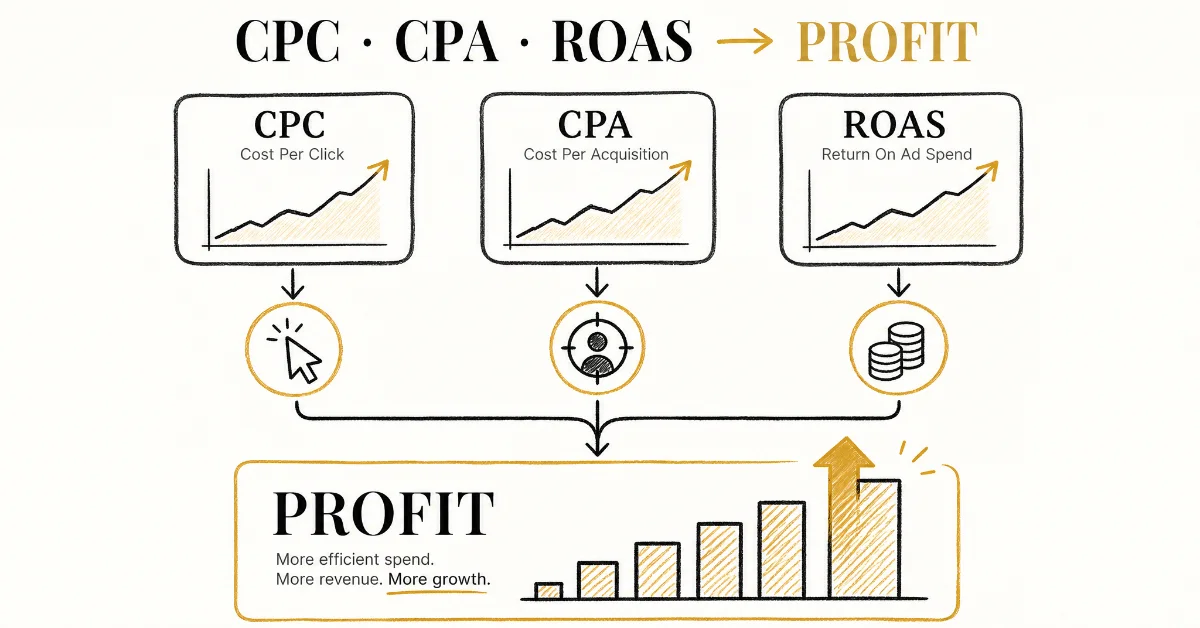
Let's break down the essential metrics that truly matter. These are the numbers you should live and breathe to determine if your investment is actually paying off.
Cost Per Click (CPC) is simply the price you pay each time someone clicks on your ad. It’s the most basic metric in channels like Paid Search and Paid Social, representing the cost of getting one potential customer to land on your website.
A "good" CPC varies wildly. A click for a London-based solicitor might cost £50, whereas a click for a novelty gift shop could be just 50p. The key isn’t just to chase a low CPC. It’s about understanding its relationship to the value of each customer. A high CPC is perfectly acceptable if it leads to a high-value sale.
This is where the analysis gets serious. Cost Per Acquisition (CPA), sometimes called Cost Per Lead (CPL) or Cost Per Sale (CPS), is the total cost to win one new customer. You calculate it by dividing your total ad spend by the number of conversions.
For example, if you spend £500 on a LinkedIn campaign and get 10 new client enquiries, your CPA is £50. This single number tells you exactly what it costs to get a potential customer to take your desired action.
Your CPA is the true cost of growth. The central goal of any performance campaign should be to acquire customers at a CPA that is sustainably lower than the profit they generate for your business.
Knowing your target CPA isn't optional. It's non-negotiable. It sets the financial guardrails for your campaigns, ensuring every conversion actually contributes to your bottom line instead of slowly eroding it.
Return On Ad Spend (ROAS) is the ultimate measure of advertising profitability. It answers the most critical question: "For every pound I put into this campaign, how many pounds did I get back in revenue?"
It’s calculated by dividing the total revenue from your ads by your total ad spend.
While a high ROAS is always the goal, the target figure depends entirely on your profit margins. A business with high margins might be profitable at a 3x ROAS, while another with tighter margins might need a 10x ROAS to see a real return.
Ultimately, mastering performance marketing means mastering these core metrics. They provide the commercial clarity you need to make smart decisions, optimise campaigns, and build a predictable engine for growth. Understanding how these numbers are tracked and analysed is crucial, which is why a solid setup of your paid search analytics is the foundation of any successful strategy.
A common friction point for founders is the tug-of-war between performance and brand marketing. It’s often presented as a choice: chase immediate sales or build a long-term identity? But that’s a false dilemma. They are not competitors fighting for your budget. They are partners playing different but equally critical roles in building a sustainable business.
The easiest way to tell them apart is to think about demand.
Performance marketing is about capturing existing demand. It’s designed to find people who are already looking for a solution like yours. The focus is immediate, the results are directly trackable, and the entire goal is to drive an action, like a sale, a lead, or a sign-up, right now.
Brand marketing is about creating future demand. It targets a much wider audience, building familiarity, trust, and positive feelings over time. The goal is to ensure that when someone eventually needs what you sell, your business is the first one that comes to mind.
Figuring out how to allocate your money between these two is one of the most important strategic decisions you will make. There’s no magic formula. The right mix depends entirely on your business model, your market position, and what you need to achieve commercially right now.
The old "either/or" mindset is outdated. Recent data shows a big shift in how UK businesses think about this, with many marketers now favouring a 60:40 or even 70:30 split that leans towards brand-building. But even with that focus on the long game, performance channels remain powerful. Email marketing, for instance, still generates an incredible ROI of £39 for every £1 spent. You can dig deeper into these numbers and discover more UK digital marketing insights on SearchHog.co.uk.
This proves it’s not about picking a side. The real question is, "What's the right balance for my business at this exact moment?"
Let’s run through a few practical examples to give you a framework for your own decision-making.
Think of it like this: Performance marketing fills your sales pipeline today. Brand marketing ensures that pipeline is still full, and much easier to fill, in two years’ time. One delivers immediate ROI; the other builds the long-term asset of brand equity that makes all your future marketing cheaper and more effective.
Ultimately, the best strategies weave both together. You use brand marketing to tell your story and warm up an audience, then deploy sharp performance marketing tactics to convert that audience the moment they signal they're ready to buy.
Stepping into performance marketing without a clear strategy is like trying to navigate a new city without a map. You might get somewhere eventually, but you’ll waste a lot of time and money along the way. After a decade of hands-on experience, I’ve seen the same avoidable mistakes trip up even the most promising businesses.
Understanding these common pitfalls is the first step towards building a campaign that delivers real, measurable results rather than just burning through your budget.
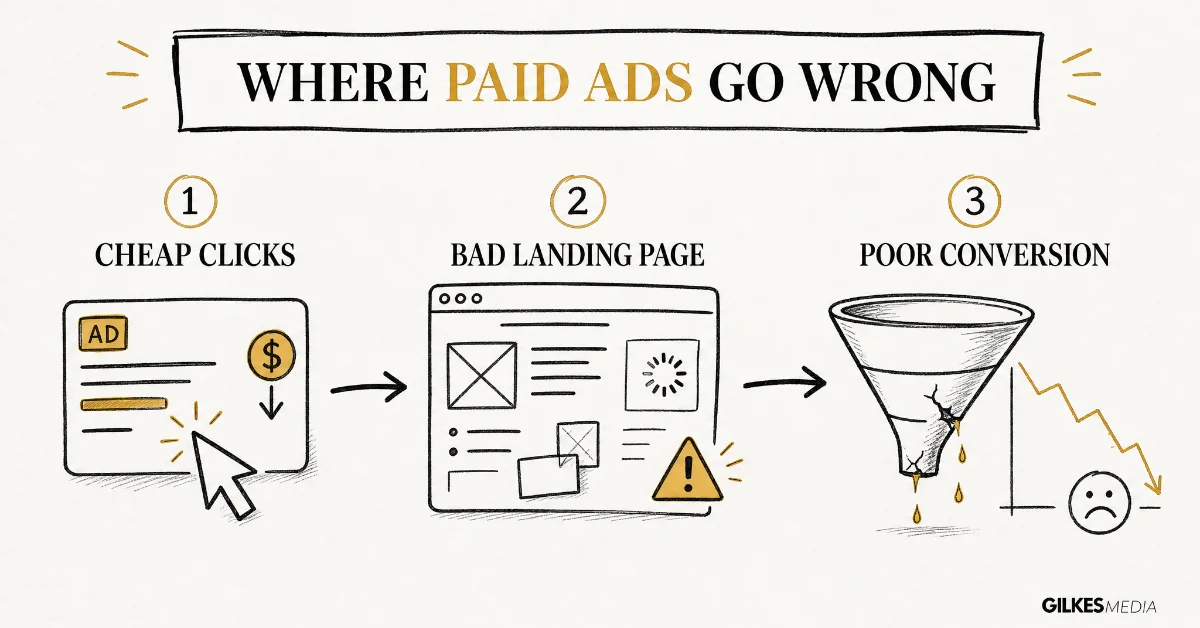
It’s easy to get excited by a low Cost Per Click (CPC). A 10p click feels like a bargain, but if none of those clicks ever turn into customers, you have still wasted your money. The goal isn't to get the most clicks. It's to get the right clicks from people genuinely interested in what you offer.
A higher CPC from a more targeted, high-intent keyword will almost always deliver a better return than thousands of cheap, irrelevant clicks. Always prioritise conversion quality over traffic quantity.
This is one of the most frequent and costly mistakes. You can have the best ad in the world, but if it sends users to a slow, confusing, or irrelevant landing page, you will lose the sale. Your ad makes a promise. Your landing page must instantly deliver on it.
The journey from ad click to conversion needs to be completely smooth. A slow page is a major barrier. Research shows that significant page speed improvements can deliver a 31% boost in conversions. This is why optimising for a load time under two seconds is now a gold standard for performance. You can read the full research on digital agency statistics to explore these findings further.
Performance marketing is not a slow cooker. You cannot just set it up and come back in a month expecting a perfect meal. It requires constant monitoring, analysis, and adjustment to deliver a strong return on investment.
A successful performance marketing campaign is a living system. It needs to be managed actively, with data guiding every decision to prune what isn't working and scale what is. This hands-on approach is where a specialist can make a significant difference.
Regularly reviewing your campaigns allows you to react to market changes, adjust bids, and refine your targeting before you waste your budget.
Focusing only on top-line revenue from your ads without considering your profit margins is a recipe for disaster. A campaign generating £10,000 in sales might look great on the surface, but if it cost you £8,000 to run and your product margin is only 20%, you’ve actually lost money.
You must have a firm grip on your key commercial metrics:
Knowing these figures ensures you’re making commercially sound decisions, not just chasing vanity metrics.
Knowing the theory is one thing. Turning that knowledge into a profitable, real-world strategy is something else entirely. The key is to move forward with a clear, deliberate plan, not trying to do everything at once.
This simple framework will help you build a solid foundation for measurable growth.
Before you spend a single pound, you need to know exactly what a "result" looks like for your business. Vague goals like "get more leads" won't work. You need specific, measurable targets that are tied directly to your commercial reality.
A strong objective is tangible and time-bound. For example:
These clear targets provide guardrails for your campaigns. They turn marketing from a vague expense into a predictable investment designed to hit a specific financial goal.
Once your objective is clear, the next step is to define precisely who you need to reach. Performance marketing is incredibly powerful, but only when you point it at the right people. Don't just think about broad demographics. Get into the mindset of your ideal buyer.
Ask yourself some critical questions:
The more detailed your customer profile, the more accurately you can target your ads and the more efficient your budget will be. You'll waste less money on irrelevant clicks and speak directly to the people most likely to convert.
You don’t need a huge budget to get started, but you do need enough to gather meaningful data. A budget of £50 is unlikely to tell you anything useful. You need to invest enough to run campaigns for a sufficient period to let the algorithms learn and provide enough clicks for informed decisions.
A sensible starting point is often between £500 and £1,500 per month for your first channel. This gives you enough runway to test different ad creatives, keywords, and audiences to find out what actually works.
Treat this initial spend as an investment in data, not an immediate profit driver.
With your objectives, audience, and budget sorted, the final step is to pick your starting channels and decide how to manage them. The biggest mistake is trying to master five platforms at once. Pick one or two where your ideal customer is most active and focus on getting them right first.
This leads to a crucial decision: do you manage this in-house or partner with a specialist?
Working with a specialist isn't just about outsourcing tasks. It's about gaining a strategic partner who can accelerate your learning curve and deliver a return much faster. If you'd like to understand this better, our guide on what is marketing consultancy explains the value a hands-on expert can bring. At Gilkes Media, we provide that direct, senior-level guidance to make sure your first steps are confident and commercially focused.
Even with a solid plan, founders and business owners often have questions when they first explore performance marketing. Let’s tackle some of the most common ones I hear, so you can move forward with more clarity.
There’s no magic number, but you need to spend enough to get meaningful data back. For a small business testing a new channel, a realistic starting point is usually between £500 and £1,500 per month.
Anything less will make it difficult to get enough clicks and conversions to make smart decisions. Think of it as an investment in learning. The initial goal isn't immediate profit; it's finding a formula you can scale later.
You can get traffic and clicks within hours of launching a campaign, but a consistent, profitable return takes longer. You should expect to see clear data and initial trends within the first 30 to 90 days.
This early phase is all about testing, learning, and adjusting. True, predictable growth comes from refining your campaigns based on that data. It’s a process of steady improvement, not a lottery ticket. Patience and active management are essential.
Performance marketing is not a quick fix; it's an engine you build. The first month is about laying the foundations and gathering data. The real growth and ROI start to materialise in months two and three as you optimise based on what you have learned.
Yes, you can, especially if you're starting small and have the time to learn. Platforms like Google Ads and Meta Ads have become more user-friendly, and setting up basic campaigns is entirely possible for a business owner.
The real challenge isn't launching the ads; it's optimising them to be profitable. That requires a deeper grasp of bidding, conversion tracking, and knowing what the numbers are actually telling you.
Ask yourself these questions:
If you’re short on time or expertise, partnering with a specialist can get you to profitability much faster and help you avoid painful early mistakes.
This is simple: start where your customers are already looking for a solution like yours.
For most businesses, it’s a choice between Paid Search and Paid Social:
The key is not to try and be everywhere at once. Get one channel working, make it profitable, and then use those profits to fund your expansion into the next one. A focused approach always wins.
At Gilkes Media, we provide the hands-on expertise and strategic oversight needed to make performance marketing a predictable driver of growth for your business. As a senior-level consultant, I am personally involved in ensuring your strategy is commercially focused and accountable from day one. If you’re ready to move from theory to profitable action, let’s talk.
