
Let's be direct: the difference between demand generation and lead generation is straightforward. Demand generation is about making people want what you sell. Lead generation is about capturing their contact details once they do.
Demand generation focuses on making your target market aware of their problems and positioning your brand as the obvious solution. It is about building trust, authority, and genuine interest. Lead generation, on the other hand, is the tactical process of converting that interest into a tangible sales lead, usually by offering something valuable in exchange for an email address or phone number.
Many businesses tell me they have a lead generation problem when they actually have a demand problem. They are trying to capture leads from an audience that has never heard of them and does not yet realise they need a solution. That is an expensive, uphill battle.
A smart growth strategy needs both, but they must happen in the right order.
Demand generation is the long game. It plays out at the top of the funnel and involves educating your market with high-value, ungated content such as articles, podcasts, and insightful social media posts. The goal is not to get an email address on the first visit. It is to become the go-to authority in your space, so when a potential customer is finally ready to buy, your company is the first one that comes to mind. This is how you build real brand equity and create an inbound flow of educated, high-intent buyers.
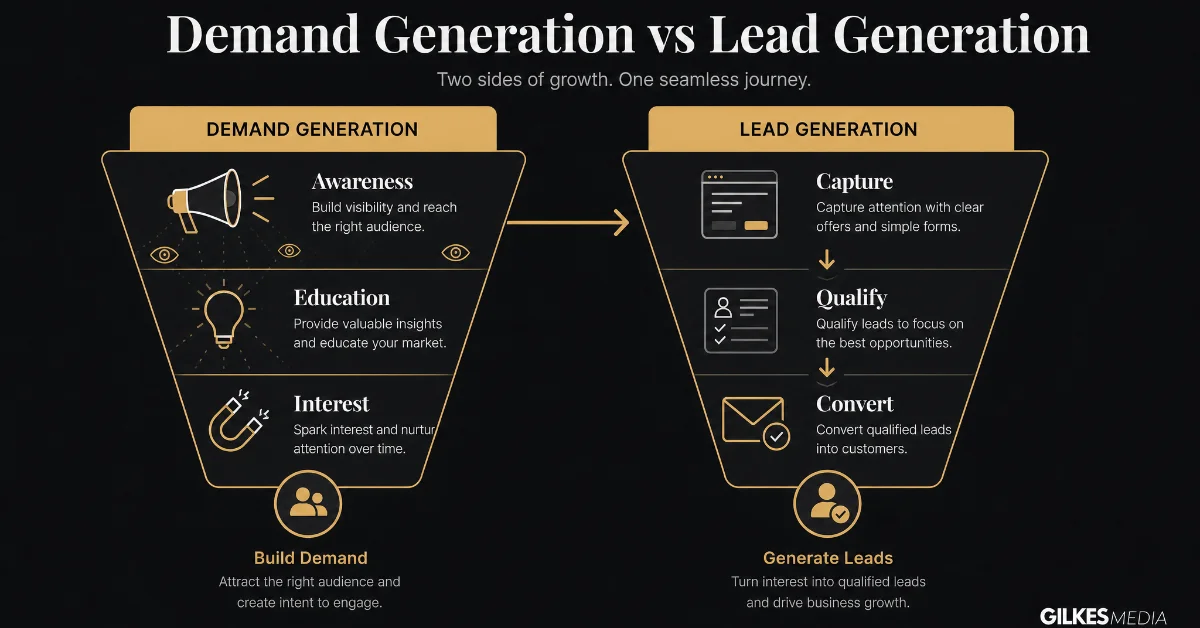
Lead generation is a direct-response activity that begins further down the funnel. To understand the distinction, it helps to know what lead generation marketing truly is beyond the buzzwords. It uses specific calls-to-action and gated offers, like webinars, whitepapers, or free consultations, to capture contact information from people who are already showing interest.
The most common mistake is trying to capture leads from a cold audience. You have to warm them up first. Effective marketing uses demand generation to create interest, then uses lead generation tactics to harvest it.
To make it even clearer, here is a breakdown of the fundamental differences in goals, focus, and metrics for each strategy.
| Aspect | Demand Generation | Lead Generation |
|---|---|---|
| Primary Goal | Create awareness, educate the market, build authority | Capture contact details from interested prospects |
| Audience Focus | Broad target market (often unaware of the problem) | Specific segment showing buying intent |
| Core Metrics | Brand search volume, content engagement, website traffic | Cost Per Lead (CPL), conversion rate, MQL volume |
| Typical Funnel Stage | Top of Funnel (ToFu) | Middle of Funnel (MoFu) |
| Time Horizon | Long-term strategy focused on building momentum | Short-term results measured in leads generated |
As you can see, they are two sides of the same coin, each with a distinct role in building a predictable growth engine for your business. One creates the opportunity, the other converts it.
Many businesses fall into the trap of chasing quantity over quality. The pursuit of more Marketing Qualified Leads (MQLs) feels productive, but it rarely translates into predictable revenue. I speak with founders who see a flurry of marketing activity but very little to show for it on the bottom line.
This disconnect is a classic symptom of a strategy built solely on lead generation. The problem is simple: a high MQL count is a vanity metric if those leads have no real intent to buy. When marketing’s only goal is to hit a number, they often resort to aggressive tactics or low-friction offers that attract anyone, not just the right people.
The commercial damage is significant. Sales teams become demoralised, wasting time on prospects who are only browsing or were just interested in a freebie. This friction between marketing and sales is not just an internal headache; it directly kills pipeline velocity and profitability.
Every hour a sales representative spends disqualifying a poor-fit lead is an hour they could have spent on a high-value opportunity. The result is a stalled pipeline and a rising customer acquisition cost. Every pound spent generating a low-quality lead is a pound wasted.
A high lead volume might look great on a marketing report, but it is a false economy. The only true measure of success is pipeline revenue, which only comes from engaging prospects who are a good fit and genuinely interested.
This is not a new problem. Frustration with high-volume, low-quality lead strategies has been building for years. Research from 2021 showed that 44% of UK marketers planned to increase their demand generation budgets, a clear signal they were moving away from chasing MQLs that go nowhere. The same analysis found that misaligned lead generation efforts in UK firms could cause MQL-to-opportunity conversion rates to fall below 10%.
To see why a high-volume strategy often falls short, especially with outdated methods, it is worth examining why your current approach might not be converting. For more detail, see how static PDF lead magnets are failing. Focusing on raw numbers without building genuine demand first is a recipe for wasted spend and commercial disappointment.
To apply this practically, you need to understand where each strategy fits inside your marketing funnel. The demand generation vs lead generation debate becomes clear once you map your tactics to the stages of a buyer’s journey. Think of it as a simple way to audit your current activity and spot any obvious gaps.
A classic mistake is using middle-funnel tactics at the top of the funnel. Pushing a "Request a Demo" CTA in a blog post aimed at a cold audience is a perfect example. It does not work. It is like asking for a serious commitment on a first date; you have not yet earned the right.
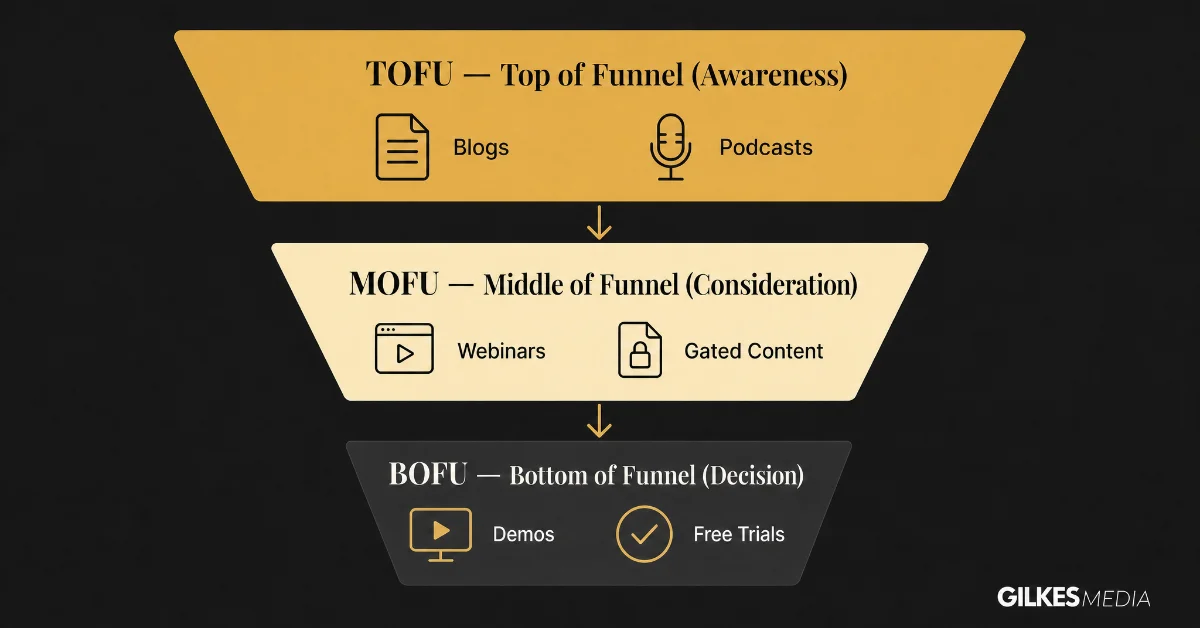
The Top of the Funnel is where your audience often does not realise they have a problem you can solve. Your only goal here is education and building awareness. Forget about conversions for now. This stage is owned entirely by demand generation.
Your tactics should be ungated, valuable, and designed to position you as an authority. The objective is to become the go-to resource in your industry, attracting an audience that will eventually need what you sell.
Effective ToFu tactics include:
Once someone becomes aware of their problem and starts actively researching solutions, they move into the Middle of the Funnel. They know who you are because they have probably seen your ToFu content. Now, the focus shifts to lead generation.
This is the point where it is appropriate to ask for their contact details in exchange for something of higher value. You are capturing the demand you worked to create.
MoFu tactics are designed to turn anonymous visitors into known leads:
Do not mistake the tactic for the strategy. A webinar can be a demand generation tool if it is purely educational and ungated. It becomes a lead generation tool the moment you put a registration form in front of it. The gate is the dividing line.
By aligning your activities correctly, you create a smooth, logical journey for your future customers. You build trust before you ask for commitment, which dramatically improves the quality and conversion rate of the leads in your sales pipeline.
Moving from theory to practice means being clear on how each strategy works on the ground. The difference between demand generation and lead generation is sharpest when you break down their goals, the channels they use, and how you measure success.
Confusing these elements leads to a wasted budget and disappointing results. One builds the audience; the other converts it.
The purpose of demand generation is to create awareness and establish authority. It is about educating your market and becoming the go-to choice long before a purchase is considered. In contrast, lead generation has one simple, direct goal: to capture contact details from people who have shown interest.
Demand generation plays the long game, building a brand that attracts high-intent customers naturally. The channels used reflect this educational, non-intrusive approach.
Effective Demand Generation Channels:
Lead generation is far more direct and transactional. It uses specific channels designed to intercept prospects who are actively looking for a solution and guide them towards a conversion.
Effective Lead Generation Channels:
You cannot measure a demand generation campaign with lead generation metrics. It is a classic mistake. Trying to track the Cost Per Lead (CPL) of a thought leadership article will always look like a failure, because that was never its purpose.
Success means tracking the right Key Performance Indicators (KPIs) for the right strategy.
Your KPIs must directly reflect the goal of the activity. For demand generation, you are measuring influence and awareness. For lead generation, you are measuring the efficiency of data capture.
Here is a practical breakdown of how the channels and metrics differ.
This table offers a detailed breakdown of the primary channels and performance indicators for each strategy, helping leaders choose the right tools and metrics for the job.
| Element | Demand Generation (Building Awareness) | Lead Generation (Capturing Interest) |
|---|---|---|
| Primary KPIs | Brand Search Volume, Content Engagement (shares, comments), Direct & Organic Traffic | Cost Per Lead (CPL), Form Conversion Rate, Marketing Qualified Leads (MQLs) |
| Supporting Metrics | Share of Voice, Video View-Through Rate, Social Media Reach | Cost Per Acquisition (CPA), Landing Page Views, Email Sign-ups |
| Commercial Focus | Long-term pipeline influence, reduced future Customer Acquisition Cost (CAC) | Immediate pipeline contribution, sales team efficiency |
Ultimately, tracking these metrics correctly allows you to build a complete picture of your marketing engine. While a paid search campaign’s CPL is easy to calculate, understanding its full impact requires more solid analytics.
For a deeper look into this, we have a detailed guide on the essentials of paid search analytics. This data helps you justify your investment and prove how top-of-funnel awareness drives bottom-of-funnel conversions.
Prioritising demand generation is not just a different marketing philosophy; it has a real, measurable impact on your bottom line. While lead generation is about immediate outputs like Cost Per Lead, a demand-first approach optimises the entire sales pipeline for long-term profit and efficiency.
It is about creating a steady flow of educated, high-intent buyers who arrive already convinced of your value. This shifts the focus from marketing activity to genuine commercial outcomes. When you successfully build demand, you attract better-fit customers who need less persuasion, which directly translates into shorter sales cycles, higher win rates, and a more predictable revenue engine.
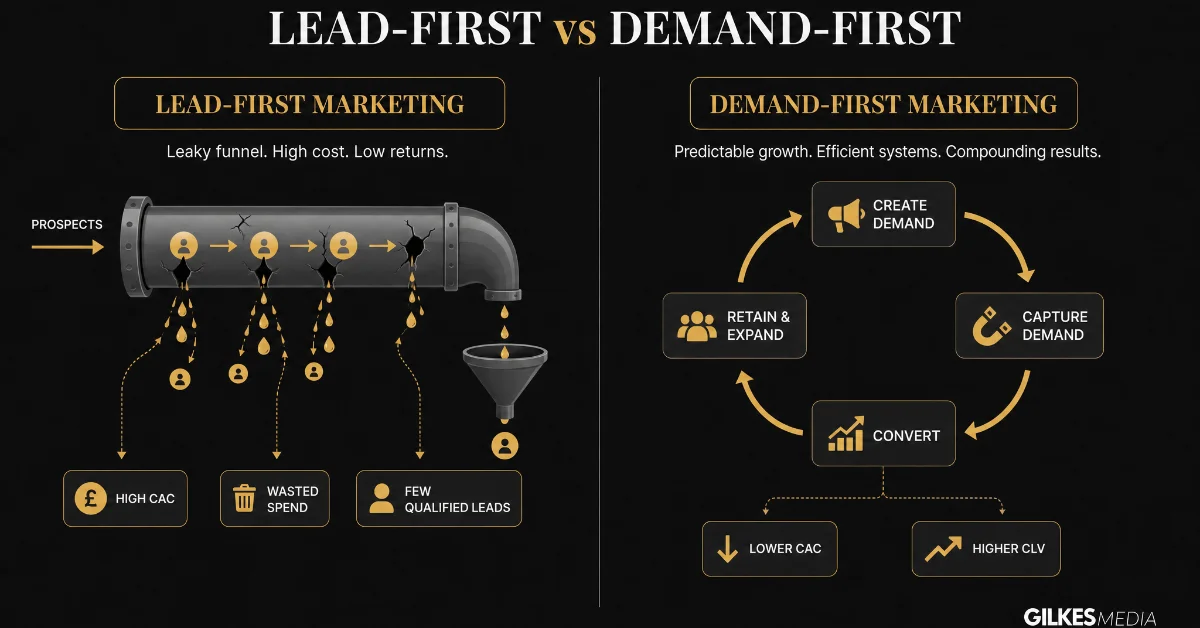
One of the biggest commercial wins is a dramatic improvement in pipeline efficiency. Instead of forcing your sales team to sift through a high volume of low-quality leads, a demand generation strategy gives them prospects who are genuinely ready for a sales conversation. This reduces wasted effort and lets your team focus on closing high-value opportunities.
The numbers support this. Recent analysis of UK B2B firms showed that demand generation strategies produced 4.37 times higher MQL-to-SQL conversion rates than their lead-focused peers. While the lead gen approach generated more initial MQLs, the cost per qualified opportunity was significantly lower with demand gen, at £2,640 vs £5,320.
Ultimately, the demand-focused firms generated £405 million in pipeline from fewer, better leads, compared to just £153 million for the lead generation group.
Beyond the initial sale, a demand-first approach also boosts Customer Lifetime Value (CLV). Customers who choose your brand based on trust and expertise are almost always a better long-term fit. They already understand your value proposition, which leads to higher satisfaction, better retention, and more opportunities for upselling.
This is the heart of what performance marketing truly aims to achieve: not just acquiring a customer, but acquiring the right customer profitably.
By investing in educating your market, you are not just generating leads; you are creating future advocates for your brand. This reduces long-term customer acquisition costs and builds a more sustainable, profitable business.
Deciding where to put your marketing budget is not a one-off choice; it is a strategic balancing act based on where your company is right now. The balance between demand generation and lead generation is about understanding your market maturity, brand recognition, and commercial objectives.
If you are an early-stage business or entering a new market, the decision is clear: it must be demand generation. Trying to capture leads from an audience that does not know you exist, let alone understand the problem you solve, is a recipe for wasted ad spend. Your first job is to educate the market, build credibility, and establish your name. Without that foundation, any money you spend on lead generation will be wasted.
On the other hand, if you are an established business with a well-known brand but a weak sales pipeline, it is time to lean more heavily into lead generation. If your website already attracts decent traffic and people recognise your name, your problem is not awareness, it is conversion.
At this point, your energy should go into optimising mid-funnel tactics. Think compelling gated content, fine-tuning landing pages, and running targeted campaigns to capture the interest you have already built.
The truth is, the smartest businesses do not see this as an either/or dilemma. They build a hybrid engine where both strategies work together. Your demand generation efforts should constantly warm up the market, creating a steady stream of informed prospects who can then be channelled into your lead generation campaigns.
Data from UK B2B marketers supports this. A significant 68% say their best-quality leads come directly from demand generation efforts. These prospects are better informed and more engaged, which can lift sales win rates by 15-25%.
Now, compare that to a pure lead generation approach. While 90% of UK marketers rely on their website for leads, a staggering 80% of those leads never become customers. You can explore more of these numbers in this breakdown on why quality trumps quantity in B2B marketing.
This gets to the heart of the matter: demand generation fills your pipeline with better prospects, while lead generation often just fills it faster. A balanced, hybrid approach is the only way to achieve both quality and volume over the long term.
Many businesses get caught up in the "demand generation vs lead generation" debate, but it is a false choice. You do not pick one over the other. The real goal is to build a single, integrated growth engine where each strategy strengthens the other.
A powerful growth system does not just capture existing interest; it creates the conditions for high-quality leads to appear in the first place. This means your top-of-funnel content should smoothly warm up audiences for your mid-funnel offers. In turn, your lead nurturing must build on the authority you have already established. When you get this right, you create a powerful, self-sustaining loop.
The first practical step is to get your marketing and sales teams on the same page, focused on shared commercial goals instead of separate vanity metrics. Forget marketing chasing MQLs while sales complains about quality. Both teams need to be accountable for pipeline revenue and customer acquisition cost. That shared responsibility forces a more strategic approach.
Your measurement must also reflect this integrated view. You have to track the entire customer journey, connecting top-of-funnel engagement with eventual sales. It is the only way to prove the true ROI of those demand-focused activities that do not have an immediate cost-per-lead. For instance, our guide to effective B2B email marketing explains how to nurture leads that come from both sides of the funnel.
The key takeaway is simple: if you have no market awareness, trying to generate leads is an expensive, uphill battle.
True growth comes from a balanced system where demand generation creates an educated, interested audience, and lead generation provides the mechanism to convert that interest into tangible sales opportunities. One builds the asset; the other monetises it.
By building this cohesive engine, you stop relying on short-term tactics and start building a sustainable model for predictable growth. It is about creating a system that delivers not just more leads, but better business.
At Gilkes Media, I work directly with founders and leadership teams to design and execute these kinds of practical, performance-focused growth strategies. If you are ready to build a marketing engine that delivers measurable results, let's talk. Book a free consultation today.
