
The development of marketing strategies has moved on from being a static, one-off plan to a dynamic, continuous process. It's about knowing your market position inside out, defining your ideal customer, picking the right channels, setting a realistic budget, and constantly measuring results to drive tangible business growth.
Not so long ago, marketing strategy meant booking a few print ads and hoping for the best. Today, it is a completely different discipline. The shift from traditional media to a complex digital world has fundamentally rewritten the rules for UK businesses, demanding a more agile, accountable, and data-driven approach to growth.
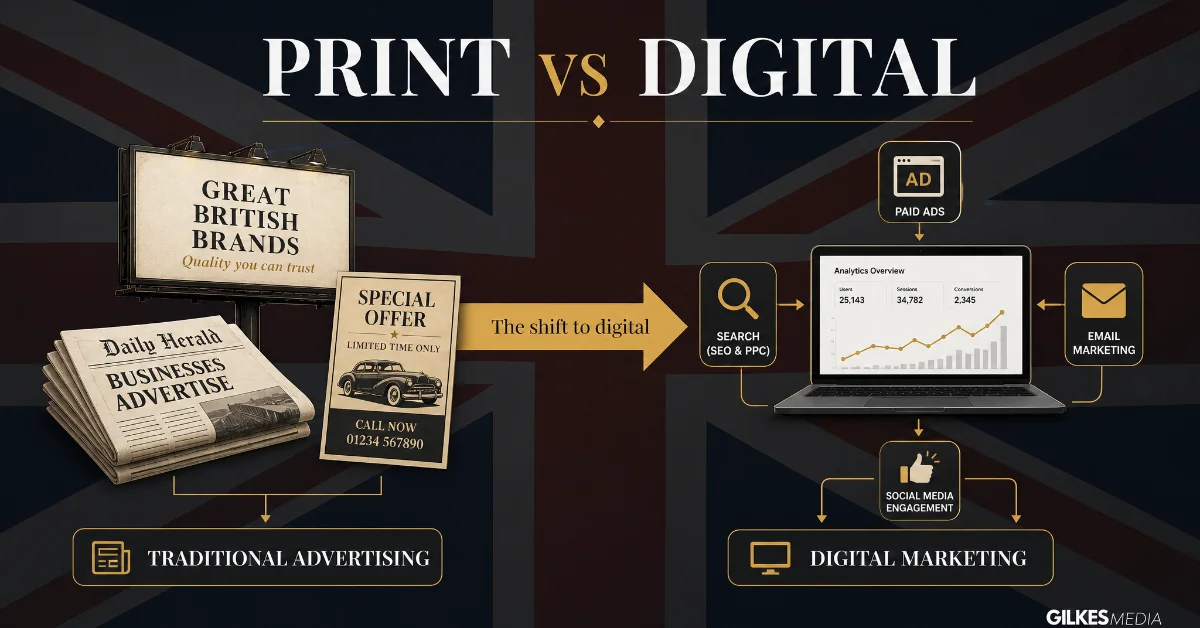
The real turning point came in the late 1990s with the internet, pulling businesses away from old-school ads and into digital channels. By the early 2000s, search engine marketing exploded, with platforms like Google enabling targeted advertising that was far more precise than mass media.
Fast forward to the 2010s, and social media platforms became game-changers, allowing real-time engagement that built communities around brands.
This is more than just a history lesson; it is the commercial reality for any SME or startup leader today. The modern marketing playbook is no longer about who shouts the loudest but who understands their customer the deepest and can adapt the quickest.
The core principles of understanding your customer still hold true, but how we execute has changed entirely. A modern strategy has to be built for:
A great strategy provides clarity and focus. It tells you not just what to do, but more importantly, what not to do. It is the essential filter for every marketing decision, ensuring your limited time and budget are invested where they will have the greatest commercial impact.
As a hands-on marketing consultant and paid ads specialist, I see too many businesses struggle because their strategy is based on outdated assumptions. They might chase the latest social media trend or run ads without a clear view of the expected return.
This guide is designed to fix that.
The following sections will provide a practical, step-by-step framework for the development of marketing strategies that deliver real commercial outcomes. We will cut through the noise and focus on the foundational elements critical for sustainable growth. To dig deeper into this, you might find some useful insights on developing a winning digital marketing strategy.
Before you spend a single pound on marketing, you need a clear-eyed assessment of where your business stands right now. The best marketing strategies are built on a bedrock of truth, not optimistic guesswork. This means going deeper than a generic SWOT analysis and conducting a rigorous situation analysis that informs every decision you make from here on out.
Too many businesses jump straight into tactics like paid ads or SEO without first understanding their own capabilities or the market they are walking into. It is like setting sail without a map or a compass; you might be moving, but you have no idea if it is in the right direction.
A proper analysis prevents wasted budget and ensures your marketing efforts are tied to real business goals from day one.
The first step is always an honest internal audit. This is where you get real about your company's capacity to deliver on its promises. Forget theory; this is about the practical strengths and weaknesses that directly impact performance.
Consider these core areas:
Once you have a clear picture of your internal world, it is time to look outwards. The goal here is to spot genuine market opportunities and neutralise potential threats before they derail you. A thorough analysis often requires deep insights into your competitors, where modern tools like AI competitor analysis tools can give you a serious data-driven edge.
This external review must be commercially focused.
The objective is not to create a detailed report that gathers dust. It is to uncover actionable insights that give you a competitive edge and highlight the most profitable path to growth.
Here is a practical way to think about your external environment.
| Factor | What to Assess | Commercial Question |
|---|---|---|
| Competitive Landscape | Who are your direct and indirect competitors? What are their strengths and weaknesses in their marketing? | Where are the gaps in their strategy that we can exploit? |
| Market Trends | What technological, economic, or cultural shifts are affecting your industry? | How can we position our offering to align with these trends? |
| Customer Behaviour | How do your potential customers research and buy products or services like yours? | Which channels will most effectively intercept them on their journey? |
| Regulatory Factors | Are there any industry regulations (like GDPR) or advertising policies that will impact your marketing? | How do we ensure our strategy is fully compliant? |
By completing this dual analysis-looking both inwards and outwards-you build the essential foundation for a solid marketing strategy. You will move from making assumptions to making informed decisions based on a clear understanding of your resources, your market, and the competitive pressures you face. This groundwork is the single most important factor in ensuring your marketing investment delivers a meaningful return.
Marketing to everyone is marketing to no one. It is a harsh truth, but it is also the most common reason marketing budgets get torched, delivering rubbish leads and failing to generate a return. A winning marketing strategy is not built on reaching the biggest audience; it is built on deeply understanding and connecting with the right one.
This all starts with defining your Ideal Customer Profile (ICP). This is not about creating a vague persona with a made-up name and some hobbies. An ICP is a data-driven definition of the perfect-fit company for your product or service. Get this right, and you can focus your sales and marketing efforts exclusively on prospects with the highest chance of becoming profitable, long-term customers.
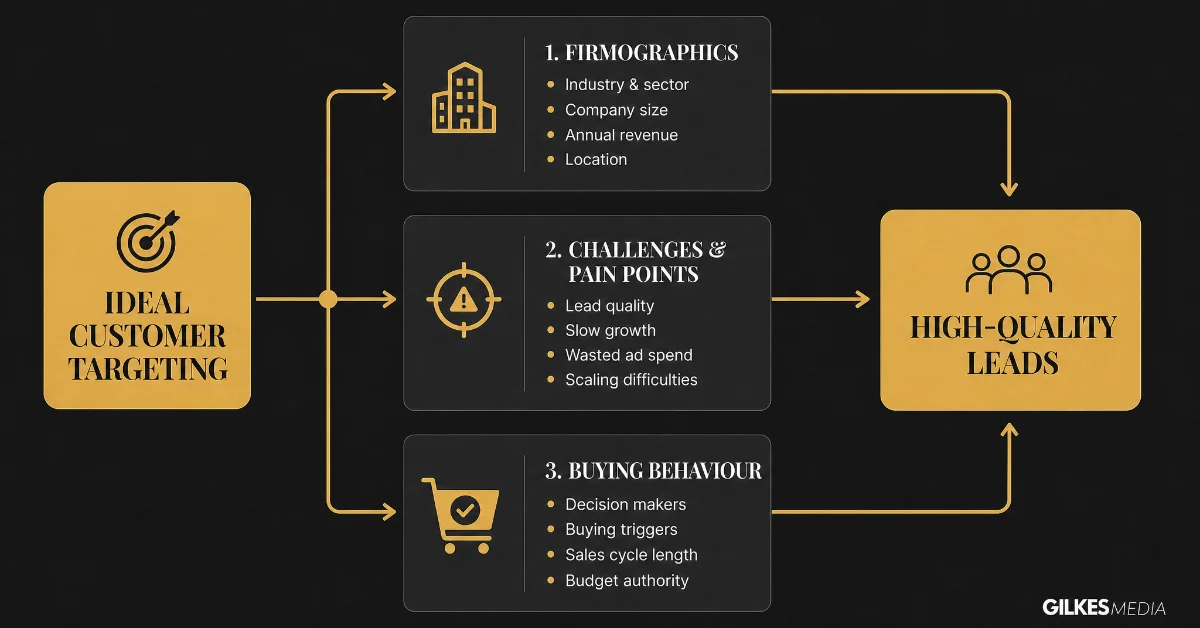
Forget broad demographics. For B2B businesses, a truly effective ICP is built on specific, tangible characteristics you can actually use for targeting on platforms like LinkedIn Ads or for building focused outreach lists. Think of it as a sharp filter that helps you say "no" to poor-fit leads and a confident "yes" to high-value opportunities.
A solid ICP needs to be built on three core pillars:
The goal is to shift from a generic description like "tech companies in London" to something hyper-specific like, "UK-based SaaS companies with 50-200 employees that have recently secured Series A funding and are actively hiring for sales roles." The second profile is infinitely more actionable and commercially valuable.
Your ICP is your commercial north star. Every piece of content you create, every ad campaign you run, and every sales conversation you have should be designed to attract and persuade this specific profile.
This detailed approach ensures your marketing spend is concentrated on prospects who not only need what you offer but also have the budget and intent to buy. Understanding this is a cornerstone of effective strategic content marketing, as it allows you to craft messaging that speaks directly to a prospect's most urgent problems.
Building a useful ICP means asking the right questions. The table below breaks down the essential components you need to define to create a profile that is actually practical for your marketing and sales teams.
| Component | Description | Example Question to Ask |
|---|---|---|
| Industry & Niche | The specific vertical or market the company operates in. Be as precise as possible. | Are we targeting FinTech, HealthTech, or a broader technology sector? |
| Company Size | Defined by employee count or annual revenue. This helps qualify resource levels. | Does our solution work best for businesses with 20-100 staff? |
| Geography | The physical location of the business, from specific cities to regions or countries. | Are our ideal clients concentrated in major UK hubs like Manchester? |
| Buying Triggers | Recent events indicating a need for your solution, such as a funding round or new hire. | Have they recently hired a Head of Marketing who might be reviewing suppliers? |
By filling this out, you move from a vague idea to a concrete, targetable profile that gives your campaigns a fighting chance from day one.
Once you know exactly who you are talking to, you need to give them a compelling reason to listen. That is the job of your value proposition. It is a clear, concise statement explaining the tangible results a customer gets from using your product or service.
It absolutely must answer three questions from the customer's perspective:
A weak value proposition is vague and full of jargon, like "We offer innovative solutions to drive business synergy." A powerful one is specific and outcome-focused: "We help UK construction firms win 30% more tenders by automating their document compliance, saving them over 20 hours per week."
Your value proposition is not just a tagline. It is the core message that should be reflected across your website, ad copy, and sales pitches. When your ICP and value proposition are perfectly aligned, your marketing strategy becomes dramatically more effective, leading directly to higher-quality leads and a much stronger ROI.
Once you have nailed your Ideal Customer Profile and value proposition, the next question is always the same: where do we actually find these customers, and how much should we spend to get them in front of us?
This is where so many businesses stumble. They either chase the latest shiny object or, worse, sprinkle a little bit of budget across every channel imaginable, hoping something sticks. That is not a strategy; it is a lottery ticket.
A smart approach is not about being everywhere. It is about being in the right places, consistently, and with enough firepower to actually make an impact. The goal is to shift from hopeful guesswork to a deliberate, ROI-driven plan that hits your sales targets.
Not all marketing channels are created equal. Some are built for speed and immediate leads, while others are a slow burn, designed to build trust and authority over time. As a paid ads specialist, I am obviously a big believer in performance channels, but a truly strong strategy nearly always needs a mix.
The key is aligning your channel choice with what you need the business to achieve right now.
Let's break down the core channels for most B2B SMEs:
Paid Ads (Google Ads, LinkedIn Ads): This is your most direct route to market. If you need to generate high-intent leads this month, paid advertising is in a league of its own. You can target your ICP with surgical precision on platforms like LinkedIn or capture red-hot demand from people already searching for your solution on Google. The trade-off is simple: it is a pay-to-play model. When you stop spending, the leads stop coming.
Search Engine Optimisation (SEO): Think of this as building a long-term asset. SEO is all about earning organic visibility in search results, which builds incredible trust and authority over time. It can deliver a consistent stream of "free" traffic and leads, but it demands patience. You are often looking at 6-12 months of upfront investment in content and technical work before you see a serious return.
Content Marketing: This is the fuel for both your paid and organic engines. High-quality content-think insightful articles, detailed case studies, and genuinely helpful guides-proves your expertise and educates your audience. It is the absolute foundation of a successful SEO strategy and gives you the valuable assets needed to make your paid campaigns actually convert.
The digital advertising market in the UK has exploded, showing just how much marketing strategies have pivoted online. This is largely driven by the dominance of smartphones, which now account for a huge slice of the market. To keep up, brands are pouring money into mobile-first campaigns, video ads, and programmatic advertising that uses AI to find the right audiences. You can find out more about this shift on themarketingcentre.com.
Forget pulling arbitrary percentages out of thin air. A commercially-minded marketing budget should be built backwards, starting from your growth targets. This simple shift in thinking transforms marketing spend from a vague 'expense' into a strategic 'investment' with a clear, justifiable return.
Here is a simple, outcome-driven way to approach it:
Start with the Revenue Target: What is the end goal? Let's say you need to generate £250,000 in new revenue over the next 12 months.
Work Out How Many Sales You Need: What is your average deal size or customer lifetime value? If it is £10,000, you need 25 new customers to hit your target. Simple.
Figure Out Your Lead Target: What is your sales team’s lead-to-customer conversion rate? If they close 1 in 10 qualified leads, then you need to generate 250 qualified leads for them over the year.
Estimate Your Cost Per Lead (CPL): This will vary massively by channel. You can research industry benchmarks, but if you have historical data, use that. For a qualified B2B lead from LinkedIn Ads, a realistic CPL might be around £150.
Build Your Budget: Now, just multiply your lead target by your estimated CPL. In this scenario, that is 250 leads x £150/lead = £37,500 annual marketing budget for this specific channel.
This method grounds your budget in commercial reality. It forges a direct link between what you invest in marketing and the revenue it produces, making it far easier to justify spend and hold your activities accountable for results.
Once you have a total budget figure, the final piece of the puzzle is allocation. This is definitely not about an even split. Your allocation should be a direct reflection of your strategic priorities. Are you prioritising speed or sustainable, long-term growth?
The table below gives you a straightforward framework for thinking about this, based on your primary business goal.
| Primary Goal | Recommended Channel Mix | Budget Allocation Rationale |
|---|---|---|
| Rapid Lead Generation | 70% Paid Ads, 30% Content | Focuses squarely on immediate, high-intent lead flow. |
| Balanced Growth | 40% Paid Ads, 40% SEO | Chases short-term wins while building a long-term organic asset. |
| Market Leadership | 60% SEO & Content, 40% Paid | Prioritises building authority and dominating organic search. |
| New Market Entry | 80% Paid Ads, 20% Content | Aggressively buys market data and gets initial customer traction. |
By choosing channels that align with your goals and building a budget based on tangible outcomes, you create a marketing plan that is not only strategic but commercially sound. This disciplined approach ensures every pound you invest is working hard to drive your business forward.
A beautiful strategy document is worthless if it just gathers dust. The real magic happens when you turn those high-level plans into a tangible, day-to-day roadmap. This is where the theory hits the road, transforming your big commercial goals into clear, actionable tasks your team can actually follow.
Without this crucial link, even the most brilliant plan is just a wish. It is the difference between knowing your destination and having the turn-by-turn directions to get there.
The secret to a roadmap that does not feel overwhelming is to break your big, ambitious annual goals into smaller, more manageable chunks. So many businesses get paralysed by the sheer size of their yearly target, leading to unfocused busywork. A structured, cascading approach gives you clarity and, more importantly, momentum.
It is a simple but incredibly powerful process:
This layered approach makes the work feel achievable. It gives your team a sharp focus each month and ensures every small task is pulling in the same direction, directly contributing to the big strategic goal.
The diagram below shows how different marketing channels feed into this cohesive execution process.
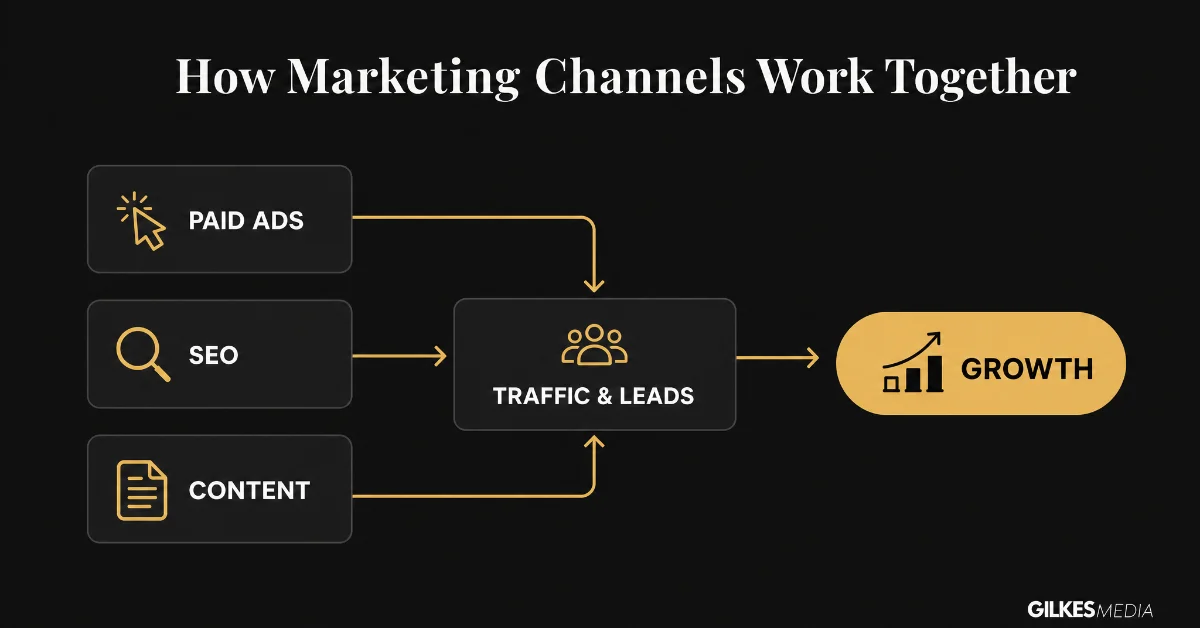
It is a great visual reminder that distinct activities like paid ads, SEO, and content creation are not isolated tasks. They need to work together within your roadmap to create a unified marketing engine.
A roadmap tells you what to do. A measurement framework tells you if it is working. To make sure your marketing is delivering a genuine return, you absolutely have to track the right Key Performance Indicators (KPIs). The goal here is to focus on metrics that have a direct commercial impact, not vanity metrics that look impressive but do not actually move the needle on revenue.
You cannot manage what you do not measure. A solid measurement framework is the accountability engine of your marketing strategy. It is what gives you the hard data to justify spend, tweak campaigns, and prove your value to the rest of the business.
For most B2B SMEs, there are only a handful of KPIs that truly matter. These are the metrics that connect your marketing activities directly to sales outcomes, allowing you to see the financial performance of every single campaign.
The table below breaks down the essential metrics you should have on your dashboard. These are the numbers that measure the real commercial impact of your marketing.
| KPI | What It Measures | Why It Matters |
|---|---|---|
| Cost Per Lead (CPL) | The average cost to generate one new lead from a specific channel or campaign. | This is your core efficiency metric. A low CPL shows that your targeting and messaging are working in harmony. |
| Lead-to-Sale Rate | The percentage of qualified leads that convert into paying customers. | This KPI is all about lead quality. A high conversion rate means you are getting the right leads. |
| Customer Acquisition Cost (CAC) | The total cost of sales and marketing needed to acquire one new customer. | This is the ultimate bottom-line metric. It tells you exactly how much it costs to win new business. |
Tracking these KPIs is non-negotiable. If you want to go even deeper, our guide on paid search analytics will help you build out a more detailed performance dashboard.
By combining a clear execution roadmap with a commercially-focused measurement framework, you create a powerful closed-loop system. You know exactly what needs doing, you do it with discipline, and you have the data to prove what is working and what is not. This is the foundation of a high-performance marketing function that drives consistent growth.
Your marketing strategy is not a document you create once and file away. The most successful businesses treat their strategy as a living, breathing process, one that is constantly being tested, refined, and improved.
This is what we call the continuous improvement loop: a disciplined rhythm of review and adjustment that turns good campaigns into great ones.
Without this cycle, you are flying blind. Sure, you might get lucky with some initial results, but you will have no idea why something worked or how to replicate that success. A continuous loop replaces guesswork with data, ensuring your marketing engine does not just run but consistently accelerates over time.
Momentum in marketing comes from a regular, structured cadence of performance analysis. Trying to review everything, every day, is a recipe for burnout and reactive, knee-jerk decisions. A structured approach ensures you are looking at the right data at the right time.
A practical rhythm for most SMEs looks something like this:
Weekly Check-ins: This is your quick, tactical review. Focus on campaign-level metrics like ad spend, click-through rates, and immediate lead volume. The goal here is to spot and fix any obvious issues, like a broken landing page link or an underperforming ad, before they burn through your budget.
Monthly Performance Reviews: Here, you zoom out a little to assess progress against your main KPIs. Are you hitting your Cost Per Lead target? Is the quality of those leads holding up? This is your chance to make more substantial adjustments, such as reallocating your budget between channels or refreshing your ad creative.
Quarterly Strategic Reviews: This is your big-picture analysis. You will evaluate progress against the quarterly priorities you set out in your roadmap and ask the bigger questions. Is our core messaging still connecting with our audience? Should we be testing a new channel? Are we actually on track to hit our annual revenue goals?
This structured review process is your accountability framework. It provides the discipline needed to learn from your data, double down on what works, and systematically cut what does not, compounding your successes month after month.
The aim is to make agile, informed adjustments.
For example, a monthly review might reveal that your LinkedIn Ads are generating leads at a £75 CPL, while your Google Ads are clocking in at £150 CPL. The immediate, data-backed decision is to shift more budget towards LinkedIn to maximise your return.
This simple act of optimisation, repeated consistently, is what drives real, sustainable growth.
When you are in the thick of building a marketing strategy, certain questions always come up. Founders and marketing leads often ask me the same things, so I have answered the most common ones here to give you a bit more clarity and confidence.
Your core strategy-the big-picture plan-should get a full review once a year to make sure it still lines up with your main business goals. But the day-to-day tactics? That is a different story. They need attention far more often.
I always recommend a monthly performance check-in to see how you are tracking against your KPIs. Alongside that, a quarterly review is perfect for adjusting your priorities and shifting the budget around. This keeps you agile enough to react to market changes without ever losing sight of your long-term commercial targets.
Hands down, the most common and costly mistake is jumping straight into tactics. It is the "we need to run LinkedIn ads" conversation that happens without any of the foundational work being done first.
Too many businesses skip the tough but essential parts: a proper commercial situation analysis and a deep dive into who their Ideal Customer Profile really is. When you do that, you are building a strategy on pure guesswork, which always leads to wasted budget, low-quality leads, and, frankly, deeply disappointing results. A solid foundation is not just nice to have; it is non-negotiable.
The most effective strategies are built on a bedrock of truth, not optimistic guesswork. Rushing the foundational stages is a false economy that will cost you far more in the long run through inefficient spend and missed opportunities.
There is no magic number here. Forget the generic "spend 10% of revenue" advice, it rarely works. A much smarter way to do it is to work backwards from your revenue targets.
Start with the end goal: how many sales do you actually need to hit your target? From there, factor in your average sales conversion rate and the estimated cost per lead for the channels you plan to use.
This approach builds a budget based on tangible outcomes and expected ROI. It stops marketing from being just another expense line and turns it into a measurable, strategic investment designed to deliver predictable growth.
Ready to build a marketing strategy that delivers real commercial results? As a senior marketing consultant and paid ads specialist, Gilkes Media offers hands-on expertise to design and execute a plan that drives growth. Book a free, no-obligation consultation to get started.
