Finding the right performance marketing agency in London means changing how you think about marketing. It is no longer a cost centre; it becomes a direct driver of revenue. This is about investing in measurable growth, where every pound you spend is held accountable for delivering tangible results like leads, sales, and qualified customer enquiries.
Let's cut through the jargon. At its heart, a performance marketing agency is a partner whose success is tied directly to your own. Unlike traditional marketing, which often chases broader, harder-to-measure goals like brand awareness, performance marketing is built on a foundation of hard data and accountability.
The entire model pivots on one simple principle: you pay for specific, agreed-upon actions. This immediately creates a clear, commercially focused relationship from day one.
Traditional advertising buys space and time, hoping to capture attention along the way. Think of a billboard on the M25 or a print ad in a trade magazine. They aim for visibility, but trying to link either directly to a sale is notoriously difficult.
Performance marketing flips this on its head.
The fundamental difference is the focus on ROI. Instead of asking "how many people saw our ad?" we ask "how much revenue did that ad generate?" This simple question changes everything, forcing a discipline of constant testing, measurement, and optimisation to ensure every pound works as hard as possible.
This shift is crucial for any business trying to stand out in London's crowded market. Your marketing budget stops being a speculative expense and becomes a direct investment in commercial outcomes. We are not talking about vague metrics; we are focused on the hard numbers that hit your bottom line.
You can explore the core concepts in our detailed guide on what is performance marketing.
To make the distinction clearer, here is a straightforward comparison of the two approaches. It highlights the key differences in focus, measurement, and what you can expect in terms of outcomes.
| Attribute | Performance Marketing | Traditional Marketing |
|---|---|---|
| Primary Goal | Direct, measurable actions (leads, sales) | Brand awareness, reach, visibility |
| Payment Model | Pay-per-action (CPL, CPA, CPS) | Pay-per-impression or placement |
| Measurement | Highly granular (ROAS, CPL, CAC) | Broad and often estimated |
| ROI | Clear and directly attributable | Difficult to calculate with precision |
As you can see, the two models operate with completely different mindsets. While brand awareness has its place, performance marketing is built for businesses that need to see a direct and immediate link between their marketing spend and business growth.
A specialist agency will build your entire strategy around Key Performance Indicators (KPIs) that directly reflect the health of your business. These are not vanity metrics; they are the numbers that drive decisions.
Key metrics include:
This data-first approach has fuelled serious growth in the sector. In the UK, performance marketing is one of the fastest-scaling agency verticals, showing a clear demand from businesses for real accountability. Research shows that, on average, every £1 spent on advertising returns £4.11 for medium to large firms. This is not just a trend; it is market validation that companies are moving away from fuzzy metrics and towards measurable returns.
Ultimately, partnering with a performance marketing specialist means you are hiring a consultant focused on profitable growth. Beyond just managing campaigns day-to-day, a good agency must also understand how to scale a digital marketing agency to keep delivering results for clients as they grow. It is all about building a predictable engine for new business.
A top-tier performance marketing agency in London does more than just manage ad accounts; they architect a growth strategy built around your commercial goals. Understanding their core services is crucial, not just as a checklist, but as a set of strategic tools, each with a specific job to do. The right mix is what powers your customer acquisition.
This map shows how all performance marketing services point towards one central objective: measurable growth, fuelled by leads, sales, and a strong Return On Ad Spend (ROAS).
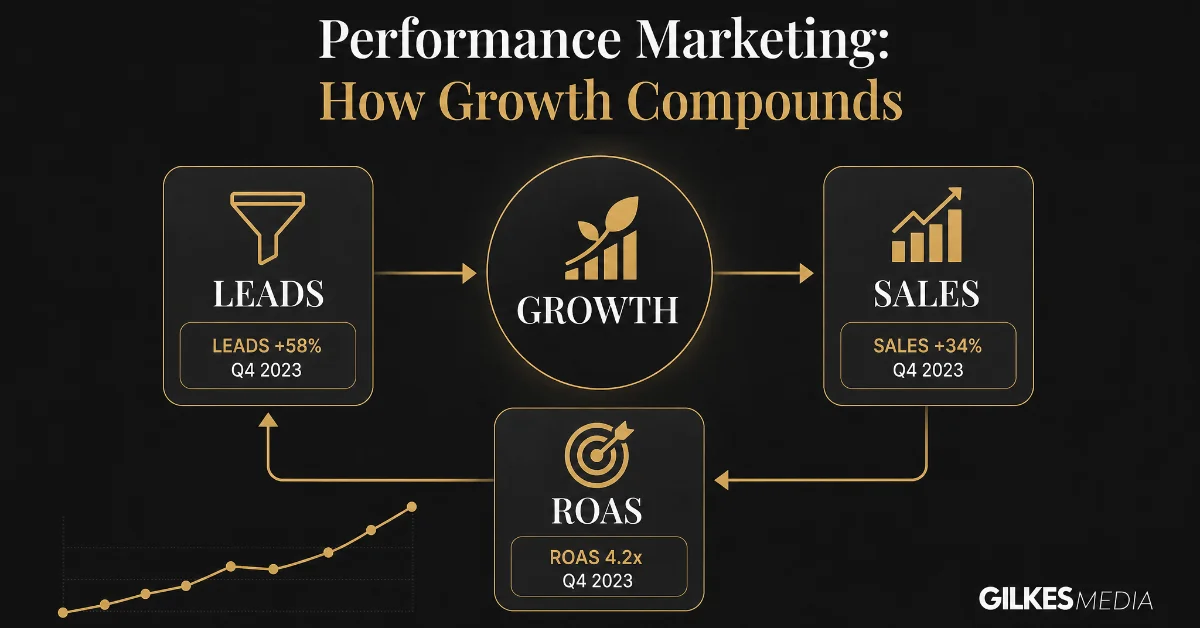
The key takeaway is simple: every single activity, from generating an initial lead to closing a sale, must be tracked and optimised to ensure your investment is actually profitable.
Paid Search, better known as Pay-Per-Click (PPC), is the fastest way to get in front of customers who are actively looking for what you sell, right now. When someone types a query into Google or Bing, PPC lets you put a targeted ad right at the top of their results. Simple.
This makes it an incredibly powerful tool for immediate lead generation. You are not trying to create demand out of thin air; you are capturing it at the exact moment of need. For many businesses, a well-run PPC campaign is the most direct and predictable source of new enquiries and sales. The whole game here is about precision, efficiency, and a clear, measurable Return On Ad Spend (ROAS).
To get a deeper understanding of this, you can learn more about our specialist paid search service and strategy.
Paid Social advertising on platforms like Meta (Facebook and Instagram) and LinkedIn works differently. Instead of capturing existing search intent, its real strength is in creating new demand. It does this by reaching highly specific audiences based on their demographics, interests, job titles, and online behaviours.
The strategic advantage of Paid Social is its ability to build awareness and generate leads from audiences who may not be actively searching for you but are a perfect fit for your product or service. It allows you to introduce your solution to a curated group of potential customers, nurturing them from awareness to conversion.
This makes it indispensable for B2B companies targeting decision-makers in specific industries on LinkedIn, or for consumer brands reaching niche interest groups on Meta. It is a proactive approach to growth, building your pipeline of future customers.
Search Engine Optimisation (SEO) is the long game. Unlike paid channels that switch off the moment you stop paying, SEO builds a lasting, organic presence that becomes a valuable business asset over time. It is all about optimising your website’s technical setup, content, and authority so that it ranks highly in search results naturally.
The commercial goal of SEO is to slash your long-term Customer Acquisition Cost (CAC) and build a durable competitive advantage. By ranking for key terms, you create a consistent flow of high-quality, free traffic to your site. This is not about quick wins; it is a strategic investment in sustainable, profitable growth that pays dividends for years to come.
A properly balanced strategy almost always involves using a combination of these services, with each playing a specific role.
An expert performance marketing agency in London will not just run these services in isolation. They will act as a strategic consultant, helping you allocate budget effectively across these channels to create a comprehensive growth engine that aligns with both your immediate needs and your long-term ambitions.
Impressions and clicks might look good in a report, but they do not pay the bills. If you want to actually gauge the success of your marketing investment, you need to look past these surface-level vanity metrics and focus on commercially driven Key Performance Indicators (KPIs).
Any specialist performance marketing agency in London worth its salt should speak the language of business, not just marketing fluff.
Every conversation should circle back to tangible outcomes. Are we generating profitable leads? Is our cost to acquire a customer sustainable? Is marketing directly contributing to revenue growth? These are the questions that truly matter.
This relentless focus on accountability is essential. The digital advertising market in the UK is growing fast, which means more opportunity but also a lot more noise. To cut through, you need a ruthless focus on performance.
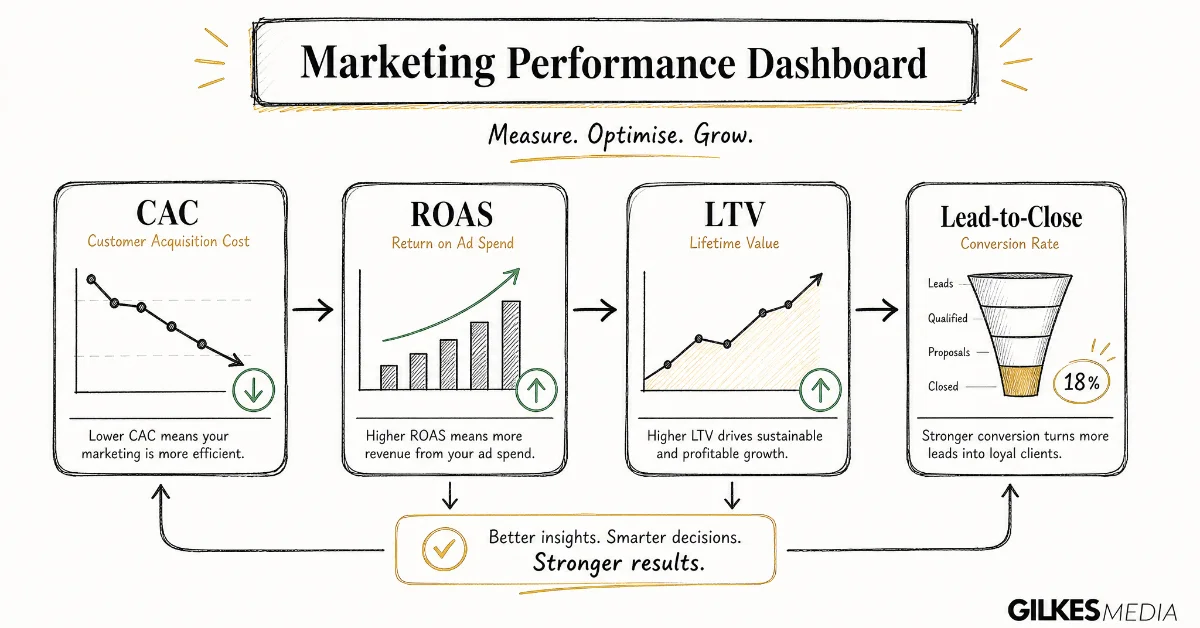
To give you a crystal-clear picture of your marketing's commercial impact, we zero in on the metrics that connect every pound spent directly to a business outcome. They strip away the noise and tell you what is really happening.
Here is a breakdown of the KPIs that should be on every business leader's dashboard.
| KPI | What It Measures | Why It Matters for Your Business |
|---|---|---|
| Customer Acquisition Cost (CAC) | The total cost to acquire a single new customer. | Determines the profitability of your growth. If CAC is too high, you cannot scale sustainably. |
| Return On Ad Spend (ROAS) | The gross revenue generated for every pound spent on advertising. | Provides a clear, immediate measure of campaign profitability and channel efficiency. |
| Lead-to-Close Rate | The percentage of leads that convert into paying customers. | A vital health check for your sales process and the quality of leads your marketing generates. |
| Customer Lifetime Value (LTV) | The total revenue a business can expect from a single customer account. | Informs how much you can afford to spend to acquire a customer (your target CAC). |
These are not just numbers on a spreadsheet; they are the foundation of every strategic decision we make, from how we allocate your budget to which channels we double down on.
Simply tracking these numbers is not the endgame. The real value is in interpreting them to make smarter business decisions. This is where a hands-on consultant shines compared to a larger, process-driven agency.
For example, a low Lead-to-Close Rate is not just a "marketing problem." It could signal an issue with lead quality, a disconnect between your marketing message and sales process, or even a problem with your product offering itself. Digging into that requires a collaborative approach, not just a monthly report.
A great agency does not just report the numbers; they provide the commercial context. They should be able to tell you why your CAC is rising, what that means for your profit margins, and present a clear, actionable plan to fix it. This is the difference between a supplier and a true strategic partner.
Likewise, knowing your Customer Lifetime Value (LTV) is fundamental. If you know the average customer generates £10,000 in revenue, it gives you a clear ceiling on your Customer Acquisition Cost. This LTV:CAC ratio is one of the most important metrics for sustainable growth, which we explore in our guide on what performance marketing actually means.
Ultimately, measuring success is about accountability. By focusing on KPIs tied directly to revenue and profit, you ensure your marketing budget is treated as a strategic investment, not just another operational expense. This commercial discipline is the hallmark of effective performance marketing.
Picking the right agency is one of the biggest commercial decisions you will make. It is the difference between a real return on your investment and months of wasted time on a strategy that goes nowhere. To help you get it right, we have put together a practical checklist for evaluating any performance marketing agency in London.
This is not about judging their sales pitch. It is about digging deeper to verify their expertise, understand their processes, and make sure the team you meet is the team that will actually be working on your account.
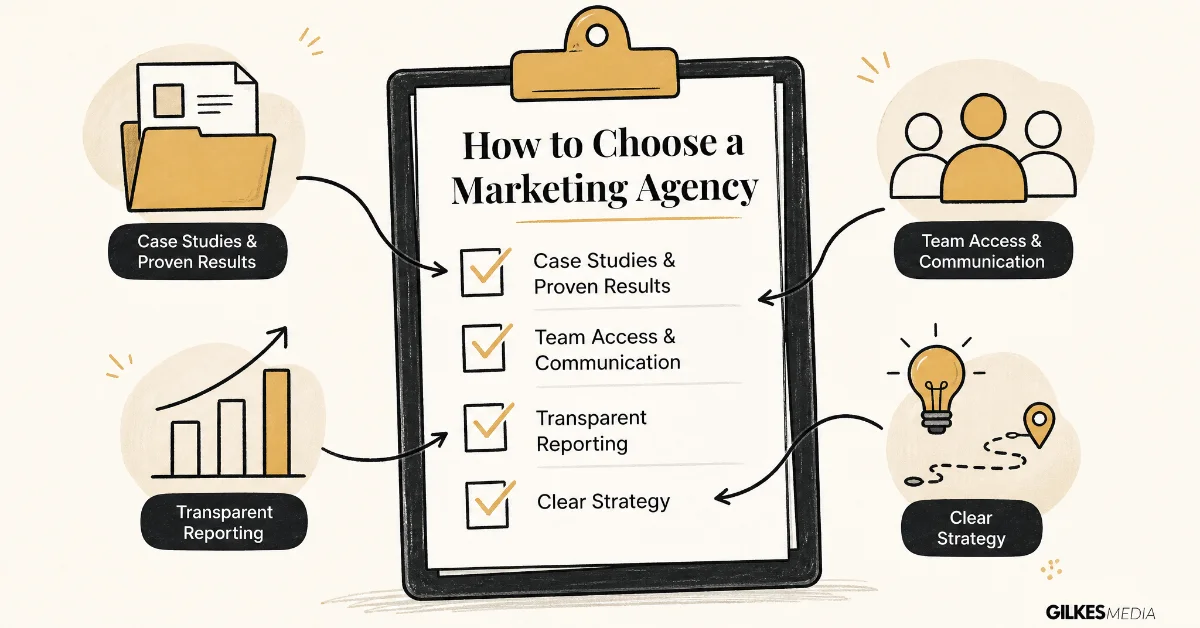
Any agency can pull together a glossy presentation, but genuine results are much harder to fake. Your first step should always be to demand proof of their past performance, especially in sectors similar to your own.
Ask for detailed case studies that go beyond vague success stories. You need to see:
This process quickly separates the agencies that deliver tangible outcomes from those who are just good at selling themselves.
This is a critical point that is so often missed. In many larger agencies, the senior team that pitches for your business is not the junior team that will be managing your campaigns day-to-day. You need absolute clarity on who you will be working with.
You are not just buying a service; you are investing in expertise. Ensure you have direct access to the senior practitioner responsible for your strategy. This personal accountability is often the defining factor between a campaign that succeeds and one that stagnates.
The UK agency sector has seen an interesting shift. While overall revenue grew by 7.3%, average headcounts actually fell by 6.1%. This points towards a move to leaner, more specialised teams where senior experts are more hands-on, rather than delegating work down a long chain of command.
A reactive agency simply manages campaigns. A true strategic partner gets under the skin of your business and builds a plan to hit your commercial goals. To figure out which one you are talking to, ask direct questions about their process. Understanding the best tools for SEO agencies they use can also give you a window into their operational capabilities.
Here are four essential questions you must ask:
“How do you approach campaign strategy when you first start?”
Their answer should involve a discovery phase, deep competitor analysis, and a proper dive into your target audience and unit economics. It should never be a one-size-fits-all solution.
“What is your process if a campaign underperforms?”
Look for an answer focused on data analysis, hypothesis testing, and systematic optimisation. Steer clear of anyone who makes vague promises or starts blaming external factors. A good partner takes ownership.
“How will you report on performance, and how often?”
Reporting must be transparent and focused on the commercial KPIs that matter to you (CAC, ROAS, etc.), not vanity metrics like clicks or impressions. Expect a clear schedule for reports and strategy calls.
“What level of access will we have to our own ad accounts?”
You must always retain full ownership and administrative access to your advertising accounts (Google Ads, Meta Ads Manager, etc.). Any agency that insists on running campaigns through their own accounts is a massive red flag.
By using this checklist, you can move past the surface-level pitch and make an informed decision based on evidence, transparency, and strategic alignment. This structured approach helps you find a true partner committed to your growth.
Choosing a performance marketing agency is a serious financial commitment, so getting your head around how they charge is the first step to building a partnership that actually delivers value. The fee structures can feel a bit murky at first, but they nearly always boil down to a few common models.
More importantly, you need to know what the warning signs look like. A great agency relationship is built on trust and straight-talking, and spotting the red flags early will save you a world of pain, wasted budget, and frustration down the line.
Most London performance marketing agencies use one of three main pricing models. The right one for you really depends on your budget, how much risk you are comfortable with, and the scale of your ambitions. A good partner will be completely transparent about their fees and help you figure out which structure makes the most sense for your goals.
Here is a quick breakdown of what you will likely come across.
| Pricing Model | How It Works | Best Suited For |
|---|---|---|
| Fixed Monthly Retainer | You pay a set, flat fee each month for an agreed scope of work. Simple and predictable. | Businesses needing predictable costs and a consistent level of service, especially for ongoing work like SEO. |
| Percentage of Ad Spend | The agency's fee is a percentage (usually 10-20%) of your monthly advertising budget. | Companies with larger ad spends, as it incentivises the agency to scale your campaigns effectively. |
| Performance-Based Fee | The fee is tied directly to results, like a fixed cost per lead (CPL) or a cut of the revenue generated. | Businesses with rock-solid conversion tracking and high confidence in their sales process. |
A fixed retainer is great for budgeting, but its biggest flaw is that it is not directly linked to performance. You pay the same whether they smash it or miss the mark. In contrast, a percentage of ad spend model gets the agency invested in scaling your budget, which should mean better results for you.
A pure performance-based model carries the lowest risk for you, but it is less common and often comes with much higher costs per result to compensate the agency for the risk they are taking on. Many agencies and consultants (like Gilkes Media) offer a hybrid model, combining a retainer with performance kickers to get the best of both worlds: stability for them, and a results-focus for you.
Beyond the spreadsheets, the way an agency behaves tells you everything you need to know about their integrity and experience. Some things should be immediate deal-breakers. A genuine performance marketing partner in London acts as a transparent extension of your team, not just another supplier sending you an invoice.
Keep your eyes peeled for these common warning signs.
"Guaranteed Results": An absolute classic. No one can guarantee a number one ranking on Google or a specific Return on Ad Spend (ROAS). The market is just too unpredictable. Anyone making these kinds of promises is either inexperienced or being dishonest. An expert talks in forecasts based on data, not unbreakable guarantees.
Vague or Fluffy Reporting: You should be getting regular, clear reports that focus on commercial KPIs like Cost Per Acquisition (CAC) and ROAS, the stuff that actually impacts your bottom line. If a report is confusing, full of vanity metrics like clicks and impressions, or does not tie back to your business goals, it is a massive red flag.
Long, Inflexible Contracts: A confident agency does not need to lock you into a rigid 12-month contract from the get-go. Look for partners who offer shorter initial terms (say, three months) or a simple 30-day notice period. It shows they are backing themselves to deliver value and keep you happy.
They Own Your Ad Accounts: This is non-negotiable. You must always have full ownership and admin access to your Google Ads, Meta, and any other advertising accounts. An agency that sets up campaigns in their own accounts is holding your data and history hostage. If you leave, you lose everything. Walk away.
The right agency operates as an extension of your team, providing open access to data and clear communication about what is working and what is not. Accountability is everything. If you feel like performance is being hidden behind jargon or confusing reports, it is time to walk away.
Navigating these conversations with confidence is key. By understanding both the pricing models and the critical red flags, you can select a partner who is genuinely invested in your commercial success.
When you are thinking about bringing in a performance marketing agency, a lot of practical questions come up. Here are the straight-up answers to the queries we hear most often from business leaders in London.
This is the big one, and it is vital to set realistic expectations. The timeline for results varies massively depending on the channel.
With Paid Search (PPC), you can get traffic and leads almost instantly. Because you are targeting people with immediate buying intent, they are literally searching for what you offer, campaigns can start bringing in enquiries within a few days of launch. It is the fastest way to get your hands on real data.
Paid Social and SEO, on the other hand, are cumulative. They build momentum over time.
Any good consultant will give you a clear forecast for each channel so you know exactly what to expect from your investment and when.
A realistic budget has two distinct parts: the agency or consultant’s management fee, and your ad spend. It is crucial to separate these two numbers in your head.
For a specialist consultant or a focused performance marketing agency in London, management fees generally start from £1,500 - £3,000 per month. This is what pays for the strategy, the hands-on execution, and the constant optimisation work.
Then you have your advertising spend, the cash that goes directly to platforms like Google or Meta. A minimum of £3,000 - £5,000 per month is usually needed just to gather enough data to make smart decisions. In competitive sectors like finance or tech, you will likely need to invest more to get meaningful traction.
The real question is not about cost, it is about profitability. A campaign is only "expensive" if it does not deliver a return. The key is whether the total investment works against your Customer Acquisition Cost (CAC) and the lifetime value of a customer.
Not always, but your website's ability to convert is non-negotiable. A reputable consultant will audit your key landing pages before they even think about recommending a big ad spend. Driving paid traffic to a website that cannot turn visitors into leads is one of the fastest ways to burn through cash.
If your conversion rates are low because of a clunky design, slow page speed, or a confusing message, we might suggest fixing those specific issues first. The goal is a smooth journey, from the first ad click right through to a conversion.
The best results always come from a partnership. While the agency handles the day-to-day heavy lifting, your team’s insight is what makes a campaign truly successful.
At the start, plan for a few hours of onboarding calls. This is where you will share your business goals, customer profiles, and commercial targets. From there, your team's most important job is to provide feedback on lead quality. That feedback loop, knowing which enquiries turned into actual revenue, is essential for us to fine-tune the campaigns.
A monthly strategy meeting is pretty standard. When you work with a consultant like Gilkes Media, you get a much more direct line of communication. This means we need focused input from key decision-makers, not long, drawn-out team meetings.
Ready to put this into action? At Gilkes Media, we partner directly with founders and leadership teams to build growth strategies that actually work. If you need a senior marketing partner who brings hands-on expertise and takes full accountability for results, let’s talk.
Book your free, no-obligation strategy call to see how we can help you hit your goals. Visit https://gilkesmedia.co.uk to get started.
