
Before you spend a single pound on advertising or content, you need a plan.
Too many businesses dive straight into tactics - running ads, posting on social media, redesigning a website - without a clear roadmap. The result is almost always the same: wasted money, inconsistent results, and a frustrating feeling that your marketing just isn't working.
A proper marketing strategy is not a dense, academic document. It’s a practical blueprint that connects your business goals to specific, measurable activities. It’s what separates deliberate, profitable growth from expensive guesswork.
This guide is built on a simple premise: a good strategy is an actionable one.
As a marketing consultant and paid ads specialist with over a decade of hands-on experience, I have seen what separates high-growth companies from the ones that stall. The difference, time and time again, is the quality of their strategy.
We are going to move beyond theory and get straight to the practical steps - from figuring out where you are right now to executing a plan that actually generates leads, wins customers, and delivers a tangible return. My goal is to give you, as a founder or business leader, a clear framework to drive sustainable growth.
This means we will cover how to:
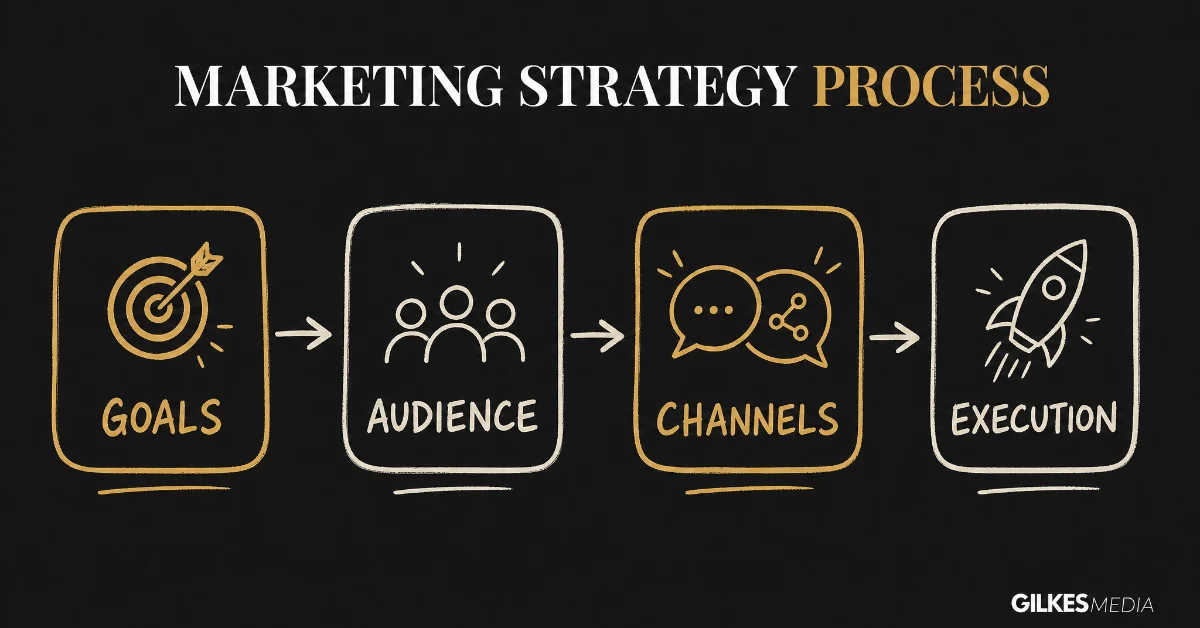
Writing your strategy down forces clarity. It gets everyone on the same page and turns your marketing from a series of reactive, disconnected tactics into a cohesive system built for growth.
Without it, you are flying blind. Efforts are disjointed, spend is wasted, and you have no reliable way to measure what is actually moving the needle. It is no surprise that businesses with a documented strategy are significantly more likely to report marketing success. They have a single source of truth guiding every decision.
Your strategy will have several moving parts, but to bring it to life, you will need great content. That's why it's a good idea to also think about how to create a content strategy that aligns perfectly with your new plan and speaks directly to your ideal customer.
This guide walks you through the core components needed to build a solid marketing plan - one that not only looks good on paper but actually performs in the real world.
Let's start by building the foundation.
Before we dive into the step-by-step process, it helps to understand the pillars that hold up any successful marketing plan. These are the non-negotiables that ensure your strategy is measurable, customer-focused, and aligned with your real business objectives.
| Component | Objective | Key Question to Answer |
|---|---|---|
| Discovery & Audit | Establish a clear baseline of performance, market position, and resources. | Where are we right now, and what is working (or not working)? |
| Goals & KPIs | Define what success looks like in specific, measurable, commercial terms. | What tangible business outcome are we trying to achieve? |
| Audience & Proposition | Gain a deep understanding of who you are selling to and why they should choose you. | Who is our ideal customer, and what problem do we solve for them? |
| Channel Mix | Identify the most effective platforms to reach your target audience. | Where does our audience spend their time, and how can we best reach them? |
| Budget & Measurement | Allocate resources intelligently and set up tracking to measure ROI accurately. | How much can we invest to acquire a customer, and how will we track it? |
| Execution Roadmap | Break the strategy down into a clear, prioritised plan of action with timelines. | What are the exact steps we need to take over the next 3-6 months? |
Think of these components as the essential ingredients. Miss one, and the entire recipe falls flat. By addressing each one systematically, you create a strategy that is not only comprehensive but also practical and ready for implementation.
Alright, before we even think about spending a single pound on ads, we need to get our foundations right. This means grounding your strategy in commercial reality. The best plans are not built on guesswork; they are built on a deep, honest understanding of your business and where it sits in the market.
This stage is all about looking inwards and outwards to gather the intelligence we need to make smart, profitable decisions down the line.
A lot of businesses skip this bit. They get impatient and jump straight into tactics because this groundwork feels slow. But I can tell you from experience, this is the single most important step in preventing wasted budget. Every single thing we do later - from choosing an ad platform to writing the copy - will be guided by what we uncover right here.
To build a marketing strategy that delivers real growth, we first have to agree on what "growth" actually means for your business. Vague goals like ‘brand awareness’ or ‘more traffic’ are commercially useless because you cannot tie them to a financial outcome.
Success has to be defined in concrete, quantifiable terms. This forces clarity and gives us a proper target to aim for. A strong marketing goal is always specific, measurable, and has a direct impact on the bottom line.
Here is how we turn vague goals into valuable ones:
From: “Increase brand awareness.”
To: “Generate 50 marketing-qualified leads (MQLs) per month from LinkedIn Ads with a target Cost Per Lead (CPL) under £75.”
From: “Improve our social media presence.”
To: “Achieve a 4:1 Return on Ad Spend (ROAS) from our Meta advertising campaigns within the next quarter.”
See the difference? These goals give us direction and, crucially, a benchmark to measure performance against. Without this specificity, you have no real way of knowing if your marketing is working or just costing you money. This clarity is the first step towards building a predictable engine for growth.
Next up, we need to take a candid look at your existing marketing efforts. This is not about judgement; it's about gathering data to see what is working, what is not, and where the biggest opportunities are hiding. We need a clear baseline to measure future success against.
The purpose of an audit is simple: stop doing what is not working and double down on what is. This exercise alone can often deliver immediate efficiency gains and improve your return on investment before you spend anything new.
Start by pulling together the key metrics from the last six to twelve months. Your analysis should answer a few critical questions that will shape your entire strategy.
Key Audit Questions
| Question | Why It Matters | Where to Look for Answers |
|---|---|---|
| Which channels generate the most leads? | Identifies profitable platforms and tells us where to put the budget. | Google Analytics (Acquisition), CRM data, ad platform reports. |
| What is our average Cost Per Lead (CPL)? | Establishes a baseline for campaign efficiency and profitability targets. | Ad platform dashboards (Google Ads, Meta), CRM tracking. |
| What is our lead-to-customer rate? | Reveals lead quality and how effective your sales process is. | CRM sales pipeline reports, manual sales data analysis. |
| Which content or offers perform best? | Shows what resonates with your audience to guide future ad creative. | Google Analytics (Landing Pages), ad campaign performance data. |
This process gives us an objective, data-backed view of your marketing engine. The findings will directly influence which channels we prioritise and the performance targets we set. It is all about replacing assumptions with hard data, ensuring our decisions are commercially sound from day one.
You cannot sell effectively without absolute clarity on who you are selling to and why they should pick you over everyone else, built from a real-world picture of your ideal customer rather than basic demographics. For the full approach to defining your audience and proposition, see our guide to the development of marketing strategies for UK SMEs.
Trying to be everywhere at once is a fast way to burn through budget with little to show for it, so channel choice should be deliberate, blending organic and paid activity around where your audience actually spends its attention. Our guide to the development of marketing strategies for UK SMEs sets out how to choose channels and budget for real ROI.
A strategy without a budget and a measurement plan is just a collection of expensive ideas, so budgeting should be built on what you can afford to pay for a lead and a new customer, not an arbitrary percentage of revenue. See our guide to the development of marketing strategies for UK SMEs for the full execution and measurement framework.
A marketing strategy should be a living system, not a document you file away and forget, moving through commercial foundations, audience and proposition, channel mix, and budget into one continuous plan for growth. Our guide to the development of marketing strategies for UK SMEs covers the full execution roadmap and continuous improvement loop.
Here are a few common questions that founders and marketing managers ask when putting together their growth strategy.
Your overarching marketing strategy should get a thorough review once a year to make sure it is still aligned with your main business goals.
But the day-to-day execution requires a much closer eye.
I always recommend a monthly performance review to check your core KPIs. We are talking lead volume, cost per lead, and conversion rates. Then, a deeper quarterly review is perfect for checking progress against your strategic goals and making bigger calls, like shifting budget between channels or tweaking your mix. This rhythm keeps you agile enough to react to market shifts without tearing up your entire strategy every few weeks.
There is no magic number here; it really depends on your industry, how fast you are trying to grow, and your revenue. As a general rule, established SMEs often invest around 5-10% of their revenue. For a startup or a business in a serious growth phase, that figure can easily jump to 15-25% or even higher.
But a far better way to set your budget is to work backwards from what you actually want to achieve.
If you are just starting out, begin with a test budget you can afford to learn from. Prove the ROI on a smaller scale, then reinvest with the confidence that you are putting money into a system that works.
It is simple when you think of it this way: the strategy is your ‘why’ and the ‘what’, while the plan is the ‘how’ and the ‘when’.
Your marketing strategy defines the high-level elements: your commercial goals, who you are targeting, and how you are going to position yourself to win in the market.
The marketing plan is the practical, on-the-ground application of that strategy. It breaks down the specific campaigns, channels, timelines, budgets, and metrics you will use to hit those strategic goals. You simply cannot have an effective plan without a clear strategy driving it.
A solid marketing strategy is your single most valuable asset for predictable growth. If you need an experienced partner to help build and execute a plan that delivers measurable results, Gilkes Media provides hands-on consultancy and paid ads management.
Book a free consultation to start building your growth engine.
