Effective lead generation for small business is not about casting the widest net or chasing every new platform. It is about building a predictable, sustainable system that delivers a strong return on your investment. This guide moves beyond generic advice to focus on what drives commercial results.
Many small businesses fall into a cycle of random marketing activities. Does this sound familiar? You boost a post one week, try a Google Ad the next, and attend a networking event the month after, all without a clear strategy connecting them.
This approach is exhausting. More importantly, it rarely delivers the predictable results you need.
The goal is to shift away from that reactive mindset. Instead of thinking, 'we need more leads', we need to build a repeatable process for attracting the right kind of customers. As a consultant who has personally managed over £3,000,000 in ad spend, I focus on building practical, measurable, and commercially-focused systems that work.
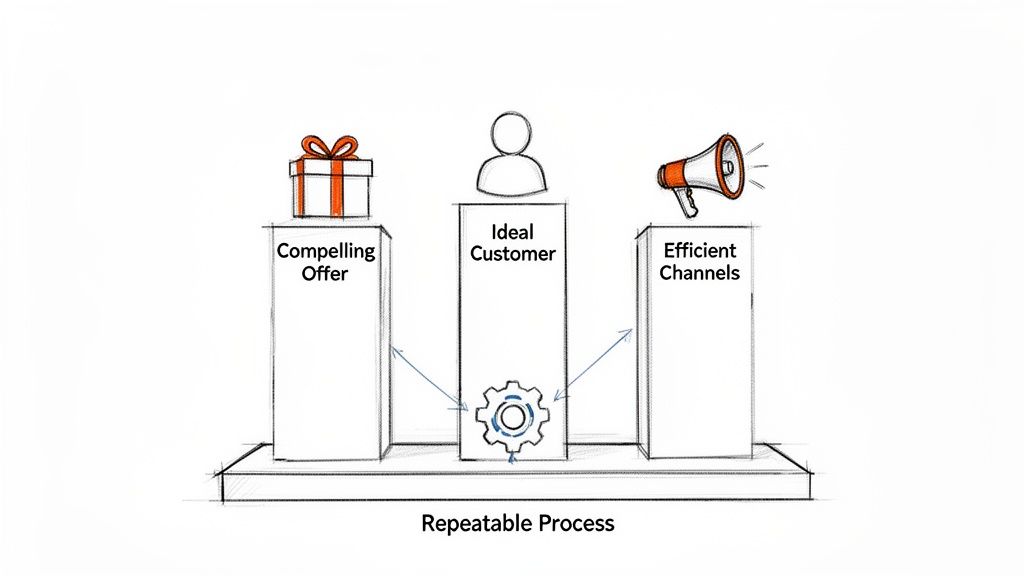
A truly effective lead generation system is built on three core pillars. When these elements work together, they create a powerful engine for your business. If you lack clarity in any one of these areas, you will undermine your efforts and waste your budget.
Here are the non-negotiable foundations:
Shifting from 'chasing leads' to building a system is the most important strategic change a small business can make. It turns marketing from an unpredictable cost into a measurable investment in growth.
To streamline this system, you might also consider using the best marketing automation software for small business. This will help you manage and nurture incoming leads efficiently, ensuring no opportunity slips through the cracks.
Ultimately, this playbook is designed to give you a clear, practical framework for growth. My approach is hands-on and results-focused, ensuring every action is tied directly to a measurable business outcome. You can learn more by exploring our guide to a full-funnel marketing strategy. This is how we turn marketing spend into predictable revenue.
Before spending a single pound on advertising, you need absolute clarity on what you're selling and who you're selling it to - without that foundation, you're just throwing money at the wall and hoping something sticks. Our full guide to digital marketing for lead generation covers how to build that foundation properly.
A classic mistake is trying to be everywhere at once, which stretches a limited budget so thin it makes zero impact on any single platform. See our full guide to digital marketing for lead generation for how to choose the right channels for your business.
Getting traffic to your website is only half the job - if visitors don't turn into leads, you're pouring budget down the drain. Our full guide to digital marketing for lead generation covers what it takes to convert that traffic properly.
You cannot improve what you don't measure, so tracking the right numbers against your goals is essential to knowing what's actually working. See the full measurement and ROI framework in our guide to digital marketing for lead generation.
A phased first 90 days lets you build momentum in stages rather than trying to do everything at once. For the complete implementation plan, see our guide to digital marketing for lead generation.
Business owners ask me these questions all the time. Instead of vague answers, here is the straight-talking, practical advice I give my clients to help them move forward with confidence.
There is no single magic number, but a good rule of thumb is to allocate around 7-10% of your gross revenue to your entire marketing budget.
For a new lead generation campaign, I always advise setting a specific test budget you are comfortable investing purely to gather data. This might be £1,000 to £3,000 over the first 90 days.
The goal here is not immediate profit. It is about buying enough data to determine your Cost Per Lead (CPL) and prove that the channel can work for you. Once you have a profitable model, you can start scaling your investment with real confidence.
This depends entirely on the channel you choose. You need to set your expectations correctly from day one.
A "good" CPL is entirely relative to your business. A £200 CPL could be incredibly profitable for a company selling a £10,000 service, but it would be a disaster for one selling a £300 product.
Forget industry benchmarks. Focus on your own numbers. Your lead generation is working if your Customer Acquisition Cost (your CPL divided by your lead-to-customer conversion rate) is comfortably lower than your Customer Lifetime Value.
That positive margin is the only thing that truly matters.
At Gilkes Media, I work directly with founders and business owners as a senior marketing consultant to build these practical, ROI-focused marketing systems. My personal involvement ensures a performance-driven strategy, not agency volume. If you are ready to move past guesswork and start generating predictable results, book a free consultation with me today.
