
Growth often stalls in a frustratingly busy way. Leads are coming in, but not enough of the right ones. Your team is active, but nobody can say with confidence which channels are pulling their weight. The agency reports look polished, yet revenue doesn't move in step with the activity.
That's usually when founders start searching for a digital marketing consultant freelance option. Not because they want another supplier, but because they need someone senior enough to diagnose what's broken, decide what matters, and stop money leaking through weak strategy or poor execution.
A common UK SME scenario goes like this. The business has a capable sales team, a decent website, some paid spend, and a few scattered marketing tactics running at once. Someone's posting on LinkedIn, someone else is tweaking Google Ads, and the CRM is full of leads that don't consistently turn into revenue.
Nobody is standing back and asking the harder questions. Which channel is producing profitable demand? Is the offer clear enough? Are leads poor because traffic is weak, or because the landing page and follow-up process are dragging conversion down?
That's where a freelance consultant starts to make sense.
Most businesses that reach this point aren't under-working. They're over-working in too many directions. The issue is usually a lack of senior marketing judgement rather than a lack of activity.
A proper consultant doesn't just add more motion. They bring prioritisation. They look at your acquisition model, sales process, reporting, website performance, paid media setup, and organic visibility as one commercial system.
Practical rule: If your business is spending money on marketing but still making decisions on instinct, you don't need more tactics first. You need clarity.
A freelance consultant is often the right move when:
It's not the right move for every company. If the issue is basic execution capacity, you may need a coordinator, designer, copywriter, or channel specialist. But if your bigger problem is deciding where to focus, what to fix first, and how to tie marketing to revenue, freelance consulting can be a smart step.
A lot of businesses use the word consultant when they really mean freelancer. Those aren't always the same thing.
A freelancer might complete tasks. A consultant should improve the commercial system behind those tasks. That means less time spent saying “I can run your ads” and more time spent asking what margin, sales cycle, lead quality, and conversion constraints the business is dealing with.

The distinction matters because the UK market is crowded and expensive. The IAB UK reported digital advertising spend reached £35.5 billion in 2024. In that environment, activity alone means very little. A consultant who reports clicks, impressions, or engagement without tying them back to pipeline or profit can stay busy while missing the actual job.
Here's the practical difference:
| Model | What they focus on | What you usually get |
|---|---|---|
| Task freelancer | Delivery | Ads launched, posts published, emails sent |
| Digital marketing consultant freelance | Diagnosis, prioritisation, accountability | Strategy, measurement, channel decisions, commercial feedback |
| Junior channel specialist | Platform mechanics | Technical execution in one area |
| Senior consultant | Business integration | Marketing linked to sales, targets, reporting, and cashflow reality |
A proper consultant should be able to:
The best freelance consultants act more like a commercial growth partner than an outsourced pair of hands.
If a consultant is credible, their conversations will quickly move beyond platform talk. They'll ask about sales quality, close rates, average deal value, time-to-conversion, and whether your website helps or hinders the buying journey.
They'll also care about where digital acquisition is heading. If you're reviewing channel mix or planning budgets, a broader view of future digital marketing strategies can help frame where attention is shifting, but the important part is still commercial fit, not trend-chasing.
If your consultant can't explain how marketing activity affects revenue, they're not consulting. They're operating software.
This decision usually comes down to one thing. Where do you want the risk to sit?
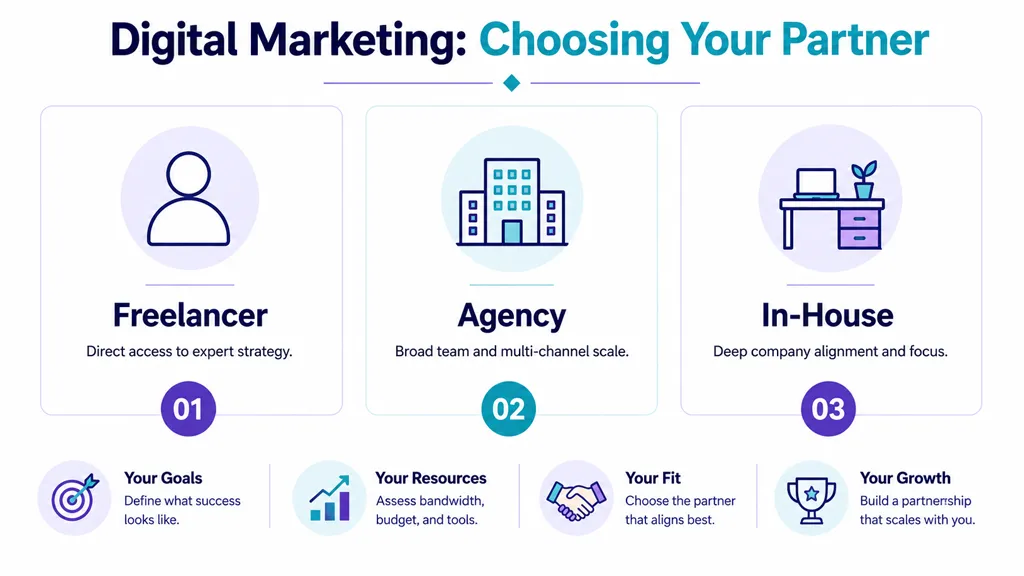
An in-house hire gives you focus and internal alignment. An agency gives you breadth. A freelancer gives you direct access to a senior operator. None is automatically right. The right choice depends on your growth stage, internal capability, and how much management bandwidth you have.
One reason freelance consulting has become more attractive is speed. Around 6% of UK employers had vacancies that were hard to fill in 2024. For businesses trying to hire a strong senior marketer, that often means recruitment drags on while growth targets don't wait.
| Option | Best for | Strengths | Weaknesses | Commercial reality |
|---|---|---|---|---|
| Freelancer | SMEs needing senior thinking without full-time overhead | Fast to start, direct communication, specialist depth | Limited capacity across every channel at once | Strong if you need focus and accountability |
| Agency | Businesses needing wider execution across multiple disciplines | Broader team, design/dev/media under one roof, scalable delivery | Can become layered, slower, less direct | Useful when volume and coverage matter more than closeness |
| In-house | Companies with enough consistent workload for a permanent role | Brand knowledge, internal access, day-to-day involvement | Hiring risk, slower recruitment, fixed overhead | Best when marketing is a core full-time function already |
Choose in-house when you have enough work for a permanent senior marketer and the business needs someone embedded in daily operations. This makes sense when marketing, sales, and delivery all need tight coordination every week.
Choose an agency when your challenge is scale across disciplines. If you need paid search, paid social, design, technical implementation, creative, and reporting all moving at once, an agency can cover more ground.
Choose a freelance consultant when you need judgement first. This is often the best fit for founder-led businesses, growing SMEs, or lean internal teams that need a sharper plan before they need a bigger machine.
They hire for execution before they've clarified ownership. Then the in-house person waits for direction, or the agency keeps producing work around a vague brief, or the freelancer is pushed into random tasks with no commercial framework.
That's why the model matters less than the operating setup. Before you choose, answer three questions:
If you're weighing these routes in more detail, Gilkes Media has a useful comparison on in-house marketing vs agency that helps frame where each model fits.
If nobody in the business can confidently define what marketing should achieve over the next two quarters, bringing in senior freelance support is often the fastest way to stop drift.
A founder usually asks the wrong pricing question first. They ask, “What's your day rate?” The better question is, “What business problem are you taking ownership of, and what happens if we get it wrong for another quarter?”
That shift matters because freelance consultants are priced on the quality of decisions they improve, not only on hours worked.

In practice, the service mix usually sits across five commercial areas:
The rate rises as the work moves closer to commercial accountability. Plenty of freelancers can launch campaigns. Fewer can tell you whether the campaign should exist, what success looks like in margin terms, and whether the bottleneck sits in traffic, conversion, follow-up, or offer-market fit.
That distinction is where a lot of hiring mistakes happen.
A lower-fee freelancer often delivers production. A higher-fee consultant usually brings judgement, pattern recognition, and the confidence to challenge weak assumptions before more budget gets burned.
That does not mean premium pricing is always justified. Some businesses need a reliable pair of hands to manage a clear channel with stable targets. Others need someone who can step into the business, align marketing with sales and finance, and make trade-offs that protect cash.
For startups with a small team and uneven internal marketing ownership, a marketing consultant for startups can make sense because the work often includes prioritisation, not only delivery.
UK freelance pricing varies by scope, seniority, and whether the consultant is advising, executing, or doing both. Hourly rates can work for short audits or specialist input. Day rates are common for strategic support, workshops, and ongoing consulting. Monthly retainers suit businesses that need continuity, weekly oversight, and someone accountable for momentum.
The mistake is comparing all three as if they buy the same thing.
A £400 day rate may be expensive if you need basic admin inside an ad account. The same rate can be cheap if that person prevents months of waste across paid search, SEO content, landing pages, and lead handling. Commercially, the right comparison is not consultant fee versus freelancer fee. It is consultant fee versus the cost of wrong decisions, slow execution, and weak accountability.
Pricing also changes based on how much specialist input sits inside the brief.
If you need ad management but the offer is weak, the consultant may spend time on positioning and conversion before media buying. If you need Meta campaigns that rely on strong messaging, it can be smarter to hire a professional Facebook ads copywriter alongside your consultant rather than expect one person to cover strategy, creative, and channel execution at the same standard.
That is a real trade-off. Hiring one person for everything can look efficient, but it often blurs accountability and lowers quality in the areas that drive response.
High value is demonstrated through improved decision-making that leads to quantifiable business results. The consultant identifies when paid search campaigns produce leads that the sales department cannot convert. They might notice that SEO traffic increases for general informational keywords while total revenue remains stagnant. Alternatively, they may conclude that the website is not the primary obstacle, and the actual issue involves delayed lead follow-up and inadequate qualification processes.
That is why a useful consultant often works across channel performance, conversion, and internal process. Marketing results are usually shaped by the handoff between functions, not by ad platforms alone.
Some businesses need advice only. Others need strategy plus implementation across SEO, paid media, and website performance. Gilkes Media's marketing consultancy and execution support is one example of that combined model.
| Price level | Usually buying | Watch-outs |
|---|---|---|
| Lower fee | Task delivery and platform admin | You may still need to set direction, priorities, and reporting |
| Mid-range fee | Competent channel management with some input on improvements | Fine if scope is clear, weaker if your business problem is still undefined |
| Premium fee | Strategic judgement, diagnosis, prioritisation, and accountability | Only worth paying if they can connect activity to pipeline, revenue, or margin |
If a consultant cannot explain how their fee links to a business outcome, the number itself does not help you make the decision.
Most hiring mistakes happen before the work starts. Founders look at a tidy website, a few channel logos, maybe a polished deck, and assume competence. That doesn't tell you how the person thinks under pressure, how they diagnose a weak funnel, or whether they can adapt to your sector.

According to Upwork's marketing consultant hiring guidance, the strongest consultants bring not just channel knowledge but sector context, including experience in areas such as e-commerce, healthcare, and financial services. That matters because the acquisition model changes when compliance, buyer caution, or long sales cycles shape conversion behaviour.
Don't ask, “Can you run Google Ads?” Ask questions that expose reasoning.
Try these instead:
A strong consultant won't answer with platform jargon alone. They'll talk about sales friction, economics, attribution, and decision quality.
A portfolio shows what they've touched. Their questions show whether they can think.
A consultant worth hiring usually does three things early.
First, they ask uncomfortable but necessary questions about revenue, lead quality, margin, and close rate. Second, they push for access to the CRM or sales feedback, not just ad accounts. Third, they resist promising easy wins before they've seen the data.
That applies even in narrower channel work. If you're hiring support around Meta campaigns, for example, ad copy quality matters, but so does how that copy fits the buyer journey and landing page.
Use this before you hire anyone:
For earlier-stage businesses, the same commercial lens applies. This overview of a marketing consultant for startups is useful because startup hiring often fails when founders buy activity before they've nailed positioning and measurement.
Hiring well is only half the job. Poor onboarding ruins good consulting relationships.
If you want useful output in the first month, the consultant needs more than logins. They need context. That means commercial goals, sales reality, customer objections, CRM visibility, and a clear understanding of what the business can fulfil once more demand is generated.
A sensible onboarding process usually looks like this:
Without that, consultants spend the first month chasing passwords and making half-informed decisions.
High-value consultants are measurement-led. They should define a KPI framework and implement tracking around metrics such as conversion rate, cost per acquisition, and return on ad spend.
That's the right standard.
A good KPI setup should answer:
| KPI area | Why it matters |
|---|---|
| Conversion rate | Tells you whether traffic and page experience are working together |
| Cost per acquisition | Shows whether paid growth is commercially viable |
| Return on ad spend | Helps judge budget efficiency in revenue terms |
| Lead quality | Stops teams celebrating enquiries that never close |
| Attribution quality | Reduces bad decisions based on incomplete reporting |
Non-negotiable: Agree what success means before campaigns change. Otherwise every monthly review becomes an argument about interpretation.
Keep reporting simple and commercial. One dashboard is enough if it reflects the right metrics. Weekly commentary should focus on what changed, why it changed, and what gets tested next.
If you need a useful benchmark for structuring those conversations, Gilkes Media has a clear guide on what marketing consultancy actually involves. The principle is straightforward. Activity is not performance. Performance is what survives contact with revenue, margin, and lead quality.
The best freelance consultants don't behave like extra hands. They behave like operators who care whether the business is making better decisions.
That's the standard to hire against. Not whether someone can talk confidently about platforms, but whether they can bring focus to your growth plan, challenge waste, improve measurement, and connect marketing to commercial reality.
For UK businesses, that usually means finding someone who can work across strategy and execution without creating more complexity. You want clear priorities. You want honest feedback. You want someone who can tell you when to spend more, when to stop, and what has to change first for marketing to produce a return.
That's also why the strongest engagements tend to cut across channel silos. SEO without conversion thinking won't go far. Paid ads without tracking discipline become expensive quickly. A good website without a lead generation strategy is just a brochure.
If you're evaluating a digital marketing consultant freelance hire, treat it like a leadership decision, not a procurement exercise. The right person should improve how your business thinks about growth, not just how it runs campaigns.
If you want a practical second opinion on your marketing setup, Gilkes Media offers a free consultation to review your current position, pressure-test the strategy, and identify where better SEO, paid ads, or website improvements could create measurable commercial impact.
