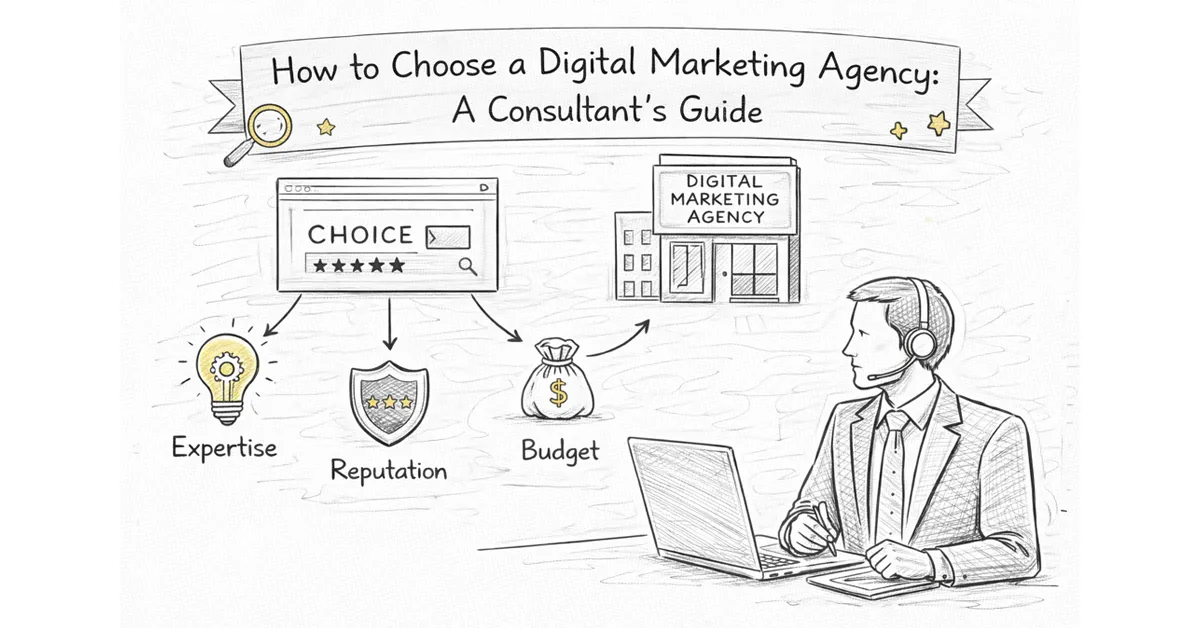
Choosing the right digital marketing agency starts long before you speak to one. It begins with defining your commercial goals, calculating your maximum cost per acquisition, and finding a partner whose skills directly match those financial targets.
Success is not about chasing vague metrics like 'traffic' or 'brand awareness'. It is about generating a real return on investment, whether that is measured in qualified leads, booked appointments, or ecommerce revenue.
It also means being honest about what kind of help you need. Sometimes the answer is an agency. Sometimes it is a consultant, and sometimes it is an in-house hire. This guide covers all three, so you buy the right model before you compare suppliers.
Before you shortlist agencies, the most important work happens internally. You need to be clear on what success looks like for your business. Without that, you cannot properly judge a potential partner.
An agency needs a specific target to aim for. Otherwise, they are guessing what matters most to you, which is a recipe for wasted budget and frustration. That means translating high-level business objectives into concrete marketing key performance indicators (KPIs).
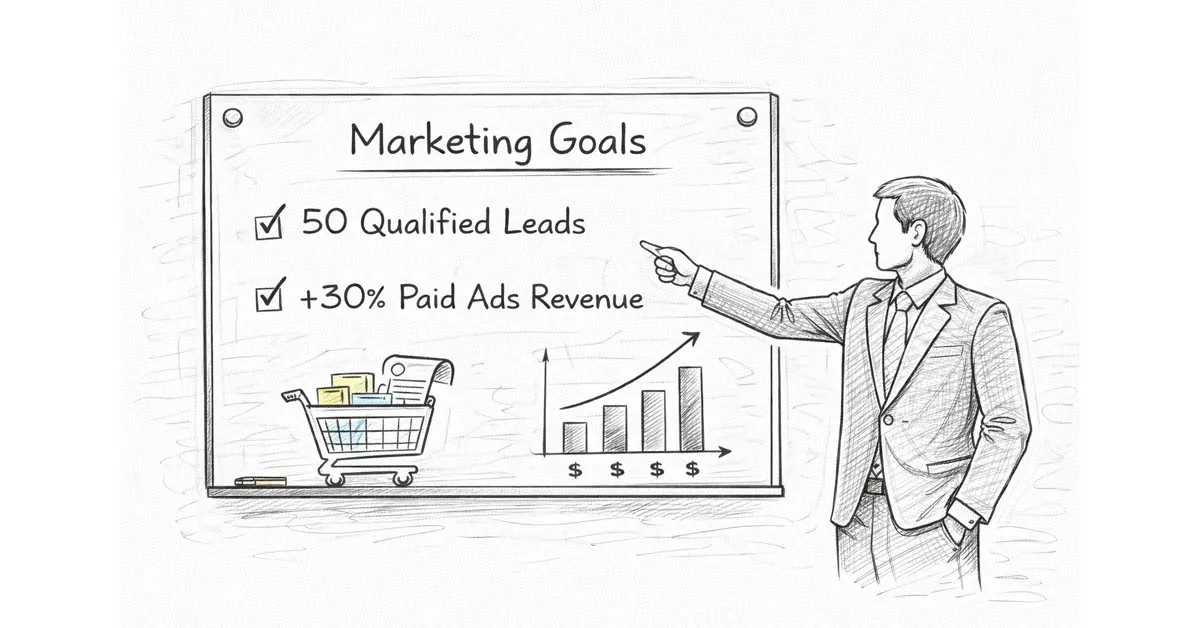
For example, if your business objective is to increase market share by 10%, the corresponding marketing goal might be to generate 50 qualified leads per month. The primary KPI you would hold an agency accountable for is the cost per qualified lead (CPQL).
Before any hiring conversation, write down what is actually broken. Not the symptoms. The problem. Most situations fall into one of three buckets:
Get this wrong and you buy the wrong help. A strategist cannot fix a team that never executes. An agency will not automatically sort your reporting if your conversion tracking is a mess.
A useful test is to ask whether you need someone to think, do or build. Think means strategy. Do means execution. Build means internal systems, process and capability.
Then turn the frustration into a short written brief. It can be four lines:
That is already far more useful than "we need better marketing". A vague brief attracts vague proposals. A sharp problem statement attracts useful ones.
The aim is a clear, logical path from your company's financial goals to the specific tasks you hand over. That keeps everyone focused on the same outcome.
With these numbers agreed, you can judge a proposal on its fit with your commercial reality, not its creative flair. For more on this process, see our guide on strategic marketing consultancy.
A common mistake is hiring an agency to 'do our marketing'. A better approach is to hire an agency to 'achieve X commercial outcome through Y marketing channels'. The first is a vague instruction; the second is a clear, performance-driven partnership.
This table gives you a simple framework for connecting what your business needs to what you ask an agency to deliver.
| Business Objective | Marketing Goal | Key Performance Indicator (KPI) |
|---|---|---|
| Increase annual revenue by 20% | Generate 500 sales-qualified leads (SQLs) per month | Cost Per SQL (CPSQL) |
| Grow market share in a new region | Drive 1,000 demo requests from the target area | Cost Per Demo Request |
| Improve customer retention by 15% | Increase upsell/cross-sell revenue | Customer Lifetime Value (LTV) |
| Boost ecommerce sales by 30% | Achieve a 4x Return on Ad Spend (ROAS) | Return on Ad Spend (ROAS) |
| Reduce customer acquisition cost | Lower average customer acquisition cost by 25% | Customer Acquisition Cost (CAC) |
This structure gives every marketing activity a direct link back to a commercial outcome, which makes performance easy to measure and accountability clear.
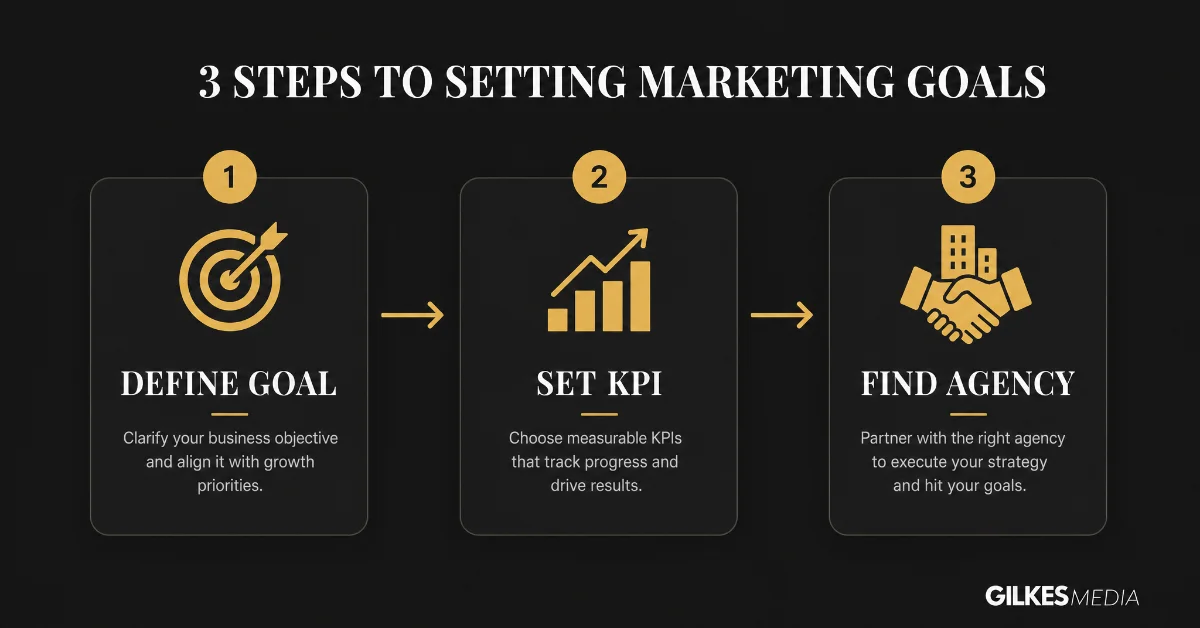
Clear goals and measurable KPIs must be set before you start your agency search, not during it. They are the foundation for everything that follows.
Once you know the problem, decide the operating model. Plenty of advice explains what each option does. Far less explains when each one makes commercial sense.
| Option | Best For | Main Strength | Main Weakness |
|---|---|---|---|
| Consultant | Diagnosis, strategy, accountability, senior guidance | Flexible access to experience | Limited delivery capacity unless paired with a team |
| Agency | Ongoing execution across channels | Delivery resource and specialist breadth | Can become process-heavy or detached from your commercial priorities |
| In-house | Long-term ownership and embedded knowledge | Close to product, sales and leadership | Hiring risk, management load and narrower skill coverage |
The common mistakes are predictable. A business with a leadership gap hires an agency for output. A business with an execution gap hires a strategist. A company that needs flexibility takes on a full-time salary too early. For a deeper look at the last trade-off, read our breakdown of in-house marketing vs agency.
If you do not yet know what the role should own, hiring in-house is premature. If you do not yet know what the strategy is, hiring an agency for delivery is premature too.
With your goals and model agreed, the real test is an agency's actual track record. A slick sales pitch and a polished website are easy to come by. They mean little without concrete, relevant proof.
Not all experience is equal. An agency that drives ecommerce sales for fast-fashion brands is probably not the right fit for a B2B tech company with a nine-month sales cycle. Their playbook and instincts are tuned to a different market.
Look for genuine vertical experience. An agency that has already worked through the problems of your sector has a big head start. They will understand your audience's pain points, your competitors, and which channels waste money in your market.
That knowledge shortens the learning curve and, most importantly, cuts the ad spend wasted while they work things out.
Next, decide whether you need a specialist or a generalist.
Specialist Consultancies: These live and breathe one or two core disciplines, like paid advertising or technical SEO. As a paid ads specialist, my world revolves around strategies that deliver a measurable return, drawing on experience managing over £3 million in ad spend. Focused expertise is right when you have a specific, high-priority problem to solve now.
Full-Service Agencies: These offer a suite of services under one roof. That sounds convenient, but quality can vary wildly between departments. The SEO team might be excellent while the social team is staffed by juniors learning on your budget.
For most SMEs, hiring a specialist to solve the most pressing commercial problem is the fastest path to growth. You can add other activity once your main revenue engine is working.
Be wary of paying for breadth you will never use. For a lead generation business, a partner's grasp of conversion tracking, landing page structure, CRM flow and sales feedback matters far more than whether they can also run every social platform.
The question is not just "Have you worked in our industry?" but "Have you achieved the specific outcomes we need for a business of our size, with a budget like ours?"
Case studies can be seriously misleading. A flashy result for a household name with a multi-million-pound budget means nothing if you are an SME spending £5,000 a month.
When you read a case study, ask:
A relevant case study should give you confidence the agency has a proven playbook for your problem. If you want a hands-on partner focused on measurable growth, it is worth reading what a dedicated performance marketing agency can deliver.
For another layer of insight, ask about the digital marketing software for agencies they use day to day. Their tools tell you a lot about their processes and efficiency.
Once you have a shortlist that looks good on paper, the real work begins. This is where you get past the pitch decks and into how they actually operate.
A common mistake is asking, "What results can you get me?". That invites vague promises and baseless guarantees. Reframe the question.
Instead, ask: "Can you walk me through a campaign for a client like us? Explain the initial strategy, the challenges you faced, how you overcame them, and how you measured success."
This forces them out of theory and into reality. It shows their strategic thinking, problem-solving and honesty. An experienced professional will welcome the question; a less confident one will stumble.
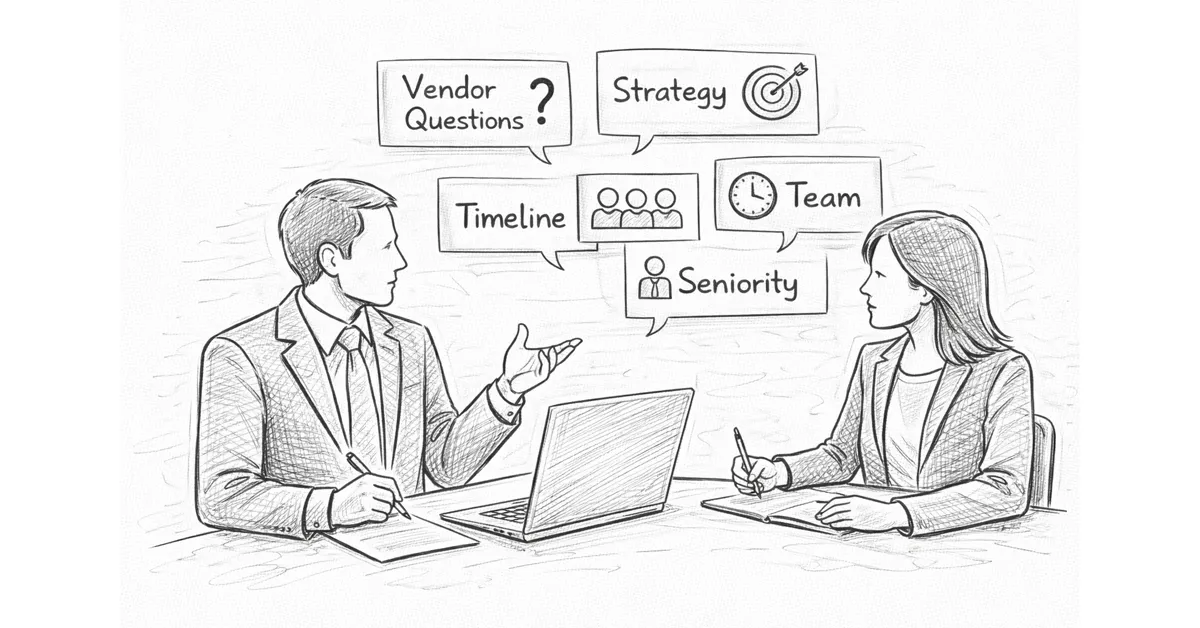
Your goal is to understand their process, not just their promises. Probe these areas:
Rehearsed questions get rehearsed answers. Scenario questions force someone to think in real time. Ask for their first three checks, not a lecture. The order they choose tells you how they think.
The best agencies stand out through transparency and a process they can explain plainly. Judge them on relevant case studies, the seniority of the team you will actually get, and UK results. You can read more about the UK digital marketing market to understand the competition you are up against.
To avoid choosing on gut feeling or a flashy presentation, use a simple scorecard. It lets you compare agencies like-for-like on the criteria that actually matter.
| Vetting Criterion | Question to Ask | Why It Matters | Score (1-5) |
|---|---|---|---|
| Strategic Depth | Can you outline the first 90 days? | Reveals if they have a thoughtful, customised plan or a generic, templated approach. | |
| Team Seniority | Who will manage my account day-to-day? | Ensures you are not sold by the A-team and handed to the B-team post-contract. | |
| Commercial Focus | How will you connect your activities to revenue? | Confirms they are focused on business impact, not vanity metrics like clicks or impressions. | |
| Transparency | Will we have full ownership of all ad accounts and data? | Guarantees you retain control of your assets and are not locked into their ecosystem. |
A scorecard keeps the decision grounded in evidence, not in how much you liked the person you spoke to.
The most powerful vetting tool you have is the reference check. A case study is the agency's version of the story; a client conversation is the unfiltered one.
Do not just ask for their happiest client. Ask for one with a similar business model or similar problems to yours. Then ask practical questions:
Pleasant to work with does not pay back the fee. Combine deep questioning, a structured scorecard and direct client feedback, and you have an evidence-based picture of each partner.
A proposal is more than a quote. It is the first real test of how well the agency has understood your business. A generic, copy-pasted document is a major red flag.
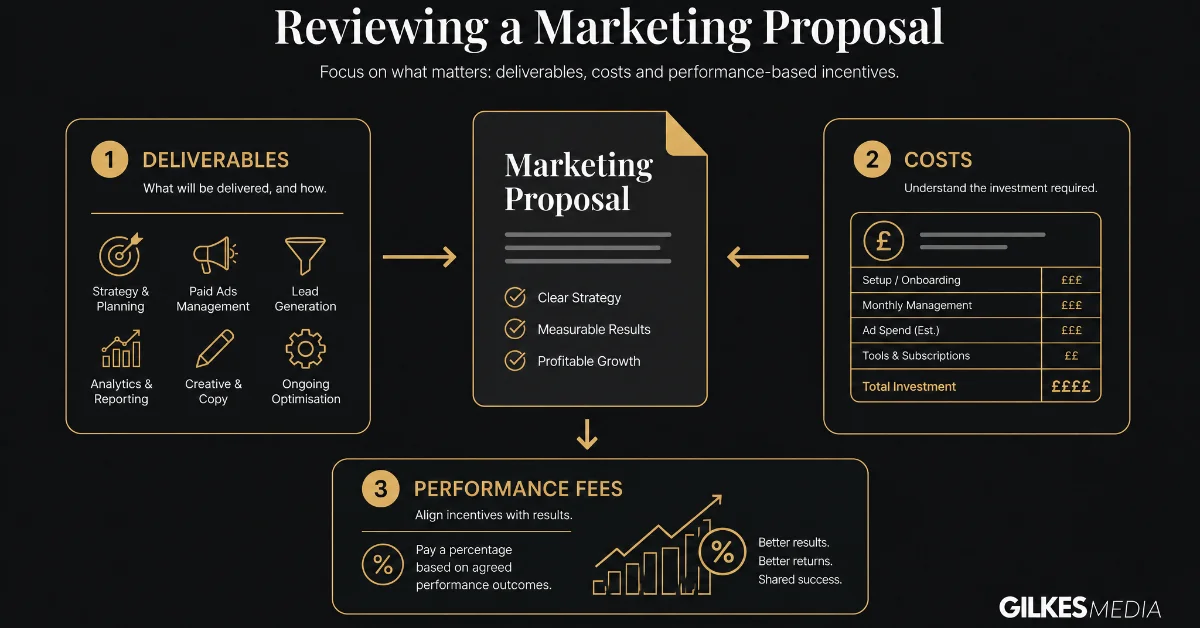
A strong proposal starts with a sharp diagnosis of your current situation, showing they listened. It then sets out a tailored strategy that ties every activity to the commercial goals you discussed, with specific deliverables, clear timelines and a transparent cost breakdown.
Most agency pricing falls into a few familiar categories. Understanding each one helps you work out which structure offers the best value. For a sense of what a good proposal looks like, this guide on how to write a perfect digital marketing proposal is useful.
Fixed Monthly Retainer: You pay a set fee each month for an agreed scope of work. It is predictable and suits ongoing work like SEO or content. The risk is that you pay the same whether results are great or dismal, so deliverables must be crystal clear.
Percentage of Ad Spend: Common in paid advertising, typically 10-20% of the budget managed. It gives the agency a reason to scale campaigns, which is good when performance is strong. It can also encourage spending for its own sake, so tie it to strict KPIs like ROAS or cost per lead.
Performance-Based Fees: Fees linked to results, like a set cost per qualified lead or a share of sales. Interests align well, but these deals often still need a base retainer and work best with a well-understood sales funnel.
Project Fee or Day Rate: Common with consultants. A fixed project suits audits, tracking setup and campaign rebuilds. Day rates suit workshops and planning, but progress can stall between sessions.
Fractional Marketing Lead: Part-time senior leadership across channels, reporting and supplier management, for businesses that need the judgement but not the full-time salary. It only works if your team can act on the advice quickly.
With several proposals on your desk, it is tempting to focus on price. That is a mistake. A low fee often means junior staff on your account, limited strategic input, or important work being skipped.
The reverse also applies. Do not buy a bigger package than your business can use. If your team is stretched, an ambitious strategy retainer can be poor value because nothing gets implemented. Buy the level of support you can act on consistently.
| Pricing Model | Pros | Cons | Best For |
|---|---|---|---|
| Fixed Retainer (£3k/mo) | Predictable costs for easy budgeting. | Can lead to complacency if not tied to KPIs. | Businesses needing consistent, ongoing work. |
| % of Ad Spend (15%) | Incentivises scaling successful campaigns. | May encourage increased spend over efficiency. | Companies with a clear paid advertising budget. |
| Performance-Based (£100/lead) | High alignment; you only pay for results. | Can be complex and may require a base fee. | Businesses with a proven, measurable sales process. |
A proposal that focuses on activities (e.g., 'we will post on social media 3 times a week') instead of outcomes (e.g., 'we will generate 30 qualified leads per month') is a warning sign. You are not paying for effort; you are investing in results.
Watch for hidden costs: setup fees, reporting software, creative production. A transparent partner puts every cost on the table from the start. Choose the agency with the best potential return on investment, not the lowest price. Understanding your numbers is a big part of that, so read our guide on calculating customer acquisition cost.
Once you have found the right agency, make it official. The contract is not a legal hoop; it is the operating blueprint for the partnership.
It should spell out what they will do, how you will pay, how performance will be reported, and what happens if things do not work out. It should be clear enough that a founder, a finance lead and a marketing manager would all read it the same way.
Read the agreement with a commercial eye, not just a legal one. Does it reflect the partnership you discussed, or does it feel one-sided? These elements are non-negotiable:
A common red flag is an agency that insists on a minimum 12-month commitment without a performance-based break clause. A confident, results-driven partner will not need to lock you in; their performance will be the reason you stay.
A great partnership starts with a structured onboarding. A clear plan here shows they are organised and ready to work without wasting your time or money. It should include:
Most first-month problems sit on the client side. Access is not progress. If landing page edits take weeks to approve, ad performance suffers. A few rules prevent early drift:
Reporting should help your leadership team make decisions, not force them to decode channel jargon. Ask for a format that answers five questions every month:
If an agency cannot explain performance in those terms, confidence drops fast once finance starts asking harder questions.
An agency can prioritise the work. Your business still needs a way to get decisions made and the work signed off.
Insist on clarity, demand transparency, and partner with an agency that has a clear plan to turn your investment into measurable commercial results from the start.
Here are straight answers to the things UK business owners ask most often.
It varies massively with the scope of work, the agency's experience and the services you need.
For a small to medium-sized business, a monthly retainer for a single service like SEO or content can start from around £1,500. For a full multi-channel strategy, you could be looking at £10,000+ a month.
Paid advertising management is usually priced as a percentage of monthly ad spend, typically 10-20%, sometimes with a minimum fee. On a £5,000 monthly ad budget, a 15% fee would be £750.
Stop focusing on the upfront cost and start thinking about the potential return on investment (ROI). A cheap agency that delivers nothing is far more expensive than a partner who drives profitable growth.
A polished pitch can be persuasive, but these behaviours should set alarm bells ringing:
It depends on your immediate priorities and in-house resources, but one path usually works better for SMEs focused on growth.
A full-service agency offers web design, SEO, social media and PR under one roof. That can suit a complete overhaul with no internal team, but quality is often inconsistent across departments.
A niche specialist or consultant brings deep, hands-on expertise in one area, like paid advertising or B2B lead generation. It is the right route when you have a specific, high-priority commercial problem.
For most businesses, the smartest move is to start with a specialist to fix the most pressing problem. Once that channel delivers a reliable return, expand from there.
A consultant is usually the better fit when you need senior judgement, commercial clarity and a direct working relationship, and your main gap is direction rather than headcount. An agency makes more sense when the strategy is clear and you need delivery capacity across several channels at once.
You do not need a perfect setup, but you do need a clear offer, access to your website, analytics, ad accounts and CRM, a decision-maker who can approve work promptly, and someone who can report back on lead quality. If those basics are missing, part of the first month will be spent building them.
Choosing the right digital marketing agency is one of the most important commercial decisions you will make. The right partner becomes an engine for growth; the wrong one drains time and money. A structured, evidence-based process gets you the right one.
At Gilkes Media, we provide the hands-on expertise and strategic thinking of a senior consultant across our full range of marketing services, focused on measurable commercial outcomes without the layers of a traditional agency. If you want a clear, performance-driven approach to your marketing, book a free, no-obligation consultation today.
