
This is one of the most common questions we get from a business with a limited marketing budget, a genuine need to grow, and two credible options sitting in front of them. Both are genuine options, and the SEO vs PPC decision usually comes down to timing, margins and how much competition you're facing.
Both require real investment to work properly. And the honest answer to which one comes first depends on specifics about your business, not a universal rule that applies equally to everyone, whatever a headline promising a definitive answer might suggest.
Here's how to actually think it through properly for your own situation, rather than picking whichever one a salesperson happened to pitch you most recently.
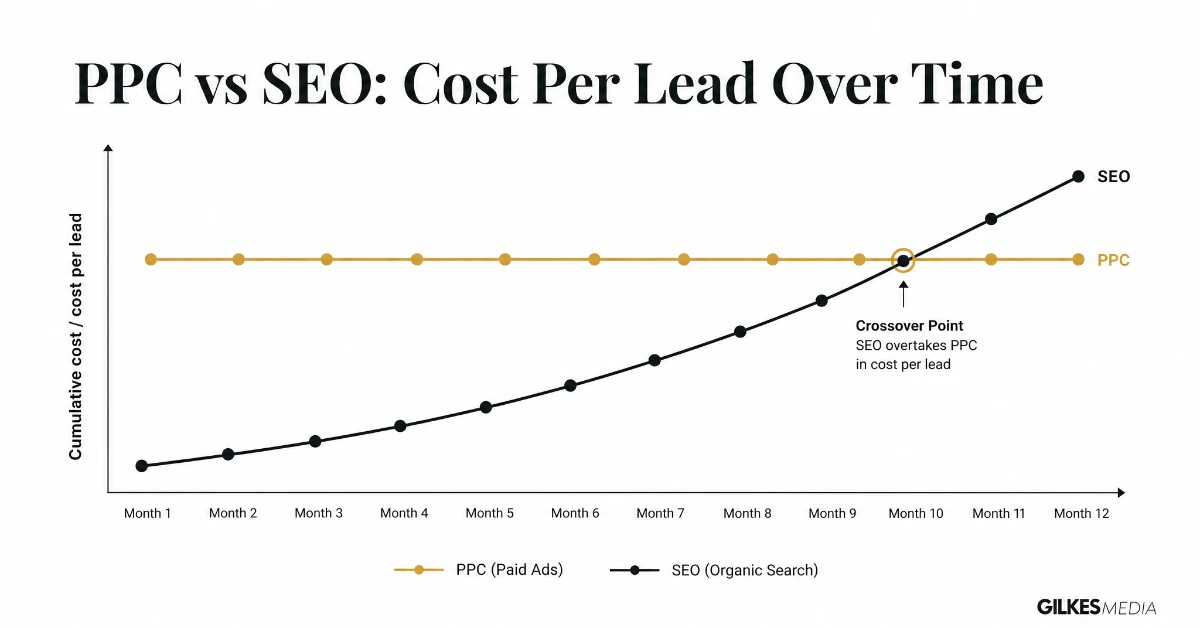
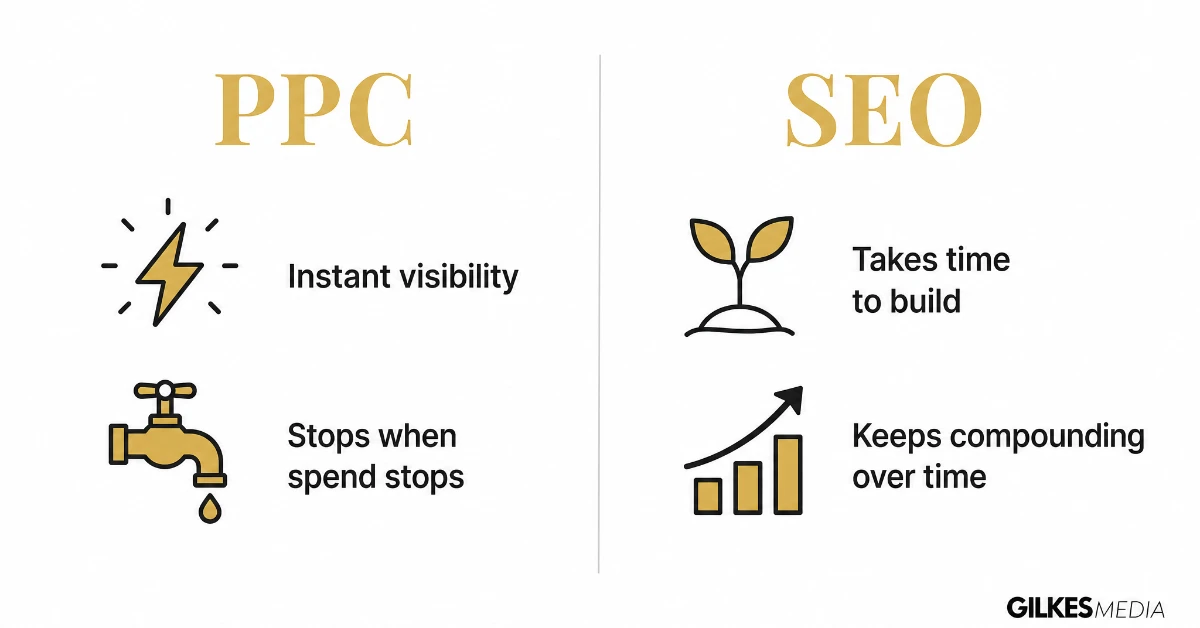
PPC, paid search advertising, gets you visibility immediately. Turn a campaign on today and you can be showing up for your target keywords by this afternoon.
The trade-off is that this visibility lasts exactly as long as you keep paying for it. Stop the campaign and your traffic stops with it, immediately and completely.
SEO works in the opposite direction. It takes time, realistically several months at minimum before meaningful results show up, and it compounds over time rather than switching on instantly.
For a realistic month-by-month breakdown of what that timeline actually looks like, see how long SEO really takes.
But once a page is genuinely ranking well, it keeps generating traffic without an ongoing per-click cost, and that traffic tends to keep building rather than disappearing the moment you stop actively working on it, though it does need ongoing maintenance to hold position against competitors who are also trying to improve.
Neither of these facts makes one option universally better, they make each one suited to different situations, timelines, and budgets.
Businesses new to digital marketing often expect both channels to behave the same way, either both fast or both slow, and are caught out when PPC delivers quick leads that then vanish the moment budget is paused, or when SEO takes months longer to show anything than a PPC campaign would.
You need results now.
If you have a genuine, immediate need for leads, a slow month, a new service launch, a gap left by a client who moved on, PPC is the only one of the two that can realistically deliver in the timeframe you need.
SEO simply cannot be sped up to match this, no matter how much budget you throw at it in a hurry.
You're testing a new offer or market. PPC gives you fast, direct feedback on whether a specific offer, message, or audience actually converts, because you can launch a campaign, gather real data within days, and adjust.
Using SEO to test messaging is slow and expensive by comparison, since you'd be waiting months to learn something PPC can tell you in a week.
Your keywords are highly competitive and you're starting from nothing.
If you're in a market where established competitors have been building SEO authority for years, and you're starting a new site from zero, ranking competitively can take considerably longer than in a less contested space.
PPC lets you compete on the same search results page as those established competitors immediately, while your SEO work builds in the background over the longer term.
You have clear, positive unit economics. If you know your average customer value and can calculate a sensible cost-per-acquisition ceiling, and PPC can deliver leads under that ceiling, it's a straightforwardly good investment regardless of how your SEO is progressing.
This calculation is worth doing properly before committing meaningful budget, and our guide on calculating customer acquisition cost walks through exactly how.

PPC gets you visibility today but it stops the moment you stop paying; SEO takes months to build but keeps generating traffic once a page genuinely ranks. If you need results right now - a slow month, a new launch, a real gap in the pipeline - PPC is the only one of the two that can actually deliver in that timeframe.
You're building for the long term and can afford some patience.
If your business isn't in urgent need of leads this month, and you're thinking in terms of years rather than weeks, SEO's compounding nature makes it the better long-term value, since the traffic it generates doesn't carry an ongoing per-click cost once established.
Your market has clear, valuable, achievable keywords.
If there are specific, meaningful search terms in your market that aren't dominated by huge, deep-pocketed competitors, and that genuinely match commercial intent, that's a strong signal SEO can work well for you without needing years to gain traction.
You want to build an asset, not just rent visibility. This is the honest, structural difference between the two. Money spent on PPC buys visibility for as long as you keep paying.
Money spent on SEO builds a genuine asset, your site's authority and rankings, that continues generating value after the active spend on any individual piece of content has stopped.
If you're thinking about the long-term value of your marketing budget rather than just this quarter's lead flow, this distinction matters.
Your margins can't sustain an indefinite cost-per-click. Some businesses operate on margins where an ongoing, scaling cost-per-click simply doesn't work long-term, even if it's profitable in the short term.
For these businesses, building organic visibility that doesn't carry a direct per-lead cost is a more sustainable long-term structure, even though it demands more patience upfront.
For most businesses with a genuine ongoing marketing budget, the real answer isn't choosing one over the other permanently, it's sequencing them deliberately based on your actual situation right now.
A common, sensible pattern: run PPC to generate leads and test messaging while SEO work builds in the background, then gradually shift budget from paid to organic as SEO starts generating a meaningful share of traffic, using the ongoing savings to either reduce total marketing spend or reinvest in areas that need it.
This isn't a compromise position invented to avoid answering an awkward question with "do both," it reflects how the two channels genuinely complement each other in practice, in a way that's easy to miss if you think of them as competing budget lines rather than as connected parts of the same overall strategy.
PPC data, which keywords and messages actually convert, which pages people land on and bounce from, directly informs your SEO content priorities, so you're not guessing at what to write about, you're building organic content around what your PPC campaigns have already proven converts.
And SEO content, once it starts ranking, reduces your dependency on an ever-scaling PPC budget as your business grows, giving you a genuine hedge against rising cost-per-click in competitive markets over time.

SEO comes first when you can afford patience and there are achievable, valuable keywords in your market not dominated by deep-pocketed competitors. For most businesses the honest answer isn't picking one permanently - it's running PPC to generate leads and test messaging while SEO builds in the background, then gradually shifting the balance.
There's no shortcut here, and anyone offering you a universal rule is skipping the actual work of understanding your business. Ask yourself three honest questions.
A business needing leads this month, with healthy unit economics and a genuinely competitive keyword landscape, should lean toward PPC first, with SEO building steadily in parallel rather than waiting to start.
A business that can afford to be patient, with tighter margins that make an indefinitely scaling PPC budget uncomfortable, and a market with achievable, under-served keywords, should lean toward SEO first, using a smaller, more targeted PPC budget for immediate needs rather than as the primary channel.
It's tempting to want a single number comparing the two, "SEO costs £X, PPC costs £Y," but this comparison only makes sense over a genuine time horizon, since the two have completely different cost curves.
A modest PPC budget of, say, £1,500 a month generates leads roughly in proportion to that spend, month after month, for as long as you keep paying it. Stop paying and the leads stop within days.
A comparable £1,500 a month invested in SEO, content, technical work, and ongoing optimisation, typically generates very little in the first three to six months while the work builds, then starts generating traffic that grows month on month if the work is done well, without that traffic requiring the same ongoing per-lead cost once it's established.
Over a twelve-month period, the total spend might be similar, roughly £18,000 either way.
But the PPC spend has generated a fairly steady, predictable stream of leads throughout, while the SEO spend has generated relatively little in the early months and considerably more by month twelve.
That momentum continues to build in year two without matching first-year costs, since a meaningful share of the ongoing cost by that point is refreshing and defending existing content rather than building everything from scratch again.
Neither pattern is objectively better, they suit different needs. A business that needs predictable, steady lead flow starting immediately should weight this comparison toward PPC.
A business planning multiple years ahead and building toward a lower blended cost per lead over time should weight it toward SEO, accepting a slower start for a better long-term trajectory.

| PPC | SEO | |
|---|---|---|
| Time to results | Days, as soon as campaigns go live | Typically 3–6 months before meaningful traffic builds |
| What happens if you stop paying | Leads stop within days | Traffic keeps working without an ongoing per-lead cost |
| Cost pattern | Steady, predictable spend for a steady stream of leads | Slow start, then compounding growth from the same investment |
| Best for | Immediate pipeline, testing offers, time-sensitive promotions | Long-term, durable visibility that keeps paying off |
There's no universal rule here - the real questions are how urgently you need leads, what your cost-per-acquisition ceiling actually is, and how competitive your specific keywords really are. A straight cost comparison only makes sense over time: PPC generates leads roughly in proportion to spend for as long as you keep paying, while SEO's cost curve works completely differently.
In year one, PPC nearly always looks like better value on a pure cost-per-lead basis, since SEO is still building. By year three, a consistent SEO investment frequently produces a noticeably lower cost per lead than an equivalent PPC spend, because the content and authority built up in years one and two keep generating traffic without additional spend. Judging the two channels only on their first-year numbers misses this entirely.
A quick self-check, before you commit budget either way:
Consider two hypothetical businesses in similar industries with similar budgets, £2,000 a month to invest in generating leads.
The first is a newly launched consultancy with no existing website traffic, a founder who left a full-time role three months ago and needs client work now to cover overheads, and healthy margins on the services being sold.
For this business, PPC is clearly the right starting point: the need for leads is immediate, the margins support a healthy cost-per-acquisition, and there's no existing SEO foundation to build on yet that would generate anything meaningful within the founder's actual runway.
The second is an established business, five years trading, a modest but steady existing client base, comfortable cash flow, and a founder thinking about how to grow sustainably over the next three to five years without proportionally growing marketing spend forever.
For this business, front-loading investment into SEO, with a smaller PPC budget running alongside for immediate needs, makes more sense: the patience is affordable, the existing trading history and case studies give genuine content and credibility to build from, and the long-term aim of reducing dependency on an ever-scaling paid budget fits the stated goal directly.
Same budget, same rough industry, genuinely different right answers, because the actual deciding factors, urgency, margins, existing foundation, and time horizon, were different in each case.
This is exactly why a generic answer to "SEO or PPC" serves neither business well.
Before committing budget, check whether search demand for what you sell already exists, whether you have the resource to manage the channel properly, and whether you're comfortable with what happens to visibility the day you stop paying. Two businesses with the same £2,000 monthly budget can have completely different right answers depending on how urgently they need cash flow versus how much runway they have.
We occasionally see businesses cut PPC entirely the moment SEO starts showing early promise, which is usually premature.
Early SEO gains are genuinely fragile, a single competitor improving their own content or a minor algorithm shift can meaningfully affect early rankings before they've had time to solidify.
Keeping a modest PPC presence running during this transition period protects your lead flow while your organic position matures into something more durable, rather than betting your entire pipeline on rankings that are still finding their footing.
Similarly, we see businesses pour their entire budget into PPC indefinitely without ever investing in SEO, effectively renting all their visibility permanently rather than building any owned asset at all.
For a business planning to operate for years rather than months, this usually represents a genuine missed opportunity to build something that reduces cost over time rather than scaling linearly with lead volume forever.
Treating PPC and SEO as entirely separate budgets misses a genuinely useful dynamic: run well, each channel makes the other one work harder.
Paid search campaigns generate fast, concrete data on which specific keywords and ad copy variations actually convert into enquiries, often within weeks. That same data, which terms genuinely drive commercial results rather than just traffic, is valuable input for prioritising which terms your SEO content should target first, rather than guessing from search volume alone.
A well-optimised landing page built for SEO, with strong relevance and genuine useful content, typically also improves the Quality Score of PPC campaigns pointing to related terms, which can meaningfully lower your cost per click. Businesses running both channels in isolation from each other frequently miss this overlap entirely.
The most common mistake in this decision isn't choosing SEO or PPC first, it's treating the choice as permanent and mutually exclusive, rather than as two channels that can share data and reinforce each other once both are running.
The strongest marketing budgets don't pick a side between SEO and PPC, they use one channel's data to make the other one more efficient.
A handful of avoidable mistakes come up repeatedly when UK businesses are deciding how to split budget between paid and organic search.
Cutting PPC spend entirely as soon as early SEO gains appear can leave a gap in lead volume, since SEO growth is rarely a clean, immediate replacement for paid volume in the short term. A gradual, deliberate shift, reducing PPC spend in proportion to genuine organic gains rather than all at once, protects against a sudden drop in total leads.
Judging an SEO investment against the speed of a PPC campaign is comparing two fundamentally different mechanisms and will almost always disappoint. SEO needs to be judged against its own realistic timeline, not against how quickly PPC can turn on visibility.
For a genuinely short-term, time-limited need, a product launch, a seasonal promotion, an event, PPC alone can make sense. For any business with an ongoing need to generate leads over years rather than weeks, ignoring SEO entirely usually means paying the full cost of visibility indefinitely, with no compounding benefit ever building up.
Often yes, at a modest scale on each. Running a smaller PPC budget alongside a consistent SEO effort, rather than a large PPC spend with no SEO at all, is frequently more sustainable for a small business than an all-or-nothing approach to either channel.
PPC usually delivers a clearer, faster return in the first few months, since it starts generating leads almost immediately. SEO typically needs most of that first year to build genuine momentum, but the businesses that stay consistent usually see the return curve cross over and overtake PPC's cost-per-lead by year two.
Not necessarily, but there is real value in whoever manages them communicating closely, since PPC conversion data genuinely informs SEO priorities and vice versa. A business running both with two completely separate, non-communicating providers often misses that overlap.
The ongoing cost never goes away, and it is fully exposed to rising cost-per-click over time as competition in your market increases. A business with no organic visibility at all is also entirely dependent on one platform's advertising policies and pricing, with no fallback if that platform changes its rules or costs rise sharply.
Once your SEO leading indicators, organic traffic, keyword rankings, and impressions, show consistent month-on-month growth over a few consecutive months, that's a reasonable signal to begin gradually shifting a portion of PPC budget toward reinforcing SEO, rather than waiting for organic to fully replace paid before making any change.
Whichever channel you lead with, the question of who executes it still stands. Our guides to B2B service marketing, hiring a B2B PPC agency, and marketing and sales consulting cover the practical side of building or buying that capability.
There's no universal correct split, and anyone claiming there is one, without asking about your specific market, timeline, and economics first, is giving you a generic answer to a question that genuinely depends on your circumstances.
If you're weighing this up and want a straight, honest recommendation based on your actual business rather than a one-size-fits-all rule, that's exactly the conversation worth having before you commit a budget in either direction.
Get in touch through our contact page for a free discovery call.
We offer both PPC and SEO as core services, so we've no reason to steer you toward one over the other beyond what genuinely suits your situation, and we'll tell you plainly if the honest answer is a split you weren't expecting, rather than pushing whichever service happens to be easier for us to sell you.
Cutting PPC entirely the moment SEO shows early promise is usually premature, since early rankings are fragile and can be knocked back by a competitor or an algorithm shift before they've solidified. There's no universal correct split - the right sequencing genuinely depends on your specific market, timeline and economics, not a generic rule.
It's worth being honest about one more thing that rarely gets said plainly in this debate: the "right" answer genuinely changes as your business changes. A business that correctly chose PPC-first three years ago because it needed leads urgently in a brand new market may well have built up enough stability now to justify shifting meaningfully toward SEO. Revisiting this decision periodically, rather than treating an initial choice as permanent, is part of getting real value from either channel.
The same applies in reverse. A business with a strong, mature SEO position that suddenly needs to launch a new product line or enter a new geography quickly may reasonably lean on PPC again for that specific push, even while its established SEO presence continues generating leads for its core offering in the background. Neither channel should be treated as a permanent, one-time decision.
One more honest consideration worth naming: the quality of execution within each channel matters far more than the channel itself. A poorly run SEO campaign, thin content, no genuine strategy, will underperform a well-run PPC campaign every time, and vice versa. Before deciding which channel to prioritise, it's worth being just as honest about whether you're set up to execute either one properly, since a mediocre effort in the "right" channel will still underdeliver against a genuinely well-run effort in the "wrong" one.
This is also why the cheapest option on paper isn't always the most cost-effective one in practice. A low-cost PPC account left unmanaged, with no ongoing bid optimisation or conversion tracking, routinely wastes a meaningful share of its budget on clicks that were never going to convert. The same is true of a cut-price SEO retainer that produces thin, generic content with no real research behind it. Spending slightly more for genuinely competent execution in either channel usually beats spending less on either one done badly.
If you're weighing this decision right now and want an honest, business-specific view rather than a generic rule of thumb, that's exactly the kind of conversation worth having before committing a year's budget to either channel.
Whichever way you lean, make the decision deliberately, based on your actual cash flow, competition, and patience for compounding results, rather than defaulting to whichever channel a previous agency happened to specialise in. Both channels can genuinely work. The businesses that get the most out of either one are the ones that chose deliberately, executed properly, and kept revisiting the decision as their circumstances changed.
There is no universal winner between SEO and PPC, and any advice claiming otherwise is oversimplifying a decision that genuinely depends on your urgency for leads, your competitive market, your cash flow, and your patience for compounding results. What matters is making that call deliberately, with a clear-eyed view of the trade-offs on both sides, rather than drifting into whichever channel happens to be easiest to start with.
That clear-eyed view, more than any single tactic in either channel, is what separates businesses that get genuinely good value from their marketing budget from those still wondering a year later why the results never quite matched what they expected.
Whatever you decide, revisit it deliberately rather than by default, and treat it as a decision that can and should change as your business does.
Get in touch if you'd like a straight, honest read on which channel makes the most sense for your specific business right now.
