"Should we be on TikTok?" comes up in nearly every B2B marketing conversation now, usually followed by "isn't it just teenagers dancing?" It isn't, not any more, but that doesn't automatically make it the right channel for your business either.
The honest answer is that TikTok can work for specific kinds of B2B businesses, in a specific way, and is a poor fit for most others. This guide covers the real numbers.
That way, you can work out which side of that line you're on.

TikTok reached 26.8 million adult users in the UK by late 2025, around 48% of all UK adults. That number grew by roughly 12.5% in a single year, and it's no longer a niche platform by any reasonable measure.
What it hasn't become is a professional network. The UK ad audience still skews notably female, at roughly 61.5% versus 38.5% male.
The platform's core behaviour remains entertainment and discovery, not deliberate B2B research. That matters for what you should expect from it.
TikTok can build awareness and put your brand in front of decision-makers scrolling on their own time. It isn't a like-for-like replacement for LinkedIn's job-title targeting or Google's captured search intent.
According to DataReportal’s Digital 2026 UK report, TikTok reached 26.8 million UK adults as of late 2025, around 48.4% of the UK’s adult population, with a user base skewed towards women (61.5% of the ad-eligible audience) over men (38.5%). That is genuinely mainstream reach, not a niche youth platform any more, but reach and B2B buying intent are two very different things.
TikTok is genuinely cheap compared with LinkedIn and Google on a per-impression and per-click basis, which is exactly why it gets pitched as an easy win.
| Metric | Typical range |
|---|---|
| CPM (cost per 1,000 impressions) | £1.50 – £4.50 |
| CPC (cost per click) | £0.10 – £0.80 |
| Minimum daily budget (campaign level) | £40 – £50 |
| Minimum daily budget (ad group level) | £15 – £20 |
Nicè B2B targeting pushes these costs up, since fewer users match a tightly defined professional audience. Competition also spikes around Black Friday and into Q4, the same as every other platform.
TikTok has genuinely gone mainstream in the UK, but it hasn't become a professional network. Its core behaviour is still entertainment and discovery, not deliberate B2B research, which is exactly why its low cost per click gets pitched as an easy win it isn't automatically.

A handful of specific situations are where TikTok is worth real, serious consideration rather than a token test budget.
TikTok works well for recruitment-flavoured content because that is genuinely native to the platform. Short videos showing what it is actually like to work somewhere, team culture, and open roles get far more organic reach here than the same content would on LinkedIn. For B2B companies competing for scarce technical talent, this is often TikTok’s strongest use case, separate from lead generation entirely.
A founder or product lead talking directly to camera about a genuine problem they solve, filmed simply rather than produced like a corporate advert, tends to outperform anything polished. TikTok’s algorithm rewards watch time and completion rate over production values, so a rough 45-second demo that holds attention beats a slick 15-second ad that gets skipped.
Once a business has enough website traffic to build a custom audience, TikTok retargeting can be genuinely cheap, often the lowest cost-per-click of any platform for warm visitors. This only works at meaningful volume though: a site with under a few thousand monthly visitors will not build an audience large enough to retarget efficiently.

For most traditional B2B businesses selling a considered, higher-value service to a narrow professional audience, TikTok is not where we'd recommend spending the first, second, or often third pound of paid budget.
TikTok earns a real place in a B2B mix for employer branding, visual or demonstrable products, and founder-led content, and it's usually the wrong bet for anything needing tight job-title targeting or a narrow, senior professional audience.
Enterprise software, professional services and anything with a six-figure contract value and multiple sign-offs does not suit a platform built for quick, dopamine-driven scrolling. Buyers in these categories research on Google, ask peers on LinkedIn, and read comparison content. They are not making purchasing decisions from a TikTok feed, however good the creative is.
Procurement teams, IT directors and public sector buyers are a small, specific audience that TikTok’s targeting simply is not built to isolate reliably. LinkedIn’s job-title and seniority targeting reaches this group with real precision; TikTok’s interest and behaviour-based targeting is a much blunter instrument for the same job.
Anything requiring detailed technical specification, compliance disclosure, or a lengthy explanation to make sense, industrial equipment, regulated financial products, complex B2B software, rarely fits a 15–45 second video format. Simplifying the message enough to work on TikTok often strips out exactly the detail a serious buyer needs to trust the claim.
These platforms aren't really competing for the same job. Our guide on LinkedIn Ads cost in the UK covers the platform built specifically for reaching people by job title and seniority, at a real premium for that precision.
Google Ads captures people already searching for a solution, which is a fundamentally different job from TikTok's discovery-based, pre-intent audience. Neither replaces the other; they answer different questions at different points in a buyer's journey.
A realistic B2B mix treats TikTok as a lower-cost awareness layer, LinkedIn as the precision targeting layer, and Google as the intent-capture layer, rather than expecting any single platform to do all three jobs at once.
In practice, a sensible starting split for a business with a total paid social and search budget of around £3,000–£5,000 a month is roughly 10–15% to a TikTok test, with the rest held in whichever of LinkedIn or Google is already proven to convert. That keeps the test honest without starving the channels already doing the heavy lifting.
Reusing a LinkedIn or Meta ad unchanged. Corporate-style creative that works on LinkedIn typically performs poorly on TikTok, where the format rewards something that looks and feels native to the platform.
Judging it after a tiny test budget. A few hundred pounds over a few days rarely tells you anything reliable about whether the platform genuinely works for your specific audience.
Expecting it to replace an existing channel immediately. TikTok is better tested as an addition to a working LinkedIn or Google strategy, not a wholesale replacement for one that's already producing results.
Ignoring watch time and completion rate. A video that gets scrolled past in the first two seconds tells you far more about whether the creative is working than click-through rate alone.
TikTok, LinkedIn and Google aren't competing for the same job: TikTok is the lower-cost awareness layer, LinkedIn the precision layer, Google the intent-capture layer. Reusing LinkedIn creative unchanged and judging results off a tiny test budget are the two mistakes that sink most B2B tests before they've had a fair run.
The single most common mistake is repurposing a LinkedIn ad, complete with a corporate voiceover and stock B-roll, and dropping it into TikTok unchanged. The platform’s own audience can spot repurposed ad content instantly and scrolls straight past it. Creative genuinely needs to be made for TikTok, not adapted to it.
A budget too small to clear the platform’s learning phase, roughly 50 conversion events per ad set within a week by TikTok’s own guidance, never gives the algorithm enough data to optimise properly. The result looks like TikTok doesn’t work, when really the test was never big enough to produce a signal either way.
For most UK B2B accounts, that means at least £500–£800 a month sustained for six to eight weeks, not a one-off £100 boost on a single video. Anything smaller is closer to noise than a genuine test, and any conclusion drawn from it should be treated as unreliable.
TikTok’s recommendation system was built and tuned around entertainment and product discovery, not B2B research behaviour, and it still optimises that way by default. Campaigns that lean into demonstration, story and personality tend to get more favourable delivery than anything that reads as a straight corporate pitch, regardless of targeting.
A UK B2B software company with a genuinely visual product set aside £800 a month to test TikTok alongside an already-running LinkedIn campaign. They used short, founder-led demo videos rather than repurposed corporate ads.
Direct leads from TikTok itself were modest in the first two months. What did shift was branded search volume and LinkedIn ad engagement from the same target accounts.
This suggested TikTok was doing genuine top-of-funnel work even without producing form fills of its own. Attributing that lift precisely proved difficult, a fair, honest limitation of using TikTok this way.
The lesson was that TikTok's value for this business showed up in other channels' numbers, not in its own lead count, which is exactly the kind of result that needs setting up as an expectation before you start, not after.
TikTok offers several distinct ad formats, and picking the wrong one is a common reason a B2B test underperforms. Each suits a different stage of a campaign, from cold awareness through to capturing a lead directly inside the app.
Spark Ads boost an existing organic post, including one from the brand’s own account or, with permission, a creator’s account, keeping its likes and comments intact. They tend to feel native rather than like advertising, and are usually the strongest starting format for a B2B test because they build on content that has already proven it can hold attention.
Standard in-feed ads run as full-screen video between organic content in the For You feed. They are the most flexible and widely used format, and the right choice for straightforward awareness or traffic campaigns with a single clear call to action, such as visiting a landing page.
These premium placements guarantee the very first thing a user sees when they open the app. They cost significantly more, often requiring a fixed daily spend well beyond a typical B2B test budget, and rarely make sense until a business already has creative proven to perform in standard placements.
TikTok’s native lead generation objective attaches an in-app form directly to an ad, so a prospect never has to leave the platform to submit their details.
Native forms convert at a noticeably higher rate because there is no page load and no context switch, but the leads they produce tend to be lower intent than someone who has clicked through, read a page, and submitted a form there. Which is right depends on whether the priority is lead volume or lead quality, and testing both against the same audience is the only reliable way to know.
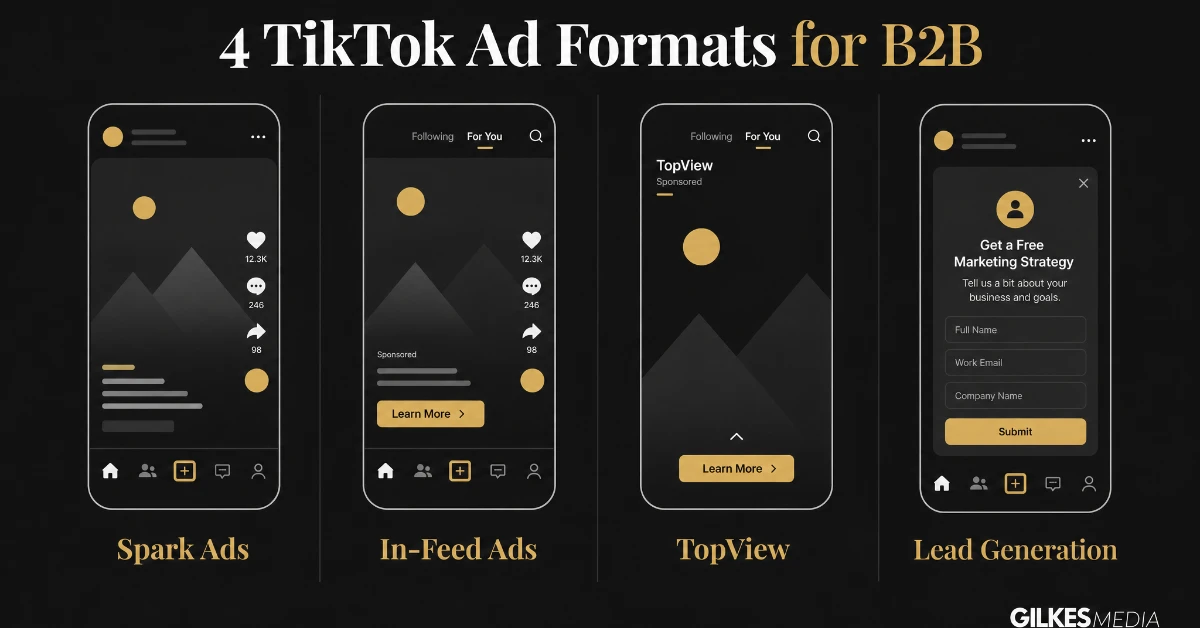
TikTok’s ad formats are not interchangeable. Picking the format that matches the actual goal of the campaign matters more than the creative sitting inside it.
Getting the account structure right before spending a pound matters more on TikTok than on more mature ad platforms, because a badly configured account makes it much harder to read whether a format or an audience is actually working.
TikTok Business Centre sits above the standard Ads Manager and is worth setting up from the start if more than one person will ever touch the account, since it handles permissions and asset sharing properly. Structure the account with one campaign per objective (traffic, lead generation, conversions) rather than mixing objectives inside a single campaign, which makes TikTok’s own optimisation less effective.
The TikTok Pixel needs to sit on the website before any paid traffic arrives, tracking at minimum a page view, a form submission, and, where relevant, a completed booking or purchase event. Without this in place from day one, the account has no way to optimise towards the actions that actually matter, and any early spend is effectively wasted on a test that cannot properly learn.
Interest and behaviour targeting is TikTok’s default and the bluntest option for reaching a professional audience. Custom audiences built from website visitors or a CRM list, and lookalike audiences built from those custom audiences, are considerably more precise and should be the first targeting layer tested, with broad interest targeting reserved for pure top-of-funnel awareness.
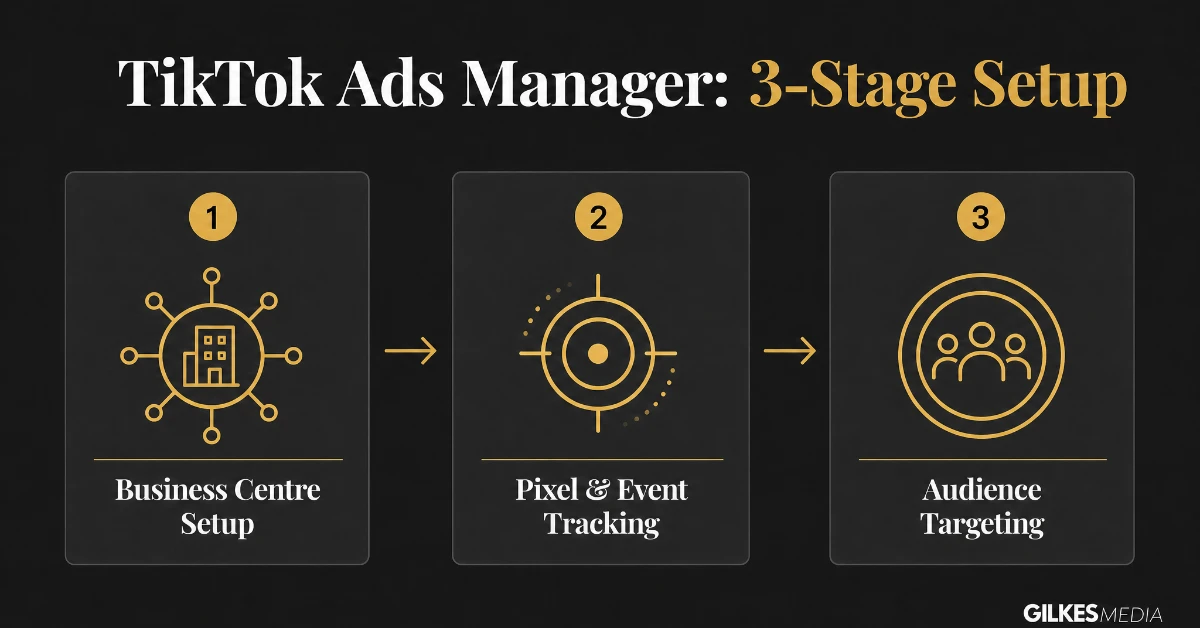
An account set up properly before the first pound is spent is the single biggest predictor of whether a TikTok test produces a usable answer.
The single biggest difference between a TikTok test that produces useful data and one that quietly wastes a budget is the creative itself, not the targeting sitting behind it.
A real person talking directly into the lens, ideally the founder or someone genuinely close to the product, consistently outperforms a polished voiceover over stock footage. It reads as more trustworthy on a platform where authenticity is the whole point, and it costs a fraction of a produced ad to make.
Demonstrating the product or the problem it solves, screen recordings, before-and-after comparisons, a genuine customer result, holds attention far longer than a list of features read aloud. TikTok’s own audience scrolls past anything that feels like a pitch within the first two seconds.
Most TikTok viewing happens with sound off or in public, so burned-in captions aren’t optional. Short on-screen text reinforcing the key point of each scene also helps the algorithm’s own content classification, which in turn affects who the ad gets shown to.
Most successful B2B TikTok ads run 15–30 seconds, considerably shorter than the 60-90 second explainer videos that work well on LinkedIn or a website. The platform rewards a fast hook and a single clear point over a fuller explanation, which takes some unlearning for teams used to longer-form B2B content.
The creative, not the targeting, is usually what separates a TikTok test that produces a real answer from one that just burns budget quietly.
Because TikTok often works indirectly for B2B, boosting brand search and engagement elsewhere rather than filling a lead form itself, judging a test purely on its own last-click conversions is one of the fastest ways to kill a channel that is quietly working.
Watch view-through rate and average watch time first; these tell you whether the creative itself is holding attention before any judgement about targeting or budget is fair. Alongside these, track branded search volume and direct traffic on Google Analytics, and LinkedIn ad engagement from the same target accounts if that campaign is running in parallel.
| Signal | Good sign | Warning sign |
|---|---|---|
| Average watch time | Consistently above 6 seconds on a 15-second ad | Drop-off inside the first 2 seconds |
| Branded search volume | Rising alongside spend | Flat despite weeks of delivery |
| Cost per click | Broadly in line with the £0.10–£0.80 benchmark | Consistently above £1.00 with no improvement |
| Form fills or native leads | Present, even if modest | Zero after a full month at adequate budget |
If watch time and click cost both look healthy but direct leads are slow, that is usually a sign to keep going and let the indirect effects show up in other channels’ numbers over another four to six weeks. If watch time is poor and cost per click keeps climbing even after creative has been refreshed twice, that is the point to stop and redirect the budget rather than keep feeding a format the audience is actively rejecting.
For a specific set of businesses, mainly those selling visually demonstrable products, competing for talent, or building brand awareness alongside an already-working LinkedIn or Google campaign, yes. For long, multi-stakeholder enterprise sales, it is rarely the best use of budget.
Budget at least £500–£800 a month sustained for six to eight weeks for a genuine test, on top of a minimum daily spend of roughly £40–£50 at campaign level and £15–£20 at ad group level.
Enough to clear TikTok’s own learning phase, roughly 50 conversion events per ad set within a week. In practice that is rarely achievable below £500 a month for a B2B account, and smaller budgets tend to produce unreliable, inconclusive results.
Not universally; they work differently. LinkedIn targets by job title and seniority with real precision and suits considered sales cycles. TikTok reaches a much broader audience more cheaply but with far blunter targeting, and suits brand awareness, recruitment and retargeting better than direct lead capture.
Short, founder-led or product-demo video filmed simply, rather than repurposed corporate advertising. TikTok’s own audience notices, and scrolls past, content that looks like a straight ad lifted from another platform.
Only once existing, proven channels like Google and LinkedIn are already running well. TikTok is worth testing as an addition, not a starting point, and works best with a modest, sustained budget rather than a one-off boost.
If you sell a considered, high-value B2B service to a narrow, senior audience and need direct, trackable leads quickly, TikTok is very unlikely to be where we'd suggest starting.
It's an honest no for a lot of businesses, and there's no benefit in pretending otherwise.
If you have genuine video capability, a visual product, or need to build employer brand and awareness alongside a working LinkedIn or Google strategy, a modest test budget is worth considering, judged over months rather than weeks.
If you're not sure which side of that line you sit on, that's exactly the kind of conversation worth having before you commit any spend.
Our paid ads management service covers Google, Meta, LinkedIn and TikTok, and we'll tell you honestly if TikTok is likely to work for your business or not.
Get in touch through our contact page for a free discovery call, and we'll give you a straight, realistic view of whether TikTok deserves a place in your marketing mix.
The worked example is a fair, honest limitation as much as a success story: direct leads were modest, but branded search and LinkedIn engagement moved, work that's genuinely hard to attribute cleanly. For a considered, high-value B2B service needing fast, trackable leads, TikTok is often an honest no, and that's a legitimate answer too.
A mistake that sits underneath several of the ones already covered is treating creative as a one-off cost rather than an ongoing part of the budget. TikTok creative fatigues faster than LinkedIn or Google ad creative, often within two to three weeks at meaningful spend, so a realistic test budget needs to fund a steady stream of new founder-led or product-demo videos, not a single video stretched across months. Businesses that budget for this from the outset tend to get a fairer read on whether the channel works, because a stale ad losing performance and a genuinely unsuitable channel look identical in the numbers if creative refresh was never part of the plan.
TikTok ads in the UK fall under the same ASA and CAP Code rules as any other advertising, including clear rules on claims, comparative advertising, and targeting anyone under 18. The TikTok Pixel also counts as non-essential tracking under UK GDPR, so it needs proper consent through the site’s cookie banner before it fires, exactly as with the Meta or Google pixels. Getting this wrong risks both an ad rejection and a genuine compliance problem, so it is worth a five-minute check before launch rather than an afterthought.
None of this makes TikTok a replacement for Google or LinkedIn in a serious UK B2B strategy, and it should not be sold to a client as one. Treated honestly, as a genuinely cheap awareness and recruitment layer that occasionally surprises you with an indirect lift elsewhere, it earns its modest slice of the budget. Treated as a shortcut to cheap leads, it almost always disappoints, and the businesses that come away disappointed are usually the ones that went in expecting the wrong thing from it.
If you are weighing TikTok against the other three platforms directly, our full comparison of Google Ads vs Meta vs LinkedIn vs TikTok breaks down cost, intent and format differences side by side.
If nothing else, run the test with a genuine end date and a written-down definition of success before the first pound is spent. That single habit, borrowed from good paid-media practice on any platform, does more to stop a TikTok test dragging on indefinitely or being killed too early than any targeting tweak ever will.
That one change, a fixed test window and an agreed definition of success written down in advance, is the cheapest improvement most businesses can make to how they evaluate any new advertising channel, TikTok included.
