
Search has changed shape faster in the last couple of years than in the previous decade.
A growing share of searches on Google now surface an AI Overview, a generated summary sitting above the traditional blue links, often answering the question well enough that the person searching never scrolls down to click anything at all.
Separately, more people are asking ChatGPT, Perplexity, and similar tools questions they'd previously have typed into Google. Both trends mean the same thing for your business: being findable in a traditional search results page is no longer the whole job.
This guide covers what actually influences whether your content gets pulled into an AI Overview or cited by an AI assistant, based on how these systems genuinely work rather than speculation dressed up as certainty, since a lot of what's published on this topic right now is the latter.
Traditional SEO optimises for ranking a page highly enough that a human clicks it.
AI Overviews and LLM-based answer engines work differently: they generate a synthesised answer, often drawing on and citing several sources, and your goal shifts from "rank first" to "get selected as one of the sources the answer draws from and cites."
This is a genuinely different target, and some of what makes a page rank well traditionally doesn't automatically make it a good source for an AI-generated answer, though there's substantial overlap.
The other important shift is that these systems favour content that answers a specific question clearly and directly, in a form that's easy to extract and summarise, over content that requires a human to read the whole page to piece the answer together.
A page stuffed with long, meandering introductions before it gets to the actual answer, still common practice for traditional SEO reasons around word count, is harder for these systems to use cleanly than a page that states the answer plainly near the top and then supports it with detail.
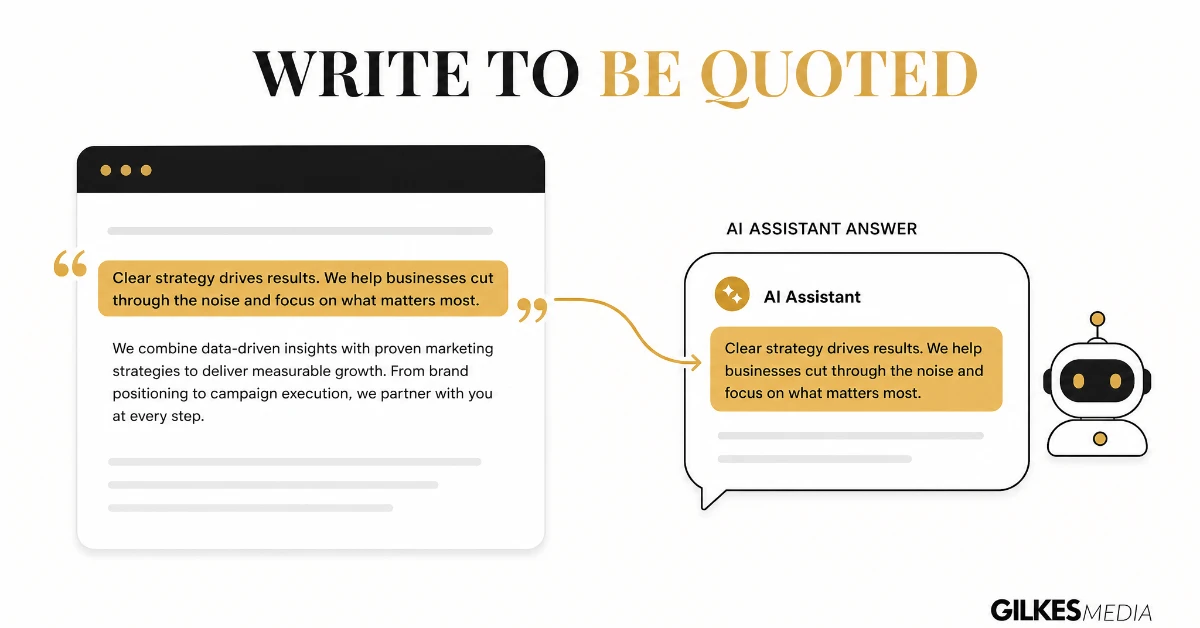
The single most useful mental shift is to write each section so that a sentence or short passage could be lifted directly and used as an accurate, standalone answer.
This doesn't mean abandoning depth or nuance, it means stating your core point clearly before you build out the supporting detail and context, rather than building up to a conclusion at the end of a long section.
Concretely: answer the implied question directly in the first sentence or two of each section, then explain, qualify, and add depth afterward.
A heading like "How much does X cost" should be followed immediately by a real number or range, not three paragraphs of scene-setting before the actual figure appears.
This same discipline, incidentally, tends to improve the experience for human readers too, since most people scanning a page want the direct answer before they decide whether to read the surrounding detail.
The goal shifts from ranking first to being selected as a source an AI answer cites and draws from - a genuinely different target from traditional SEO, even with substantial overlap. Write each section so a sentence could be lifted and used as a standalone answer: state your core point clearly before building out the supporting detail.
Take any paragraph from your existing content and ask: if this sentence alone was read aloud as the answer to a question, would it make sense on its own, without the surrounding context? If not, the point is likely buried too deep in the paragraph to be picked up cleanly by an AI system summarising the page.
AI answer systems are frequently responding to a specific question, "how much does X cost," "what is the difference between X and Y," "is X worth it for a small business."
Content structured explicitly around these specific question-and-answer pairs, using headings that mirror how people actually phrase questions, gives these systems a much easier match between the query and your content than a page organised purely around broad topic headings.
This is part of why FAQ-style sections, and content that uses clear, question-phrased subheadings throughout rather than only vague topic labels, tend to perform well in this new landscape.
It's also worth reviewing your existing content with this lens: a page that covers the right information but buries the direct answers inside dense paragraphs is a good candidate for restructuring, not necessarily rewriting from scratch.

Schema markup, the structured data that explicitly labels what a piece of content is, an FAQ, a how-to, a review, a product, gives search engines and AI systems an unambiguous, machine-readable signal about your content's structure and meaning, removing the need for them to infer it from unstructured text.
As AI systems increasingly parse content programmatically rather than purely as a human would read it, this structured signal becomes, if anything, more valuable than it was for traditional search alone.
FAQ schema on genuine question-and-answer content, HowTo schema on step-by-step guides, and Organization and LocalBusiness schema establishing who you are and what you do, are all worth reviewing and implementing properly if they aren't already in place across your site.
Structure content around specific questions people actually phrase, not broad topic headings, since AI systems are usually answering a precise query and need an easy match. Schema markup matters more than ever here too - it gives an unambiguous, machine-readable signal about what your content is, rather than making the system infer it.
AI systems, particularly ones designed to cite sources, favour content from sites that demonstrate genuine expertise and trustworthiness, the same underlying principle behind Google's long-standing emphasis on experience, expertise, authoritativeness, and trust in its own quality guidelines.
Original data, genuine case studies with real numbers, and first-hand expertise expressed in your own voice, rather than generic, widely duplicated advice that could have come from any of a hundred similar sites, give these systems a stronger reason to treat your content as a worthwhile source to cite rather than one interchangeable option among many nearly identical pages.
This actually raises the bar in a useful way for a business willing to invest in genuinely original content: as more generic, templated content floods the web, distinctive, evidently first-hand expertise stands out more, not less, to systems trying to identify genuinely useful, trustworthy sources.

Because an AI system is effectively vouching for a source when it cites it in a generated answer, these systems have a strong incentive to favour sources that already show clear signals of genuine expertise and trustworthiness, real author attribution, cited data, a track record of being referenced elsewhere, over anonymous or thin content making unverified claims.
It's worth being direct about something a lot of content on this topic gets wrong: AI search optimisation isn't a replacement discipline that supersedes traditional SEO, it's an additional layer on top of the same fundamentals.
Technical crawlability, genuine topical authority built over time, quality backlinks, and solid on-page fundamentals remain the foundation, because AI systems still largely draw on the same underlying web content and ranking signals that traditional search relies on.
A technically broken, thin, or poorly structured site won't suddenly perform well in AI search just because you've added FAQ schema to a few pages.
Treat everything in this guide as additive refinement on top of properly executed fundamentals, covered in our technical SEO audit checklist, not a shortcut that bypasses the need for them.
| Factor | Traditional SEO | AI search optimisation |
|---|---|---|
| Main goal | Rank first so a human clicks the page | Get selected as one of the sources an AI answer cites |
| Content structure | Broad topics, can build up to the answer | Specific questions, answered clearly and directly, early on the page |
| Success measure | Rankings and click-through rate | Citations and mentions inside AI-generated answers |
| Structured data and authority | Helpful | Arguably matter even more than before |
AI systems favour genuinely original data, real case studies with real numbers, and first-hand expertise over generic advice that could have come from any of a hundred similar sites. AI search optimisation isn't a replacement for traditional SEO - technical crawlability, topical authority and quality backlinks remain the foundation everything else sits on.
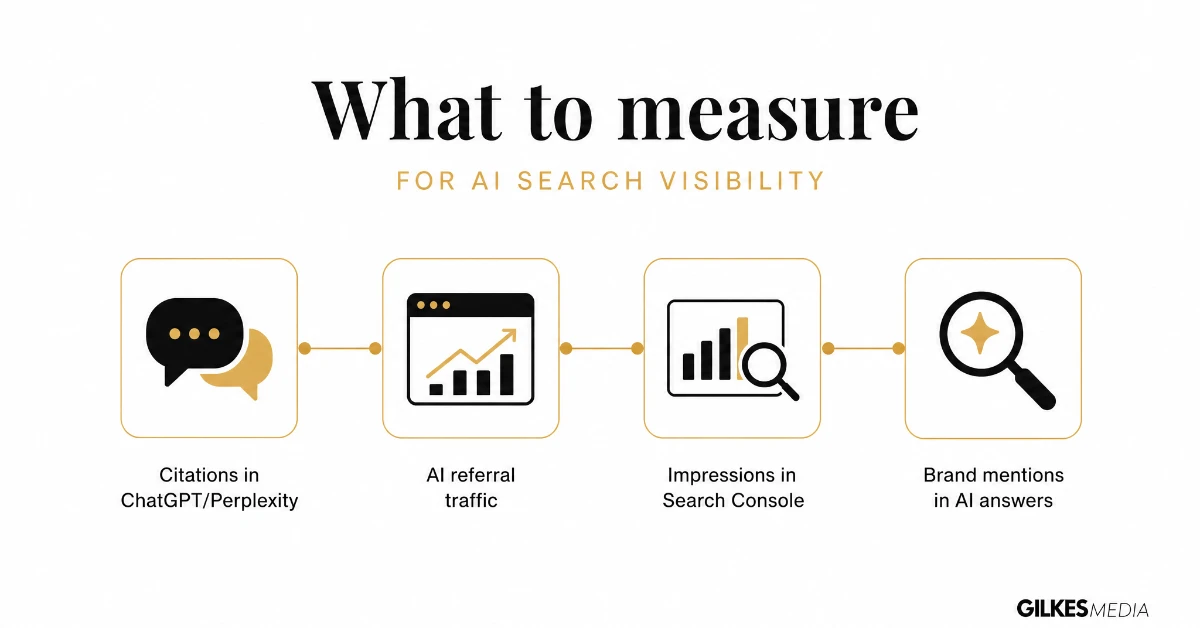
This is genuinely still an evolving area, and the tooling for measuring AI search visibility specifically is less mature than standard rank tracking. That said, a few practical signals are worth tracking now.
None of these give you a clean, definitive dashboard yet, the way keyword rank tracking does for traditional search, and treating early tools in this space with appropriate scepticism is sensible until the measurement landscape matures further.

People typing into ChatGPT or a voice assistant phrase questions differently to how they type into a traditional search box.
Instead of a clipped "web design cost UK," someone asking an AI assistant is more likely to type or say something closer to "how much should I expect to pay for a new business website in the UK."
These longer, more natural, more specific queries have always existed in search data, but they've become a much larger share of how people actually phrase questions to AI systems specifically.
This matters for content planning because it rewards content that genuinely anticipates and answers specific, real-world phrasings of a question, not just the short, high-volume keyword a traditional keyword research tool surfaces.
Writing a section that explicitly addresses "how much should I expect to pay" alongside the more clipped keyword-style heading gives you a better chance of matching how someone actually asked an AI system the question, without sacrificing the traditional keyword targeting that still matters for standard search.
A practical technique: read through your own customer emails, sales call notes, and any recorded discovery calls for the exact phrasing customers use when they ask you these questions themselves.
Weave that natural phrasing into your content directly, rather than relying purely on keyword tool suggestions that tend to normalise everything into shorter, more clipped phrases than people actually use in genuine conversation.
Measurement tooling for AI search visibility is still immature, but tracking whether your brand gets cited in ChatGPT, Perplexity and AI Overviews, plus any AI-referral traffic, is a practical starting point. People phrase questions to an AI assistant more conversationally than they type into a search box, so long-tail, natural-language phrasing matters more than ever.
Before a new page goes live, run it through this short check. It takes a couple of minutes and catches the most common gaps:
Take a hypothetical existing page answering "how long does a website take to build."
A traditional-SEO-first version might open with several paragraphs about the importance of websites and the variables involved before eventually stating, buried in paragraph four, that most builds take six to twelve weeks.
Restructured with AI search in mind, the same page opens with a direct, quotable answer in the first two sentences: a typical small business website takes six to eight weeks from kickoff to launch, while a larger custom build can take three to four months.
Only after that direct answer does the page go on to explain the variables that push the timeline in either direction, the same supporting detail as before, just reordered so the direct answer comes first rather than last.
Nothing about the underlying information changed, the facts, the depth, the expertise are identical.
What changed is the order the ideas are presented in, and that reordering alone measurably improves the odds of the passage being lifted cleanly into a generated answer.
As a genuine side benefit, it also improves the experience for the meaningful share of human readers who came looking for exactly that one number and would otherwise have to hunt for it.
A quick pre-publish check: could a single paragraph be lifted out as a standalone answer, does the page state the answer before the reasoning, and does it reference something specific and checkable rather than vague claims? A traditional-SEO page that buries "most builds take six to twelve weeks" in paragraph four is exactly the pattern worth restructuring - lead with the answer instead.
A word of caution worth stating plainly: chasing this too literally can produce stilted, robotic-sounding content, short, choppy answer sentences stacked mechanically under every heading with no natural voice or personality left in the writing.
That's a real risk, and it produces content that reads poorly for actual humans even if it technically ticks the extraction boxes.
The better target is content that leads with clarity and directness as a writing discipline, the same discipline good journalism and technical writing have always valued, not a mechanical formula applied without judgement.
If a direct-answer-first structure ever fights against genuinely explaining something that needs proper context before the answer makes sense, let the explanation come first.
The goal is content a person would genuinely find well written and useful, that also happens to be structured in a way these newer systems can use cleanly, not content optimised for a machine at the expense of the person actually reading it.
Understanding roughly how these systems decide what to surface makes the practical advice above easier to apply with real intent, rather than as a checklist followed blindly.
Most AI answer engines work in two stages: first retrieving a set of relevant, credible sources for the query, then generating a natural-language answer that draws on and often cites those sources. This means the retrieval stage still behaves a lot like traditional search, relevance, authority, and clear topical match all still matter enormously in getting a page considered as a source in the first place.
Once a page has been retrieved as a candidate source, the generation stage tends to favour content that states its point plainly and can be lifted cleanly, over content that makes the same point through a clever turn of phrase or an extended narrative build-up. This is a genuinely different skill from writing for a human reader who will patiently follow a longer argument, though the two are not mutually exclusive when done well.
Being quotable is not the same as being simplistic. The clearest, most quotable sentence in a section can still sit alongside genuinely detailed, nuanced supporting analysis immediately afterward. The goal is ordering, stating the answer first, then building out the depth, not stripping the depth out entirely.
Being retrieved as a source and being quoted in the answer are two separate hurdles. Traditional SEO fundamentals still clear the first one; clear, quotable writing clears the second.
Rather than treating AI search optimisation as a separate workstream, the most efficient approach folds it directly into the existing content process.
A small number of additions to a standard content brief cover most of what AI search visibility needs: a required direct-answer opening sentence for each major section, a note on which FAQ questions the page should explicitly answer, and a check that appropriate schema markup (FAQ, HowTo, or Article, depending on content type) is applied before publishing.
None of this checklist substitutes for the fundamentals covered earlier in this article, technical health, genuine authority, and relevant, well-researched content. It sits on top of those fundamentals as a small set of additional habits, not as a separate strategy competing with them for resource.
It's too early to say with confidence, but the more likely near-term outcome is that AI-generated answers sit alongside traditional results rather than fully replacing them, at least for queries with genuine commercial or local intent where users still want to compare multiple options directly.
Generally, no. Content written clearly, with direct answers, genuine expertise, and solid structure, tends to perform well both in traditional search and in AI-generated answers. A genuinely separate content stream for AI alone is rarely a good use of a typical UK business's content budget.
No markup guarantees inclusion. Schema markup makes your content easier for these systems to parse and understand correctly, which improves the odds of being considered as a source, but the ultimate decision on what gets cited or surfaced remains outside any individual website's control.
Ask the relevant questions directly in tools like ChatGPT, Perplexity, and Google's AI Overviews and note whether your business or content is cited. It's a manual, imperfect process currently, since dedicated tracking tools for this specific area are still maturing.
It's worth building the good habits, clear direct answers, genuine expertise, solid structure, into content now, since they cost little extra to apply and also benefit traditional search performance. A wholesale strategy pivot purely chasing AI visibility isn't necessary yet for most small businesses.
Done well, no. Leading with a clear, direct answer and then building out supporting depth and nuance afterward tends to improve readability for human visitors too, since it respects a reader's time rather than making them wait for the point.
Rather than trying to overhaul your entire site for this at once, start with your highest-value existing pages, the ones already answering genuine, specific customer questions, and review them against the principles above.
This is exactly the kind of work we do in our SEO service for clients who want to make sure their content works for both traditional search and the newer AI-driven surfaces reshaping how people find answers.
Get in touch through our contact page for a free discovery call, and we'll walk through what's realistic for your specific site.
Chasing this too literally produces stilted, mechanical writing that ticks the extraction boxes but reads badly for actual humans - clarity and directness should stay a writing discipline, not a formula. Start with your highest-value existing pages rather than overhauling the whole site at once, and review each against these principles.
It's also worth watching how quickly this area continues to shift. AI Overviews, ChatGPT search, Perplexity, and Google's own evolving AI features have all changed meaningfully within the space of a year, and the specific mechanics of what gets cited and how will keep evolving. The businesses that stay ahead of this won't be the ones chasing every individual platform update, but the ones with genuinely strong content fundamentals already in place, since those fundamentals have proven remarkably stable across every search algorithm shift so far, including this one.
That consistency is worth holding onto amid a lot of noisy, often contradictory advice about "optimising for AI." Clear writing, genuine expertise, proper structure, and real authority signals have underpinned good SEO for years, and every indication so far is that they underpin good AI search visibility too. Treat AI search optimisation as an extension of doing SEO properly, not as a wholesale replacement for it.
One practical way to prioritise where to start: audit your highest-traffic existing pages first, since improving how an already-authoritative page is structured for AI retrieval tends to show results faster than trying to build brand-new pages from scratch specifically for this purpose. A page that already ranks well and gets genuine organic traffic has already cleared the harder authority bar; restructuring its content to be more directly quotable is a comparatively small, high-impact change.
For a newer or smaller UK business without that established page authority yet, the priority should stay on the fundamentals: build genuine topical authority through consistent, well-researched content over time, and layer in direct-answer structure and schema markup as standard practice from the outset, rather than treating AI visibility as a separate project to tackle only once the basics are in place.
If you want a second pair of eyes on whether your current content is genuinely well positioned for how people are searching now, across traditional search and the newer AI answer engines alike, that's a conversation worth having sooner rather than later, while this shift is still relatively early and the competitive advantage of getting it right first is still real.
It's worth resisting the temptation to treat every new AI-related headline as a reason to overhaul your entire content strategy. Most of what genuinely moves the needle here is a modest, sensible extension of practices that already produce good SEO results: answer questions clearly, structure content so it can be understood at a glance by both a human skimmer and a machine parser, back up claims with genuine, checkable data, and maintain real topical depth rather than thin, generic coverage.
Applied consistently over the coming months, that approach positions a business well regardless of exactly how AI search continues to evolve, since it is fundamentally about communicating clearly and credibly, a standard that has outlasted every previous shift in how search engines work and shows no sign of becoming less relevant with this one.
That is the standard worth building your content programme around, whatever the search landscape looks like a year from now.
Start with your existing highest-performing pages, apply the direct-answer and structure principles above, and keep building genuine authority the way you always should have, and you will be well placed for whatever comes next in how people search.
That patience and consistency, more than any single tactic, is what has always separated genuinely strong search visibility from a short-lived spike.
If you'd rather have that groundwork done properly from the start, we're happy to talk it through.
