
If you serve customers in a specific area, a trade business, a clinic, a firm of accountants, a consultancy that works with local clients, local SEO is probably doing more for your enquiry volume than any other single piece of your marketing, and it's also probably the most neglected.
Most businesses claim their Google Business Profile once, fill in the basics, and never touch it again.
That's a genuine missed opportunity, because the map pack, the block of three local results Google shows above the standard organic listings for local searches, gets a disproportionate share of clicks compared to results further down the page.
This is a practical guide to getting local SEO right, built around what actually moves the needle rather than a generic checklist of things to tick off once and forget.
Standard organic SEO is about ranking a specific page for a specific keyword based largely on content quality and backlinks.
Local SEO, particularly the map pack, is driven by a different set of signals: how complete and accurate your Google Business Profile is, how consistent your business name, address, and phone number are across the web, how many genuine reviews you have and how you respond to them, and how relevant and close your business is to the person searching.
This means a smaller business with a well-optimised, actively managed Google Business Profile can regularly outrank a much larger competitor with a stronger website but a neglected profile, in the specific local searches that actually drive footfall or enquiries.
Local SEO rewards consistent, ongoing effort in ways that are genuinely achievable for a small business, unlike competing for a broad national keyword against agencies with far bigger content budgets.
Complete every field, not just the obvious ones.
Business name exactly as it appears on your signage and paperwork, the correct primary category and any relevant secondary categories, your service area if you don't have a public storefront, opening hours kept genuinely up to date including holidays, and a business description that naturally includes the services and area you serve without reading like a keyword list stuffed together.
Choose your primary category carefully. This single field has an outsized effect on which searches you show up for. A "marketing consultant" listed under a generic "business consultant" category will miss searches specifically for marketing help.
Check what category your closest, best-performing local competitors use as a sense check, and choose the most specific accurate category available rather than the broadest one.
Add photos regularly, not just once at setup. Profiles with recent, genuine photos of the team, premises, and work perform better than static profiles with a handful of stock-style images uploaded years ago and never refreshed.
This doesn't need to be elaborate, a phone photo uploaded monthly of recent work or the team is genuinely enough.
Use Google Posts.
The Posts feature, essentially short updates that appear directly on your profile, is underused by most small businesses and is a straightforward way to signal an active, well-maintained profile while giving searchers a reason to click through for a specific offer, event, or piece of news.
Local SEO runs on different signals to standard organic SEO - Google Business Profile completeness, NAP consistency, review volume and proximity - which is why a smaller, actively managed business can consistently outrank a bigger one. Complete every field on your profile, not just the obvious ones, including accurate categories, service area and up-to-date hours.
NAP stands for name, address, and phone number, and consistency across every place your business is listed online, your website, directories, social profiles, industry listings, is one of the more reliable trust signals for local search.
An inconsistent address format on one directory, "Unit 4" here and "Unit 4a" there, or an old phone number still listed somewhere from years ago, quietly undermines the confidence Google has in your business information.
Run your business name through a search periodically and check the major directories, Google, Bing Places, Apple Maps, Yell, Facebook, and any industry-specific directories relevant to your sector. Fix inconsistencies as you find them.
This is tedious, unglamorous work, and it's exactly the kind of thing that gets skipped by businesses in a hurry, which is partly why doing it properly is a genuine competitive advantage against competitors who haven't bothered.

Review count and average rating are an obvious ranking and trust signal, but two less obvious factors matter almost as much: recency and response.
A profile with fifty reviews all from three years ago signals less current activity than a profile with twenty reviews, several from the last month. A steady, ongoing flow of new reviews matters more than a large historical stockpile.
How you respond matters too, and not just to negative reviews. Responding to positive reviews, briefly and genuinely rather than with a copy-pasted template, shows both Google and potential customers that the business is actively engaged.
Responding to negative reviews calmly and professionally, acknowledging the issue and explaining what you did or will do about it, does more to build trust with someone reading it later than the negative review itself does to damage it.
Never argue publicly with a reviewer, whatever the provocation, since anyone reading the exchange later will judge the business by how it handled the conflict, not by who was technically right.
Build a simple, consistent process for asking happy customers for a review, right after a positive interaction or project completion, rather than an occasional ad hoc request.
This is the single highest-impact habit in local SEO and the one most businesses do least consistently.
NAP consistency - the exact same name, address and phone number everywhere your business is listed - is one of the more reliable trust signals in local search, and small mismatches quietly undermine it. Review recency and how you respond matter almost as much as volume: a steady flow of new reviews signals more current activity than a large pile of old ones.
The businesses with the strongest, most consistent review flow tend to build the ask into an existing process, a follow-up email after a job completes, a QR code on an invoice, a text message a day after service, rather than relying on staff remembering to ask in the moment. A repeatable, low-friction system beats an occasional manual effort every time.
If you serve multiple distinct areas, several towns, several service regions, dedicated local landing pages can help you show up for area-specific searches beyond what your Google Business Profile alone covers.
The mistake to avoid is creating near-identical pages for each location with only the town name swapped, which reads as thin, low-value content to both users and Google and risks looking like deliberate manipulation.
Each local page needs genuinely distinct content: specific to that area's context, mentioning local landmarks or client examples where genuine, addressing anything area-specific about how you serve that location, and ideally including a review or case study from a client in that specific area if you have one.
If you can't write something genuinely distinct and useful for a location, you probably don't need a dedicated page for it, a mention within your main service pages and a well-optimised Google Business Profile service area setting will do the job better than a thin, templated page.

Beyond Google itself, being listed accurately on relevant directories, general ones like Yell and Thomson Local, and industry-specific ones relevant to your sector, contributes to the same trust signals covered under NAP consistency.
This matters less than it did some years ago as Google's own signals have become more sophisticated, but it hasn't disappeared as a factor, and it costs little beyond the time to do it properly.
Prioritise quality and accuracy over quantity, ten accurate, relevant listings do more good than fifty low-quality ones with inconsistent information.
If you serve multiple areas, build genuinely distinct local landing pages rather than near-identical ones with just the town name swapped, which reads as thin and manipulative. Citations on general and industry directories still contribute to the same trust signals as NAP consistency - less than they once did, but not gone.
Adding LocalBusiness schema markup to your website, structured data that explicitly tells search engines your business name, address, hours, and other key details in a format they can read precisely, reinforces the same information found on your Google Business Profile and can help your listing display more richly in search results.
This is a technical addition best implemented properly rather than guessed at, since malformed schema can do more harm than not having it at all.
If you're not sure whether your site currently has this, it's worth checking as part of a broader technical SEO review.

| Local SEO factor | What to do |
|---|---|
| Google Business Profile completeness | Fill in every field, choose the most specific accurate category, and add photos regularly |
| NAP consistency | Keep your name, address and phone number identical everywhere they appear online |
| Reviews | Build genuine volume and recency, and respond to every review, good or bad |
| Local landing pages | Build a proper, genuinely useful page for each area you serve, not a thin duplicate |
| Citations and directory listings | Get listed accurately on the directories that actually matter for your industry |
| Structured data | Add local business schema so search engines understand your business details properly |
Track your visibility in the map pack for your priority search terms, ideally checked from a genuinely local IP address or using a rank tracking tool that simulates local search, since local results vary by the exact location of the person searching in a way standard organic rankings don't.
Track calls, direction requests, and website clicks directly from your Google Business Profile insights, which show a clearer picture of local intent than website analytics alone.
And track review growth rate over time, not just your current total, since a stalled review count is an early warning sign worth addressing before it affects rankings noticeably.
LocalBusiness schema reinforces what's on your Google Business Profile and can help your listing display more richly - but malformed schema can do more harm than none at all, so it's worth implementing properly rather than guessing. Track visibility from a genuinely local IP or a local rank tracker, since map pack results vary by searcher location in a way standard organic rankings don't.
A Business Profile with no new photos, posts, or activity for months signals reduced activity to both Google and prospective customers browsing the listing. Regular, even modest, updates keep the profile looking active and current, which matters both for trust and for the prominence signals discussed earlier.
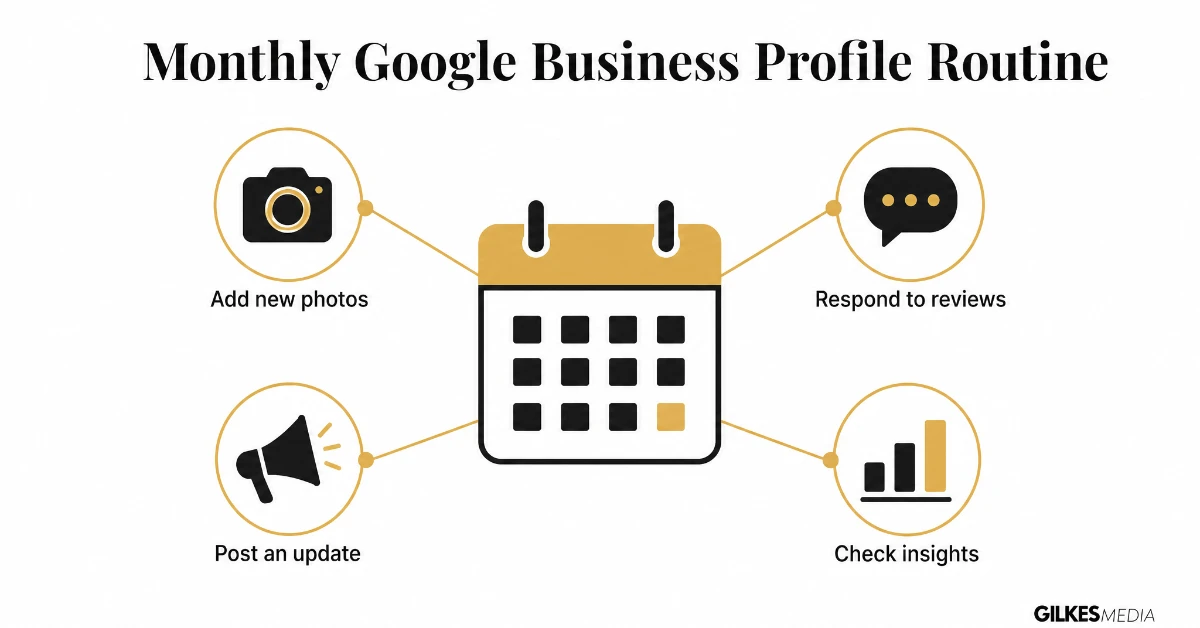
Local SEO rewards consistency more than one big push. A short routine, done monthly, keeps a profile working properly:
Duplicate Google Business Profiles for the same address split your reviews and signals in two, and keyword-stuffing your business name is against Google's guidelines and risky - check for both periodically. Local SEO rewards consistency more than one big push: a short monthly routine of replying to reviews, adding a photo and posting an update keeps a profile working properly.
Consider a small firm of chartered surveyors operating across a UK city and its surrounding towns.
Before any local SEO work, their Google Business Profile had the basics filled in but no photos added in over a year, twelve reviews with three left unanswered, and an inconsistent phone number between their website and their profile, an old number nobody had noticed was still listed.
Over three months of consistent, unglamorous work: fixing the phone number discrepancy across every listing found, responding to every existing review and building a simple process to request reviews after every completed instruction, adding photos of surveys in progress monthly, and posting a short Google Post roughly every two weeks.
No paid advertising, no new website, just consistent profile management.
The result was a genuine increase in map pack visibility for their core service terms across the towns they served, and a corresponding rise in phone enquiries directly attributable to Google Business Profile insights.
None of this required technical expertise or a large budget, it required consistency applied to the right, specific actions rather than treating the profile as a one-off setup task.
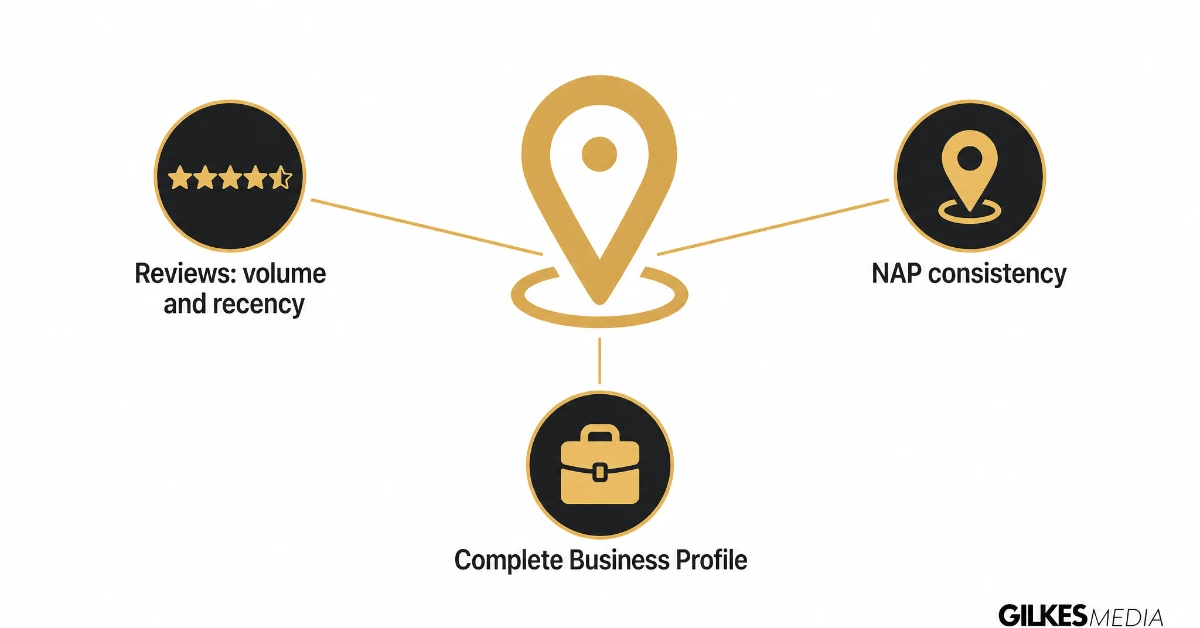
Google has been fairly open about the broad factors behind local map pack rankings, and understanding them helps prioritise effort correctly.
Google groups local ranking factors into three broad categories: relevance (how well your profile matches what the searcher is looking for), distance (how close your business is to the searcher or the location they searched), and prominence (how well-known and well-reviewed your business is, both on Google and more widely). A strong local strategy addresses all three, not just the one that feels easiest to influence.
You cannot change how far your business physically sits from a searcher, but you have real, ongoing control over prominence, reviews, citations, content depth, and general online authority, which is exactly why the bulk of a genuine local SEO strategy focuses there rather than on factors outside your control.
Local results are calculated relative to the searcher's specific location, which is why a business can rank strongly for a term when searched from one part of a city and barely appear at all from another part just a few miles away. This is normal and expected, and it is one reason a single "are we ranking" check from one location gives an incomplete picture.
Local rankings are relevance, distance, and prominence combined. You cannot move your business, but you can absolutely build prominence.
How a business handles a negative review publicly often matters more to future customers reading it than the review itself.
Acknowledge the specific issue raised, avoid a defensive or dismissive tone even when the review feels unfair, and take the detailed resolution offline with a clear invitation to contact the business directly. Future customers reading the exchange are judging how the business handles a problem, not just whether the problem occurred at all.
Google will remove reviews that violate its policies, genuinely fake reviews, reviews containing no actual customer experience, or reviews that are clearly spam or contain inappropriate content, but flagging a review purely because it is negative and factually accurate is unlikely to succeed and can waste time better spent responding constructively instead.
Google Business Profile optimisation can show movement within a few weeks for less competitive terms, since it responds faster than standard organic SEO. More competitive local terms in busy town or city centres typically take a few months of consistent effort, reviews, citations, and content, before meaningful movement appears.
For most local business categories, yes, Google requires a genuine, verifiable physical location or service area to create and maintain a Business Profile. Service-area businesses without a public-facing office can still set up a profile using a service-area configuration rather than a public address, provided they genuinely serve the areas they claim to.
There is no fixed threshold. Consistency and recency of reviews tend to matter more than a large historical total, so a business with a steady, ongoing flow of new reviews each month is typically better positioned than one with many old reviews and no recent activity.
For a business with limited time, a citation-building service can be a reasonable use of budget to ensure consistent NAP data across the major directories. For a business willing to do the manual work, most core citations can be built directly at no cost beyond time, so the real question is which resource, time or budget, is more available.
It is considerably harder. The local map pack, which occupies prominent space for most local searches, draws directly from Google Business Profile data, so a business without a claimed, optimised profile is effectively invisible in that section entirely, regardless of how strong its website's standard SEO is.
Only where there is a genuine, meaningfully distinct audience and content to write for that area. Creating a large number of near-identical pages purely for area names, with no real local distinction, tends to underperform and can risk looking like manipulation to Google rather than genuinely useful local content.
Local SEO isn't a separate discipline from your broader SEO strategy, it's a specific, high-impact layer on top of it for any business with a genuine local or regional customer base.
Our SEO content strategy guide applies just as much to local landing pages as to any other page on your site.
If you're not sure how visible your business actually is in local search right now, or you know it needs work but aren't sure where to start, that's exactly the kind of thing worth a proper look before you spend more time guessing.
Our SEO service covers local SEO as a core part of how we work with businesses that depend on a local or regional customer base.
Get in touch through our contact page for a free discovery call, and we'll take an honest look at your current local visibility and what's realistically achievable for your business.
A firm of chartered surveyors turned a neglected profile - stale photos, unanswered reviews, a mismatched phone number - around with three months of unglamorous, consistent fixes rather than one big overhaul. Local SEO isn't separate from your broader SEO strategy; it's a high-impact layer on top of it for any business with a genuine local customer base.
It is worth saying plainly that local SEO rewards genuine, ongoing operational discipline more than any single clever tactic. A business that consistently asks satisfied customers for reviews, keeps its opening hours and contact details accurate everywhere they appear online, responds to reviews within a day or two, and posts a modest update every few weeks will typically outperform a competitor chasing more elaborate tactics inconsistently.
This is also good news for smaller UK businesses without a large marketing budget, since most of what genuinely moves local rankings costs time and consistency rather than significant spend. A sole trader who dedicates twenty minutes a week to their Business Profile, responding to reviews, adding a photo from a recent job, checking for new duplicate listings, will often outperform a larger competitor who paid for an expensive local SEO package once and then left the profile untouched for a year.
It also pays to think about local SEO alongside the customer experience it reflects, rather than as a separate marketing exercise sitting apart from how the business actually operates. A genuinely good, well-run local business that makes it easy for happy customers to leave a review, keeps its listing accurate, and photographs its actual work will naturally accumulate most of the signals that drive local rankings, almost as a by-product of running the business well. The tactics in this guide are mostly about making sure that natural good performance is properly reflected online, rather than trying to manufacture signals a business hasn't actually earned.
If you're not sure whether your current local SEO position genuinely reflects how well your business actually serves customers, that gap is usually worth closing before spending further budget elsewhere, since local visibility is often the highest-return channel available to a genuinely local UK business.
Get the fundamentals right, an accurate, complete, actively maintained Business Profile, consistent NAP data everywhere, a steady flow of genuine reviews handled well, and the rest of your local visibility tends to follow naturally, without needing to chase every new tactic that gets talked about in an SEO forum.
If your business genuinely serves several distinct towns or regions, it is also worth periodically reviewing whether your current setup, one profile, multiple profiles, dedicated local pages, still matches how the business actually operates. A business that has expanded into new areas since first setting up its Google presence often carries an outdated setup that no longer reflects its real service area, quietly capping visibility in the newer regions it now genuinely serves.
None of this needs to happen all at once. Pick the single biggest gap from this guide, an incomplete profile, inconsistent NAP data, a thin review flow, and fix that first, then work steadily through the rest. Local SEO responds well to steady, consistent maintenance far more than to one intense burst of activity followed by months of neglect.
If you would rather have an experienced set of eyes audit your current local set-up and tell you honestly what is genuinely holding your visibility back, that is exactly the kind of conversation worth having before spending further budget elsewhere.
Local search remains one of the fairest, most winnable areas of SEO for a genuinely good UK business, since the businesses that consistently show up and consistently earn strong reviews tend to be exactly the ones customers actually want to find.
