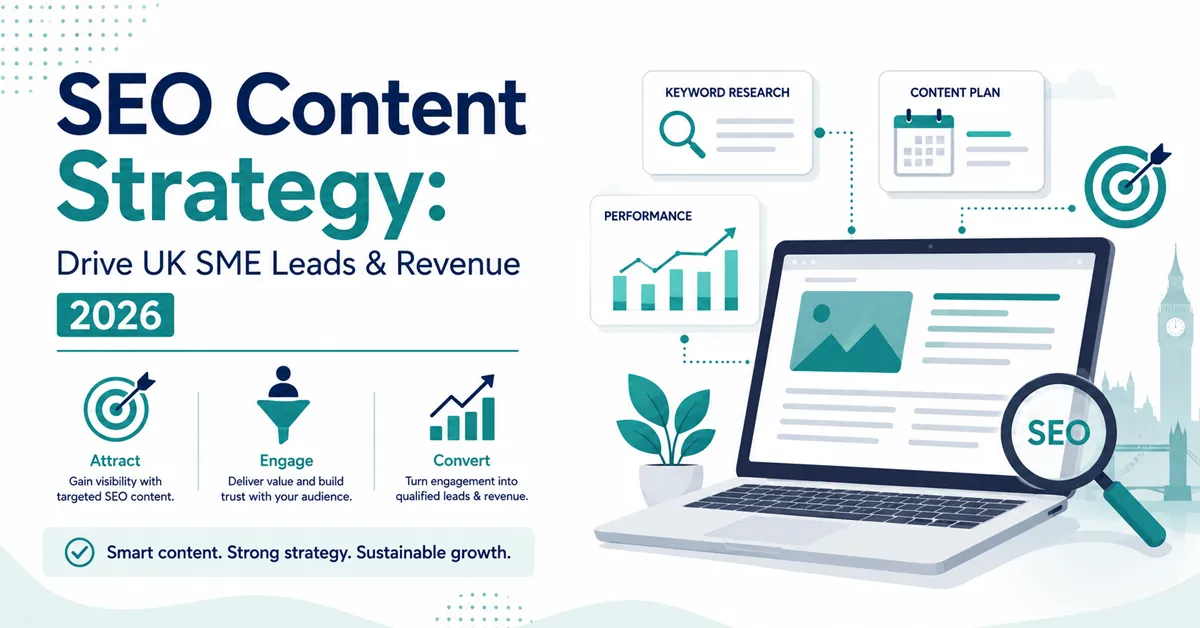
You're probably doing one of two things right now. You're either publishing content that gets polite attention but no enquiries, or you've stopped publishing because the last round felt like a waste of time.
That isn't a writing problem. It's a strategy problem.
A proper SEO content strategy isn't a blog calendar filled with vague ideas. It's a commercial system for attracting the right searchers, moving them towards action, and turning organic visibility into leads. If you run a UK SME, that distinction matters more than ever.
Most SMEs don't fail at content because they lack effort. They fail because they publish disconnected pages with no clear role in the buying journey.
One article covers an industry trend. Another targets a broad keyword. A service page gets written once and then forgotten. Six months later, traffic is patchy, rankings are inconsistent, and sales still come mostly from referrals or outbound. That's normal when content is treated as output rather than infrastructure.
In the UK, organic search isn't a side channel. The UK's internet economy was valued at £222 billion in 2022, and modern SEO teams most commonly rely on on-page SEO, keyword research, internal linking, and content updates, with 91.60%, 87.39%, 87.39%, and 81.51% of surveyed teams reporting use of those methods. That tells you something simple. Winning in search usually comes from disciplined basics, not clever tricks.
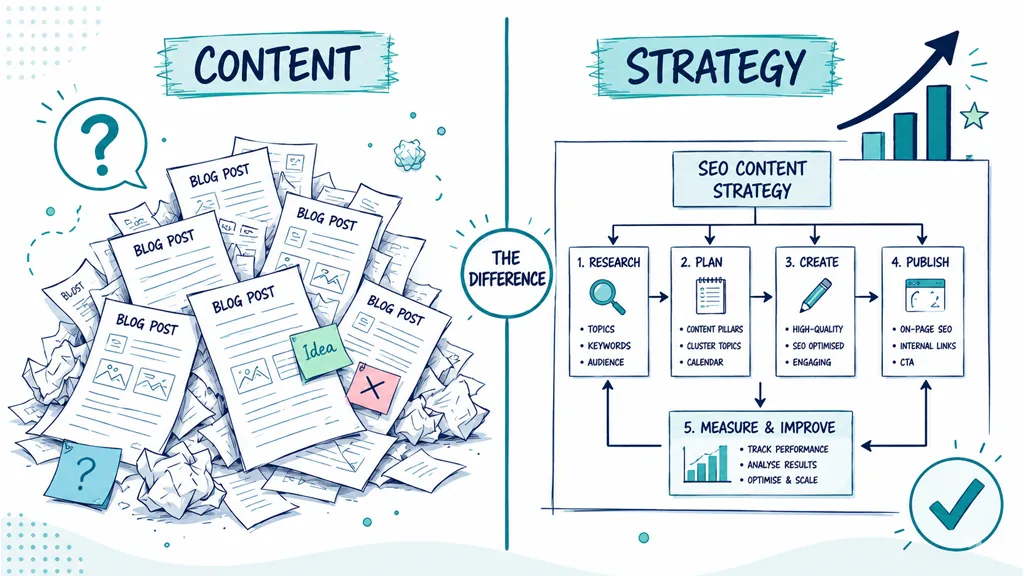
Content is the asset. A page, article, guide, landing page, case study, or video.
Strategy is the decision-making behind it. It answers:
If you can't answer those questions, you don't have a strategy. You have activity.
Practical rule: If a page has no target intent, no internal linking role, and no commercial purpose, it probably shouldn't exist.
A useful SEO content strategy starts with intent, not output targets. Someone searching for a service, a comparison, a cost question, or a local provider is far closer to action than someone skimming a broad educational term.
That doesn't mean informational content is pointless. It means every informational page needs a job. It should support a service page, answer a buying objection, or build trust around a commercial theme. Even formats outside written content can help. If you want a stronger supporting channel, it's worth seeing how brands boost conversions with video marketing when they pair search-led content with better on-page engagement.
A sensible plan also includes your existing pages. Many businesses don't need more content first. They need sharper service pages, better topic coverage, and stronger internal linking. That's why a strategic content marketing approach usually beats another batch of random blogs. A useful starting point is this guide to strategic content marketing for business growth.
The real shift is this. Stop asking, “What should we post next?”
Start asking, “What content do we need to rank, convert, and support revenue?”
That's the difference between content and a content strategy.
The worst way to start an SEO content strategy is with a keyword tool.
Start with money instead.
If you run a UK SME, you don't need vanity traffic. You need enquiries, booked calls, quote requests, and sales opportunities. That's why the first job is to audit what already exists and tie it to commercial outcomes.
The UK market is dominated by smaller firms. UK small businesses accounted for 99.9% of the business population in 2024, which is exactly why efficient lead generation matters more than broad traffic growth. Most SMEs don't have the luxury of publishing for prestige. Every page should earn its place.
A basic audit doesn't need to be complicated. Open your site map, analytics, Google Search Console, and CRM. Then review each important page against four questions.
| Question | What to look for |
|---|---|
| Does this page attract the right visitor? | Search terms, landing page relevance, local intent |
| Does it support a commercial objective? | Enquiry form, call click, quote request, booked consultation |
| Does it fit a buyer stage? | Awareness, comparison, decision, local service intent |
| Does it deserve to stay? | Keep, improve, merge, or remove |
That process usually reveals the same issues.
“Rank higher” isn't a useful goal.
“Generate qualified enquiries from organic search” is. Better still, define the type of lead you want. A legal firm may want consultation requests. A B2B software company may want demo bookings. A local service business may want calls from a defined area.
Good SEO planning starts with the sales target, then works backwards into content.
Use a simple goal framework:
Define the revenue objective
What kind of business result matters most right now?
Identify the highest-value enquiry type
Which actions signal genuine buying intent?
Map content to that action
Which pages should attract, warm up, and convert those prospects?
Cut anything that doesn't contribute
If a topic won't support pipeline, it drops down the list.
A lot of SMEs waste months chasing broad informational keywords because they look exciting in a report. That's usually the wrong move.
If budget and time are tight, focus first on pages that support commercial intent:
Educational content still matters, but it should support those pages rather than replace them.
When reviewing any topic, ask one hard question.
Would you still create this page if rankings were hidden and you could only judge it by lead quality?
If the answer is no, it's probably filler.
That doesn't mean every article should be sales-heavy. It means every page should serve a commercial system. Awareness content should pre-sell. Consideration content should reduce objections. Decision-stage content should make it easy to enquire.
That's what commercial focus looks like in practice.
Most websites don't lack content. They lack architecture.
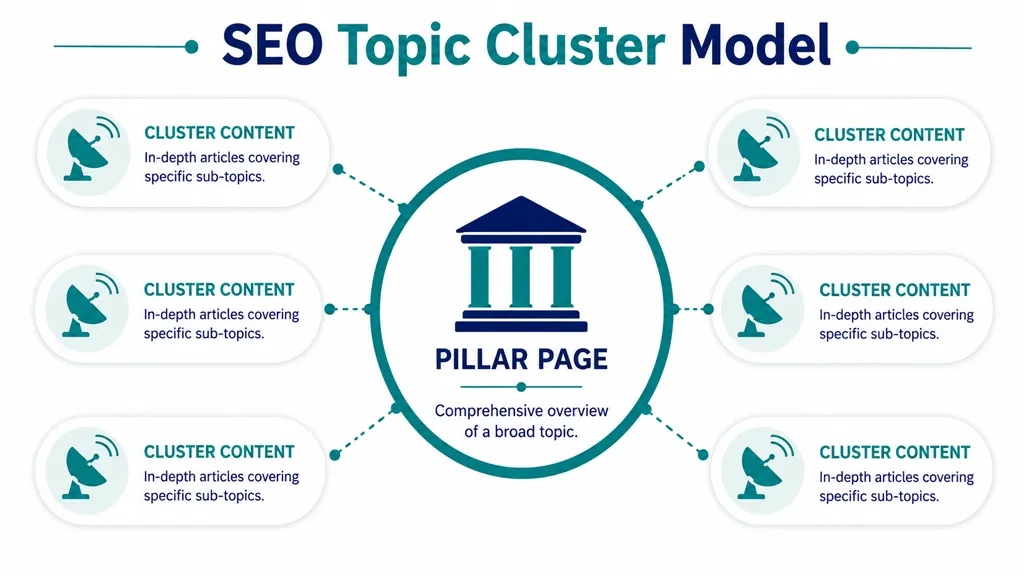
That's why topic clusters work. They organise content around a central commercial page, then use supporting pages to build context, depth, and internal linking. Search engines can understand the relationship between pages more clearly, and buyers get a better journey instead of landing on isolated articles.
A practical UK-focused approach starts with search-intent mapping, then groups keywords into clusters around pillar pages. SEO results typically take 3 - 6 months to begin showing, with fuller impact taking longer, which is why short testing windows give a distorted picture. It also points out a common mistake. Businesses chase broad, competitive terms too early instead of building from lower-competition opportunities first.
Think of a pillar page as the main commercial or strategic page. Usually that's a core service page or a high-value guide.
Then create supporting cluster pages around subtopics, objections, comparisons, and long-tail searches linked to that main theme.
For a UK B2B accountant, the cluster could look like this:
| Pillar page | Supporting cluster content |
|---|---|
| Outsourced finance director services | What an outsourced FD does |
| Outsourced finance director services | In-house FD vs outsourced FD |
| Outsourced finance director services | When a growing company needs finance leadership |
| Outsourced finance director services | Cost considerations for outsourced finance support |
| Outsourced finance director services | Finance reporting mistakes SMEs should fix |
Every supporting page links back to the pillar. The pillar links out to relevant supporting pages. That's the structure.
A lot of businesses do the opposite. They start by trying to rank for the biggest phrase in the market, then wonder why nothing moves.
Start tighter.
Pick one service line, one audience, one problem set, and one cluster. Get the structure right there first. Once that section starts gaining traction, expand into adjacent themes.
A smaller cluster with clean intent will usually outperform a sprawling content library built on guesswork.
Don't publish clusters randomly. Use an order that supports authority.
Start with the pillar page
It needs enough substance to justify internal links and target the main intent.
Add the easiest supporting pages first
Go after lower-competition subtopics with clear relevance.
Fill obvious gaps in buyer knowledge
Include cost, process, timeline, comparison, and local relevance where appropriate.
Review query data weekly
Adjust titles, depth, and linking based on what real search behaviour shows.
Many firms prematurely lose patience. They publish a handful of pages, check rankings too soon, then abandon the plan. That's not strategy. That's impatience.
A strong strategy still fails if production is messy.
Most businesses falter at this point. They know what they should publish, but the execution is inconsistent. One page gets written properly. The next is rushed. Internal links get missed. Titles are vague. Local relevance is weak. Nobody updates anything once it's live.
You need an engine, not occasional effort.
For UK local and regional SEO, the strongest results usually come from location-specific copy combined with credibility signals such as expert citations, reviews, and authoritative in-depth coverage. Google-aligned guidance also puts emphasis on E-E-A-T-style signals and content structures that make page purpose clear.
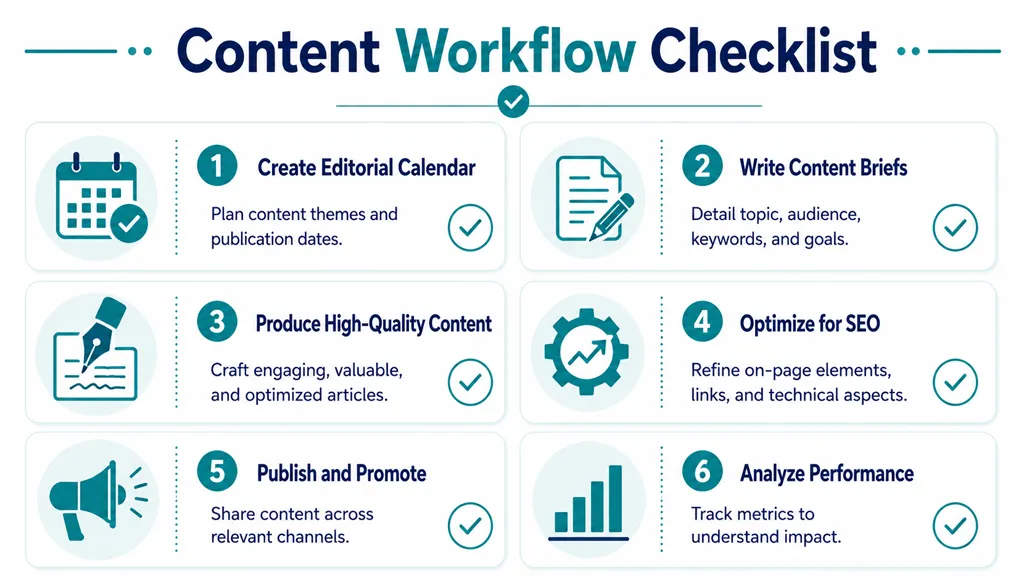
You don't need a bloated editorial department. You need a repeatable workflow.
Plan the month properly
Use a simple editorial calendar in Notion, Trello, or Google Sheets. Assign one primary topic, one target intent, one owner, and one CTA per page.
Write a brief before anyone writes copy
The brief should include the target audience, keyword theme, search intent, internal links, CTA, and the questions the page must answer.
Draft for clarity first
Good SEO copy isn't stuffed with phrases. It answers the query cleanly and moves the reader forward.
Optimise before publishing
Check page title, heading structure, internal links, image alt text, and whether the page supports conversion.
A useful shortlist of platforms for that process includes Google Search Console, Google Analytics, Google Docs, Notion, Trello, and WordPress. If you want a starting stack without spending heavily, these best free SEO tools for SMEs are worth bookmarking.
Forget gimmicks. On-page SEO still comes down to disciplined basics.
Each page should target one primary topic. Not three. Not five. One.
That helps both users and search engines understand the page immediately. Supporting subtopics can sit underneath, but the central purpose must be obvious from the heading, intro, and page structure.
Use the target phrase where it belongs. Title tag, H1, opening copy, subheadings where relevant, and body text where it reads naturally.
Don't force repetition. Buyers notice clumsy copy faster than you think.
Service pages should link to support content. Support content should link back to service pages. If those links don't exist, your cluster is weak no matter how much you publish.
The internal link is often the difference between a page that sits alone and a page that contributes to authority.
For UK service firms, trust signals aren't optional.
A page feels stronger when it includes:
That matters even more on local pages. A generic “we serve London” paragraph won't do much. A page that explains the service, references the area naturally, answers objections, and links to supporting guidance is much more credible.
Even great copy underperforms on a weak site.
If pages load badly on mobile, forms are clunky, layouts are confusing, or service pages are buried in poor navigation, the content has less chance of converting. That's why SEO content and website build quality belong in the same conversation. Search visibility gets the click. Good UX turns the click into an enquiry.
SEO reporting is often full of nonsense.
Businesses get sent ranking graphs, impression curves, and vague visibility updates, but still don't know whether organic search is producing worthwhile leads. That's the wrong way to measure content performance.
The rise of AI Overviews and zero-click search makes this even more important. In the UK, Google handled 93.95% of mobile searches in April 2025 and 89.62% of desktop searches, which means a practical SEO content strategy still has to be built around Google-first visibility.
Rankings matter, but they're not the KPI. The better question is whether your pages are attracting qualified visitors and creating commercial movement.
Use Google Search Console and Google Analytics to build a simple dashboard around:
If your article traffic rises but service-page conversions stay flat, the strategy needs adjusting. If local pages generate calls while blog posts mainly assist, that's fine. Different pages play different roles.
A content strategy should be reviewed regularly, but not chaotically.
Try a simple operating rhythm:
| Review frequency | What to check |
|---|---|
| Weekly | Query changes, click-through issues, page engagement |
| Monthly | Enquiries, lead quality, internal linking gaps |
| Quarterly | Content refreshes, cluster expansion, underperforming pages |
That rhythm stops the usual mistake of either ignoring the data or reacting to it too quickly.
If Google shows your page but searchers don't click, the issue is often the angle, title, or intent match, not the topic itself.
AI-generated summaries mean some informational searches won't send as many clicks as they once did. That doesn't mean informational content is useless. It means you need to be more selective.
Prioritise content that does at least one of these:
In other words, choose pages that can earn attention and support conversion, not just impressions.
If you want a better framework for tying channel performance back to commercial outcomes, this guide on calculating customer acquisition cost is a useful companion read.
Content is only one part of a working SEO strategy. If you're also evaluating outside help, our guides to choosing a B2B SEO service and what to look for in a B2B SEO agency cover the practical side of hiring, and if you're in a regulated or credentials-heavy field, our guide to SEO for professional services firms covers the extra considerations that come with it.
Less than most agencies tell you.
You don't need endless articles. You need enough high-quality content to cover your core services, support them with useful cluster pages, and answer the objections buyers raise before they enquire. For some SMEs, that means tightening existing service pages first. For others, it means building one strong cluster at a time.
Quality, structure, and relevance beat volume.
Yes, if you've got time, commercial judgement, and the discipline to review performance properly.
No, if content keeps getting pushed down the list, nobody owns the strategy, or the site already has structural issues. Many founders start well but then get dragged back into delivery, hiring, and sales. When that happens, content becomes irregular and the strategy loses momentum.
It depends on competition, site strength, and how focused the plan is. As covered earlier, SEO results typically start to show in 3–6 months when the strategy is built properly. That's why random testing for a few weeks is a waste of time.
You should expect gradual traction first, then stronger gains as clusters mature and pages get refined.
Service pages first.
If your core offer pages are weak, no amount of blogging will fix the commercial gap. Once those are solid, use supporting content to build authority, capture related searches, and move visitors towards enquiry.
No. It means lazy content is less important.
Search is getting stricter about what deserves a click. Thin articles written just to target a phrase will struggle. Useful pages with clear intent, authority, and a commercial role still matter.
Yes, especially for SMEs that need both short-term lead flow and long-term visibility.
Paid ads can test intent, offers, and landing page messaging quickly. SEO content builds durable acquisition over time. The two channels work better together than in isolation.
If you want a straight-talking plan for turning search visibility into enquiries, Gilkes Media can help. The consultancy combines SEO strategy, paid ads management, and conversion-focused website design and development, so you're not left with rankings that don't translate into revenue. If your current content feels busy but commercially weak, start with a proper review and build a strategy that effectively supports growth.
Meta title suggestion: SEO Content Strategy for UK SMEs That Drives Leads and Revenue
Meta description suggestion: Learn how to build an SEO content strategy that attracts qualified UK traffic, strengthens authority, and turns organic search into real SME leads.
Suggested internal linking opportunities:
