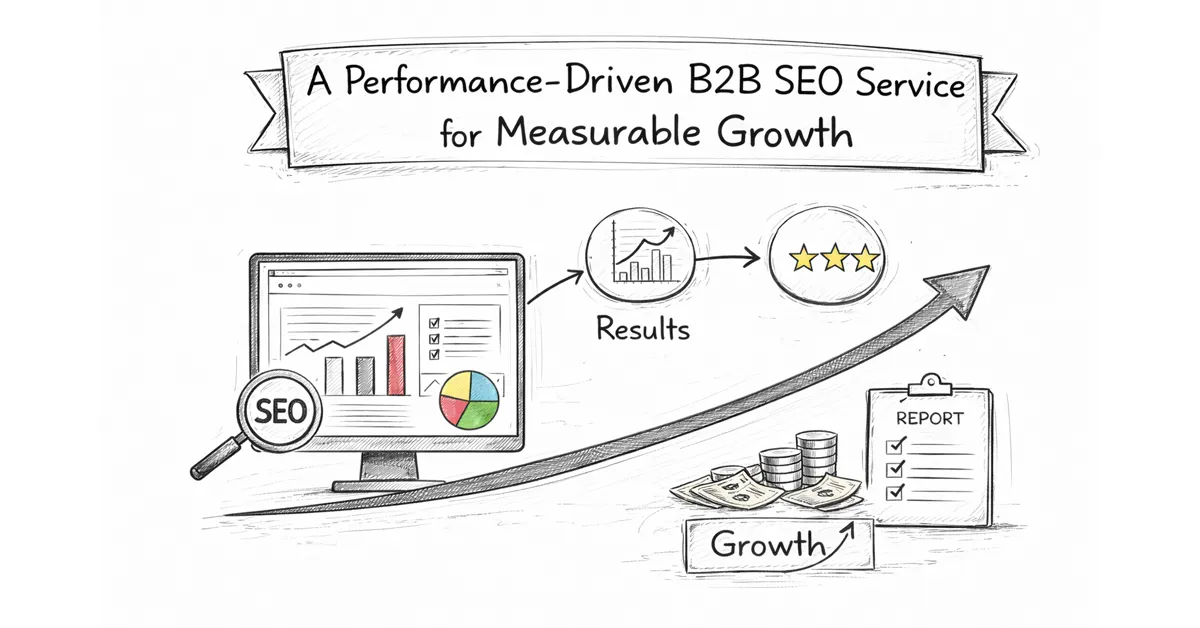
A B2B SEO service is not just another marketing cost; it is a strategic investment in building a predictable, long-term pipeline of qualified leads. Forget paid ads that vanish the moment you stop paying. A well-executed SEO strategy creates a compounding digital asset that attracts high-intent buyers actively looking for solutions just like yours.
In the B2B world, decisions are not made on a whim. They involve long sales cycles, multiple stakeholders, and a serious amount of research. A potential client is not just buying a product; they are investing in a partnership to solve a complex, expensive problem.
This is exactly where a strategic B2B SEO service becomes your most powerful tool for sustainable growth.
While paid advertising offers a quick hit of visibility, it is like renting an audience. SEO, on the other hand, is about building equity. It systematically grows your authority and visibility for the precise terms your ideal customers are typing into Google when they are ready to evaluate solutions.
Too many businesses fall into the trap of chasing quick wins, completely overlooking the profound, long-term impact of organic search. The data is crystal clear: organic search is the dominant force in B2B.
Research shows it generates nearly half (44.6%) of all UK B2B revenue, twice as much as any other channel. Crucially, these leads close at a remarkable 14.6%, compared to just 1.7% for outbound methods like cold calling.
This performance gap exists for one simple reason: SEO connects you with prospects at their point of highest intent. They are not being interrupted; they are actively seeking answers and vetting potential partners on their own terms.
To put this into perspective, let's compare B2B SEO with other common marketing channels.
This table shows why SEO consistently delivers superior business value compared to channels that rely on rented attention.
| Channel | Typical Close Rate | Asset Value |
|---|---|---|
| B2B SEO | 14.6% | High (Compounding) |
| Paid Social | 2-5% | None (Stops when you stop) |
| Cold Outreach | <2% | None (Relies on activity) |
| Display Ads | <1% | None (Brand awareness) |
The numbers do not lie. While other channels have their place, none build a sustainable, high-converting asset quite like SEO.
Think of every piece of optimised content, be it a detailed guide, a case study, or a technical article, as a digital salesperson working for you 24/7. It does not get tired, it does not take holidays, and its effectiveness actually grows over time.
This consistent presence achieves several critical business objectives:
A B2B SEO service shifts your focus from "buying attention" to "earning it." It is the most effective way to ensure that when a committee of decision-makers starts its research, your business is not just an option, but the obvious choice.
Ultimately, a B2B SEO service is the most powerful lever for effective B2B digital marketing lead generation. It is about playing the long game to win bigger, more valuable contracts and secure your position as a leader in your market.
To understand what a high-impact B2B SEO service involves, you must look past the industry jargon and focus on what each part actually does for your business. Think of it like engineering a high-performance vehicle designed for one specific purpose: generating qualified leads.
Each component is critical. If one part fails, the entire system underperforms. A winning strategy smoothly integrates four core pillars, all working together to drive measurable growth.
The diagram below shows how these components build on each other to hit the ultimate goals of filling your sales pipeline and cementing your status as a market leader.
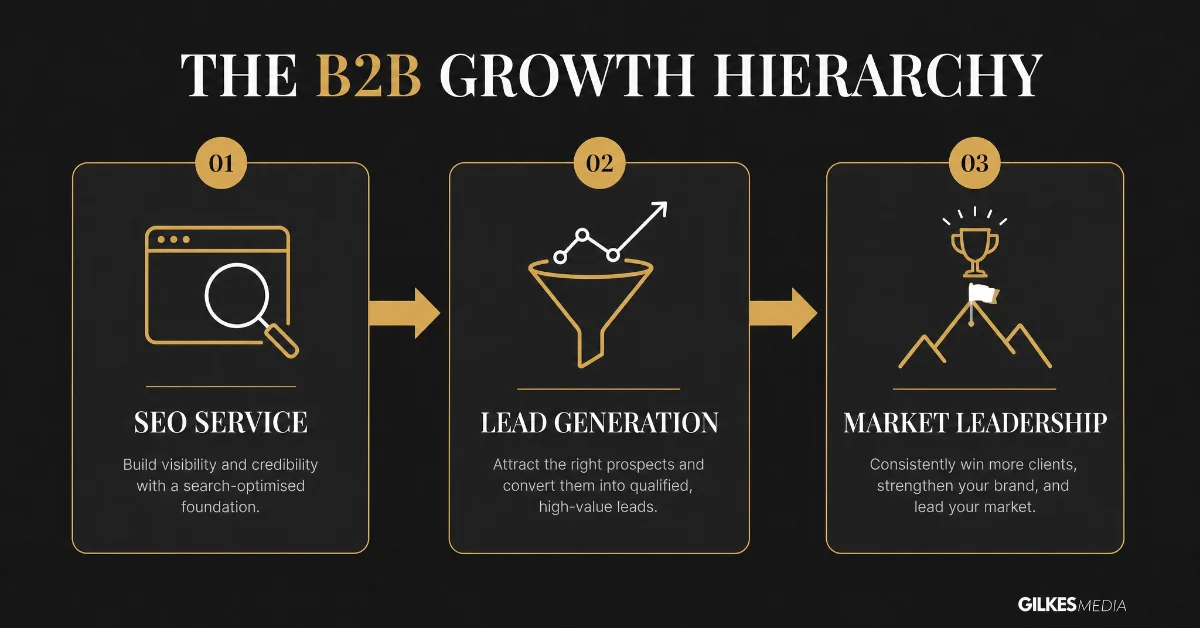
This makes it clear: every single SEO activity should directly support tangible business outcomes, whether that is getting more demos booked or becoming the go-to authority in your space.
Before you can think about winning a race, your vehicle has to be mechanically sound. This is exactly what Technical SEO does for your website. It is the foundational work that ensures your site is fast, secure, accessible, and easily understood by search engines like Google.
This is not about flashy features; it is the non-negotiable groundwork. Key activities include:
Without a strong technical base, even the most brilliant content will fail to rank. It is always the essential first step in any credible SEO campaign.
Once the foundation is solid, On-Page SEO comes in. This is the precision work, focused on optimising individual pages to rank for the specific, high-intent keywords your ideal clients are typing into Google. It is all about aligning your content directly with what your audience is searching for.
This means strategically refining page elements to signal relevance to search engines. You can get into the details in our complete guide to on-page SEO best practices. It covers key tasks like optimising title tags, meta descriptions, headings, and internal linking to create a clear, logical structure that both users and Google love.
Content is the fuel that powers your entire B2B SEO engine. But just churning out blog posts is a waste of time and money. It must be strategic, genuinely valuable, and designed to address the specific pain points of your target audience at every stage of their buying journey.
A successful B2B content strategy is not about volume. It is about creating the right assets that solve genuine problems for your ideal customer, building trust and authority with every article, guide, or case study.
Finally, Off-Page SEO acts as your portfolio of third-party endorsements. The main activity here is earning high-quality backlinks from other reputable and relevant websites in your industry.
Think of each quality backlink as a vote of confidence. It tells search engines that your content is credible and authoritative, which is crucial for competing for the most valuable B2B keywords. This is not about buying links; it is a process that requires strategic outreach and genuine relationship building.
Applying a consumer-focused SEO strategy to a business audience is one of the most common and expensive mistakes a company can make. The game plan for a B2C brand selling trainers is worlds apart from a B2B firm selling enterprise software. Understanding these differences is the first step toward building a strategy that actually drives commercial growth.
B2C SEO is like fishing with a wide net. It is all about high search volumes, emotional triggers, and aiming for a quick, simple sale. The goal is to catch as many individual consumers as you can, as fast as you can.
On the other hand, a B2B SEO service is more like spear fishing. It demands precision, patience, and a deep understanding of a much smaller, more specialised audience. The goal is not just traffic; it is about attracting the right people from the buying committee at the right time.
The biggest difference is who you are talking to. B2C SEO targets one person making a relatively low-stakes personal purchase. The B2B buyer, however, is almost never a single person.
Instead, you are dealing with a complex buying committee, which often includes:
A winning B2B SEO strategy must create content that speaks to the unique needs and headaches of each of these people. It has to justify ROI for the CFO, show efficiency gains for the operations manager, and prove technical compatibility for the IT lead, all within one cohesive strategy.
This difference in audience completely changes your keyword strategy. B2C keywords are often broad, high-volume, and focused on a product (e.g., "best running shoes"). The intent is nearly always to buy something now.
B2B keywords, however, are typically long-tail, have lower search volumes, and are centred on solving complex business problems. A potential client is not just searching for "CRM software"; they are searching for "how to reduce sales team admin time" or "best CRM for financial services compliance".
The heart of a great B2B keyword strategy is targeting the problem, not just the product. This approach gets you in front of high-intent prospects at the very start of their research, letting you shape their understanding of what the solution should look like.
Because the B2B sales cycle can last for months or even years, the purpose of your content is entirely different. B2C content is often designed to create desire and drive an immediate sale. B2B content, in contrast, must educate, build trust, and nurture a relationship over a long period.
This is why certain types of content work so much better in a B2B setting:
The focus is on demonstrating expertise and proving your worth long before a sales call ever happens. This commitment to an educational approach is why so many UK businesses are investing heavily in this area. In fact, 60% now use SEO as a core marketing strategy, with a massive 91% reporting positive impacts on their performance. You can find more insights on these UK SEO trends on LinkQuest. This strategic shift highlights just how critical a well-executed, consultative B2B SEO service really is.
Let's discuss one of the most important parts of this process: the investment. Understanding how B2B SEO services are priced is not just a marketing task; it is a critical business decision. The numbers can feel all over the place, but they almost always reflect the depth of expertise, strategic work, and the resources needed to get real, commercial results.
The goal here is to stop seeing SEO as a line-item cost and start seeing it for what it is: a strategic investment in your future growth engine.
When you start looking for a B2B SEO consultant or agency in the UK, you will generally come across two main ways of working. Each has its place, and the right one for you will depend on your goals, your in-house capabilities, and how mature your digital presence already is. Getting this choice right from the start is key to building a partnership that actually delivers a return.
The most common model for any serious, long-term growth campaign is the monthly retainer. This gives you the consistency needed to build and execute a proper strategy, covering everything from deep-dive technical audits and content creation to link building and performance reporting. It allows your SEO partner to become a true extension of your team, constantly tweaking and improving the plan based on what the data is telling them.
Then you have project-based fees. These are perfect for specific, one-off jobs. Think of it like calling in a specialist for a particular operation. It might be a comprehensive technical site audit to fix foundational problems, a targeted content campaign to support a new product launch, or an initial keyword research and strategy phase to set you on the right path. It is incredibly useful for defined tasks, but it lacks the ongoing optimisation that really drives that powerful, cumulative growth over time.
The right investment is not about finding the cheapest quote. It is about matching the scope of work to your commercial ambitions. A low-cost service that delivers zero leads is infinitely more expensive than a strategic investment that fills your sales pipeline.
To make an informed decision, you need to know what your money actually buys. Pricing for a credible B2B SEO service in the UK will vary based on the provider's experience, how competitive your industry is, and the scope of what needs to be done.
Here is a realistic breakdown of what different monthly retainer investments look like and the level of service you should expect for your money.
This table offers a clear look at how different investment levels usually correspond with the depth of service and strategic involvement you will receive from a UK-based provider.
| Model | Typical Monthly Cost (GBP) | Best For |
|---|---|---|
| Consultancy & Strategy | £2,000 - £3,500 | Businesses with in-house teams needing senior strategic direction, audits, and oversight. Focus is on guidance, not full execution. |
| Full-Service Retainer | £3,500 - £6,000 | Companies seeking a fully managed service, including strategy, content creation, technical SEO, and link building. Ideal for driving significant growth. |
| Aggressive Growth | £6,000+ | Ambitious firms in highly competitive markets aiming for market leadership. Involves extensive content production and proactive authority building. |
Choosing the right level of investment is about aligning the service with your growth targets. It is a strategic decision that dictates the pace and scale of your SEO success.
At Gilkes Media, my focus is on providing direct, hands-on expertise. I do not run a large-scale agency with layers of account managers; instead, I partner directly with you. This ensures every pound you invest is tied to a clear business objective, not lost in overheads. My approach guarantees total accountability and a strategy built entirely around your specific commercial goals. Ultimately, choosing a partner should always be about securing the right expertise to drive the outcomes you need.
Any good partnership starts with clear, honest expectations. When it comes to a B2B SEO service, success is not measured by vanity metrics like raw traffic figures or rankings for keywords that do not convert. True performance is judged by one thing: its direct impact on your sales pipeline.
Let's be blunt. The entire point of investing in SEO is to generate more qualified leads and, ultimately, more revenue. That means we must look past the surface-level data and focus on the key performance indicators (KPIs) that actually matter to your business. To get this right, you have to understand how to measure marketing ROI accurately, which is about connecting activity to commercial outcomes.
This intense focus on business outcomes is why investment in the tools that power these strategies is soaring. In the UK alone, the SEO software market hit a value of £4.6 billion and is expected to more than double by 2030. This is not just a trend; it is a clear signal that businesses demand measurable digital growth.
To ensure your investment in SEO is delivering a real, tangible return, we must track the metrics that connect directly to your commercial goals. These are the numbers that matter to your board, your leadership team, and your sales department.
Here are the primary KPIs a proper B2B SEO service should be measured against:
By tracking these KPIs, the conversation shifts from "how much traffic did we get?" to "how much revenue did SEO generate?" This focus is fundamental to understanding your return. If you want to dig deeper into the mechanics, our guide on how to measure marketing ROI offers some practical frameworks.
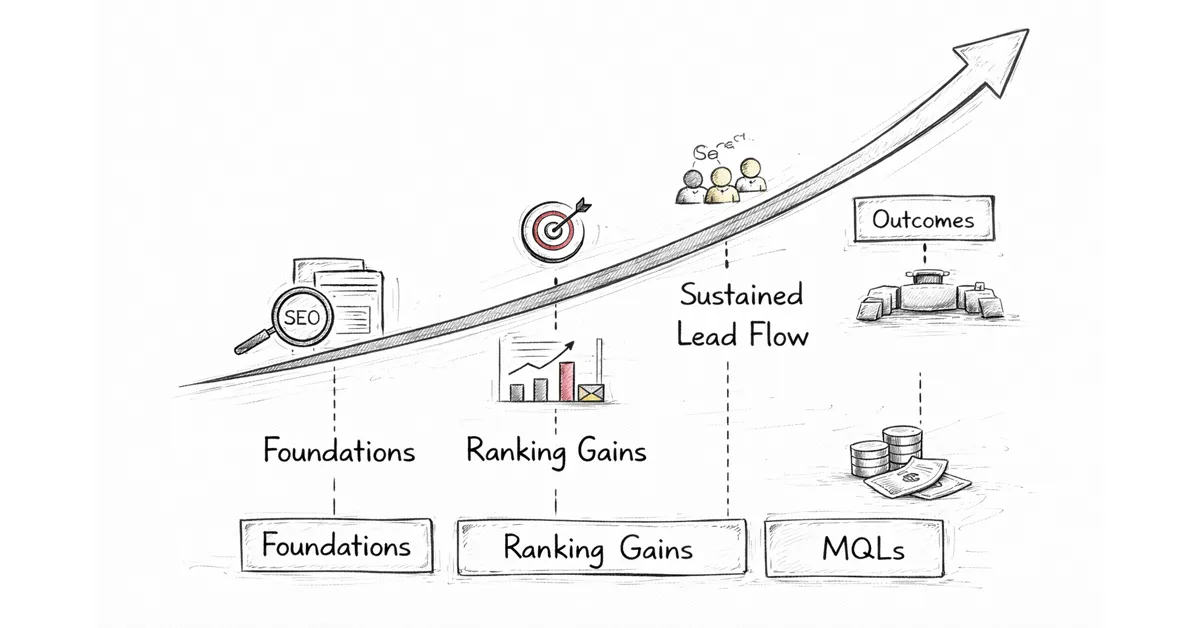
SEO is a marathon, not a sprint. You are building a compounding asset, and that process requires strategic patience. While some technical fixes can deliver quick wins, the real business impact unfolds over a structured timeline. Setting realistic expectations from day one is the only way a long-term partnership succeeds.
Here is a practical breakdown of what you should expect, and when:
Months 1-3: Foundational Work and Initial Audits
The first three months are all about building a solid foundation for growth. This is the most critical phase, where we diagnose the real issues and map out the strategic roadmap.
Months 4-9: Gaining Traction and Initial Rankings
This is where the strategy starts to bear fruit. With the foundations secure, we shift focus to creating high-value content and building your site's authority.
Months 9-12+: Sustained Lead Flow and Authority
By this point, the compounding effect of consistent SEO work becomes undeniable. Your website is now becoming an authoritative voice in your industry, attracting a steady stream of high-intent buyers.
Picking the right partner is the single most important decision you will make for your entire SEO initiative. It is the difference between building a predictable sales pipeline and burning your budget on activities that deliver zero commercial return.
This is not about finding someone to tick boxes from a generic checklist. It is about securing a partner who digs deep into your business, challenges your assumptions, and holds themselves accountable for measurable results. You need an expert who acts as an extension of your team, not just another vendor.
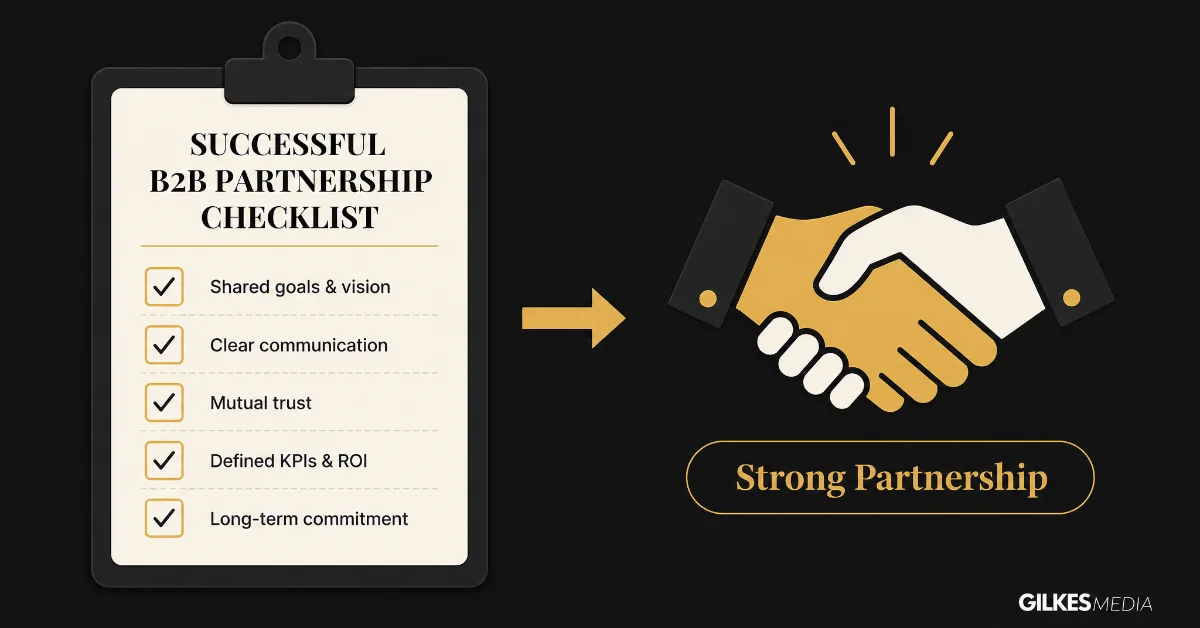
A genuine consultant solves business problems; an order-taker just executes tasks. The first is obsessed with your commercial goals: leads, MQLs, pipeline contribution. The second is obsessed with vanity metrics like traffic and rankings for keywords that do not actually convert.
To tell them apart, you have to ask the right questions. Their answers will reveal their entire approach.
Arm yourself with these questions to cut through the sales pitch and find out what a potential B2B SEO service can actually deliver.
How will you connect your SEO activities directly to our revenue goals?
Their answer must go beyond "increasing traffic." A strong partner will talk about tracking MQLs, pipeline contribution, and the specific conversion points that your sales team cares about. Anything less is a red flag.
Can you show me a case study from a B2B company with a similar sales cycle?
Experience in your sector is vital. They need to prove they understand the complexities of long, multi-stakeholder decision-making. If they cannot, they will be learning on your budget.
Who will be my day-to-day contact and who is doing the strategic work?
Direct access to senior expertise is non-negotiable. With a consultant-led model like Gilkes Media, you work directly with the expert. At larger agencies, your strategy can get lost in translation between junior account managers.
What is your process for keyword research and proving commercial intent?
Listen for a focus on targeting the problems your customers face, not just your product or service names. A great strategy uncovers the long-tail, high-intent questions that signal a buyer is deep in the research phase, ready to find a solution.
A partner's value is not in their ability to rank for a keyword, but in their ability to select the right keyword that drives a profitable customer action. This is the core of a commercially focused B2B SEO service.
Beyond their answers, pay close attention to the quality of their thinking. Do they ask you insightful questions about your business model, ideal customer profile, and sales process? A true partner will be as interested in your operations as they are in your website.
The final choice comes down to trust, transparency, and a shared focus on outcomes. You are not just buying a service; you are investing in a growth engine. Make sure the person you choose has the experience and commercial mindset to build it correctly.
At Gilkes Media, my entire approach is built on this foundation of direct partnership and accountability. To see how this hands-on, strategic model works, explore our digital marketing consultancy services.
Let's cut to the chase. Here are the straight, commercially-focused answers to the questions every business leader asks before investing in professional B2B SEO.
This is always the first question, and rightly so. While you might see small wins from technical fixes early on, real business results follow a predictable curve.
Think of the first 3-6 months as laying the foundations: we are talking deep audits, building a solid strategy, and creating the first wave of pillar content. From months 6-9, you should start seeing the early signals of success, such as ranking improvements and a noticeable uptick in traffic. The real prize, a steady and predictable flow of qualified organic leads, typically starts arriving from month 9 onwards.
The key is to treat SEO as a compounding business asset, not a quick-win tactic. The value you build in year one pays dividends for years to come.
The investment needed for a credible B2B SEO service really depends on the scope and how aggressively you want to grow. As a general guide for the UK market, it breaks down like this:
A quick word of warning: be very sceptical of providers offering services for under £1,500 per month. At that price point, it is virtually impossible to deliver the strategic depth, quality content, and consistent execution needed to make any real commercial impact in a competitive B2B space.
SEO and paid advertising (PPC) are not separate channels; they are two sides of the same coin. When you get them working together, the results are far greater than the sum of their parts.
A strong SEO presence builds long-term authority and organic traffic, gradually reducing your reliance on ad spend. This directly lowers your overall client acquisition cost over time. It is your path to sustainable growth.
Meanwhile, PPC gives you immediate, invaluable data. It tells you exactly which keywords, phrases, and messages are converting right now. We can then feed that intelligence directly into your SEO content strategy, prioritising topics we already know have high commercial intent. It is a powerful feedback loop where each channel makes the other one smarter and more effective.
Ready to build a predictable pipeline of qualified leads with a B2B SEO service that is built around your commercial goals? Gilkes Media provides the senior, hands-on expertise you need to drive measurable growth.
Schedule your free, no-obligation strategy call today at https://gilkesmedia.co.uk.
