
If you're past the basic definition and want to know what digital marketing consultancy actually delivers commercially, this is the ROI-focused version. Below covers the core services involved, the specific outcomes you should hold a consultant accountable for, how engagement models and pricing actually work, and how a proper onboarding checklist protects your first few months.
For the broader picture of what marketing consultancy is and when it fits your business, see our guide on what marketing consultancy involves.
Imagine having a dedicated expert whose sole focus is making sure every pound you spend on marketing is a strategic investment, not just a cost. That is the essence of a digital marketing consultant. Their job is to translate complex channels like paid ads or SEO into real-world commercial outcomes like more leads, higher revenue, and a stronger position in your market.
Unlike a traditional agency that might concentrate on delivering campaigns, a consultant provides the oversight, strategy, and performance management that makes everything work together. It is a hands-on, senior-level partnership built on accountability. We work directly with founders and leadership teams to ensure marketing stops being a cost centre and becomes a powerful engine for growth.
The difference between a consultant and an agency is fundamental. An agency is often built for scale, juggling many clients with account managers as the primary point of contact. A consultant, especially a specialist like Gilkes Media, offers you direct access to the practitioner. This is the person with deep, hands-on experience who is designing your strategy and is accountable for its performance.
This distinction is more important than ever. With the UK's digital advertising market forecast by Grand View Research to more than double by 2030, more business leaders are shifting away from DIY campaigns. They are seeking specialist consultancy to get better efficiency, clearer attribution, and a much stronger ROI from their spend.
To make this clearer, let's break down the key differences.
The table below highlights how the focus and approach differ between a marketing consultant and a typical digital agency. It helps clarify which model is the right fit for your business needs.
| Focus Area | Digital Marketing Consultant | Traditional Digital Agency |
|---|---|---|
| Primary Role | Strategic leadership and oversight | Execution and implementation |
| Main Objective | Align marketing with business goals and drive ROI | Deliver campaigns and tactical outputs |
| Relationship | Strategic partner or external director | Outsourced service provider |
| Accountability | Direct and personal; one person owns the results | Often layered across account managers and teams |
Ultimately, a consultant is the architect who designs the blueprint for growth, while an agency is often the build team that executes it. The most powerful results come when you have a strong strategy guiding the execution.
A consultant’s work centres on the high-impact activities that directly influence your bottom line. This usually includes:
Engaging a digital marketing consultant is about getting a trusted advisor who is as invested in your commercial success as you are. It is about building a solid, predictable, and profitable marketing function you can count on.
Effective digital marketing is not about throwing everything at the wall to see what sticks. It is about mastering the right channels to build a powerful, interconnected growth engine for your business. A consultant’s job is to cut through the noise and focus on the strategic pillars that deliver tangible results: leads, sales, and a genuine return on your investment.
The main goal here is to implement proven strategies to grow your online business. Let’s break down the core services that make this happen, framed not by what they are, but by what they do for your bottom line.
Paid advertising (PPC) on platforms like Google, LinkedIn, and Meta is the fastest way to get your offer in front of qualified buyers. Without expert management, it is also the fastest way to burn through your budget. A specialist consultant treats your ad spend as a direct investment, obsessing over one thing: Return on Ad Spend (ROAS).
This is not about setting up campaigns and hoping for the best. It is a relentless cycle of testing, analysing, and optimising.
To get a better handle on making paid advertising work for you, take a look at our guide on PPC ad services for growing your business exponentially. Real success in paid media comes from a forensic approach to data and a constant drive to push down your cost per acquisition (CPA).
Search Engine Optimisation (SEO) is often mistaken for a dark art of technical tricks. A consultant sees it differently: it is the strategic process of building a valuable, long-term business asset. When your website ranks high on Google for the right commercial keywords, it becomes a predictable, low-cost source of new customers.
Unlike paid ads, where your visibility vanishes the moment you stop paying, the results of good SEO compound over time. It builds authority, trust, and a direct line to customers who are actively searching for what you offer. The focus is on creating a sustainable pipeline of organic traffic that converts.
This map shows how a consultant’s core functions-strategy, oversight, and performance analysis-are the engine behind these services.
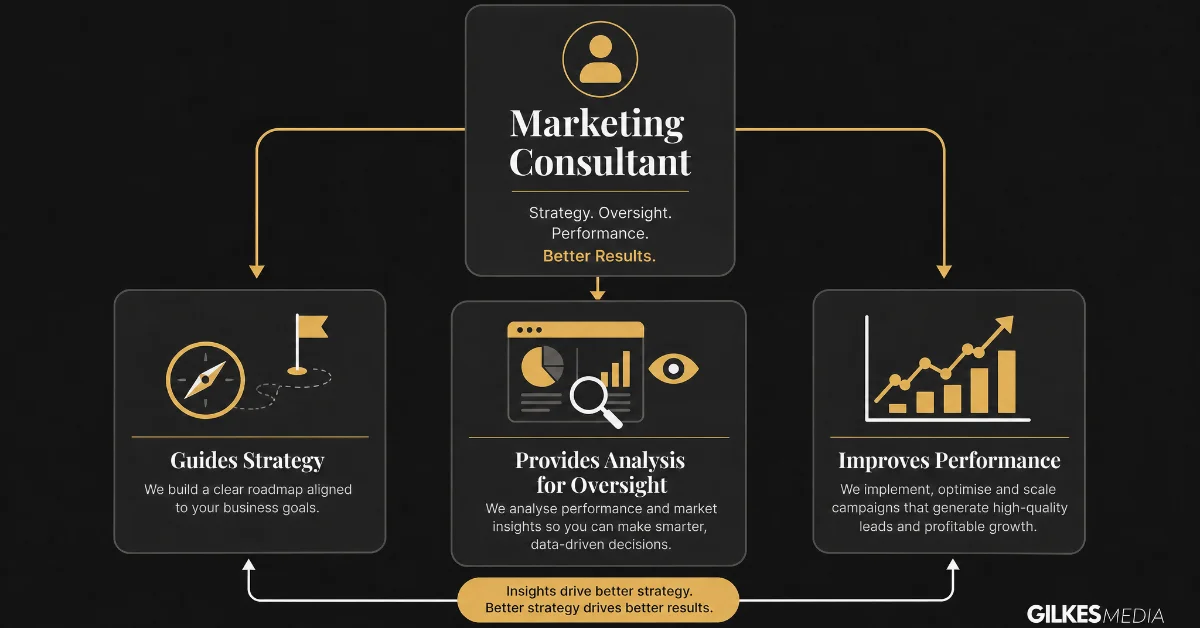
As you can see, a consultant's real value is in pulling these threads together, making sure every activity is measured and squarely aimed at your business goals.
Getting visitors to your website is only half the battle. The real money is made when you turn that traffic into action. Conversion Rate Optimisation (CRO) is the science and art of improving your website to increase the percentage of visitors who do what you want them to do: fill out a form, make a purchase, or book a call.
A consultant uses data, not guesswork. We use tools like heatmaps, session recordings, and A/B testing to see exactly where users are getting stuck, then make evidence-based changes that directly impact your revenue.
Even small tweaks to your conversion rate can lead to a huge uplift in leads and sales, all without spending a single extra penny on acquiring more traffic.
Holding all of this together is a solid framework of strategy and analytics. You could say this is the most critical part of any digital marketing consultancy service. It is the "why" that powers the "what."
A consultant provides the high-level thinking to make sure all your marketing efforts are working in harmony towards the same goals. This involves:
This strategic layer transforms your marketing from a collection of disconnected tactics into a fully integrated system designed for one purpose: to drive real, measurable business growth.
Social media marketing uses platforms such as LinkedIn, Instagram, Facebook and TikTok to build visibility, engagement and demand. It only works when the platform matches your audience and the content supports a genuine business objective. Posting because "we need to stay active" is not a strategy.
For some businesses, particularly founder-led brands and visually strong products, social can drive serious demand. For others, it works better as a supporting channel that reinforces search and referral activity rather than a lead engine in its own right. Part of our job is telling you honestly which camp you're in, rather than selling you a content calendar you don't need.
Content marketing gives buyers useful material that helps them understand their problem and trust your solution. This includes service pages, guides, landing pages, articles, comparison pages and case studies. Good content shortens the path from interest to enquiry, and it strengthens SEO, sales conversations and remarketing at the same time.
The mistake most businesses make is publishing content with no clear commercial job to do. Every piece we recommend earns its place by supporting either search visibility, a specific stage of the buying journey, or your sales team's follow-up conversations.
Email marketing keeps you in front of prospects and customers you've already earned. It's one of the simplest ways to recover value from existing traffic. If someone downloaded a guide, requested pricing, abandoned an enquiry, or bought from you once before, email gives you a direct route back into that conversation.
It's also where we see the easiest wins go missing. Many businesses spend heavily to generate leads, then fail to follow up with them properly. Fixing that is often cheaper and faster than any new campaign.
Marketing is only worth doing if it makes the business money. It is that simple. When you bring in a digital marketing consultant, you are not paying for clicks, impressions, or fluffy reports. You are paying for a measurable impact on your bottom line. The entire point of the partnership is to turn marketing activity into cold, hard cash.
This means shifting the conversation away from surface-level metrics and focusing on the numbers that actually matter to you as a business owner. A good consultant holds themselves accountable for these outcomes. Every campaign, every piece of content, and every pound spent on ads has to justify itself with the financial results it brings in.
The first thing you should notice is more enquiries hitting your inbox. A well-run paid ads campaign or a smart SEO strategy will directly lead to more demo requests, quote forms, and phone calls. But volume is only half the story. The real magic is in the quality of those leads.
A specialist consultant does not just cast a wide net; they refine your targeting and messaging to attract prospects who are a perfect fit for what you sell. This means your sales team stops wasting time filtering out tyre-kickers and starts spending their days closing deals with genuinely interested buyers.
Think about the difference:
Beyond bringing in new business, a consultant's job is to make every pound you spend work harder. This comes down to two critical numbers: Cost Per Acquisition (CPA) and Return on Investment (ROI). Their goal is to systematically push your CPA down while driving your ROI up.
This is not guesswork; it is relentless optimisation. By digging into the performance data, a consultant can see what is working and what is not. They will reallocate budget away from underperforming channels and double down on the winners. That could mean refining your Google Ads keywords to cut out wasteful spending or tweaking a landing page to improve its conversion rate, making your existing traffic instantly more valuable. Our guide on how to measure marketing ROI breaks this down in more detail.
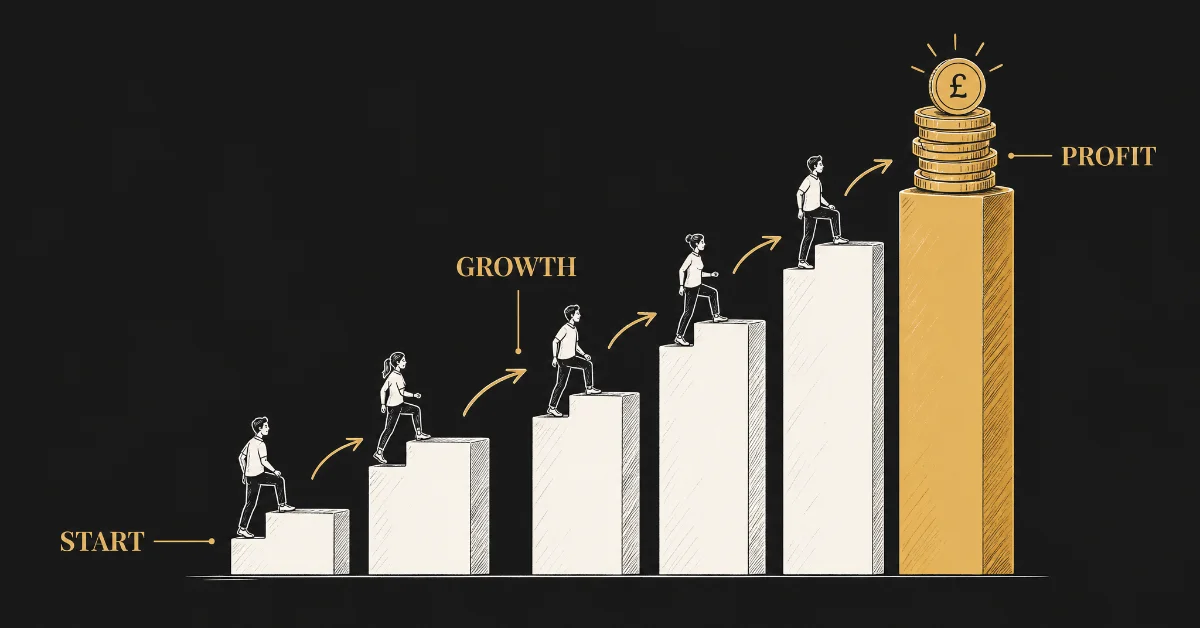
For UK SMEs, this is most obvious where lead generation meets paid media. With 67% of UK B2B marketers calling PPC “crucial” for generating leads, having an expert at the helm is essential to stand out in competitive sectors like tech, finance, and professional services.
Ultimately, the most important outcome is creating a predictable and scalable revenue engine. Random acts of marketing get you random, inconsistent results. A strategic, data-led approach builds a system you can actually rely on for sustainable growth.
A consultant’s role is to transform your marketing from an unpredictable expense into a reliable investment. You should be able to forecast that for every £1,000 invested in a specific channel, you can expect to generate £5,000 in new business.
This level of predictability gives you the confidence to invest in scaling the business, knowing your marketing is directly fuelling that expansion. The table below shows the kind of shift you should expect to see.
| Metric | Typical Starting Point | Expected Outcome with Consultancy |
|---|---|---|
| Lead Quality | Low; many unqualified enquiries | High; leads are pre-vetted and sales-ready |
| Cost Per Acquisition | High and unpredictable | Lowered and stabilised |
| Return on Investment | Unknown or inconsistent | Measurable and consistently positive |
In the end, working with a digital marketing consultant is all about achieving commercial clarity. It is about knowing exactly how your investment is performing and seeing a direct, positive impact on your company's sales and profit.
Not every business should buy the same stack. The right mix depends on your stage, your sales model, and how quickly you need results.
A startup usually has one urgent problem: proving demand before it burns time and budget building a full marketing operation. The smartest starting stack is usually:
If you're early-stage, don't start with broad brand activity unless your funding position allows it. You need signal first: which audience responds, which message lands, and which offer creates action. Paid media gives you that fastest.
An established SME often has a different issue. The business already sells, but lead flow is inconsistent, referrals dominate, and growth stalls whenever the pipeline goes quiet. The better starting stack is:
This combination works because it balances speed and sustainability. PPC fills the short-term gap while SEO and content reduce your dependence on paid channels over time. Most SMEs don't need more channel variety, they need tighter execution across fewer channels. If your team is small and your follow-up process isn't watertight, adding more channels usually creates more leakage, not more revenue.
Professional services firms face a trust problem before they face a traffic problem. Buyers need confidence in your expertise, relevance and credibility before they'll make contact. The strongest starting stack is usually LinkedIn-led visibility, high-authority content such as insight articles and sector-specific guides, and search campaigns aimed at high-intent enquiries.
This is especially true for firms selling advisory, legal, financial, technical or specialist B2B services. Buyers want proof that you understand their context. Generic content and broad social posting won't get you there.
For professional services, the best marketing often feels like useful expertise rather than advertising.
If you're stuck, decide based on three filters:
| Business situation | Start with | Why |
|---|---|---|
| Need leads quickly | PPC | Fastest route to demand and testing |
| Need steady inbound over time | SEO and content | Builds compounding visibility |
| Need authority and trust | Content and LinkedIn | Supports credibility before enquiry |
That's usually enough to make the first decision.
Picking the right strategic partner is one of the biggest decisions you will make for your business. The right consultant becomes an engine for growth; the wrong one leads to wasted budgets and missed opportunities. It is vital to look past the sales pitch and evaluate potential partners with a sharp commercial eye.
The UK digital agency market is crowded, yet many businesses still cannot find the support they need. A recent industry report found that while thousands of agencies operate in the UK, only 56% of businesses were actually satisfied with their digital strategy's performance. You can read the full report on UK digital marketing performance statistics.
This tells a clear story: there is a huge gap between activity and results. Vetting your partners properly has never been more important. A great partnership is not built on promises. It is built on a specific blend of expertise, approach, and genuine commercial alignment.
First things first: find out who will actually be doing the work. Many agencies wheel out their senior strategists during the sales process, only to pass your account to a junior account manager the moment a contract is signed. It is a classic bait-and-switch, and it is a disaster for results.
When you are evaluating a consultancy like Gilkes Media, you are talking directly to the practitioner. You need to ask any potential partner some direct questions:
This is not about ego; it is about accountability. When one senior expert is directly responsible for your results, the focus stays sharp, communication is crystal clear, and the strategy is executed by a professional, not delegated to an apprentice.
Too many marketers get lost in vanity metrics like clicks, impressions, and website traffic. While these numbers have their place, they do not pay the bills. Your consultant should be obsessed with the figures that directly impact your bottom line.
Your conversations should centre on business outcomes, not marketing jargon. A true partner talks less about click-through rates and more about your Cost Per Qualified Lead, Return On Ad Spend (ROAS), and the total lifetime value of a new customer.
Before you sign anything, check that the consultant properly understands your commercial objectives and can translate them into a measurable marketing plan. They must be able to build a logical framework connecting their proposed activities directly to your revenue goals. If they cannot explain how their work will make you money in simple terms, walk away.
Finally, expertise is useless without a strong working relationship. You need a partner you can trust, who communicates clearly, and who operates with total transparency. Steer clear of consultants who hide behind complex terminology or vague reports.
A good cultural fit means finding a partner who:
This is the bedrock of any successful long-term partnership. By prioritising hands-on expertise, a commercial focus, and a strong cultural fit, you can confidently choose a consultant who will act as a genuine partner in your growth.
Let's talk about the money side of things. Getting this clear from the start is non-negotiable for a healthy partnership. Once you understand how consultants structure their fees, you can walk into any conversation with confidence, ready to find a model that fits your budget and your goals.
A transparent financial agreement is the bedrock of a good relationship. It means we are both focused on the same thing from day one: getting you tangible, commercially valuable results.
Here is a breakdown of the most common models you will come across.
This is the simplest way to engage a consultant. You agree on a fixed price for a specific, well-defined piece of work. It is perfect for one-off strategic jobs where the scope and the finish line are crystal clear from the outset.
Examples of project-based work often include:
The big win here is cost certainty. You know exactly what you are paying and what you are getting, which makes budgeting a breeze. The key is to make sure the scope of work is nailed down in meticulous detail to avoid any confusion later on.
For ongoing work like managing ad campaigns or driving a sustained SEO effort, a monthly retainer is the standard. This model is built for services where consistent, expert attention is what gets you the results. It is not a set-and-forget deal.
A retainer is not just about paying for hours. It is about securing ongoing access to senior expertise, strategic oversight, and proactive management that keeps your marketing engine running and improving, month after month.
At Gilkes Media, our retainers for services like paid ads management are designed to give you continuous, hands-on support. We are always in your account, refining campaigns to push down your cost per lead and drive up your return on investment. It is an agreement built for a long-term growth partnership.
This one is less common but can be incredibly powerful. In a performance-based or hybrid model, a chunk of the consultant's fee is tied directly to hitting specific, pre-agreed targets. This could be a bonus for generating a certain number of leads, hitting a target cost per sale, or reaching a revenue milestone.
This model creates the ultimate alignment. The consultant only truly wins when you win. It makes them a genuine partner in your commercial success. While it demands crystal-clear tracking and attribution, it is one of the best ways to ensure everyone is relentlessly focused on the bottom line.
To help you figure out which structure fits your needs, the table below neatly summarises the common models.
This table should clear things up, breaking down the best use for each model so you can choose the right structure for what your business needs right now.
| Model | Best For | Typical Structure |
|---|---|---|
| Project-Based Fee | Defined, one-off tasks like strategy creation or website builds. | A fixed price (£X,XXX) for a clearly defined scope. |
| Monthly Retainer | Ongoing services like paid ads management, SEO, and continuous support. | A recurring monthly fee (£X,XXX) for a set level of service. |
| Performance-Based | Ambitious growth targets where outcomes are easily measurable. | A lower base retainer plus a bonus tied to specific KPIs. |
Ultimately, the right model comes down to your immediate needs and your long-term ambitions. Any good consultant will talk through these options openly, helping you shape an agreement that delivers exceptional value and keeps the focus firmly on driving your business forward.
A great partnership starts with a smooth, organised onboarding. To get real value from your digital marketing consultant from day one, you need to be prepared. A little proactive effort ensures your new consultant can hit the ground running, turning those initial strategy sessions into genuinely productive, action-focused meetings.
When you have the right information and access ready to go, you cut out delays and set the stage for a partnership that is all about results. This checklist covers the essentials to get sorted before your first official meeting.
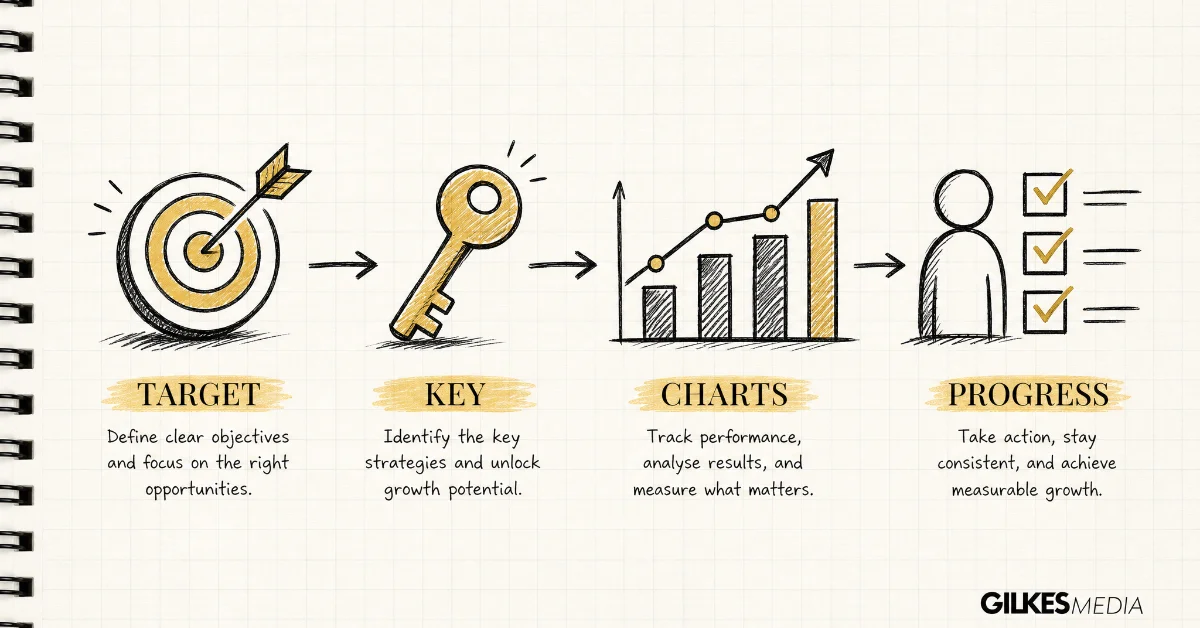
Before anyone touches a single campaign, you need to be crystal clear on what success actually looks like for your business. A good consultant will push you on this, but having your initial thoughts prepared is invaluable. Vague goals like "more leads" just will not cut it.
You need specific, measurable outcomes. This gives every marketing effort a clear target and provides a hard benchmark to measure performance against.
Thinking through these numbers forces you to connect marketing activity directly to your bottom line. If you need a hand structuring this, our guide on how to create a marketing strategy offers a practical framework.
Your consultant needs data to make informed decisions. To avoid getting bogged down in admin delays, grant access to your key marketing and analytics platforms ahead of time. This allows them to run an initial audit and arrive at your first session with valuable insights, not just a list of questions.
Make sure you provide access to the following:
Finally, pull together all the internal documents that will help your consultant quickly get up to speed on your brand, your market, and your customers. This context is crucial for crafting messaging and strategies that actually resonate.
Providing these assets upfront saves weeks of discovery time. It allows your consultant to immerse themselves in your business and start adding value immediately, rather than learning the basics on your time.
Compile a folder containing:
By completing this checklist, you position the entire engagement for success. It fosters a collaborative and efficient partnership right from the start.
A good partnership starts with clarity and momentum. The first 90 days lay the foundation for everything that follows, and it should be a structured, transparent process rather than vague promises and long meetings. Here's exactly what to expect as we move from analysis to real-world execution.
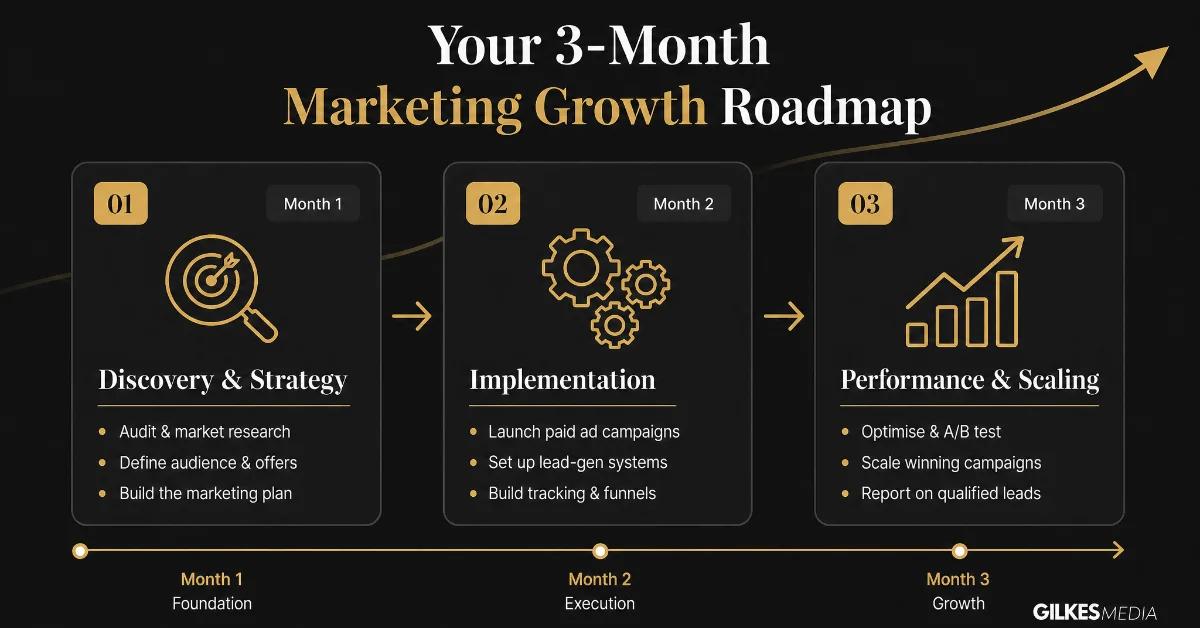
The first 30 days are about deep immersion. Before a single penny is spent on ads, we need to understand your business, your market and your customers with precision, because every later decision is grounded in what we learn here.
With a strategy signed off, month two is about execution. This is where the plan comes to life through live campaigns and real activity, and the priority is to launch efficiently, start collecting performance data, and begin optimising.
The goal here isn't instant perfection, it's rapid learning. Early campaign data tells us what's resonating and what isn't, so we can refine targeting, messaging and bids to improve performance fast.
In the final month of the initial sprint, the focus shifts from launching to scaling. By now there's enough performance data to make smart decisions about what's working and where to double down.
Let's clear up a few of the most common questions business owners have before working with a digital marketing consultant. My goal here is to give you honest, straightforward answers so you can make the right decision for your business.
It is the most important question, and the honest answer is: it depends on the channel.
If we are running paid advertising campaigns on platforms like Google or LinkedIn, you will see the impact almost immediately. We can get traffic, impressions, and early-stage leads flowing within the first 30 days. Paid ads are like a tap; you turn them on for instant visibility.
Search Engine Optimisation (SEO) is a different beast entirely. It is about building a long-term asset, not flipping a switch. You are earning trust with Google and your audience, and that takes time. Realistically, you should expect to see meaningful organic traffic and a steady stream of leads within 6 to 12 months. The payoff is huge, as SEO delivers compounding returns for years to come.
Consultancy costs vary depending on what you need, but engagements generally fall into one of three models:
Here at Gilkes Media, all pricing is transparent. It is tied directly to the commercial outcomes we are aiming for and the value we bring to your business.
Your input is absolutely vital, especially at the beginning. The best results always come from a strong partnership.
In the initial strategy phase, I will need your expertise on your business goals, your ideal customers, and what makes you different. This usually means a couple of focused workshops to get everything aligned.
Once we are up and running, your time commitment drops right down. I handle all the day-to-day management, optimisation, and reporting. You will get concise weekly updates to keep you in the loop and a more detailed monthly review where we will dig into the results, what we have learned, and what is next. The aim is to deliver maximum impact with minimum disruption to your schedule.
I will be direct: any consultant who guarantees a specific result like "we'll double your revenue in 90 days" should be treated with extreme caution. Marketing is not a perfect science. Markets change, competitors react, and there are always variables outside of our control.
What I do guarantee is a completely transparent, data-driven process that is relentlessly focused on your commercial goals. I guarantee you get senior, hands-on expertise, a clear strategy, and total accountability for performance. My commitment is to manage your investment as if it were my own, making smart decisions to maximise your return.
This confuses a lot of people, and getting it right means hiring the right person for the right job. I work as your strategic partner: you bring me in for commercial insight and the ability to solve complex growth problems, diagnosing what's broken and building the plan for growth. A freelancer is a task-based specialist you hire to do a specific, pre-defined job, like writing blog posts or managing a social feed. Put simply, you hire a consultant to think and a freelancer to do.
Clarity, not volume. A good report shows spend, lead output, lead quality signals, commercial impact, and the next actions being taken. If a report is full of platform metrics but doesn't help you make a better business decision, it isn't good enough, and I won't send you one like that.
No. It's useful for many businesses, but not all. If your audience buys through search, referrals and direct outreach, social may be a support channel rather than a core growth driver. I'll only recommend it when it serves a clear purpose, not because it looks modern to be active on it.
They can't explain success in business terms. If they talk endlessly about impressions, brand awareness and "activity" but struggle to define lead quality, cost efficiency or revenue contribution, the risk is obvious: you're buying motion, not progress.
Ready to stop guessing and start building a predictable growth engine for your business? Gilkes Media provides a practical, no-nonsense approach to digital marketing consultancy. Book a free, no-obligation consultation today to talk through your goals and get a clear plan of action.
