
This is probably the single most common question we get asked, usually within the first five minutes of a first conversation with a new client, and it deserves a straight, honest answer rather than the vague "it depends" that a lot of agencies default to when they don't want to commit to anything checkable.
It does depend, genuinely, but here's what actually drives the timeline and what you should realistically expect.
For a typical small or medium UK business starting from a reasonable foundation, expect to see the first meaningful movement in rankings and traffic within three to four months, with genuinely significant, business-changing results usually taking six to twelve months to materialise fully.
Anyone promising first-page rankings within a few weeks is either describing an extremely low-competition, low-value keyword that won't move the needle commercially, or not being straight with you about how search engines actually work.
This isn't a limitation specific to any one agency's approach, it's a structural feature of how Google evaluates and trusts new or improved content, and understanding why helps set expectations that won't leave you disappointed or, worse, talked into abandoning genuinely good work too early.
Google needs to discover and crawl your changes. New or updated content doesn't appear in search results the moment you publish it.
Google's crawlers need to find it, which can take anywhere from a few days to several weeks depending on how often your site is crawled, itself a signal influenced by your site's overall authority and how frequently it's updated.
New content needs to earn trust over time. Google is understandably cautious about ranking brand new pages highly immediately, since a new page has no track record yet demonstrating it's genuinely useful, accurate, and trustworthy.
This trust builds gradually as the page accumulates engagement signals, time, and often backlinks, not instantly on publication regardless of how well written the content is.
Competitive keywords take longer than easy ones.
If you're targeting a term with established, well-optimised competitors who've been building authority for years, you're not just waiting for Google to notice you, you're working to overtake sites with a genuine head start.
A low-competition, specific long-tail term can rank within weeks. A competitive, high-value commercial term realistically takes months to over a year of sustained work.
Technical and content foundations need fixing first, and that takes time to pay off.
If your site has underlying technical SEO issues — indexation problems, poor site structure, thin content — fixing these is necessary groundwork. But the benefit doesn't show up as an immediate ranking jump.
It shows up as removing a ceiling that was previously capping your progress, with the actual ranking improvement following over subsequent months as the rest of the work builds on a now-solid foundation.
Content needs time to accumulate the signals that prove it's good. Time on page, return visits, the natural backlinks a genuinely useful piece of content earns over months as people discover and reference it, all build gradually.
A page published yesterday hasn't had the chance to accumulate any of this yet, however good the content itself is.
For a typical UK business, expect first meaningful movement within three to four months and genuinely significant results within six to twelve - anyone promising first-page rankings within weeks is either describing a low-value keyword or not being straight with you. Behind the scenes, Google first has to discover and crawl your changes, which alone can take days to several weeks depending on your site's crawl frequency.
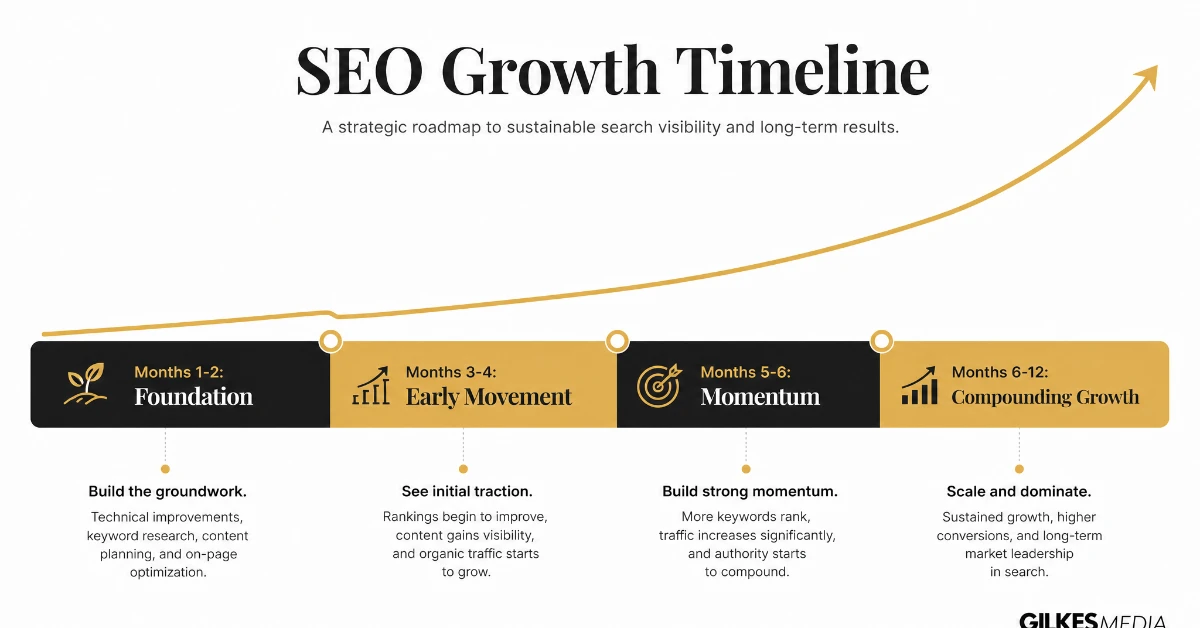
Months one and two. Technical foundation work, fixing any indexation or crawlability issues, on-page optimisation across priority pages, and the start of new content production.
Very little visible movement in rankings or traffic yet, this is foundational work, and it's normal, not a sign anything is wrong.
Months three and four. Early movement starts to appear, usually first on lower-competition, longer-tail keywords, with some initial ranking improvements on primary target terms.
Traffic increases are typically modest but measurable at this stage, and this is genuinely the point where a lot of businesses start to see the first proof the work is paying off.
Months five and six. More substantial ranking improvements on primary keywords, genuine, noticeable traffic growth, and often the first clear increase in leads or enquiries directly attributable to organic search.
This is typically the point where SEO starts to feel like it's contributing meaningfully rather than being a cost sitting in the background waiting to prove itself.
Months seven to twelve. Continued compounding growth as more content matures, accumulates authority, and additional pages start ranking.
For a well-executed campaign, this period usually shows the clearest, most convincing return, with month-on-month organic traffic and leads meaningfully ahead of where they started.
Beyond twelve months. Growth continues, though the rate of increase for an already well-optimised site naturally moderates compared to the early months, since you're building from a stronger base rather than fixing foundational gaps.
Ongoing work at this stage shifts more toward defending existing rankings against competitors and expanding into new, adjacent keyword opportunities.
These are realistic averages, not guarantees, and your specific timeline will vary based on the factors covered below.

| Timeframe | What to expect |
|---|---|
| Months 1–2 | Technical foundation work and on-page fixes; very little visible movement yet, and that's normal |
| Months 3–4 | Early movement on longer-tail keywords, with modest but measurable traffic increases |
| Months 5–6 | Substantial ranking improvements on primary keywords and the first clear increase in leads |
| Months 7–12 | Continued compounding growth as more content matures and accumulates authority |
| Beyond 12 months | Growth continues but moderates; focus shifts to defending rankings and expanding into new keywords |
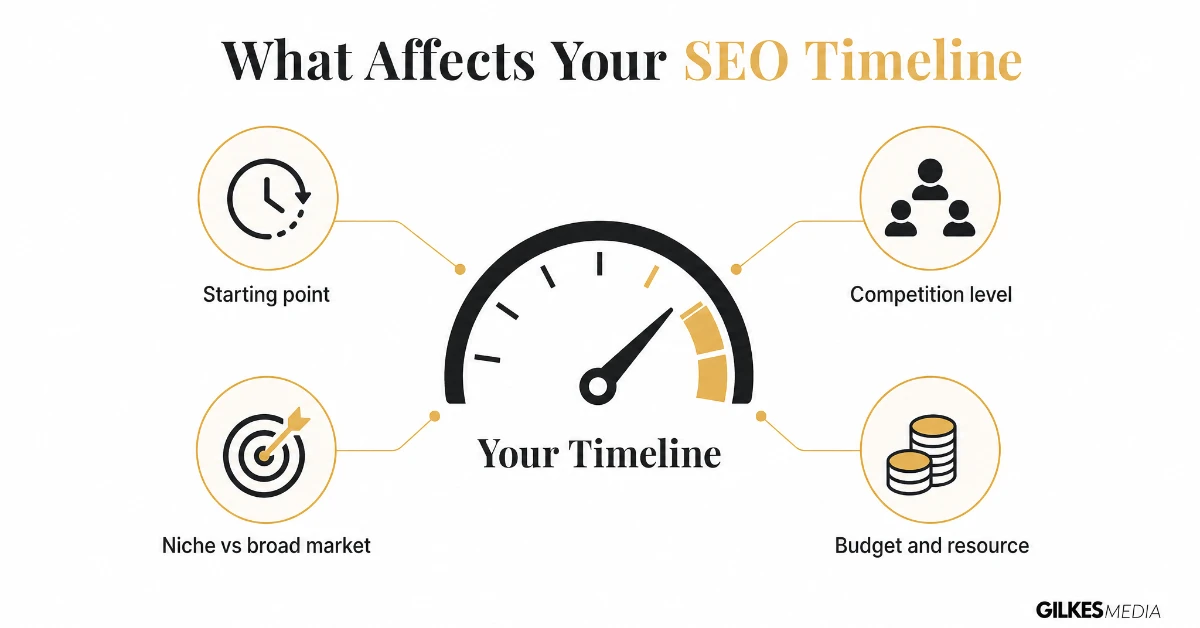
Your starting point.
A site with a reasonable existing history, some organic traffic already, and no major technical problems will generally see results faster than a brand new site or one recovering from a penalty or major technical issue, simply because there's less foundational ground to cover before the real growth work can begin.
Your competition. A niche B2B service in a specific region has a meaningfully easier path than a term with dozens of well-funded national competitors all targeting the same keywords.
Realistic timeline expectations should always be set against your actual competitive landscape, not a generic industry average that might not reflect your specific market at all.
Your content investment.
SEO work that includes genuinely substantial, regular new content production tends to show results faster than a minimal, occasional approach, simply because there's more surface area for Google to discover, index, and rank, and more opportunity to capture a wider range of relevant search terms across your topic.
Your website's technical health. A site with underlying technical problems that go unaddressed will see any content or optimisation work underperform regardless of quality, since technical issues can effectively cap how well even excellent content is able to rank.
Fixing these first, even though it delays the point at which content work starts paying off, ultimately produces a faster overall path to real results than building great content on top of a broken foundation.
Months one and two are foundational work with very little visible movement, and that's normal, not a sign anything is wrong - early gains typically show up on longer-tail keywords by months three and four. Your starting point matters most for pace: a site with existing history and no major technical problems will generally see results faster than a brand new site or one recovering from a penalty.
A business able to commit to consistent, genuinely good content production and prompt technical fixes will move faster than one where every recommendation waits weeks for internal sign-off or development resource. SEO progress is often gated as much by how quickly a business can act on recommendations as by the strategy itself.
Some agencies, under pressure to close a sale, will promise faster timelines than are realistic — sometimes lifted from an actual case study for an unusually low-competition keyword and presented as if it were typical.
Or the promise is based on tactics that produce a short-term ranking bump through methods that risk a Google penalty later — black-hat link schemes, keyword stuffing, or other approaches that genuinely can produce faster short-term movement at real long-term risk.
If a proposal promises specific ranking positions within a specific, short timeframe, particularly for competitive commercial keywords, ask exactly what techniques would achieve that, and be sceptical of vague answers.
Legitimate SEO work can be transparent about its methods precisely because the methods themselves are sound and don't need to be obscured.

If you're the one managing this relationship internally, whether with an agency or an in-house effort, it's worth setting these timeline expectations clearly with anyone else in the business who'll be asking about progress, a business partner, a board, a manager expecting quick wins.
Nothing undermines genuinely good SEO work faster than an internal stakeholder losing patience at month two and pulling the budget just as the work was about to start paying off in months three and four.
A simple, honest internal message works well: meaningful early signals by month three or four, clear business impact by month six, with growth continuing to compound from there.
This is checkable against real reporting along the way, which is far more useful than either an over-optimistic promise that sets you up for disappointment, or vague reassurance with nothing concrete to check progress against.
Watch for a proposal promising specific fast rankings - it's often a cherry-picked low-competition case study, or built on tactics that risk a Google penalty later for a short-term bump. Set realistic timeline expectations internally too: nothing undermines genuinely good SEO work faster than a board or manager expecting quick wins that were never realistic.

A website redesign or migration that isn't planned with SEO in mind can quietly undo months of progress, through lost URLs, broken redirects, or removed content that had been ranking well. Any redesign should involve an SEO review before launch, not as an afterthought once the new site is already live.
Rather than only watching rankings, track a few different signals as you go. It gives you a clearer read on whether things are actually moving:
Changing direction every few months effectively resets the clock, since SEO compounds and needs a consistent strategy long enough to build on itself. Rather than only watching rankings, track indexation and crawl activity early on, since impressions for your target terms usually move before rankings do.
Consider two hypothetical UK businesses starting SEO work on the same day. The first is an established regional business, trading for eight years, with a reasonable existing site, no major technical issues, and a moderately competitive local market.
The second is a brand new business, a site launched three months ago with no existing authority, entering a genuinely competitive national market against well-established competitors.
For the first business, meaningful movement on priority keywords is realistic within two to three months, since there's an existing foundation of trust and some historical signals for Google to build on.
Noticeable commercial impact, a genuine uptick in enquiries attributable to organic search, typically follows within four to five months, ahead of the general averages set out above because the starting point was stronger than typical.
For the second business, the honest expectation is longer.
With no existing site history and considerably tougher competition, the first three to four months are almost entirely foundational, technical setup, initial content, and the slow process of Google beginning to trust a genuinely new domain.
Meaningful ranking movement is more realistic from month five or six onward, with genuinely significant commercial impact more likely in the nine to twelve month range rather than the six-month mark that suits the first business.
Same service, same broad approach, genuinely different timelines, because the starting point and competitive landscape were different in each case.
This is exactly why a single number quoted without qualification, "SEO takes six months," is rarely the full honest answer for any specific business.
You shouldn't be flying blind for six months waiting to see if it worked.
Proper reporting against leading indicators, keyword rankings, organic traffic, and impressions in Google Search Console, should show gradual, visible progress from around month two or three onward, well before the full commercial impact arrives.
If you're not seeing any movement at all in these leading indicators by month four, that's the point to genuinely question whether the strategy or execution needs adjusting, not to wait passively for another six months hoping it improves on its own.
Our technical SEO audit checklist covers the foundational checks worth confirming are in good shape early, since problems here are the most common reason a campaign underperforms its realistic timeline.
An established business with an existing site and no technical issues can see meaningful movement within two to three months, while a brand new site entering a competitive national market needs considerably longer - the same effort, two very different realistic timelines. Proper reporting against leading indicators should show gradual, visible progress from around month two or three onward, well before the full commercial impact lands.
The same "three to six months" guidance can look wildly different in practice depending on the industry, and understanding why helps set the right expectations from the outset.
Legal, finance, and insurance are among the most competitive sectors in UK search, with large, well-resourced competitors that have often invested in SEO for years. A realistic timeline in these sectors usually sits at the longer end of the range, and often needs a sustained twelve-month-plus effort before genuinely competitive terms start moving meaningfully.
A local service business, or a B2B company in a genuinely specific niche, faces considerably less competition for its most relevant terms. These businesses often see meaningful movement noticeably faster than the general timeline suggests, simply because there are fewer well-resourced competitors fighting for the same search terms.
A generic timeline answer has to average across all these different competitive realities, which is why a specific business asking this question deserves a specific answer based on their actual market, not a single number pulled from an industry-wide average.
Knowing what to check along the way is only useful if the reporting you receive actually shows it clearly.
A genuinely useful monthly SEO report shows keyword ranking movement on your actual priority terms, organic traffic and impressions from Google Search Console, and a plain-language explanation of what work was done and why, connected back to the agreed strategy. A report that only shows vague "visibility score" metrics from a third-party tool, with no connection to your actual business terms or traffic, tells you very little about real progress.
Ask what timeline the agency considers realistic for your specific market and competition level, ask to see an example of their monthly reporting before committing, and ask what happens if the agreed leading indicators aren't moving by month four or five. A provider unwilling to answer these plainly, or one who deflects with vague reassurance instead of specifics, is worth treating with real caution.
A genuinely transparent SEO report should tell you exactly what happened and why, not just show you a score that goes up.
Occasionally, particularly for a site with an existing strong foundation and only a handful of specific, low-competition terms to target. But for most UK businesses starting from a typical position, expecting meaningful results before month three is unrealistic, and any provider promising it is worth questioning closely.
Paid advertising buys visibility directly and instantly. SEO earns visibility by building genuine authority, technical quality, and relevance over time, which search engines need time to discover, crawl, and factor into rankings. That underlying mechanism is why the timelines differ so fundamentally between the two channels.
Yes, this is entirely normal. Early months are typically spent on technical foundation work and on-page optimisation, which needs time to be crawled and indexed before it can influence rankings. A complete absence of any movement in leading indicators like impressions by month three or four is the more meaningful warning sign, not the first month alone.
It often does, at least partially. A new agency typically needs time to properly understand the existing strategy, audit what has been done, and decide whether to continue the existing direction or change it. Frequent agency switching is one of the most common reasons a business never sees the compounding benefit SEO is meant to deliver.
A minimum of six months is a reasonable commitment before making a serious judgement, provided leading indicators (rankings, traffic, impressions) are showing some genuine movement along the way. Judging an SEO strategy after only six to eight weeks rarely gives it a fair chance to demonstrate whether it is working.
No. Longer-tail, lower-competition terms typically move first, often within the first few months, while broader, more competitive head terms generally take considerably longer. This staggered pattern is normal and is one reason tracking a spread of keywords, not just one or two, gives a truer picture of progress.
Generic timelines are a useful starting point, but your actual timeline depends on your specific starting point, competition, and the work genuinely being done.
Google's own SEO starter guide is honest about this too, it deliberately avoids promising a fixed number of weeks or months, because the reality genuinely does vary by site.
If you want an honest assessment of what's realistic for your business specifically, rather than a generic promise designed to close a sale quickly, our SEO service starts with exactly that kind of assessment before any work begins.
Get in touch through our contact page for a free discovery call. We'll look at where you're starting from and give you a straight answer about what to expect and when.
It also helps to think about SEO timelines the same way you would think about any other compounding business investment. The value doesn't arrive as a single lump sum on a fixed date, it builds gradually, and each month's work makes the next month's work more effective, provided the strategy stays consistent. A business that stops after four months, just as the early momentum from months one to three starts translating into visible results, gives up right before the investment starts paying off properly.
The businesses that get the most out of SEO tend to share a similar mindset: they treat the first six months as building genuine foundations rather than expecting overnight results, they ask for and actually read the leading-indicator reports along the way rather than only checking in at the end, and they stay consistent with the agreed strategy rather than switching direction every time a competitor tries something different.
If you're currently a few months into an SEO effort and unsure whether the pace is genuinely normal or a sign something needs to change, that's a worthwhile check to get a second opinion on rather than sit with uncertainty about for another quarter.
There is no shortcut that reliably compresses a genuine SEO timeline without taking on real risk, whatever any provider promising instant results might claim. The realistic answer, three to six months for early movement and six to twelve months for the fuller commercial impact, is not a disappointing one once you understand what is actually happening behind it: a genuine, durable improvement in how search engines see your business, built to keep compounding well beyond the point any paid campaign would have stopped.
That patience is exactly what separates the businesses genuinely benefiting from SEO a year from now from the ones who gave up at month three and moved their budget somewhere else, only to start the whole process again from scratch a year later.
Set the right expectations from day one, track the right leading indicators, and stay the course, and the timeline stops feeling like an uncertain wait and starts looking like exactly what it is: a predictable process with a genuinely worthwhile outcome at the end of it.
