
Ask five different businesses what they pay for Meta ads and you'll get five different answers, and unlike a lot of pricing questions in marketing, that's not because anyone's being cagey about it. Meta doesn't have a rate card.
There's no fixed price per click or per thousand impressions that applies to everyone, because every single ad you run is competing in a live auction against every other advertiser trying to reach the same person at the same moment.
Understanding that auction is the actual answer to "how much do Meta ads cost," so that's where we'll start before getting into realistic numbers.
Facebook and Instagram ads work on an auction model, not a price list.
Every time someone scrolls their feed, Meta runs a real-time auction among every advertiser who wants to show that person an ad at that moment, and the winner is decided by a combination of your bid, your ad's estimated relevance to that specific person, and how likely Meta thinks they are to actually engage with it.
This means your cost per result depends heavily on how many other businesses are trying to reach the same audience, how well your ad matches what that audience actually responds to, and how tightly or broadly you've defined who you're targeting.
This is also why two businesses in completely different industries, running what looks like a similar budget, can see wildly different results.
A home services business targeting a broad local audience is often competing in a far less crowded auction than a SaaS company targeting "marketing directors" in London, where dozens of other B2B advertisers are bidding for the same narrow, valuable audience at the same time.
Meta scores every ad on estimated action rate and relevance alongside your bid, meaning a more engaging ad can beat a higher bid from a less relevant competitor. This is the direct mechanism behind why creative quality affects cost, not just a general best practice.
A home services business targeting a broad local audience competes in a far less crowded auction than a SaaS company targeting narrow, senior job titles, where dozens of other B2B advertisers are bidding for the same small pool at the same time.
These are sensible starting points based on what we typically see working for UK businesses, not fixed prices, since your actual cost per result depends on your industry, audience size, and how competitive your specific market is.
A modest testing budget: roughly £300 to £800 a month.
This is enough to run two or three ad variations to a reasonably targeted audience and start gathering real data on what resonates, without enough volume yet to draw firm conclusions.
This tier suits a business validating a new offer or audience before committing more seriously.
A genuine lead generation budget: roughly £800 to £3,000 a month.
This is where most established small and medium UK businesses land once Meta ads are a proper, ongoing part of the marketing mix, with enough spend to test multiple audiences and creative angles and let Meta's algorithm optimise properly against a real volume of results.
A scaled, multi-campaign budget: roughly £3,000 to £10,000+ a month.
This tier typically supports several campaigns running in parallel, targeting different audience segments or funnel stages, with enough historical data feeding the algorithm that performance tends to be considerably more stable and predictable than at lower spend levels.

| Budget tier | Monthly spend | Best suited for |
|---|---|---|
| Testing | £300–£800 | Validating a new offer or audience before committing further |
| Lead generation | £800–£3,000 | Established SMEs treating Meta as an ongoing part of the marketing mix |
| Scaled | £3,000–£10,000+ | Multiple campaigns running in parallel across audience segments and funnel stages |
Meta ad costs are set by auction, not a price list, so treat any figure you're quoted as a starting point, not a promise. The real budget bands depend on your industry, your audience size and how competitive your specific market actually is.
A handful of factors explain most of the difference between a business getting genuinely cheap results and one burning through budget for very little.
Meta shows a rough relevance signal through metrics like quality ranking and engagement rate ranking, visible in Ads Manager. An ad ranked below competitors on these measures pays more for the same placement, so checking them is a genuine diagnostic step, not just a vanity metric.
Meta’s algorithm needs a reasonable volume of conversions to optimise delivery properly, generally at least 50 a week per ad set by Meta’s own guidance. An audience narrowed so far that this threshold is never reached often costs more per result than a slightly broader one the algorithm can actually learn from.
These two channels are answering genuinely different questions, and the cost comparison only makes sense once that's clear.
Google Ads generally targets people actively searching for something, which usually means higher intent and a higher cost per click, but a shorter distance to conversion.
Meta Ads generally interrupts someone who wasn't actively looking for you, which usually means a lower cost per click but a longer journey from first seeing your ad to actually converting.
Our guide on SEO versus PPC covers a similar trade-off in more depth, and the same underlying logic applies here: cheaper clicks aren't automatically better value if they convert at a much lower rate, and the right answer usually depends on what you're selling and how considered the purchase is.
For a considered, higher-value B2B service, a blended approach often works best: Google Ads catching people already searching for a solution, and Meta Ads building awareness and staying in front of a well-defined audience earlier in their decision, before they're actively searching at all.

Audience competitiveness and ad relevance do more to move your cost per result than anything else, and Meta genuinely rewards ads people engage with. Meta and Google Ads answer different questions too, so comparing their costs only makes sense once you're clear which intent each one is capturing.
The advertised monthly ad spend is rarely the whole cost.
Creative production, decent ad imagery, video, and copywriting that doesn't look like it was thrown together in five minutes, needs either time or budget, and ads with genuinely good creative consistently outperform ones without it by a wide margin.
A learning phase cost is also worth expecting: every time you make a significant change to targeting or creative, Meta's algorithm needs a period of relatively less efficient delivery while it re-learns who responds best, and constantly restarting that learning phase by tinkering too often is one of the most common ways businesses quietly waste budget.
Finally, someone needs to actually manage the account, reviewing performance, testing new angles, and killing what isn't working, and that time has a real cost whether it's your own or an agency's.

Meta creative fatigues faster than a search ad, since the same audience sees it repeatedly in a feed rather than only when actively searching. Budgeting for new creative every few weeks, not a single ad set stretched across months, is a real recurring cost worth planning for from the outset.
Properly configuring the Meta pixel and Conversions API, rather than relying on pixel tracking alone, has become increasingly important as browser privacy changes reduce how much data the pixel alone can capture. Skipping this setup cost typically shows up later as unreliable optimisation and reporting.
Targeting too narrowly, too early.
It's tempting to define your ideal customer down to a tiny, hyper-specific segment from day one, but with too small an audience the algorithm simply doesn't have enough data or reach to optimise properly, and cost per result often suffers as a result.
Judging performance too soon. Meta's algorithm needs a genuine learning period, typically a week or two of consistent delivery, before performance stabilises.
Pausing or heavily editing a campaign after two or three days because early numbers look weak usually means never actually seeing what it could do once it settles.
Sending traffic to a generic homepage instead of a proper landing page.
An ad that earns a click but drops someone onto a page that doesn't match what the ad promised, or asks them to hunt for the actual offer, wastes a genuinely well-performing ad on a weak conversion point.
Our guide on landing page design best practices covers what that page actually needs to do its job.
Ignoring frequency. If the same small audience is seeing your ad dozens of times a month, performance will decline regardless of how good the creative is.
Keeping an eye on frequency and refreshing creative or expanding the audience before fatigue sets in avoids paying steadily more for steadily worse results.
The advertised monthly spend is rarely the whole cost. Budget for proper creative production and expect a learning-phase dip every time you change targeting or creative, since restarting that learning phase too often is one of the quietest ways budget gets wasted.
A short self-check before you commit any spend:
A UK home improvement business set aside £1,200 a month to test Meta Ads for the first time, split across two audience segments and three ad creative variations.
In the first month, cost per lead sat noticeably higher than they'd hoped, largely down to the algorithm's learning phase and one underperforming creative variation dragging the average up.
Rather than pulling the budget entirely, they paused the weakest ad, kept the two strongest running, and let the campaign continue into its second full month of stable delivery.
By month two, with the learning phase behind them and only the better-performing creative left running, cost per lead dropped by roughly a third compared to the first month, and continued to hold reasonably steady once a small rotation of fresh creative was introduced every few weeks to avoid fatigue.
The lesson wasn't that Meta Ads were cheap from day one, it was that judging performance properly meant waiting for the algorithm to actually settle before drawing conclusions.
Run through the self-check before you commit spend: know your lifetime value, have creative and a landing page ready, and commit to at least two to three weeks before judging results. The worked example shows why pulling budget after one rough month is usually the wrong call.
Meta automatically spreads a campaign across several placements by default, and each behaves differently on cost and typical use case.
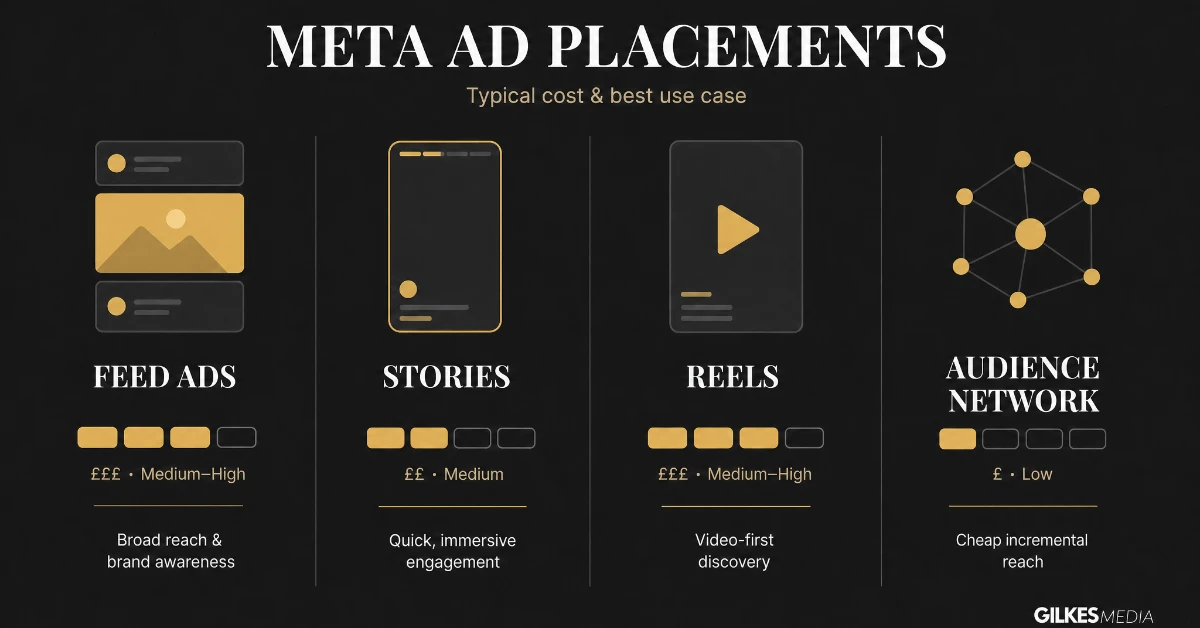
Standard Facebook and Instagram Feed placements remain the most reliable all-rounder, typically carrying a moderate cost per click and working well for most objectives from awareness through to conversion.
Full-screen, vertical Stories placements often cost less per impression than Feed, but need creative built specifically for the format, a repurposed square or horizontal Feed ad tends to underperform noticeably here.
Reels placements currently benefit from Meta actively pushing the format, which can mean genuinely cheap reach for well-made, native-feeling short video, though performance varies more than the more mature Feed placement.
Ads shown on third-party apps and websites through Audience Network are usually the cheapest placement by a distance, but typically produce the lowest-quality traffic of the four, and are worth watching closely or excluding entirely for lead generation campaigns.
Letting Meta choose placements automatically is usually right for a new campaign, but reviewing placement-level results after a few weeks and excluding the weak ones is where real budget efficiency comes from.
Meta rewards relevance and engagement directly in its auction, which means there is genuine room to lower cost per result without simply shrinking the audience.
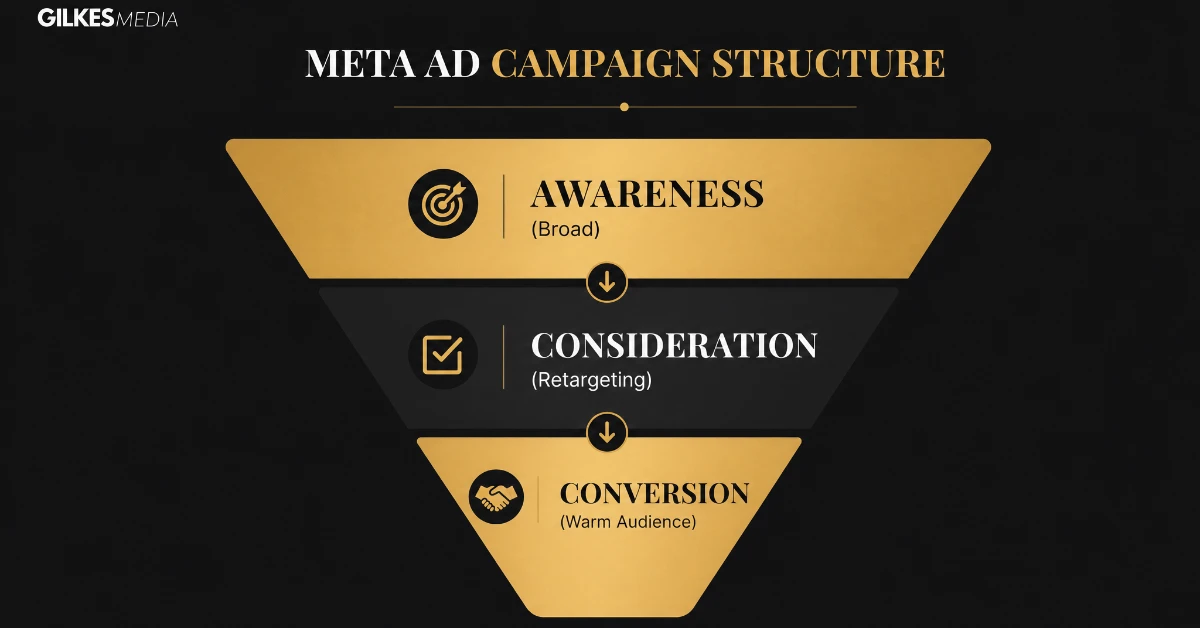
Website visitors, video viewers and page engagers are typically far cheaper to reach again than a cold audience, since they already have some familiarity with the business. A campaign with no retargeting layer at all is usually leaving one of the cheapest, highest-converting audiences on the table entirely.
A lookalike audience built from existing customers or website converters, rather than a broad interest-based audience, usually produces a cheaper, more relevant reach because it is modelled directly on people who have already shown real intent, not just a stated interest.
Cost per result reliably rises once an audience has seen the same ad too many times, referred to as frequency fatigue. Rotating in new creative every two to four weeks, before performance visibly declines, keeps cost per result more stable than waiting for a drop and reacting to it.
The budget bands earlier in this guide are sensible UK starting points, but turning them into a number specific to your business takes one more step.
Work out what a converted customer is genuinely worth, and what conversion rate you can reasonably expect from lead to customer. That gives a maximum viable cost per lead, which may sit well above or below a generic industry average depending on how valuable your specific customer is.
Meta needs a meaningful number of conversion events, roughly 50 a week per ad set by its own guidance, to optimise delivery properly. A budget too small to reach this threshold rarely produces a fair test of whether the channel works.
A cold awareness or traffic campaign feeding a warmer retargeting campaign, feeding a conversion campaign aimed at the warmest, most engaged audience, typically produces a lower blended cost per result than one flat campaign targeting everyone the same way.
Meta typically produces leads at £10-45 depending on industry and offer, though the right number depends on what a lead is worth to your specific business rather than a fixed UK benchmark.
A modest testing budget usually starts around £500-1,000 a month, enough to gather a genuine signal on targeting and creative within a few weeks.
Usually audience fatigue, the same people seeing the same ad too often, or increased seasonal competition. Refreshing creative and reviewing frequency data addresses most cases.
Audience Network is usually cheapest per impression, but typically produces the lowest-quality traffic. Feed remains the most reliable all-round placement for genuine lead generation.
It depends what you need. Meta interrupts rather than captures intent, generally at a lower cost per click, while Google captures people already searching. Our guide on Google Ads cost in the UK covers that comparison in more depth.
Give a new campaign at least one to two weeks to exit Meta’s learning phase, and four weeks for a fuller, fairer picture, particularly if it includes any retargeting or lookalike audiences that need time to build properly.
There isn't a single correct Meta ads budget for every business, but there is a sensible way to arrive at one: start with enough spend that the algorithm has a genuine chance to learn and optimise, give a campaign a fair run before judging it, and put real thought into creative rather than treating it as an afterthought to the targeting.
Working out your genuine customer acquisition cost before you commit to a monthly figure gives you a much clearer sense of whether a given cost per lead actually makes sense for your business, rather than judging it against a number you saw quoted somewhere else for a completely different industry.
If you're weighing up whether Meta Ads make sense for your business, or want an honest read on what a realistic budget and result actually look like for your specific market, that's exactly the kind of conversation worth having before you commit any spend.
Our paid ads management service covers Meta, Google, LinkedIn and TikTok, and we'll always tell you honestly if a different channel is likely to work harder for your specific budget.
Get in touch through our contact page for a free discovery call, and we'll give you a straight, realistic view of what Meta Ads would cost for your business and whether it's the right channel to start with.
Since Apple’s App Tracking Transparency and broader browser privacy changes reduced how much individual user data Meta can access, tracking and optimisation have become somewhat less precise across the board, which has pushed average costs up industry-wide over recent years. Properly configuring server-side tracking through the Conversions API meaningfully offsets this, recovering conversion data the pixel alone increasingly misses.
Businesses still running on pixel-only tracking, without the Conversions API layered in, are effectively optimising with a smaller, less accurate dataset than competitors who have made the setup investment, and often pay a real cost per result penalty for it without realising the setup itself is the fixable cause.
Below roughly £1,000-1,500 a month, the overhead of specialist management often outweighs what it adds, and running the account carefully in-house, following the fundamentals in this guide, tends to make more sense. Above that, particularly once a funnel spans several campaigns and retargeting audiences, the complexity of managing creative refresh, audience layering and tracking setup properly usually justifies specialist input.
A sensible middle path for a growing account is a one-off audit and setup, including proper Conversions API configuration, from a specialist, followed by in-house management with a quarterly review, rather than committing to full ongoing management before the account has proven it can sustain that spend profitably.
Of everything covered here, retargeting is the most consistently underused. Businesses will happily spend on cold, broad targeting month after month while never building a proper retargeting layer for website visitors, video viewers, or people who engaged with a previous ad. That warm audience is routinely the cheapest, highest-converting segment available, and leaving it unbuilt means paying cold-audience prices for an audience that could convert far more cheaply.
Setting it up costs very little: the Meta pixel or Conversions API needs installing once, and a handful of retargeting audiences, website visitors in the last 30 days, video viewers, page engagers, take minutes to create. Businesses running Meta Ads without this in place are, in effect, leaving one of the platform’s cheapest wins unused.
Bring the pieces in this guide together, sensible budget bands, an honest read on hidden costs, a proper retargeting layer, and creative refreshed on a schedule, and Meta Ads stops behaving like an unpredictable cost centre and starts working like the reliable, scalable channel it can genuinely be for a UK business willing to manage it properly.
That is a more useful outcome than chasing the lowest possible cost per result on a dashboard. The number on its own says very little without the context of what it actually produces further down the funnel, and that context, not the raw figure, is what should drive every budget decision covered in this guide.
Every figure in this guide reflects genuine UK market ranges, not invented numbers, but they describe averages across thousands of accounts with very different offers, audiences and customer values. Paying above these ranges is not automatically a sign of a poorly run account; a narrower, more valuable audience will naturally cost more than the typical account these benchmarks represent.
The more useful question is always whether your cost per result is justified by what a converted lead is actually worth to your business, worked out from your own numbers, not a benchmark from an article, including this one.
Treat Meta Ads as a genuinely ongoing part of the marketing mix, reviewed monthly, refreshed regularly, and structured properly around a real funnel, and the platform starts producing the kind of predictable, compounding results that a channel switched on and off in short bursts almost never manages to reach.
That consistency, more than any single tactic covered here, is what separates UK businesses getting genuine, compounding value from Meta year after year from ones that keep relitigating whether the platform still works every time a quarter looks disappointing.
Get the fundamentals right, a budget matched to genuine customer value, placements chosen deliberately rather than left on autopilot, a retargeting layer built from day one, and Meta Ads becomes one of the more predictable, defensible lines in a marketing budget rather than the one that gets questioned first whenever spend comes under review.
That defensibility, always being able to explain plainly why the account costs what it costs and what it produces in return, is worth more over time than chasing whatever number looks best on a screenshot for a single reporting month.
Build the account, and the reporting around it, on that basis from the start, and the conversation about whether Meta Ads is worth the spend gets a great deal easier to have every time it comes up.
That is, ultimately, the difference between running Meta Ads and genuinely managing them, and it is worth the modest extra effort it takes to get there.
