
“What is a good conversion rate?” It is the million-pound question in marketing, and the honest answer is always… it depends.
There is no single magic number. A good rate is a moving target that changes with your industry, where your traffic comes from, and what you are actually asking a visitor to do. For a UK e-commerce shop, 3% might be fantastic. For a B2B consultancy selling high-value services, a 1% lead conversion rate from a specific campaign could be a huge win.
Think of your website as your digital shop on the high street. Every person who walks through the virtual door is a potential customer, but not everyone is going to buy something.
Your conversion rate is the percentage of those visitors who take the valuable next step you want them to. This could be anything from buying a product, to requesting a quote, or signing up for your newsletter. It is the single most important vital sign for the commercial health of your website.
A conversion is any meaningful action a user takes that moves them closer to becoming a paying customer. To get a real grip on what a good conversion rate looks like for you, you first need to understand the fundamentals of what is conversion rate and why it's your most important metric. Without that clarity, you are just tracking visitors, not results.
At Gilkes Media, we see conversion rate as the ultimate measure of marketing effectiveness. It is the metric that turns website traffic into real business outcomes: leads, sales, and a clear return on your investment.
A "good" conversion rate is completely relative. A number that is exceptional for one business could be a sign of serious trouble for another. Before you start chasing benchmarks, you have to understand the context.
Several critical factors shape what is realistic for you:
Understanding these variables is the first step to meaningful measurement. Forget about generic industry averages for a moment. Your real goal should be to establish a baseline for your own business and then focus on making consistent, incremental improvements. That is how you move from guessing what works to knowing what drives profitable, scalable growth.
Knowing what a conversion rate is is one thing. Knowing what a good conversion rate looks like for your business is where strategy begins. It is easy to get distracted by generic, global averages, but a realistic benchmark for a UK professional services firm will look completely different from a US-based e-commerce brand.
So, where do you start? The two factors that matter most are your industry and your marketing channel. Different industries naturally have longer sales cycles and higher price points, while different channels attract people with completely different levels of buying intent.
If you only take one thing away from this section, let it be this: understanding user intent is the single most important concept when you look at channel performance. It is the reason why a 1% conversion rate from a social media campaign might be a huge success, while a 5% rate from paid search could be a more realistic target.
Think about the user's mindset. Someone idly scrolling through their LinkedIn feed is in a passive, discovery mode. An advert might catch their eye, but they were not actively looking for a solution. Their intent is low.
Now, compare that to someone typing "accountant for small business in Manchester" into Google. This person has a specific, immediate need. They are actively hunting for a solution, which means their intent is sky-high. High-intent channels will almost always deliver higher conversion rates. It is that simple.
This chart gives you a clear picture of how performance typically stacks up across the major channels here in the UK.
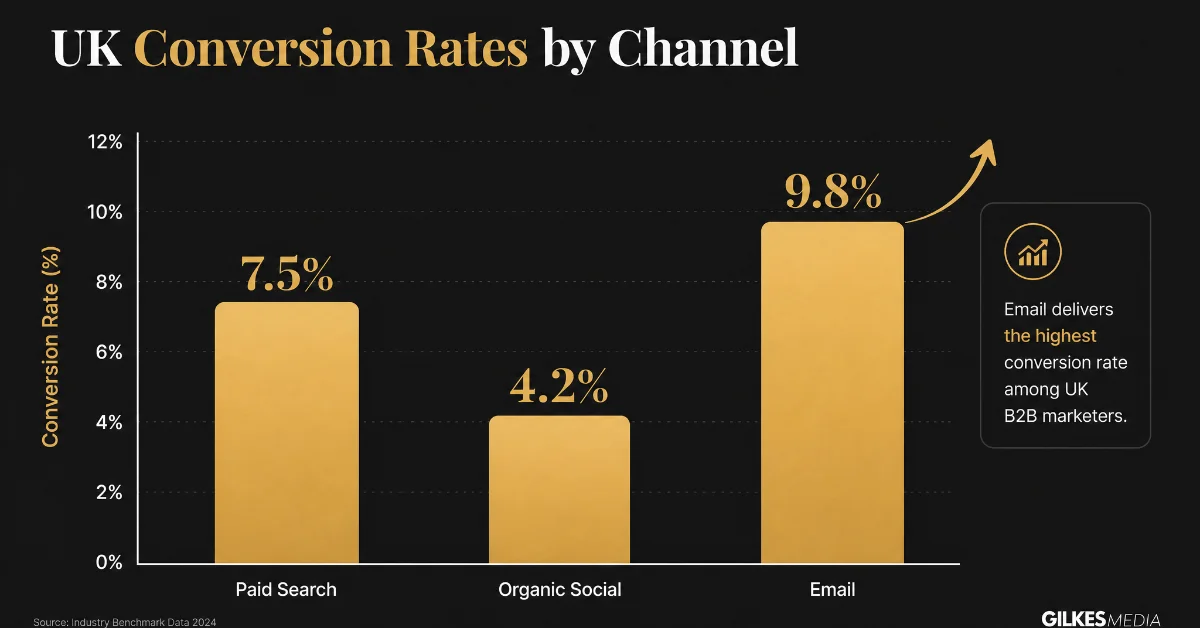
As you can see, channels that capture users with immediate needs (Paid Search) or nurture warm audiences (Email) consistently outperform channels designed for brand awareness, like Organic Social.
Let's break down what a good conversion rate looks like across the most common digital marketing channels in the UK.
Understanding these differences is vital for allocating your marketing budget effectively. You can learn more about how we tackle this by exploring our guide to paid search analytics.
On top of the channel, your industry plays a massive role. It stands to reason that B2B sectors with complex, high-value services will see different conversion patterns than B2C e-commerce.
For UK B2B sectors like finance and professional services, the latest benchmarks show top performers hitting 3.2% on paid search. While sectors like automotive and real estate might lead overall, professional services perform exceptionally well in organic search (2.7%) and email. For businesses in this space, a 'good' rate is one that beats the 2.6% all-industry average, especially as social media lags at just 1.5%. You can discover more insights in Ruler Analytics' detailed report on the topic.
The table below gives you a clearer view of what to expect in key UK service-based industries.
| Industry Vertical | Typical Goal | Good Rate (Paid Search) |
|---|---|---|
| Professional Services | Lead/Quote Request | 3% – 6% |
| Finance & Insurance | Application Start | 4% – 8% |
| Technology/SaaS | Demo/Trial Sign-up | 2% – 5% |
| Healthcare | Appointment Booking | 3% – 7% |
These figures are not absolute rules; they are strategic starting points. The main takeaway is to use the right benchmark for your context. Comparing your B2B SaaS conversion rate to a B2C e-commerce average is a recipe for flawed analysis and poor decision-making.
Before you can improve your conversion rate, you have to measure it properly. Relying on guesswork is like trying to navigate a new city without a map. You might be moving, but you are probably not heading in the right direction.
Building a reliable data foundation is the first, non-negotiable step toward making smart, commercially-driven marketing decisions.
This all starts with getting the right tools set up. For almost any UK business, that means getting comfortable with Google Analytics 4 (GA4). Think of it as the central hub for understanding everything that happens on your website.
Alongside GA4, you will need tracking pixels from the ad platforms you use, like the Meta Pixel for Facebook and Instagram or the LinkedIn Insight Tag. These tools place a small snippet of code on your site, tracking user actions and sending that data back to the platform. Without this setup, you are flying blind.
It is important to realise that not all conversions are created equal. To understand your customer's journey, you need to separate your main business goals (macro-conversions) from the smaller, supporting steps a user takes along the way (micro-conversions).
A macro-conversion is the single most important action you want a visitor to take. It is the event that directly impacts your bottom line.
These are the big wins, the high-value actions that translate directly into qualified leads and sales. They are your ultimate measure of success.
Micro-conversions, on the other hand, are smaller actions that signal a user is engaged and moving in the right direction. While they do not generate revenue on their own, they are crucial indicators of interest.
Tracking both is essential. If you only focus on macro-conversions, you get a narrow view of performance. For example, a user might download a guide (a micro-conversion) and then come back a week later to request a quote (a macro-conversion). If you only tracked the final quote request, you would miss the critical first touchpoint that built the relationship.
By tracking both macro and micro-conversions, you get a complete picture of user behaviour. This allows you to see which content and channels are warming up potential customers and guiding them towards the final purchase.
Once you have identified your key macro and micro-conversions, you need to set them up as 'events' or 'goals' inside your analytics and ad platforms. In Google Analytics 4, every interaction is an 'event', and you can tell GA4 which of those events are most important by marking them as a 'conversion event'.
For instance, you would create an event that fires every time a user lands on the "Thank You" page after submitting your contact form. That tells the system a lead has been generated.
Here is a simple framework to follow:
This structured approach ensures your data is clean, reliable, and consistent across all your marketing channels. It replaces dangerous assumptions with hard data, empowering you to optimise your campaigns for what actually grows your business.
Knowing your numbers is the first step, but understanding why they are low is where the real growth happens. A poor conversion rate is rarely a single, isolated problem. Think of it as a symptom, a sign that something deeper in your website, messaging, or offer is not connecting with what your audience needs.
Pinpointing the exact cause requires detective work. Let's break down the four most common culprits that kill conversion rates and walk through some practical, commercially-focused ways to fix them.
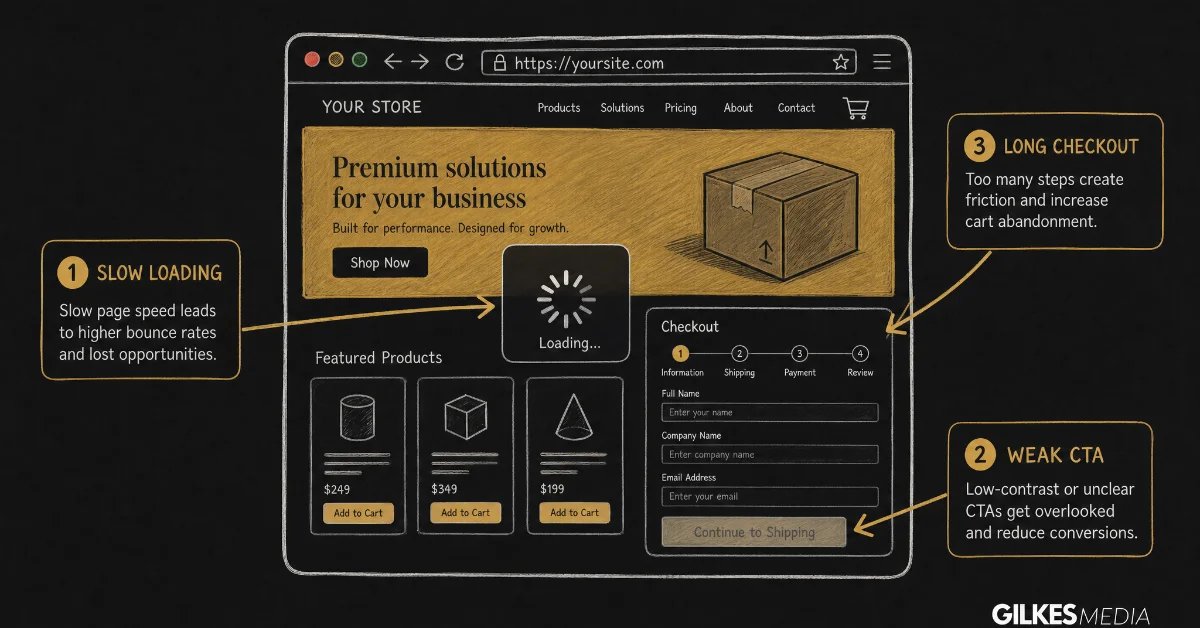
Before a visitor even reads your headline, your site's technical performance is making a first impression. A slow, clunky, or broken website creates instant friction. It erodes trust and sends potential customers away before you have had a chance to make your case.
Every second of loading time counts. Research shows that as page load time goes from one second to three seconds, the probability of a visitor bouncing increases by a staggering 32%. That is a massive, immediate hit to your conversion potential.
Common Technical Issues:
Fixing these foundational issues is often the quickest way to see a tangible lift in conversions.
A visitor should land on your page and immediately know two things: where they are and what to do next. If the path to converting is unclear, convoluted, or requires too much effort, most people simply will not bother.
Take an e-commerce checkout. If a customer has to click through seven pages and fill out twenty form fields just to buy something, they will abandon their basket. The same logic applies to generating leads or getting sign-ups.
Your goal is to make the journey from visitor to customer as smooth as possible. Every unnecessary click, confusing menu, or vague instruction is another reason for them to leave.
Strategic Fixes for a Clearer Journey:
Your website copy needs to do more than just describe what you do; it must answer the visitor’s most important question: "What's in it for me?" If your messaging is generic, full of jargon, or talks about you instead of their problems, it will fall flat.
Your value proposition has to be front and centre. It should instantly explain the benefit you provide, who you provide it for, and what makes you different. If a visitor cannot grasp this within five seconds, your messaging is not working hard enough.
Exploring different conversion rate optimisation tools can help you test and refine your messaging with techniques like A/B testing to see what really resonates.
Finally, the most persuasive website in the world cannot fix a fundamental mismatch between what you are offering and what your audience actually wants. This misalignment can torpedo your conversion rate for several reasons.
Perhaps you are driving the wrong traffic to your page. For instance, running a paid ad campaign targeting "enterprise software solutions" but sending that traffic to a page designed for small businesses is a recipe for failure. The audience and the offer are completely out of sync.
This is a key reason why UK digital marketers focus so heavily on conversion rates. A recent report found 15% see it as the most valuable metric for gauging success. Yet, while 54% of businesses are chasing sales revenue growth, only 56% are happy with their digital strategies. This suggests a clear disconnect between marketing efforts and customer response. You can read the full report on UK digital marketing trends for more details.
By methodically auditing these four areas, you can stop guessing what is wrong and start implementing targeted fixes that deliver a real, measurable impact on your leads and sales.
You have identified the weak spots in your conversion funnel. That was the diagnosis. Now it is time for the treatment.
Conversion Rate Optimisation (CRO) is not about guesswork or chasing the latest design trends. It is a disciplined process. It is about making strategic, data-backed changes to your website to generate more leads and sales from the traffic you already have.
Let's walk through some proven, high-impact tactics that deliver tangible results. We will focus on strategies that are practical for founders and small business owners to implement. These are changes that deliver a clear return without needing huge teams or budgets.
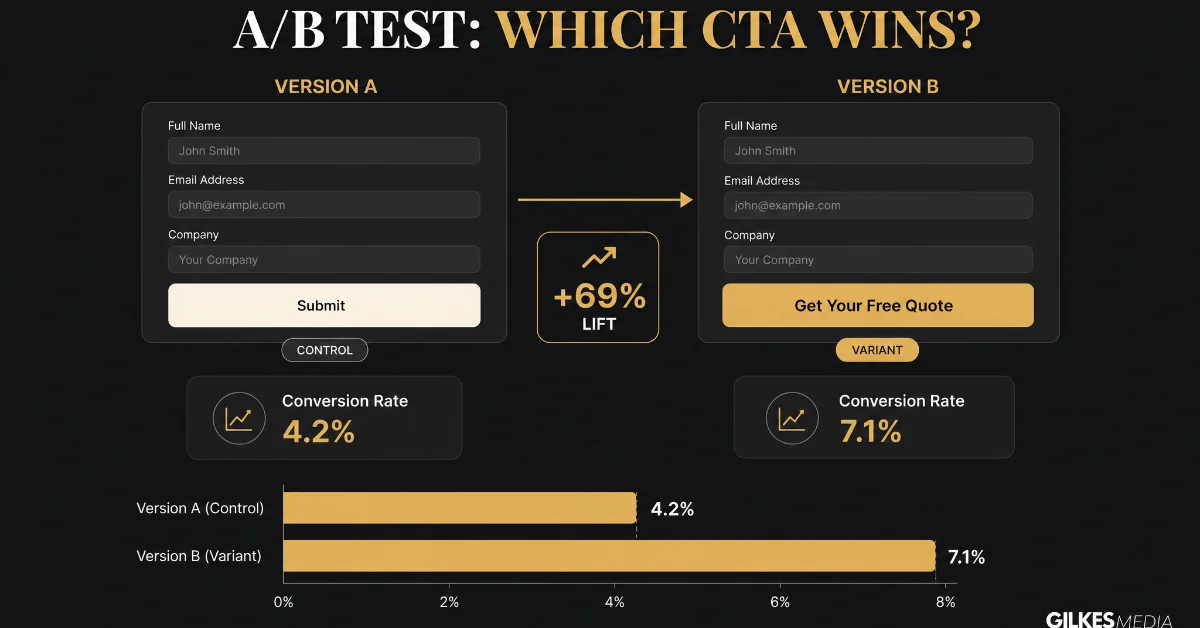
A/B testing, also known as split testing, is the cornerstone of effective CRO. The principle is simple: you create two versions of a webpage element (like a headline or a button) and show each version to a different segment of your audience to see which one performs better.
The key is to test one thing at a time and focus on the high-impact elements. These are the parts of your page that have the biggest potential impact on a user's decision. Small changes here can lead to significant gains.
A confusing landing page is a conversion killer. When a user arrives from an ad or a search result, they need to understand your offer and see the next step within seconds. If they have to work to figure it out, they will just leave.
Clarity and simplicity are your most powerful allies here. Your landing page should have a single, clear objective, and every element on that page should support that one goal.
Your landing page must answer three questions instantly: Where am I? What can I do here? Why should I do it? If the answers are not obvious, you are losing customers.
To get this right, you need to be mastering Conversion Rate Optimization (CRO), which is a systematic process designed to get more visitors to take action. For instance, a well-structured B2B landing page should have a crystal-clear headline, a concise summary of benefits, trust signals, and a prominent contact form, all visible without needing to scroll. A clean, focused layout directly translates to more leads.
People trust other people more than they trust marketing messages. Social proof is the psychological phenomenon where people assume the actions of others reflect the correct behaviour. In marketing, this means using evidence of customer satisfaction to build instant credibility.
This is especially critical in sectors like professional services, where trust is everything. For UK businesses in this space, a good lead conversion rate typically falls between 3% and 7%. On average, just 13% of B2B leads progress to become real opportunities, a process that can take around 84 days. Strong social proof helps shorten that cycle by building confidence much faster.
Types of Social Proof to Implement:
| Social Proof Type | Why It Works | Best For |
|---|---|---|
| Testimonials | Provides direct, authentic quotes from happy clients. | Service businesses and consultancies. |
| Case Studies | Offers in-depth stories of customer success with data. | B2B, SaaS, and high-value service providers. |
| Logos | Shows you are trusted by recognisable brands. | Establishing authority and credibility. |
| Reviews/Ratings | Gives unbiased, third-party validation from users. | E-commerce and local service businesses. |
Integrating these elements strategically across your website, especially on key conversion pages like your homepage or service pages, reduces friction and reassures potential clients that they are making the right choice. To see how these principles are applied in practice, explore our approach to SEO website development, where user trust is built into the fabric of a site from day one.
We have covered the benchmarks, diagnostics, and strategies. Now it is time to put it all together and build a practical framework for setting conversion goals that are both ambitious and achievable for your business. This is the final step, where we move past generic industry averages and build a truly performance-driven marketing strategy.
The aim is not to chase one perfect number. It is about creating a process of continuous, incremental improvement. This is how you build momentum and deliver consistent, measurable growth in leads and sales over time. It all starts with a simple audit of where you stand today.
Instead of getting bogged down in endless data, I recommend a clear, three-step process. This approach strips away complexity and forces you to focus on the actions that will have the biggest commercial impact on your business.
This small, focused target is powerful because it is measurable, achievable, and time-bound. A 0.5% increase might not sound like much, but it represents a 50% improvement in performance for that channel, directly impacting your lead volume and your return on ad spend.
Once you hit that first goal, you will not only build confidence but also gather the data needed to set the next one. This cycle of measuring, targeting, and improving is the essence of effective Conversion Rate Optimisation.
If you are ready to move from guesswork to a strategic, data-driven approach, Gilkes Media can help. We work directly with founders and business leaders to implement these frameworks, turning your website traffic into measurable growth.
Here are answers to the practical questions that always come up when founders and marketing managers start getting serious about their conversion data.
Think of it as a two-step process.
Your lead conversion rate measures how good you are at turning a website visitor into an interested prospect, someone who fills out a form, downloads a guide, or books a call.
Your sales conversion rate then measures how effective you are at turning that prospect into a paying customer. Both are vital for understanding your entire marketing and sales funnel, from first click to final invoice.
It depends on the channel and the volume of traffic.
For fast-moving, high-traffic channels like paid ads, you will want to keep an eye on performance weekly. This lets you spot trends and make quick adjustments before you waste budget.
For everything else, like your overall site performance or organic traffic, a monthly review is usually perfect. It gives you enough data to make smart, strategic decisions without getting caught up in tiny daily fluctuations.
Yes. A high conversion rate is only a good thing if it is attracting the right kind of customer.
For example, you could be converting visitors at 20% on a 'free trial' offer, which looks great on paper. But if none of those free users ever upgrade to a paid plan, you are just filling your pipeline with low-quality leads who drain your resources.
The real goal is not just a high number; it is a high conversion rate that leads directly to profitable, sustainable growth.
At Gilkes Media, we help businesses move beyond simply tracking metrics to achieving real commercial outcomes. If you are ready to build a strategic, data-driven plan to grow your leads and sales, book a free consultation with us today. Find out more at https://gilkesmedia.co.uk.
