
A professional paid search service is not about managing clicks or buying keywords. It is a strategic partnership designed to place your business directly in front of customers at the exact moment they are looking for what you sell.
Its entire purpose is to generate a predictable stream of high-quality leads that fuels genuine business growth.
Imagine your ideal customer is ready to buy. They know their problem and are actively looking for a solution. They go to Google and type in a search that perfectly describes their need.
A paid search service ensures your business appears right at the top of the results page, ready to solve their problem. Think of it as renting a premium storefront on the busiest high street in the world, but you only pay when an interested shopper walks through the door.
This is not another form of advertising that interrupts people. Paid search meets them at their precise point of need. That fundamental difference is why it is such a powerful engine for reliable, measurable growth.
Many businesses try to manage paid search internally but quickly discover that achieving a positive return demands specialist knowledge, constant attention, and deep platform experience. A dedicated paid search service brings a level of strategic oversight and hands-on expertise that is almost impossible to replicate in-house.
The value of this partnership is clear:
This focus on delivering tangible business outcomes is why investment in search advertising continues to grow so consistently. The UK search advertising market saw a remarkable 11.9% rise in 2023, reaching a total spend of £14.7 billion. It is projected to climb even further.
This sustained investment shows the confidence UK businesses have in paid search’s ability to deliver qualified leads and drive revenue. You can explore more about UK advertising spending trends to see the full picture.
Choosing how to manage your paid search is a critical decision. While handling it internally seems cost-effective, it often comes with hidden costs and missed opportunities. Here is a practical comparison between managing it in-house and partnering with a specialist consultant.
| Aspect | In-House Management | Specialist Consultant |
|---|---|---|
| Expertise & Focus | Team members are often generalists, splitting time between marketing tasks. PPC is one of many responsibilities. | A dedicated expert whose sole focus is paid search. They bring deep, up-to-date platform knowledge and experience. |
| Strategy & Execution | Often reactive and tactical, focused on basic campaign setup and maintenance. | Strategic and proactive. Builds campaigns around commercial goals, buying intent, and long-term profitability. |
| Speed & Agility | Slower to react to market changes or performance dips due to competing priorities. | Can make immediate adjustments to bids, budgets, and ad copy. Speed is a key advantage for maximising ROI. |
| Cost & ROI | Appears cheaper initially, but hidden costs include salaries, training, and the high cost of mistakes and wasted spend. | Higher upfront fee, but typically delivers a much stronger ROI by eliminating waste and scaling what works. |
Ultimately, the choice comes down to your goals. In-house management might work for very small-scale campaigns. For businesses serious about growth, a specialist consultant provides the expertise, focus, and accountability needed to turn paid search into a predictable and profitable channel.
At its core, a paid search service is much more than a technical function; it is a strategic investment in predictable growth.
By systematically capturing high-intent demand, it creates a reliable pipeline of new business opportunities. This allows you to forecast sales more accurately, allocate resources with confidence, and make informed decisions about scaling your entire operation. When managed by an experienced consultant, paid search stops being a marketing cost and becomes a dependable growth engine for your company.
A high-performance paid search campaign is not built by chance. It is a meticulously engineered structure designed for one purpose: to generate profitable customer action. This process goes far beyond picking a few keywords and writing an advert. It is a strategic framework built on deep analysis, logical structure, and a relentless focus on commercial outcomes.
As a specialist consultant, my role is to construct this framework from the ground up, ensuring every component works together to maximise your return on investment. The process starts not with the ad platform, but with your business.
This simplified flow shows how a well-structured campaign translates a customer's initial search into measurable business growth.
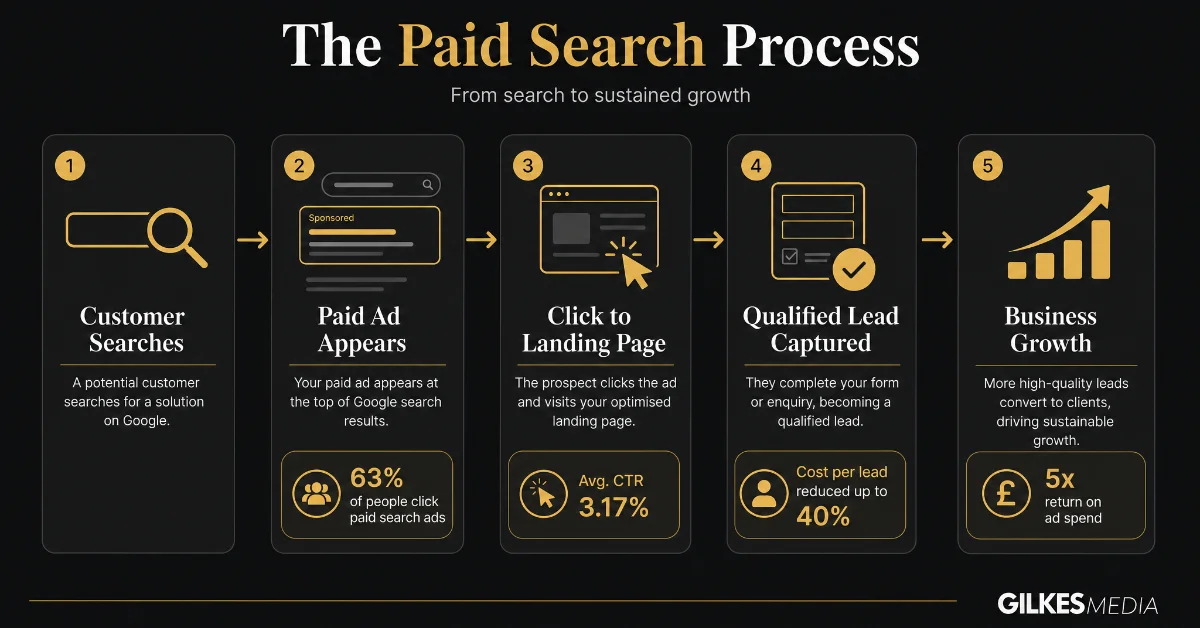
It illustrates the direct line between capturing a user's intent on a search engine and achieving tangible results like more revenue and leads for your business.
Before a single penny is spent, the essential groundwork must be laid. This initial phase is the most critical for long-term success and involves a deep dive into three core areas.
A paid search campaign built on assumptions is destined to waste money. A campaign built on data and strategic insight from the very beginning has a clear path to profitability.
With a solid strategic foundation, the next step is to build the campaign's structure within platforms like Google Ads. A logical, organised structure is vital for control, measurement, and optimisation. This is not a simple setup; it is a deliberate architectural design.
The core components include:
Once your professional paid search campaign is built, ongoing optimisation is crucial to maximise results and ensure predictable business growth. You can explore advanced strategies to improve Google Ads performance that build on this foundational structure. This continuous process of testing, learning, and refining is what separates a basic campaign from a true business growth engine.
When you invest in any professional service, you need to know two things: what it costs and what you will get back. Paid search is no different. Your investment is split into two clear parts, and both are vital for campaign success.
It is better to think of these not as expenses, but as a direct investment in winning new customers and creating a predictable stream of revenue.
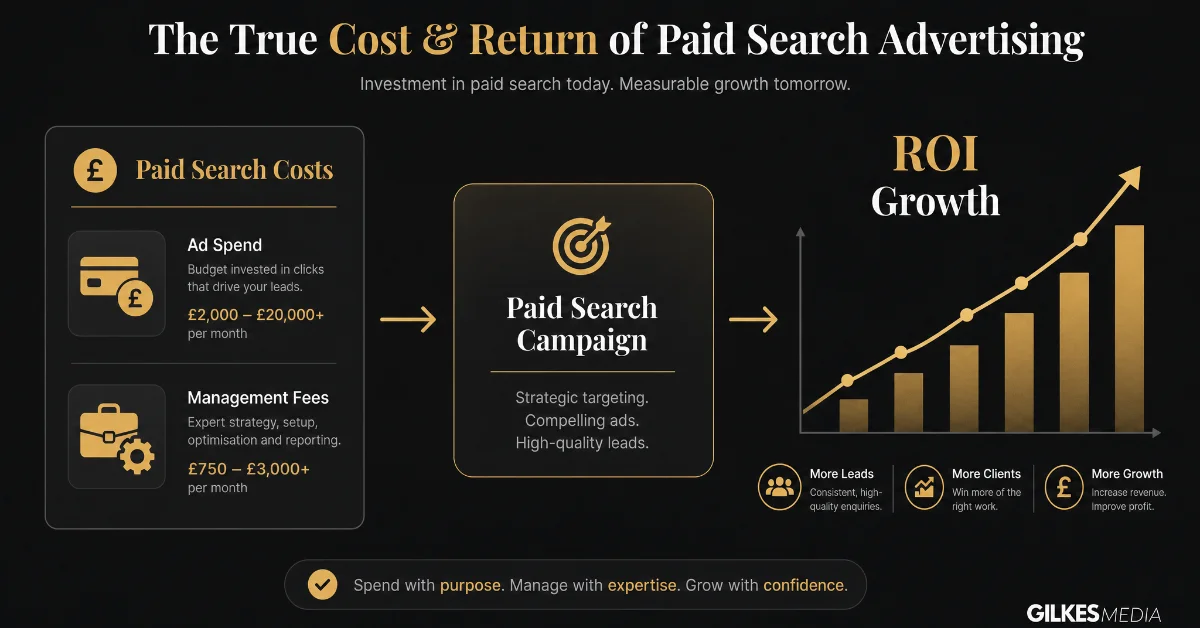
The financial side is quite simple. Your total investment is a combination of what you pay the ad platform and what you pay for expert management.
The management fee is what turns raw ad spend into a high-performance growth engine. Without an expert at the controls, it is incredibly easy to waste money on the wrong clicks, poorly structured campaigns, and missed opportunities.
As a business owner, you want a transparent pricing model that makes sense for you. Most paid search services use one of these common structures.
I find a fixed retainer fosters the best kind of partnership. It keeps everyone focused on the real commercial goals, not just on spending more on ads.
This is the most important question: "What return will I actually get?" While it is impossible to give a precise figure upfront, we can build a solid business case using realistic numbers. This turns a leap of faith into a data-informed decision.
Recent figures show the UK average Google Ads cost-per-click (CPC) has climbed to around £3.65. For competitive industries like legal or professional services, that can easily jump to between £5.53 and £7.11. The key point is that even with these costs, a well-managed campaign can achieve brilliant conversion rates. That is where expert optimisation really pays off.
Your return is not just about clicks; it is about the entire customer acquisition pipeline. It starts with an optimised click and ends with a profitable new client.
To give you an idea of how this might look in the real world, let's run through a simplified example for a service-based business.
| Metric | Example Value (£) | Calculation/Note |
|---|---|---|
| Monthly Ad Spend | £2,500 | Your direct payment to Google for clicks. |
| Average CPC | £5.00 | A realistic figure for a competitive UK service industry. |
| Total Clicks | 500 | £2,500 Ad Spend / £5.00 CPC |
| Website Conversion Rate | 5% | The percentage of clickers who become a lead. |
| Total Leads Generated | 25 | 500 Clicks x 5% Conversion Rate |
| Lead-to-Client Rate | 20% | The percentage of leads your sales process converts. |
| New Clients Acquired | 5 | 25 Leads x 20% Conversion Rate |
| Client Lifetime Value (LTV) | £3,000 | The total revenue a new client is worth. |
| Total Revenue | £15,000 | 5 New Clients x £3,000 LTV |
| Total Investment | £3,500 | £2,500 Ad Spend + £1,000 Management Fee |
| Return on Investment (ROI) | 328% | (£15,000 - £3,500) / £3,500 |
As you can see, even with conservative numbers, the return can be substantial when every part of the process is optimised.
Of course, a great ad campaign can only do so much if your website lets it down. To get maximum value from your paid traffic, you need a site that converts. This practical guide to website conversion rate optimization is a brilliant starting point.
By understanding these figures and the value each new client brings, you can see how a professional paid search service drives real, tangible growth. For a deeper dive into the numbers, check out our guide on how to properly measure your marketing ROI.
When you hire a paid search specialist, you are not just buying clicks or campaign setups. You are investing in a strategic partnership designed to generate profit. The real value comes from tangible outputs and clear communication that tie every action back to your business goals. It is about turning raw data into genuine commercial intelligence.
So, what should you expect to receive? A healthy partnership is built on strategic planning, transparent reporting, and proactive advice. This ensures you always know how your investment is performing and what is coming next.
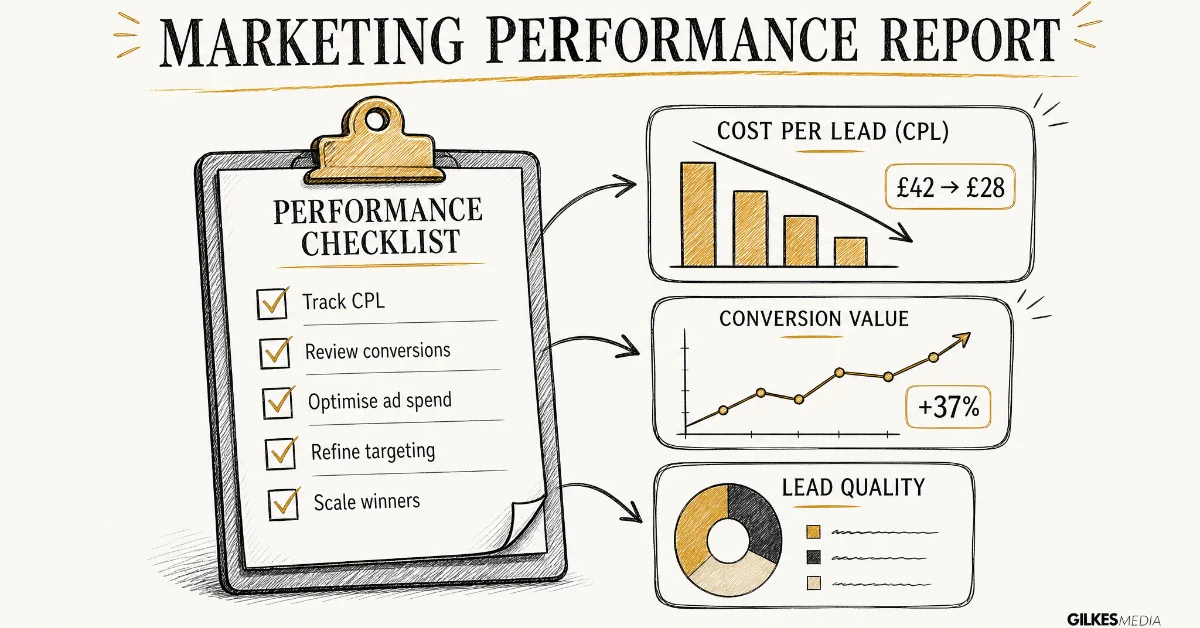
From the start, your consultant should lay out a clear framework for success. This is not guesswork; it is a structured plan built on solid research and a deep understanding of what you want to achieve.
A good report should never leave you with more questions than answers. Its purpose is to provide clarity and guide your next move, not to drown you in confusing charts and technical jargon. The entire focus has to be on business impact.
The only report worth reading is one that connects ad spend directly to revenue. It translates clicks and impressions into a clear story about customer acquisition cost and profitability.
Too many providers focus on ‘vanity metrics’ that look impressive but have little bearing on your bottom line. As a business owner, you need to know the difference and insist on reporting that matters.
This table shows the shift in focus you should demand-moving from basic activity metrics to genuine performance indicators that reveal the financial health of your campaigns.
| Vanity Metric | Meaningful Metric |
|---|---|
| Impressions (How many times the ad was seen) | Conversion Rate (% of clicks that became leads/sales) |
| Clicks (How many people clicked the ad) | Cost Per Lead (CPL) (The exact cost to generate one enquiry) |
| Click-Through Rate (CTR) (% of viewers who clicked) | Return on Ad Spend (ROAS) (Revenue generated for every £1 spent) |
By focusing on metrics like CPL and ROAS, you get a precise, unfiltered view of your customer acquisition costs and profitability. This is what allows you to make informed decisions about scaling your investment with confidence. Transforming raw data into this kind of business intelligence is a core deliverable of any high-quality paid search service.
For a deeper dive, you can explore our overview of effective paid search analytics and reporting.
Picking the right specialist to manage your paid search budget is one of the most important marketing decisions you will make. This is not about finding a technician to click buttons in Google Ads. It is about finding a strategic partner who thinks commercially and is directly accountable for driving your business forward.
The right partner understands that clicks are a means to an end. The real goal is to build a predictable pipeline of high-quality leads that turn into profitable revenue. Your choice here determines whether your ad budget becomes a cost centre or a powerful investment in sustainable growth.
With 65% of UK businesses now using paid search and 67% of B2B marketers seeing it as vital for lead generation, the demand for genuine expertise is huge. Businesses invest heavily because they see the value in targeted traffic, making your choice of partner a critical commercial decision. You can discover more UK digital marketing insights to get a better sense of the competitive landscape.
The most important distinction to make is between a technician and a true consultant. A technician can set up campaigns, tweak bids, and pull reports.
A consultant does all of that but starts with your business goals and works backwards.
They connect every action in your ad account directly to your commercial objectives, whether that is lowering your Cost Per Acquisition or increasing customer lifetime value. They operate as an extension of your leadership team, offering strategic guidance, not just campaign administration. A huge part of this means looking beyond the ad platforms to build a cohesive growth strategy, something we cover in our approach to strategic marketing consultancy.
The right partner will not just ask about your budget; they will ask about your business. They will want to understand your sales process, your margins, and your growth ambitions before they ever log into Google Ads.
To cut through sales pitches and find a specialist who is genuinely focused on results, you need to ask the right questions. Your aim is to test their strategic thinking, their track record, and their accountability.
Here is a practical checklist to guide those conversations:
Once you have gathered your answers, you can evaluate potential partners using a simple but effective framework. A good paid search partner should align with your business across three critical areas.
| Evaluation Area | What to Look For | Red Flags to Avoid |
|---|---|---|
| Accountability | A single, senior point of contact who is directly responsible for performance. Clear, commercially-focused reporting. | Vague promises, junior account managers, and reports filled with vanity metrics. |
| Strategy | A clear focus on business goals and a structured process for achieving them. Proactive recommendations. | An over-emphasis on technical platform features without connecting them to business outcomes. |
| Transparency | Open communication about what is working, what is not, and how your investment is being managed. | Complicated fee structures, a lack of access to your own ad accounts, and jargon-filled reports. |
By using this structured approach, you can move past the surface-level sales pitch and find a partner who is genuinely invested in your success. This decision is far too important to leave to chance.
We have covered how a professional paid search service works, what it costs, and how to measure its impact. If there is one thing to take away, it is this: when managed with a sharp commercial focus, paid search is not a marketing expense. It is a powerful, reliable engine for predictable and scalable business growth.
It is a system for connecting you with customers who are actively looking for a solution right now, creating a direct and measurable path to more revenue. Moving forward with that level of clarity is a serious advantage.
To help you move forward with confidence, here are the essential takeaways. Think of this as the foundational knowledge you need to make a smart decision and invest wisely in your company’s future.
Theory is useful, but a practical plan tailored to your specific business is what actually drives results. The next logical step is to translate this into a clear strategy designed to hit your unique commercial goals.
I invite you to book a complimentary, no-obligation strategy call. This is not a sales pitch. It is a genuine consultation where we will:
[Book Your Free Strategy Call Today]
Even the sharpest business owners have questions before they invest in a professional paid search service. Getting straight answers is essential before you commit your budget, so here are the most common queries we receive.
This is always the first question, and rightly so. While a paid search campaign can start driving traffic almost instantly, achieving a predictable stream of high-quality leads takes a little more time.
You should plan for a 60 to 90-day period of initial data gathering and optimisation. This is where we analyse performance, sharpen the targeting, and determine what works for your market. The goal is not to chase short-term clicks; it is to build a sustainable, long-term growth machine. Patience in the first quarter lays the foundation for profitable growth.
This is a common point of confusion, but the answer is simple. The terms are often used interchangeably, but they describe two different things.
Think of it this way: paid search is the activity, and PPC is how you pay for it. A professional paid search service manages the entire strategic channel, using the PPC model to bring you customers profitably.
Understanding this difference helps you see that you are not just buying clicks (PPC). You are investing in a complete strategy (paid search) designed to generate leads and revenue.
Rarely. A full website redesign is usually unnecessary and can cause long delays. What you absolutely do need, however, is an effective, conversion-focused landing page. This is the specific page a user lands on after clicking your ad.
A good consultant will not just send traffic your way; they will work with you to ensure that page is optimised to turn an expensive click into a valuable lead. This could mean tweaking the headline, simplifying the contact form, or making the call-to-action clearer. The entire focus is on getting maximum value from every visitor.
At Gilkes Media, our job is to turn paid search into a predictable and profitable growth engine for your business. If you are ready to move beyond just getting clicks and start focusing on real commercial outcomes, let's talk.
Book your free, no-obligation strategy call today and we will outline a practical plan to hit your growth goals.
