
Developing a marketing strategy is the process of creating a clear, long-term plan to achieve your company's commercial goals. It is about understanding your market, knowing exactly who you are selling to, and choosing the right channels to bring in leads, drive sales, and maximise your return on investment.
In short, a solid strategy provides the 'what' and the 'why' behind all of your marketing efforts.
Before a single pound is spent on ads, a clear marketing strategy must be in place. Think of it as the commercial roadmap for your business. It is the thread connecting your day-to-day marketing activities, like running a Google Ads campaign or posting on LinkedIn, directly to your most critical business objectives, whether that is capturing more market share or generating a steady flow of qualified sales leads.
Many growing businesses make the expensive mistake of mixing up strategy and tactics. Tactics are the specific actions you take, like creating a content strategy or setting up an email sequence. The strategy is the overarching plan that decides which tactics to use, why you are using them, and how they will deliver a measurable return.
Without that solid strategy, marketing becomes a series of disjointed, reactive tasks that burn through cash with very little to show for it.
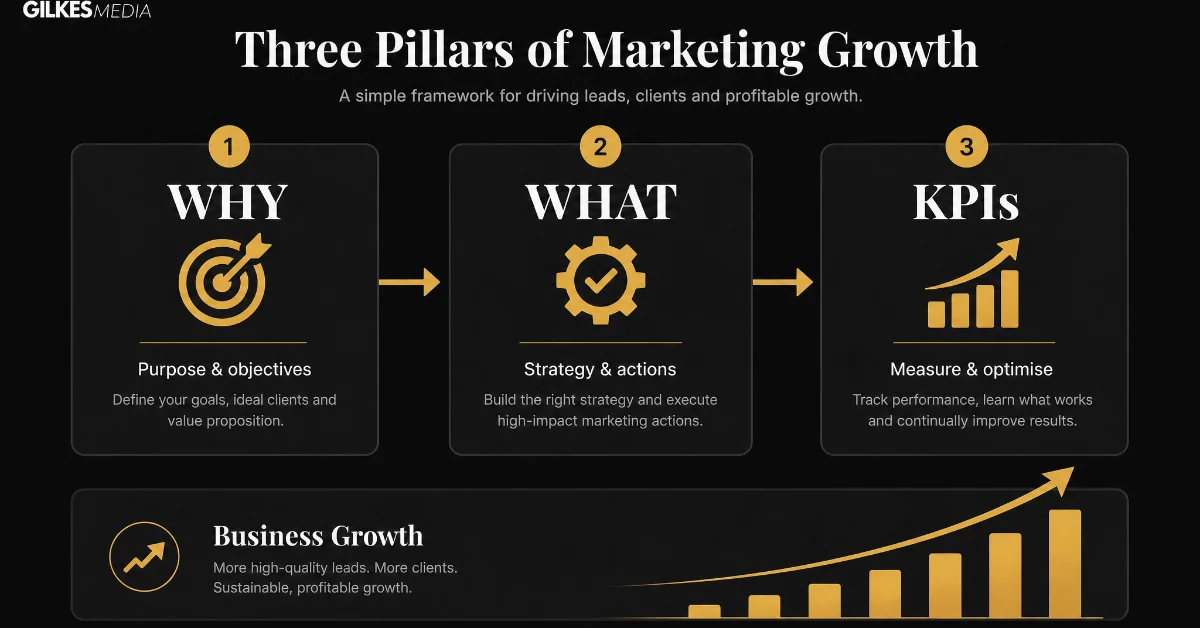
A performance-driven strategy forces you to think commercially. Every decision is weighed against its potential impact on the bottom line. This approach ensures your marketing is not just a cost centre but a primary engine for business growth.
The core of a strong marketing foundation always includes:
At Gilkes Media, we build strategies that are grounded in commercial reality. As a hands-on marketing consultant, my focus is on delivering a clear plan that aligns your team, stops wasted spending, and gives you a direct path to hitting your growth targets.
The UK market has shifted decisively towards digital. Recent figures show that digital activities now account for 48.7% of all marketing budgets, a number that jumped by 12.8% in just one year. This digital-first reality means that effective marketing strategy development requires deep, practical expertise in paid channels and data analysis to extract maximum ROI from your spend.
Building this foundation is the first step towards sustainable growth. A well-defined strategy does not just guide your marketing; it points your entire business towards a common, profitable goal.
Before you can plan the journey, you need to know exactly where you are starting from. The first practical step in marketing strategy development is taking a brutally honest look at where your business stands right now. This means getting past gut feelings and assumptions and digging into hard data to get a clear, objective picture of your current performance.
A candid audit is not about blaming anyone for past failures; it is about learning from expensive lessons. It is a commercial necessity that grounds your future strategy in reality, not wishful thinking. Skip this, and you are building a plan on a weak foundation, guaranteeing wasted budget and missed opportunities.
First, look inwards. Pull together all the performance data you can find from the last 12 to 18 months of marketing activity. The goal here is simple: find out what worked, what did not, and why.
You need to ask some tough questions:
Next, be realistic about your resources. This is not just about your budget; it is a full inventory of what you can actually put to work.
Competitor analysis should not be a box-ticking exercise that results in a useless spreadsheet of features. It needs to be a focused investigation to find gaps in the market that you can exploit.
Do not try to analyse every competitor. Instead, pick two or three of your closest competitors, the ones actively winning business you feel should be yours.
Analyse their approach across these key areas:
This deep dive will show you their strengths, but more importantly, it will highlight their weaknesses. Perhaps their messaging is vague, or they are completely ignoring a key channel like LinkedIn. These are the strategic gaps where you can build a strong foothold.
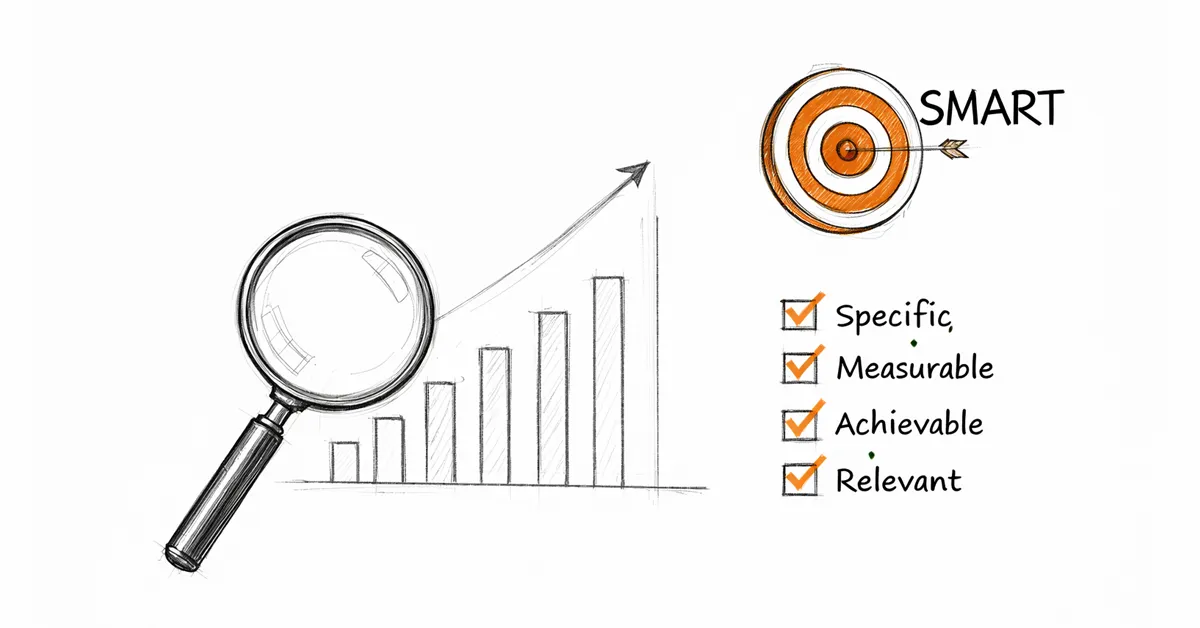
With your audit complete, you can now set objectives that are tied directly to business growth. Vague goals like "increase brand awareness" or "get more leads" are useless. Your objectives must be specific, measurable, and commercially meaningful.
The single biggest shift a business can make is moving from aspirational goals to accountable targets. A good objective leaves no room for interpretation and makes it crystal clear whether you have succeeded or failed.
We use the SMART framework to bring this discipline to goal-setting:
Let's see how this transforms a vague goal into a powerful SMART objective.
| Vague Goal | SMART Objective |
|---|---|
| Get more leads | Generate 50 marketing qualified leads (MQLs) per month from LinkedIn Ads within six months. |
| Improve sales | Achieve a Customer Acquisition Cost (CAC) of under £450 for all new customers acquired through Google Ads by the end of Q3. |
| Grow website traffic | Increase organic search traffic to key service pages by 25% over the next 12 months. |
This level of precision turns your marketing from a series of hopeful activities into a targeted, performance-driven operation. Now, every decision, from channel selection to budget allocation, can be measured against its ability to move you closer to these concrete targets. This is the foundation of a strategy that actually delivers a return on investment.
Great marketing is not about shouting into a crowded room; it is a direct conversation with a specific person. If your objectives tell you where you are going, your audience defines who you are talking to.
Get this wrong, and even the most technically perfect campaign will be a commercial flop. The goal here is to move past vague demographics and build a crystal-clear picture of your ideal client.
Many businesses make the costly mistake of basing their audience on assumptions. This always leads to generic, ineffective messaging because it fails to address a real, urgent problem. A data-driven approach is the only way to guarantee your marketing budget is spent talking to people who are actually likely to buy from you.
At the heart of this is the crucial process of audience analysis. This is not just about knowing job titles; it is about understanding the human being on the other side of the screen.
A customer persona is a semi-fictional profile of your ideal client, but it is built from real data and actual insights. It gives your marketing a face and a name, making it much easier to write copy and create ads that feel personal and relevant.
To build a persona that is actually useful, you need to gather both qualitative and quantitative data. Here is where to look:
With this information, you can build a simple but detailed persona document. Do not just list their role; map out their goals, their biggest challenges, and what truly motivates them.
A great persona tells you more than what a person does. It tells you why they do it, what they are struggling with, and how your business can concretely solve their problem. This is the foundation of messaging that converts.
Once you know exactly who you are talking to, you must be brutally clear on what you want to say. Your value proposition is a short, sharp statement that explains the tangible results a customer gets from using your product or service.
It is the straight answer to their question: "Why should I buy from you and not your competitor?"
A strong value proposition is:
Let's look at the difference for a B2B software company. It is night and day.
| Vague Statement | Strong Value Proposition |
|---|---|
| We sell project management software. | Our software helps construction firms reduce project delays by 15% by automating their resource scheduling. |
| Our CRM is easy to use. | Our CRM saves sales teams 10 hours per week by eliminating manual data entry, letting them focus on closing deals. |
See the difference? That specificity is what separates you from the noise. It shifts the conversation away from features and towards the commercial outcomes your clients actually care about.
Your positioning is all about how you occupy a distinct space in your customer's mind. Are you the premium option? The most efficient? The best choice for a specific niche? This clarity has to shine through in every single piece of marketing you produce.
From this foundation, you can then develop your core messaging pillars. These are the two to four key themes or benefits you will communicate relentlessly across all your channels. It ensures that whether someone sees your Google Ad, reads a blog post, or finds you on LinkedIn, they get a clear, unified message about the value you deliver. This consistency is what builds trust and makes your brand memorable for all the right reasons.
You have your objectives nailed down and a crystal-clear picture of your audience. Now comes the intensely practical part: deciding where to spend your money and how to actually reach the people who matter.
This is not a creative exercise; it is a critical commercial decision.
The biggest mistake I see businesses make is spreading themselves too thin. They try to be everywhere at once, a bit of Facebook, a dabble in Google Ads, the occasional blog post, and end up mastering nowhere. A far smarter approach is to identify the one or two channels where your ideal customers are most active and dominate them. Quality of engagement will always trump quantity of channels.
This process of crafting your message starts with data, not guesswork. The flowchart below shows a simple but powerful way to think about it.
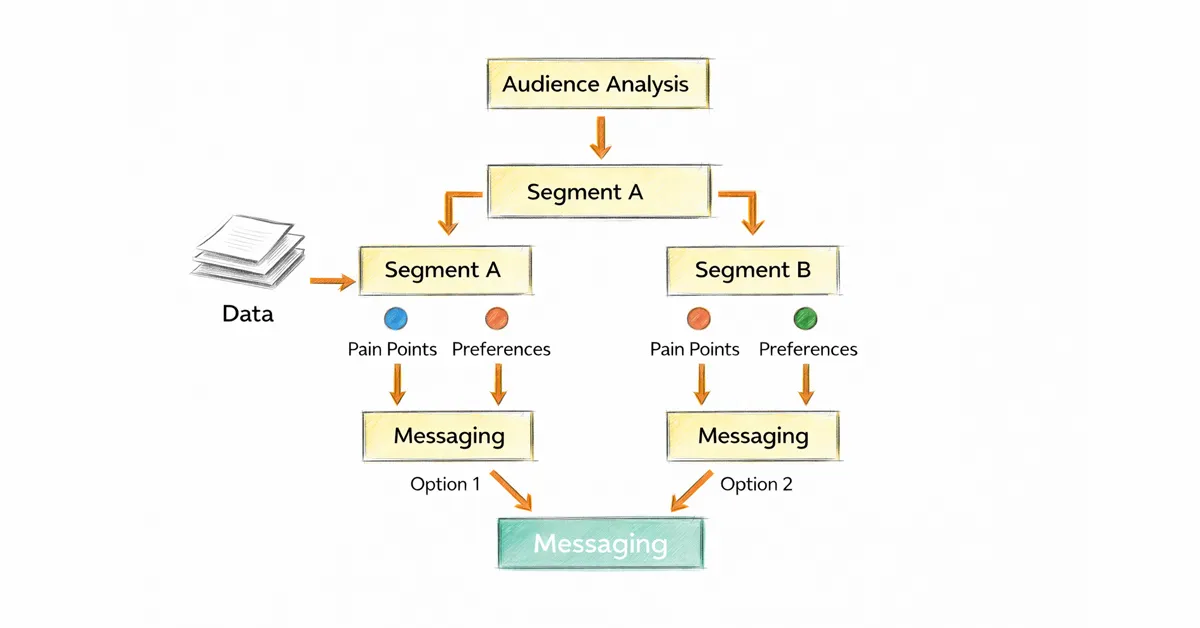
It highlights a fundamental truth: your budget is best spent on communications that connect with real customer needs, and you can only discover those needs by looking at the data.
To choose your channels effectively, you need a simple way to connect your commercial goals to the strengths of each platform. For most UK SMEs, the choice often comes down to three core contenders.
Your channel choice is a strategic bet. Betting on Paid Search is a bet on capturing existing intent. Betting on Paid Social is a bet on creating new intent. Betting on SEO is a long-term investment in building an asset that pays dividends for years.
To make this even clearer, here is a simplified framework to help you decide where to focus your resources first.
| Channel | Primary Objective | Time to ROI | Best For |
|---|---|---|---|
| Paid Search (Google Ads) | Immediate Lead Generation | Days to Weeks | Businesses solving an urgent problem or capturing high-intent searches. |
| Paid Social (Meta/LinkedIn) | Demand Creation & Nurturing | Weeks to Months | Building brand awareness, reaching specific demographics/job titles, and lead nurturing. |
| SEO | Long-Term Asset Building | Months to Years | Establishing authority, generating consistent organic traffic, and lowering long-term acquisition costs. |
This table is not exhaustive, but it should help you align your commercial goals with the channels most likely to deliver. Do not try to do everything; pick the one that best fits your immediate needs and commit to mastering it.
Your marketing budget should never be based on what you feel you should spend. It has to be a calculated investment tied directly to your commercial goals. Recent data shows that UK marketing budgets are on the rise, with digital spending increasing by 14.43% on average as businesses shift their money to channels with measurable returns.
The best way to do this is to start with your revenue goals and work backwards. This approach brings financial discipline to your marketing and turns it from an expense into a growth driver.
Here is how it works, step-by-step:
This method completely changes the conversation around marketing spend. It is no longer an arbitrary expense, but a predictable investment in growth where every pound is accountable to a specific commercial outcome.
A strategy document is commercially useless if it just gathers dust on a shelf. The real value comes from execution, turning that brilliant plan into consistent, focused action. This is where theory translates into tangible results.
The key is to break your big, ambitious annual goals into a manageable, practical action plan. Doing this stops the team from feeling overwhelmed and ensures you are making steady progress. It turns a long-term vision into a series of achievable short-term wins.
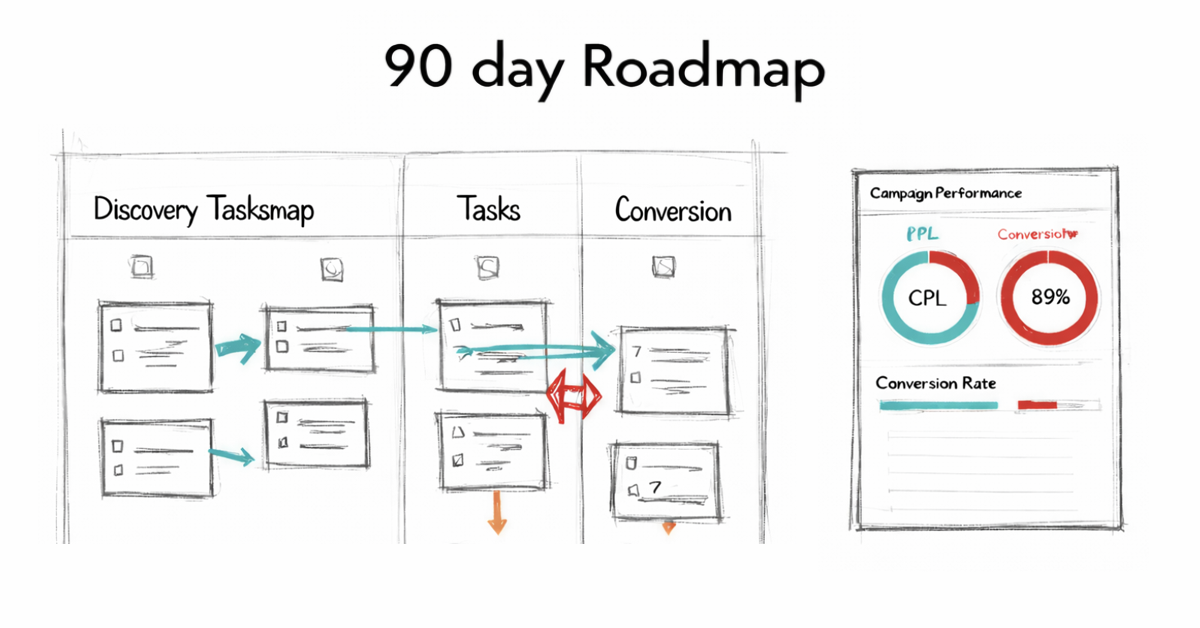
Thinking in 90-day sprints is a powerful way to bring your strategy to life. It gives you enough time to launch meaningful initiatives and see results, but it is short enough to let you pivot based on performance data. An annual plan is just too rigid; a 90-day roadmap builds momentum and agility.
Your roadmap should break down your high-level strategic goals into concrete deliverables. Here is a simple way to structure it:
This structured approach transforms your strategy from a high-level document into a clear work plan the whole team can follow. It drives accountability and keeps everyone focused on the work that actually makes a commercial impact.
To know if your execution is working, you have to measure the right things. Many businesses get distracted by vanity metrics, numbers that look impressive on the surface but have no real connection to business outcomes.
Vanity metrics like impressions, likes, or website visitors feel good, but they do not pay the bills. The only metrics that matter are the ones that tell you if you are making money.
Performance metrics, on the other hand, are directly tied to your commercial goals. They give you an honest, unfiltered view of your marketing's financial performance. Focusing on these is fundamental to making smart, data-driven decisions.
Here is how to tell them apart:
| Metric Type | Examples | What It Tells You |
|---|---|---|
| Vanity Metrics | Impressions, Page Views, Social Media Followers, Clicks | How much activity you're generating. These are often indicators of reach, but not necessarily impact. |
| Performance Metrics | Cost Per Lead (CPL), Customer Acquisition Cost (CAC), Conversion Rate, Return on Ad Spend (ROAS) | How efficiently you're generating leads and sales. These metrics directly measure profitability and ROI. |
Your Key Performance Indicators (KPIs) should be a short, focused list of performance metrics that align directly with the SMART objectives you set earlier. For a lead generation campaign, your primary KPIs would be Lead Volume, Cost Per Lead, and Lead-to-Customer Conversion Rate. Everything else is secondary.
You need a single source of truth to track progress against your KPIs. A performance dashboard does not need to be complicated; it just needs to show clearly whether you are on track to hit your targets.
A simple spreadsheet or a tool like Google Data Studio can work perfectly. The dashboard should display your core KPIs on a weekly or monthly basis, comparing your actual performance against the targets you set in your strategy.
This dashboard becomes the centrepiece of your review meetings. It removes emotion and opinion from the conversation and focuses everyone on the hard data, fostering a culture where results, not just effort, are what count. Understanding how to connect spend to results is vital; our guide on creating a marketing strategy offers a practical framework for this.
A marketing strategy is not a "set it and forget it" document. The market changes, competitors adapt, and new opportunities arise. Your strategy has to be a living plan that evolves based on real-world performance.
This is where regular review cycles become non-negotiable.
This disciplined rhythm of execution and review is what separates businesses that succeed with their marketing from those that do not. It builds a powerful feedback loop of Plan, Execute, Measure, Iterate that ensures your marketing strategy continuously improves and delivers an ever-greater return on your investment.
Putting a strategy together is one thing; keeping it practical for a smaller team is another. Our guide to marketing strategy for small businesses covers that balance, and if you're also weighing up how many channels to run at once, our guide to omni-channel vs multi-channel marketing is a useful next read.
Even with the best framework in place, a few practical questions always come up. Founders and SME leaders, in particular, need to know the answers because every decision and every pound counts.
Here are the straight-talking answers to the questions we hear most often.
There is no magic number, but a smart budget is never based on guesswork. The question is not, "What's a typical budget?" It is, "What revenue do I need to achieve, and what can I afford to pay to acquire a new customer profitably?"
For SMEs looking for a rough benchmark, allocating 7% to 12% of total revenue to marketing is a decent starting point. But a much better, performance-driven approach is to work backwards from your commercial goals.
Here is how we do it:
This simple exercise transforms your budget from a blind expense into a calculated investment, tied directly to commercial outcomes.
The time it takes to see a real return on investment (ROI) depends entirely on the channels you have chosen. It is absolutely crucial to set realistic expectations here, otherwise, you risk pulling the plug on a great strategy just before it starts to deliver.
Different channels work on different timelines.
| Channel Strategy | Typical Time to See Positive ROI | Key Considerations |
|---|---|---|
| High-Intent Paid Ads | 1–3 Months | Targets people actively looking for a solution now. Needs a testing budget and sharp optimisation to hit profitability quickly. |
| Demand-Creation Paid Ads | 3–6 Months | Builds awareness and nurtures potential leads who are not ready to buy yet. The sales cycle is longer, but it creates a pipeline for the future. |
| SEO & Content Marketing | 6–12+ Months | This is a long-term asset. It takes time to build authority and rankings, but the reward is compounding, low-cost leads for years to come. |
The most common mistake we see is judging a long-term strategy like SEO by short-term metrics. Each channel has its own rhythm; your strategy has to respect that to deliver its full value.
A strategy should be a living document, not something you carve in stone. You should always be ready to pivot based on performance data and shifts in the market. The trick is knowing the difference between a necessary strategic shift and just being impatient.
Think about a pivot when you see these clear signs:
Do not panic and tear everything up after one bad week. A real pivot should be a deliberate decision, made after a thorough review of performance data over a meaningful period, usually a full quarter.
Ready to build a marketing strategy that delivers measurable commercial results? At Gilkes Media, we partner directly with business leaders to design and execute plans that drive leads, sales, and sustainable growth.
Book a free, no-obligation consultation at https://gilkesmedia.co.uk to discuss your objectives.
