
Google is no longer the only place people search. Millions of UK searches now happen inside ChatGPT, Perplexity, and Google’s own AI Overviews.
The way those tools pick which businesses to mention is different to classic SEO, and that difference is starting to matter for anyone relying on search for new business.
If you’ve started asking what it costs to get recommended inside an AI answer, rather than just ranked on a results page, you’re not early and you’re not late. Most UK providers are still working out how to price this properly.
This guide sets out what AI SEO actually involves. It’s also called GEO, generative engine optimisation, or AEO, answer engine optimisation, depending on who’s selling it.
It covers what UK agencies and consultants are charging in 2026, and how to tell a genuine service from a relabelled SEO retainer.
AI SEO, GEO, and AEO all describe the same broad shift: making sure your business gets cited, quoted, or recommended when someone asks an AI tool a question, rather than just ranked in a list of blue links.
The terms get used loosely. GEO (generative engine optimisation) is the most common label for optimising content so generative AI tools can find it, understand it, and quote it accurately.
AEO leans slightly more towards structuring content as direct answers to likely questions. In practice, most UK providers use the two terms interchangeably, and few clients ask them to draw a hard line between them.
None of this replaces traditional SEO. Google’s AI Overviews, ChatGPT’s web search mode, and Perplexity all still rely heavily on indexed, crawlable web content, much of it pulled from pages that already rank well organically.
What’s different is the mechanics. Structured data, machine-readable formatting, and explicit permissions for AI crawlers matter more than they used to.
Strong traditional rankings alone no longer guarantee a citation inside an AI-generated answer, which is the gap this whole discipline exists to close.
Three years ago, nobody budgeted separately for “AI search.” The reason it’s a genuine conversation now is a measurable shift in where clicks go once an AI Overview appears on a results page.
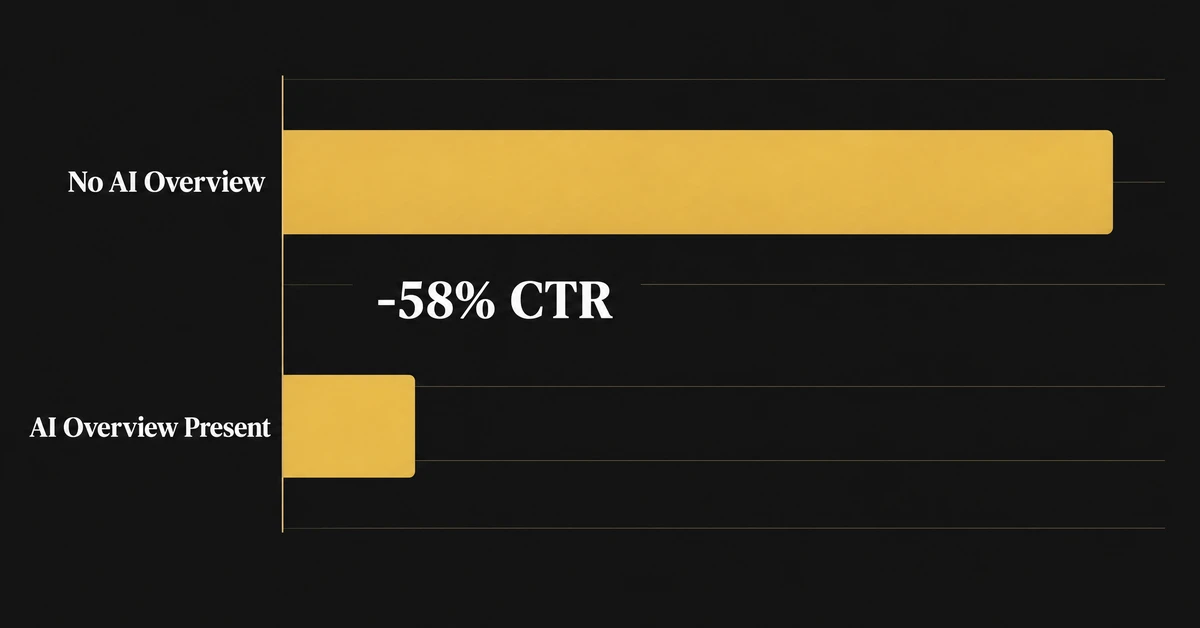
Ahrefs tracked 300,000 keywords and found that when a Google AI Overview appears above the organic results, the top-ranking page’s average click-through rate drops by 58%.
That’s up sharply from a 34.5% drop measured less than a year earlier, which tells you how fast this is moving, not just that it’s happening.
It’s not a UK-specific figure. Ahrefs’ study used aggregated Search Console data rather than a UK-only sample. But the mechanism, the AI Overview answering the query before anyone reaches your site, applies wherever Google shows one.
Ofcom’s 2026 News Report found 21% of UK adults had used an AI app or service for news in the previous month, with ChatGPT the single most-used tool at 13%.
That’s news consumption specifically, not search generally, but it’s real, measured UK adoption data rather than a vendor’s own projection.
UK SEO analytics firm SearchScore estimates roughly one in three Google searches in the UK now trigger an AI Overview, up from around one in five at the start of 2025.
Treat that as one firm’s own estimate rather than an independently audited figure. It’s still a believable direction of travel given what Ahrefs and Ofcom are both separately showing.
AI Overviews haven’t replaced organic search in the UK, but they sit in front of it often enough that losing even half your clicks on the queries where one appears is now a real, measurable cost.
Fewer visits arrive from an AI tool’s own link-outs than from Google today, by a wide margin. But the growth rate, and the quality of that traffic once it arrives, is why providers are paying attention.
Adobe Analytics found AI-referred traffic to US retail sites grew 138% year on year by May 2026, and over 1,300% since October 2024.
More strikingly, Adobe found that traffic arriving from AI tools converted 54% better than traffic from non-AI sources, a reversal from a year earlier when AI-sourced visits converted worse.
That’s US retail data, not UK or B2B services data, so treat the exact percentages as directional rather than a figure to plan a UK budget around. The underlying pattern, small but high-intent traffic, is worth watching regardless.
Someone who asked ChatGPT or Perplexity a specific question, got a recommendation, and clicked through has already done most of their research. They’re further down the funnel than someone skimming ten blue links.
That’s the real commercial argument for paying attention to this now, not the volume of traffic itself, which is still modest for most UK service businesses.
ChatGPT, Claude, Perplexity, and Google AI Overviews don’t source answers the same way. Treating “AI search” as one single target is a common, costly mistake.
Analysis from AEO vendor Discovered Labs found ChatGPT cites Wikipedia in roughly 7.8% of answers and leans towards “best of” style roundup content. It also cited competitor sites noticeably more often than Google Search results did for the same query.
The same analysis found Reddit accounted for 46.7% of Perplexity’s top citations, nearly double Wikipedia’s share. Perplexity performs live retrieval at query time rather than relying purely on a pre-built index.
Google AI Overviews showed 54% overlap with top-20 organic rankings in the same analysis, so classic SEO still carries real weight here. Even so, 48% of citations came from outside the top 100 organic results, which traditional ranking alone wouldn’t explain.
These figures come from a single AEO consultancy’s own research, not an independent academic study, so they’re worth treating as a useful directional signal rather than an exact, audited benchmark.
The practical takeaway holds regardless of the exact percentages: a provider optimising only for Google AI Overviews is solving a different problem to one optimising for Perplexity, and a genuinely useful AI SEO service should say which engines it’s actually targeting.
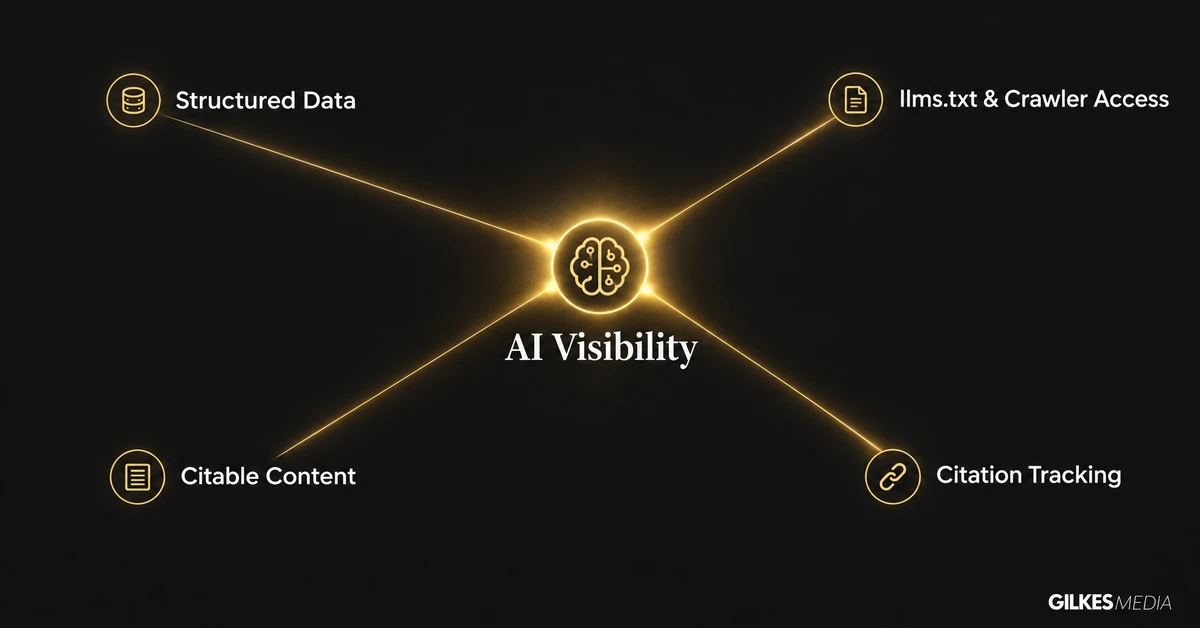
Strip away the branding and most AI SEO work breaks into four practical jobs. None of them are exotic, but most UK businesses haven’t done any of them yet.
AI tools lean heavily on structured data (Schema.org markup) to understand what a page is actually about: a product, a service, a review, an FAQ, a person.
Clean, accurate schema makes it easier for an AI tool to extract and quote your content correctly, and it’s the same markup that underpins Google’s rich results.
llms.txt is an emerging, informal standard: a simple text file telling AI crawlers what’s on your site and how to use it, similar in spirit to robots.txt.
Checking that robots.txt isn’t accidentally blocking crawlers like GPTBot or PerplexityBot is an equally basic, equally overlooked step, worth checking even if you do nothing else in this guide.
AI tools tend to lift short, self-contained, factually confident passages rather than long, hedging paragraphs.
Content written with clear definitions, direct answers, and genuine data performs better here than copy written purely to satisfy a keyword density checklist.
You can’t improve what you can’t measure. Tools like Profound and BrightEdge, and a growing number of smaller UK entrants, now track how often, and how accurately, a brand gets mentioned inside ChatGPT, Perplexity, and AI Overview answers.
Without this baseline, there’s no honest way to prove any AI SEO work has actually changed anything, which is exactly why it belongs in any serious provider’s scope from day one.
This isn’t equally urgent for every business. Some sectors have far more to gain from acting now than others.
Pure transactional ecommerce, low-consideration purchases, and hyper-local businesses with no realistic chance of being recommended outside their immediate area can reasonably wait and watch this space for another year.
If you’re unsure which camp your business falls into, the baseline check in the “getting started” section below costs nothing but time, and answers the question directly rather than leaving it to guesswork.
Before paying anyone for this, agree what success actually looks like. Vague “visibility” reporting is how this category earns a bad reputation.
The core metric: out of a fixed set of real customer questions, how often does your business get mentioned, and how does that compare with named competitors? This needs checking on a fixed schedule, not just once.
Google Analytics can already segment traffic from chatgpt.com, perplexity.ai, and similar referrers. It’s small for most UK businesses today, but it’s a real number worth watching, not a vanity metric.
When a business gets recommended inside an AI answer, a common follow-on behaviour is a branded Google search for that business a day or two later.
A rise in branded search volume is a reasonable proxy signal, even without a direct AI-referral click showing up in analytics.
Agree which of these three a provider will actually report on before signing anything, and insist on a baseline measurement before work starts, not an estimate produced afterwards.
If a provider can’t tell you your current citation rate before they start, they can’t honestly tell you it’s improved six months later either.
Genuine, published UK pricing for this specific service is still thin on the ground. Most providers either fold it into an existing SEO retainer or quote bespoke.
That makes comparing like-for-like harder than it is for an established service like Google Ads management, where published benchmarks are everywhere.
A standalone audit, checking your current AI visibility, structured data, crawler access, and where competitors are already being cited, typically runs from a few hundred pounds for a small site to several thousand for a larger one with multiple service lines.
Kent-based agency Level Up Leads publishes four tiers blending local SEO with AI SEO and GEO work, from £200 a month at entry level up to £2,300 a month as scope grows to include AI-optimised content and backlinks.
The GEO Agency, a UK-registered specialist, describes entry-level AI visibility programmes starting “at a few hundred pounds a month” and scaling past £20,000 a month for national brand programmes.
| Tier | Typical Monthly Cost | What's Usually Included |
|---|---|---|
| Entry-Level | £200 – £500 | Basic structured data fixes, llms.txt setup, light AI visibility reporting |
| Growth / SME | £1,000 – £2,500 | Full technical AI SEO, citable content rewrites, multi-engine tracking |
| Enterprise | £3,000 – £6,000+ | Dedicated content production, ongoing citation tracking across engines |
| National Brand | £20,000+ | Multi-vertical, multi-engine programmes with a dedicated account team |
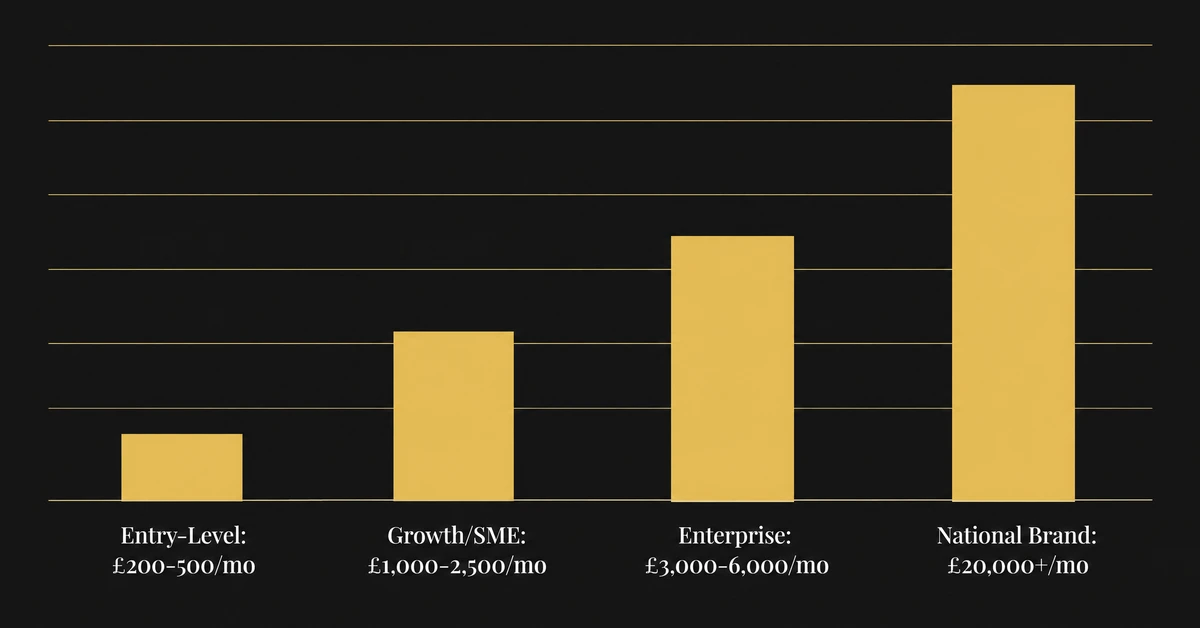
At the top end, pricing stops looking like an SEO retainer and starts looking like a PR or brand-monitoring budget.
That typically means ongoing citation tracking across several AI platforms, dedicated content production, and continuous technical work across a large site or multiple brand verticals.
Treat any AI SEO quote with scepticism until it names the AI engines being tracked, how citations are measured, and what you’ll actually see at the end of month one.
Our own SEO Cost UK guide puts a typical UK SME SEO retainer at roughly £500 to £3,000 a month, depending on competitiveness and scope.
AI SEO/GEO retainers sit in a broadly similar range at the entry and growth tiers, which is exactly why most providers bundle the two rather than selling AI SEO as a standalone service.
The main pricing difference shows up at the top end. Enterprise AI visibility programmes, with citation tracking across several AI platforms, can scale past an equivalent traditional SEO retainer.
That’s because the tooling and monitoring layer behind citation tracking is still new, and relatively expensive to run, compared with mature rank-tracking tools built for traditional SEO.
None of these drivers are unique to AI SEO. They’re the same variables that move a traditional SEO retainer up or down.
What’s new is that most providers haven’t yet built a standard, comparable package around them, which is exactly why asking detailed scope questions matters more here than for an established service.
Hiring in-house for this specifically is rare in the UK right now. Most businesses fold it into an existing SEO or marketing hire’s remit rather than recruiting a dedicated role.
Indeed puts the average UK SEO Specialist salary at £35,293 a year, based on 433 reported salaries.
Add the 2026/27 employer National Insurance rate of 15% above the £5,000 secondary threshold, and a fully loaded in-house hire costs roughly £39,500 to £40,000 a year, before tools or training.
Freelance marketplace Malt lists UK SEO consultants with 8 to 15 years’ experience averaging around €417 a day, roughly £350 at current exchange rates, rising to around €483 (about £405) for consultants with 15 or more years’ experience.
A few days a month at that rate, enough for a focused AI SEO workstream alongside existing SEO, lands in a similar £1,000 to £2,500 monthly range as a small agency retainer.
Outsourcing a mid-tier retainer, £1,000 to £2,500 a month per the bands above, costs £12,000 to £30,000 a year. There’s no recruitment risk, and immediate access to someone already tracking multiple AI platforms.
For most SMEs, that makes outsourcing, whether freelance or agency, the more realistic starting point than a dedicated hire.
A dedicated in-house role tends to make sense only once a business already runs a large content and technical SEO operation, where AI visibility becomes one more layer, not a standalone job.
A £1,500 a month retainer and a £40,000 a year hire aren’t really competing for the same budget line. One is a specialist add-on, the other is a headcount decision.
It’s a fair question. SearchScore’s own audit of 101 Birmingham accountancy firms in May 2026 found an average AI visibility score of just 47.4 out of 100.
Over 60% of those firms were missing structured data entirely, and only 8% had an llms.txt file in place.
That’s one sector, one UK city, one firm’s own dataset, so treat the exact numbers cautiously rather than as a national benchmark.
But it points at something real: most UK SMEs in a given sector haven’t done the basics yet, which means the cost of competing for AI visibility right now is lower than it will be once everyone catches up.
If your customers are the kind of people who’d ask ChatGPT or Perplexity to recommend a business like yours before they’d Google it, being one of the few who’s addressed this is worth real money.
If they’re not, it’s reasonable to spend the budget on channels with a proven return first, and revisit this in six to twelve months as adoption grows.
Take a typical UK B2B services business with around 40 pages: a handful of service pages, a blog, case studies, and an FAQ section.
A one-off audit at this size would likely sit in the low hundreds to low thousands of pounds, covering structured data gaps, llms.txt setup, and a baseline citation check across ChatGPT, Perplexity, and Google.
An entry to growth-tier retainer, £500 to £1,500 a month, would typically cover fixing the structured data gaps the audit finds, rewriting the two or three highest-value service pages, and monthly citation tracking.
That’s a modest add-on to an existing SEO budget for most businesses this size, not a second major marketing line item, provided the scope is genuinely new work and not a renamed SEO retainer.
A larger ecommerce site with hundreds of product pages would need a different shape of work entirely, with structured data and content prioritisation focused on the highest-margin or highest-volume product lines first, rather than attempting everything at once.
In both cases, the first invoice should map directly onto the audit findings. If a provider can’t explain why a particular fix costs what it does, that’s worth questioning before work starts, not after the first payment.
A growing number of SEO agencies have simply added “AI SEO” or “GEO” to their service list without changing what they actually deliver.
The giveaway is usually in the reporting: if nothing in a monthly report mentions structured data changes, llms.txt, or citation tracking across named AI engines, the work probably hasn’t changed either, whatever the proposal called it.
That doesn’t make the underlying SEO work bad. It just means you’re not actually buying the thing this guide describes, and shouldn’t be paying a premium for it.
Judge any AI SEO quote on scope and receipts: engines named, a tracking method, and a saved example of your own content actually being cited. Never judge it on the number alone.
AI SEO isn’t a replacement service, it’s an extension of the same technical and content foundations covered in our guide to what SEO actually costs in the UK.
A site with weak technical SEO won’t suddenly perform well in AI answers just because someone adds an llms.txt file.
If you’re already paying for SEO and nothing in that retainer covers structured data, AI crawler access, or citation tracking, that’s worth raising with your current provider before paying anyone else for a separate service.
Our guide on choosing a B2B SEO agency covers what to ask before signing anything, and much of it applies equally well here.
For a deeper look at the mechanics, see our guide to ranking in AI Overviews and LLM answers.
If you haven’t had a technical SEO audit in the last year, that’s the more useful first step for most businesses, AI-focused or not.
Local businesses should also check their Google Business Profile is fully optimised first. AI tools lean on much of the same local data Google’s map pack uses.
A thin or inconsistent profile undermines AI visibility exactly as it undermines local search rankings. The same vetting logic applies here as when choosing a PPC agency: ask what’s actually being done, not just what it’s called.
This is roughly what a sensible entry-level retainer or a focused one-off project should deliver.
If a provider’s proposal looks materially different to this list, ask what they’re doing instead, and why.
The businesses getting cited inside AI answers right now aren’t necessarily the best in their market. They’re the ones who’ve actually done the basic technical work. That’s a genuinely winnable position for a while yet.
AI search optimisation is real, measurable work with a real, if still inconsistent, UK price range attached to it.
It’s not a replacement for SEO, and it doesn’t need to dominate your marketing budget this year.
But ignoring it entirely while competitors quietly fix their structured data is a choice, not a neutral default.
Our SEO service already covers the technical and content foundations this work builds on, so an AI visibility check is a natural add-on for existing clients, not a separate project to budget from scratch.
If you want a straight answer on whether this is worth prioritising for your business, get in touch for a free discovery call. We’ll tell you honestly if it’s a priority yet or not.
They're largely interchangeable terms for the same discipline. GEO (generative engine optimisation) and AEO (answer engine optimisation) both describe optimising content so AI tools like ChatGPT, Perplexity, and Google AI Overviews can find, understand, and cite it accurately.
Published UK pricing runs from around £200 to £500 a month at entry level, £1,000 to £2,500 a month for a typical SME programme, and £3,000 to £6,000 or more a month for enterprise work, with national brand programmes reaching £20,000 or more a month.
Not necessarily as a separate service. Ask your current provider whether their retainer already covers structured data, AI crawler access, and citation tracking. If it doesn't, that's worth raising before paying for a second, separate service.
No legitimate provider can guarantee a citation inside an AI-generated answer, in the same way no legitimate SEO provider can guarantee a specific Google ranking. Be cautious of anyone who promises otherwise.
Yes, measurably. Ahrefs found a 58% drop in click-through rate for top-ranking pages when a Google AI Overview appears, and UK data from SearchScore suggests roughly one in three UK Google searches now trigger one.
It's a simple text file telling AI crawlers what's on your site. It's an emerging, informal standard rather than a confirmed ranking factor, but it's quick and cheap to add, and most UK businesses still haven't done it.
It's still small for most UK businesses, but it's growing fast and converts well once it arrives. Adobe found US AI-referred retail traffic grew 138% year on year and converted 54% better than non-AI traffic, which is a pattern worth watching even before it's a major traffic source.
There's no established UK benchmark yet, since the discipline is new, but most providers suggest checking progress after 60 to 90 days, similar to the realistic timeline for traditional SEO improvements.
If your customers would plausibly ask an AI tool to recommend a business like yours before Googling it, yes, even a modest first step is worth taking while most competitors still haven't started.
A baseline AI visibility check plus a structured data fix on your core service pages. Both are low cost, don't require a long-term retainer, and directly address the two most common gaps found in UK audits so far.
