
Ask five website designers which platform is best and you will get five confident, contradictory answers.
WordPress, Wix, Squarespace and Shopify all claim to be the right choice, and in a narrow sense each of them is right, just for a different business.
The platform question only gets a sensible answer once you know what you are actually optimising for.
A sole trader who needs a credible one-page presence by Friday has different priorities to a growing B2B firm that wants a website generating qualified leads for the next five years.
This guide compares WordPress, Wix, Squarespace and Shopify on the things that actually affect a UK business. Real monthly cost, speed and SEO performance, how locked in you become once you commit, and which type of business each platform genuinely suits.
None of this is about which platform is "best" in the abstract.
It is about avoiding the two most common and most expensive mistakes: picking a platform you outgrow within eighteen months, or paying for far more flexibility than you will ever use.
Before the detail, here is the short version. Each platform has a genuine strength and a genuine weakness, and neither disappears just because a salesperson tells you otherwise.
| Platform | Typical monthly cost (UK) | Best suited to | Built-in ecommerce? | Main trade-off |
|---|---|---|---|---|
| WordPress (self-hosted) | £10–£50 hosting, plus build cost | Growing SMEs, content-led and lead-generation sites | Via WooCommerce plugin | Most flexible, but you own the maintenance |
| Wix | £17–£159 (plan-dependent) | Sole traders and very small businesses wanting speed | Yes, from mid-tier plans | Easiest to start, hardest to migrate away from later |
| Squarespace | £12–£89 | Design-led brands: studios, consultants, portfolios | Yes, on Core plan and above | Beautiful templates, limited structural flexibility |
| Shopify | £5–£344, plus transaction fees | Any business selling physical or digital products online | Yes, it is built for this | The best dedicated ecommerce engine, but a poor fit for a non-shop site |
If you only read one section of this article, read that table again and be honest about which row actually describes your business, not which one you would prefer to be.
There is no universally "best" platform. WordPress, Wix, Squarespace and Shopify each solve a different problem well, and the right choice depends entirely on what your business actually needs the site to do.
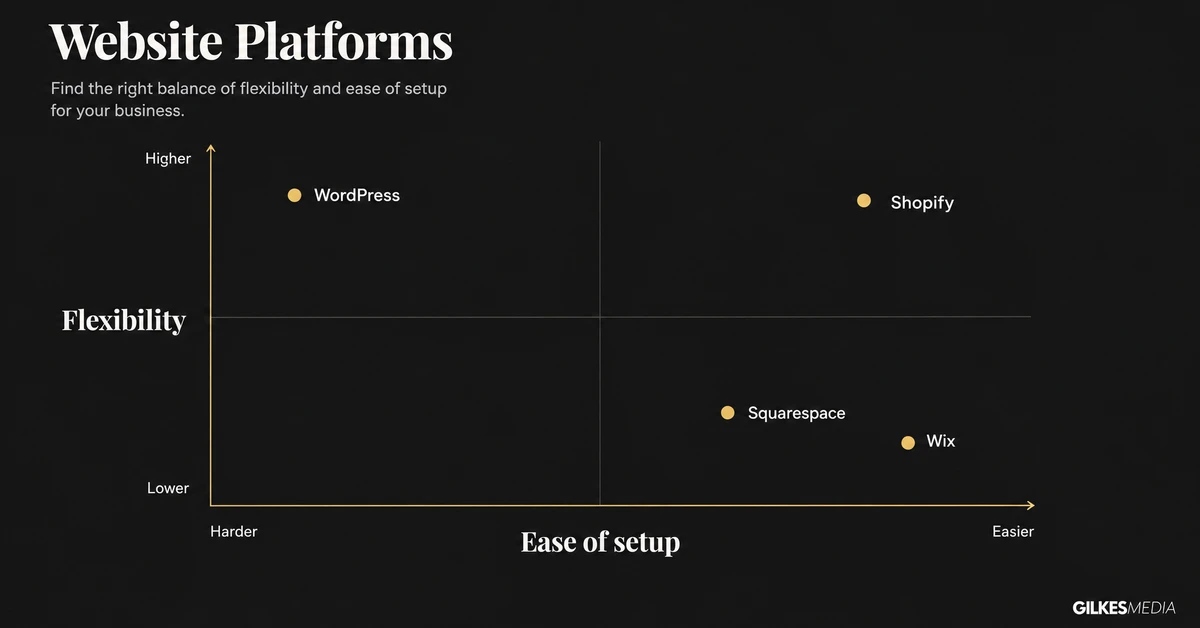
The four names get lumped together as "website builders", but they are not the same kind of product. Understanding the real difference explains most of what follows.
WordPress is open-source software you install on hosting you choose, not a single company's product.
According to W3Techs, it now powers 40.2% of all websites and 58.7% of websites that use any content management system at all, making it the default choice for most of the internet.
That scale means an enormous ecosystem of themes, plugins and developers, which is exactly why it suits businesses that expect their site to grow, change, and integrate with other systems over time.
The trade-off is that you, or whoever builds it for you, are responsible for hosting, updates and security.
Wix is a fully hosted, drag-and-drop builder aimed squarely at people building their own site with no developer involved. You drop elements onto a canvas, Wix hosts everything, and there is nothing to install or patch.
It holds 4.2% of all websites and 6.1% of CMS-powered sites per W3Techs, making it a distant third, but a genuinely strong option for a straightforward small business site that needs to exist quickly and needs minimal ongoing attention.
Squarespace takes a more curated approach than Wix. The templates are consistently well-designed, the editor is simpler, and the whole product leans toward brands that care deeply about visual presentation: photographers, studios, consultants and boutique service businesses.
W3Techs puts it at 2.4% of all websites and 3.6% of CMS-powered sites, the smallest share of the four. What you gain in design polish, you give up in structural flexibility once your needs get more complicated than the template anticipated.
Shopify is not really a general website builder at all, it is an ecommerce platform that happens to let you build marketing pages around the shop.
Every feature, from checkout to inventory to shipping rules, is built for businesses that sell physical or digital products.
It sits at 5.4% of all websites and 7.8% of CMS-powered sites per W3Techs, but a far more telling figure comes from StoreLeads' ecommerce-specific tracking: Shopify runs 19.6% of tracked online stores, second only to WooCommerce's 33.4% share of the same market.
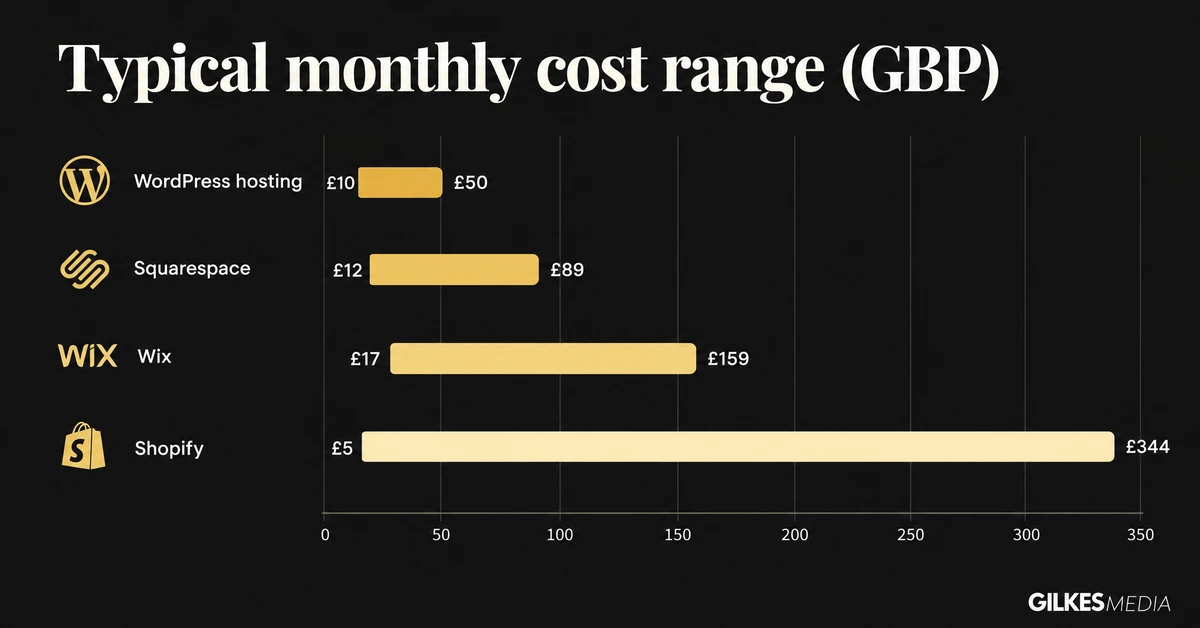
Headline prices are where most comparisons go wrong, because the number advertised on a pricing page rarely matches what a real UK business ends up paying once hosting, transaction fees and build costs are added in.
WordPress itself is free. What you actually pay for is hosting and, usually, someone to build the site.
Budget shared hosting runs roughly £10 to £50 a month, while managed WordPress hosting from providers such as Kinsta or WP Engine typically starts around $30 to $35 a month for a single site, climbing with traffic.
The build cost is the real variable.
A template-based five to ten page small business site typically runs £800 to £3,000 in the UK.
A semi-custom mid-size business site runs £3,000 to £10,000, and a fully bespoke, conversion-focused build £10,000 to £25,000 or more, per our own previously published UK pricing research.
Wix publishes its pricing in US dollars even for UK customers, which is worth flagging rather than quietly converting.
On annual billing its paid tiers run from around $17 a month (Light) through $29 (Core) and $39 (Business) up to $159 a month on Business Elite, with monthly billing costing noticeably more at every tier.
The Core plan is the realistic starting point for a small business that wants basic ecommerce or proper analytics, not the entry-level Light plan most price comparisons lead with.
Squarespace, usefully, does quote directly in pounds. Annual billing runs £12 a month for Basic, £17 for Core, £29 for Plus and £79 for Advanced, with monthly billing adding a premium of roughly 13% to 41% on top of those figures.
Selling physical products now carries no transaction fee on any commerce plan, but digital products still do: 7% on Basic, 5% on Core, 1% on Plus and 0% on Advanced.
That fee structure alone should steer a digital-product seller straight to a higher tier than they might otherwise choose.
Shopify's UK plans run from a cut-down £5 a month Starter tier through Basic at £19 to £25, Grow at £49 to £65, and Advanced at £259 to £344.
Plus is negotiated individually, starting somewhere north of £1,800 a month for larger operations.
The detail that catches new sellers out is the card transaction fee on top of the subscription: 2.0% plus 25p on Basic, dropping to 1.7% on Grow and 1.5% on Advanced.
A shop doing £20,000 a month in sales on the Basic plan loses roughly £400 a month to that fee alone, before any subscription cost.
The advertised monthly price is rarely the real cost. Hosting, transaction fees and build work routinely double or triple the headline figure, and Shopify's transaction fees in particular can outweigh the subscription itself once sales volume grows.
Market share will not choose a platform for you, but it is a useful sanity check against claims that any of these four is a fringe or risky option. All four are mainstream, mature products used at genuine scale.
W3Techs' October 2026 figures put WordPress at 40.2% of all websites, Shopify at 5.4%, Wix at 4.2% and Squarespace at 2.4%. Among the narrower set of sites that use a CMS at all, those figures become 58.7%, 7.8%, 6.1% and 3.6% respectively.
Ecommerce tells a slightly different story. StoreLeads' August 2025 tracking of live online stores found WooCommerce, WordPress's ecommerce plugin, running 33.4% of tracked shops, with Shopify close behind at 19.6%, Wix Stores at 7.4% and Squarespace Commerce at 2.6%.
The practical takeaway is that WordPress dominates general-purpose sites, while the two serious contenders specifically for selling products are WooCommerce and Shopify, with Wix and Squarespace a distant third and fourth for ecommerce specifically.
None of these figures should be read as a popularity contest to win. A platform used by millions of sites is not automatically right for your business.
A smaller platform is not automatically a risk either, provided it is well-funded and actively maintained, which all four clearly are.
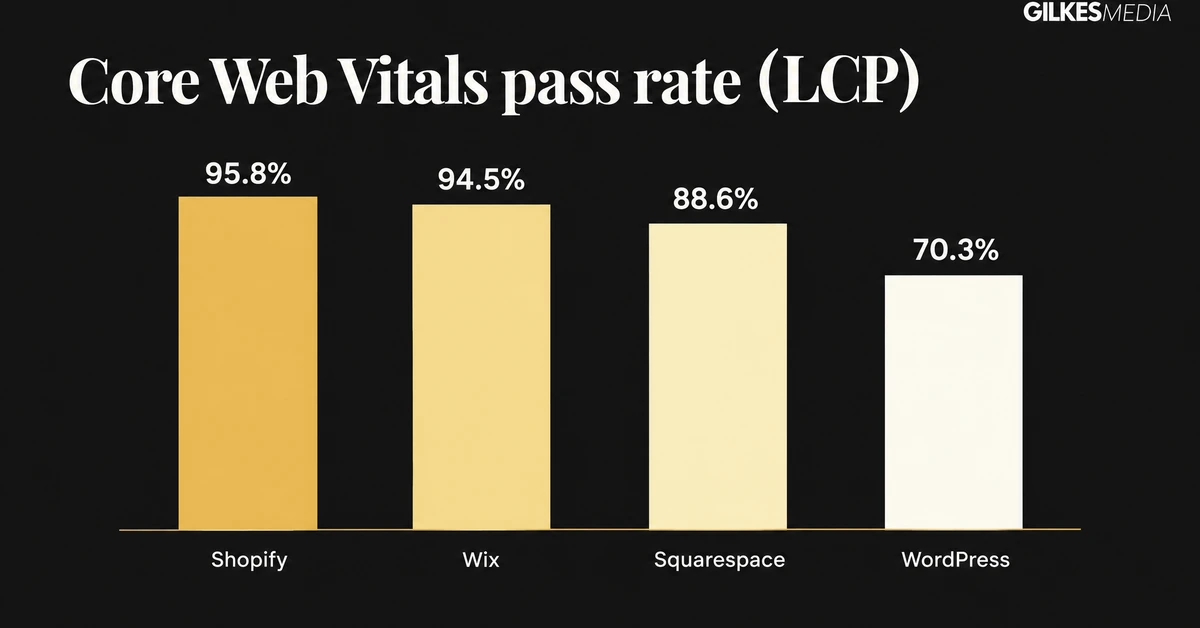
This is the section where honesty matters more than brand loyalty, including to our own platform of choice. Core Web Vitals, Google's real-world speed and user-experience benchmarks, show a genuine gap between these platforms, and WordPress does not come out on top.
The State of Web Vitals report, analysing almost 190,000 live sites in the second quarter of 2026, found Shopify sites passing the Largest Contentful Paint metric 95.8% of the time, against 94.5% for Wix and 88.6% for Squarespace.
WordPress trailed at 70.3%, a 26 percentage point gap to the leader.
That gap is real, but it is not really a WordPress problem, it is a plugin and theme problem.
WordPress's open ecosystem means anyone can bolt on a bloated theme and a dozen unnecessary plugins, and a huge proportion of the 40% of the internet running WordPress does exactly that with no one checking the result.
Wix, Squarespace and Shopify score better on average largely because the platform itself constrains what you can do, which also constrains how badly you can break performance.
A professionally built, lean WordPress site with a proper hosting setup competes with any of them on speed, but it takes deliberate work to get there, where the closed platforms get you most of the way by default.
On raw SEO capability rather than default speed, the picture flips. WordPress's plugin ecosystem, Yoast and similar tools included, gives far more granular control over technical SEO, schema markup, URL structure and content strategy than any of the closed builders currently offer.
The gap matters most for a content-led growth strategy.
A business publishing regular blog content to rank for buyer-intent keywords needs fine control over internal linking, structured data and content architecture, which is exactly where Wix and Squarespace's simpler, more constrained editors start to show their limits.
To put the speed gap in concrete terms, a site that improves its Largest Contentful Paint from a failing score into a passing one typically sees a measurable drop in mobile bounce rate.
A slow load loses visitors before the page has even finished rendering.
That is a real cost if it happens on a page driving paid traffic, not just a vanity metric.
WordPress's lower average Core Web Vitals score is a plugin and theme problem, not a platform ceiling. A well-built WordPress site matches the closed platforms on speed and beats them on technical SEO control, but getting there takes deliberate work rather than coming free by default.
The question nobody asks at the start, and almost everybody asks three years in, is: what happens when I want to leave?
The answer differs enormously between these four platforms, and it should influence the decision up front, not become a crisis later.
WordPress sits on your own hosting, using an open database format. You can move host, change developer, or rebuild the front end entirely while keeping your content and your URLs intact. You own the asset outright, for better and for worse.
Wix and Squarespace are proprietary, closed systems. There is no way to export a Wix or Squarespace site as a working website elsewhere, only a static snapshot of the content at best.
Rebuilding on another platform later means starting the design from scratch, not migrating it.
This rarely matters in year one.
It starts to matter the moment a business outgrows its starter platform and wants functionality the closed builder was never designed to support, a custom integration, a non-standard layout, or a content structure the template simply cannot express.
At that point the choice is not "upgrade the plan", it is "rebuild the website from nothing on a different platform", which is a far bigger project than most businesses expect when they first picked the easy option.
Shopify sits in the middle.
It is also closed and proprietary, but its ecommerce data, products, orders and customers, exports cleanly to most other ecommerce platforms if you ever need to move, even if the storefront design itself does not travel with it.
WordPress's plugin library runs to tens of thousands of options, covering everything from booking systems to membership portals to custom CRM integrations, almost always with more than one choice at every price point, including genuinely free ones.
Wix and Squarespace have their own app marketplaces, but both are smaller, more tightly vetted, and generally charge their own separate monthly fee per app on top of your plan.
Shopify's app store is the most mature of the three closed platforms, reflecting how much of its own revenue comes from the apps ecosystem rather than subscriptions alone.
If you are selling products, this entire comparison narrows considerably. The realistic choice is between Shopify and WooCommerce on WordPress, with Wix Stores and Squarespace Commerce worth considering only for a very small catalogue.
Shopify's advantage is that everything, payments, shipping, tax, inventory and fraud protection, is built and maintained for you as one coherent product. You are trading some flexibility and a transaction fee for not having to think about any of it.
WooCommerce on WordPress gives you more control over exactly how products, checkout and content work together, with no mandatory transaction fee beyond your payment processor's own rate.
It also sits on the same content management system as the rest of your marketing site, rather than bolted alongside it.
The cost of that control is that you, or your developer, are responsible for keeping the plugins, payment gateway and security patches current, which matters more for a shop handling live payments than it does for a brochure site.
A rough rule of thumb: under roughly 50 products with simple shipping, any of the four can work. Above that, with variants, multiple shipping zones or wholesale pricing, Shopify or WooCommerce stop being optional and become the only sensible choice.
For a genuine ecommerce business, this is really a two-horse race between Shopify and WooCommerce. Wix Stores and Squarespace Commerce only make sense for a very small, simple product catalogue.
Timeline is often the deciding factor in practice, even when businesses tell themselves it is about features or price. A platform that gets you live this week beats a theoretically better platform that takes two months, if your actual need is urgent.
A competent owner can have a simple Wix or Squarespace site live within a day or two, using a template and swapping in their own text and photos.
WordPress, self-managed with no developer, realistically takes a week or two longer for the same simple result, because there is more to configure before anything resembles a finished site.
A DIY Shopify store sits between the two, usually two to five days for a simple catalogue, longer once you factor in setting up payment processing, shipping rules and tax correctly, which is not somewhere to cut corners.
The gap narrows considerably once an agency is involved, because most of the timeline is spent on strategy, copy, and design decisions rather than the platform's own learning curve.
A template-based WordPress or Squarespace brochure site typically takes two to four weeks agency-side, a semi-custom WordPress build six to ten weeks, and a fully bespoke build three months or more.
An agency-built Shopify store follows a similar timeline to a WordPress brochure site for the storefront itself, with the real variable being how many product variants, integrations and custom app configurations need setting up before launch.
Pulling all of the above together into an honest, practical framework rather than a sales pitch for any one platform. Match yourself to the closest description below.
If you still are not sure which description fits, work through the decision in this order rather than starting from the platform you have already heard of.
A handful of avoidable errors show up again and again in how UK businesses pick a platform, usually because the decision gets made on price alone, or on whatever the business owner has personally used before.
None of these are platform defects. They are planning failures that happen regardless of which of the four platforms gets chosen, which is exactly why they are worth naming explicitly before you commit to one.
The first is choosing based on today's size rather than next year's ambition.
A platform that fits a five-page site perfectly can become a genuine constraint the moment the business wants a client portal, a booking system, or a content hub that drives organic traffic.
The second is underestimating transaction fees on a growing ecommerce shop. A fee structure that looks trivial at £2,000 a month in sales can quietly cost thousands a year once revenue scales, and few businesses model that out before committing.
The third is assuming a closed platform's default speed means no SEO work is needed.
A fast-loading Wix or Squarespace site with thin content and no keyword strategy will still lose to a slower WordPress competitor that has actually invested in search visibility.
The fourth, and the most expensive, is picking the cheapest option with no plan for what happens if the business outgrows it.
The cost of migrating off a closed platform later routinely exceeds what a more suitable platform would have cost from the start.
The most expensive mistake is picking the cheapest platform with no plan for growth. Migrating off a closed builder later usually costs more than building on the right platform would have cost in the first place.
None of this means WordPress is automatically right for every business reading this, despite it being the platform we build on for most clients.
It genuinely is not the right choice for a sole trader who just needs a simple, low-maintenance presence online.
Where we do think the decision deserves real scrutiny is the growing SME still running on a starter Wix or Squarespace site purely because that is what got set up years ago, with no one revisiting whether it still fits.
If you want a second opinion on which platform actually fits where your business is heading, not just where it is today, our guide to choosing a web design agency and our breakdown of realistic UK website costs are good next reads.
If your current site is slow, check that properly rather than guess, using our guide to website speed and Core Web Vitals.
If you are already planning a move, read our notes on redesigning a website without losing your SEO rankings before you start.
We build and migrate WordPress websites for UK businesses that have outgrown a starter platform.
Conversion rate optimisation and local search visibility, covered in our CRO cost guide and our local SEO guide, are built in from the start, not bolted on afterwards.
If you would like an honest view on whether your current platform still fits your business, get in touch for a free discovery call.
We will tell you plainly if a platform change is not actually worth it yet, not just when it is.
On headline price, Shopify's £5 Starter plan and Squarespace's £12 Basic plan look cheapest, but neither suits a general small business site well. For a straightforward brochure site, a template-based WordPress build at £800–£3,000 plus roughly £10–£50 a month hosting is usually the realistic cheapest option that still gives you a proper, ownable website.
Yes, for building and maintaining it yourself with no developer. Wix and Squarespace are designed for a non-technical owner to manage entirely alone. WordPress is more powerful but expects either some technical comfort or an agency relationship to handle hosting, updates and security.
You can move your written content and images, but not the design itself, because Wix and Squarespace do not export a working website. In practice this means a fresh design and build on WordPress, reusing your existing copy and media rather than migrating the site as-is.
Shopify can host basic marketing pages alongside a shop, but it is built around the checkout experience first. If selling products is not a core part of your business, you will be paying for and working around ecommerce features you do not need.
On average, yes. The State of Web Vitals report for Q2 2026 found WordPress passing Largest Contentful Paint 70.3% of the time versus 95.8% for Shopify. This reflects how WordPress sites are typically built, with heavy themes and plugins, rather than a hard limit of the platform itself.
For technical SEO control, content strategy and schema markup, WordPress offers the most capability through its plugin ecosystem. Wix and Squarespace have narrowed the gap on basic SEO settings, but still fall short of WordPress's flexibility for a content-led growth strategy.
On the Basic plan, 2.0% plus 25p per transaction using Shopify Payments, dropping to 1.7% on Grow and 1.5% on Advanced. On £20,000 of monthly sales at the Basic rate, that is roughly £400 a month, which should be modelled against WooCommerce's lack of a mandatory platform fee.
Whether the website needs to sell products as a core function. That single answer narrows the realistic choice to two platforms immediately, Shopify or WooCommerce for ecommerce, and WordPress, Wix or Squarespace for everything else, based on growth plans and who maintains the site.
