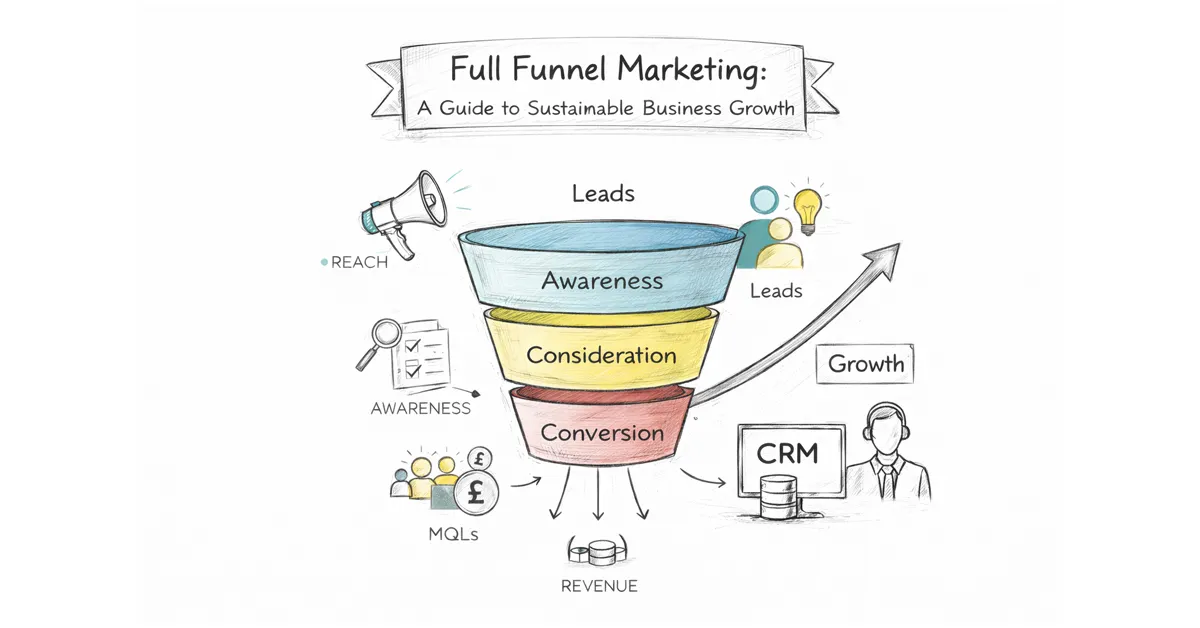
Many UK businesses get stuck chasing leads. They pour money into bottom-of-funnel ads, watch their costs creep up, and wonder why growth feels so unpredictable.
This is like trying to build a house without a foundation. You might get a roof up, but the entire structure is unstable and will not last. Full funnel marketing is the strategic shift you need to build a proper pipeline of future customers, not just scramble for today’s sale.
Focusing only on immediate leads is a short-sighted game. You are fighting over the tiny fraction of your market ready to buy right now, completely ignoring the much larger group of people who will become your customers tomorrow, next month, and next year.
This relentless pressure to convert creates a high-cost, high-stress cycle. You end up paying more and more to capture the same small pool of demand. It is an exhausting and unsustainable way to run a business.
A full funnel marketing strategy, on the other hand, builds a resilient system for growth. It is about creating demand, not just capturing it. You can learn more about the significant difference between these two mindsets in our guide on demand generation vs lead generation.
Think of your marketing as if you are building a house. Every single part is essential for the structure to be sound.
Relying only on lead generation is like trying to install a roof in mid-air. It does not work.
This is not just a pleasant theory; it has a direct, measurable impact on your bottom line.
Investing in brand-building activities at the top of the funnel creates a powerful commercial advantage that your competitors cannot easily copy. Research has shown that even a 1% increase in brand awareness can lead to a 0.6% increase in long-term sales.
This proves why a balanced investment is so critical. The data suggests an optimal split is around 50-60% of your budget on brand building and 40-50% on performance tactics. You can find more insights on this in this full funnel marketing strategy guide.
By investing across the entire customer journey, you lower your customer acquisition costs over the long term, build brand equity, and create a predictable stream of revenue. As a consultant, this is the exact framework I implement to maximise the ROI on every pound spent, turning marketing from a cost centre into a reliable growth engine.
A truly successful marketing strategy is built on one simple idea: understanding your customer's mindset at every step. It is not enough to know who they are; you have to know where they are in their decision-making process. This entire journey can be broken down into three distinct, actionable stages.
Let's move beyond abstract theory and look at what each stage means for a typical UK SME, like a professional services firm. This framework is all about meeting potential clients with the right message at the right time, making your marketing spend far more effective.
At the top of the funnel, your audience is not actively looking for your services. In fact, many do not even realise they have a problem you can solve. Your goal here is simple: introduce the problem and, by extension, position your brand as a helpful voice in that space.
Think about a business consultancy. An 'Awareness' prospect might be a founder feeling swamped by operational chaos but attributing it to "being busy." They are not searching for "outsourced operations consultants." Your job is to create content that speaks directly to their pain points, perhaps an article or a short video on "Three Signs Your Business Has Outgrown Its Processes."
Once a prospect recognises they have a problem, they enter the 'Consideration' stage. Now, they are actively researching solutions. They compare different approaches, read reviews, and try to understand their options. Your objective shifts from introducing the problem to establishing your firm as the go-to expert.
Our overwhelmed founder is now searching for things like "how to improve business efficiency" or "small business process automation." This is your chance to provide genuine value. You can retarget them with a detailed guide, a case study, or an invitation to a webinar. When mapping your customer journey through the three funnel stages, it is worth exploring strategies like using personalized video throughout the sales funnel to grab their attention and build a stronger connection.
At this middle stage, you are not selling your service directly. You are selling your expertise. The goal is to build trust and demonstrate that you understand their challenge better than anyone else.
The infographic below shows how these stages build on one another, creating a solid foundation for growth.
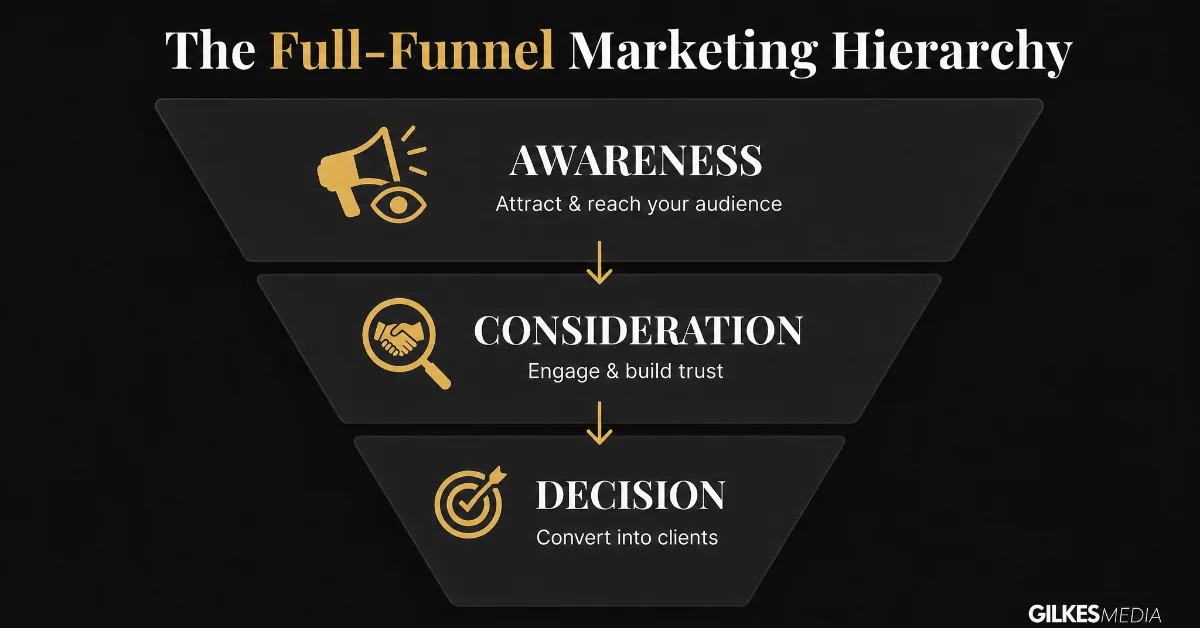
This visual helps to show how each stage supports the next. Awareness forms the essential foundation for any marketing effort that hopes to succeed.
Finally, we arrive at the bottom of the funnel. The prospect is ready to make a choice. They have done their research, they understand the value, and now they are comparing specific providers. The objective here is to convert all that interest into a sale.
Our founder has now decided they need a consultant. Their searches become specific and commercial, like "business operations consultants in Manchester" or "Gilkes Media reviews." Your marketing needs to be direct, with crystal-clear calls-to-action: "Book a Free Consultation," "Get a Quote," or "See Our Pricing." Testimonials, powerful case studies, and sharp service pages are absolutely critical here.
You can find more detail on building this part of your plan in our complete guide on how to create a marketing strategy.
The awareness stage, or Top of Funnel (TOFU), is where you lay the groundwork for everything that follows. The goal here is not to sell; it is to introduce the problem you solve to a UK audience that might not even know you exist. It's a shift from direct response to capturing attention and earning mindshare.
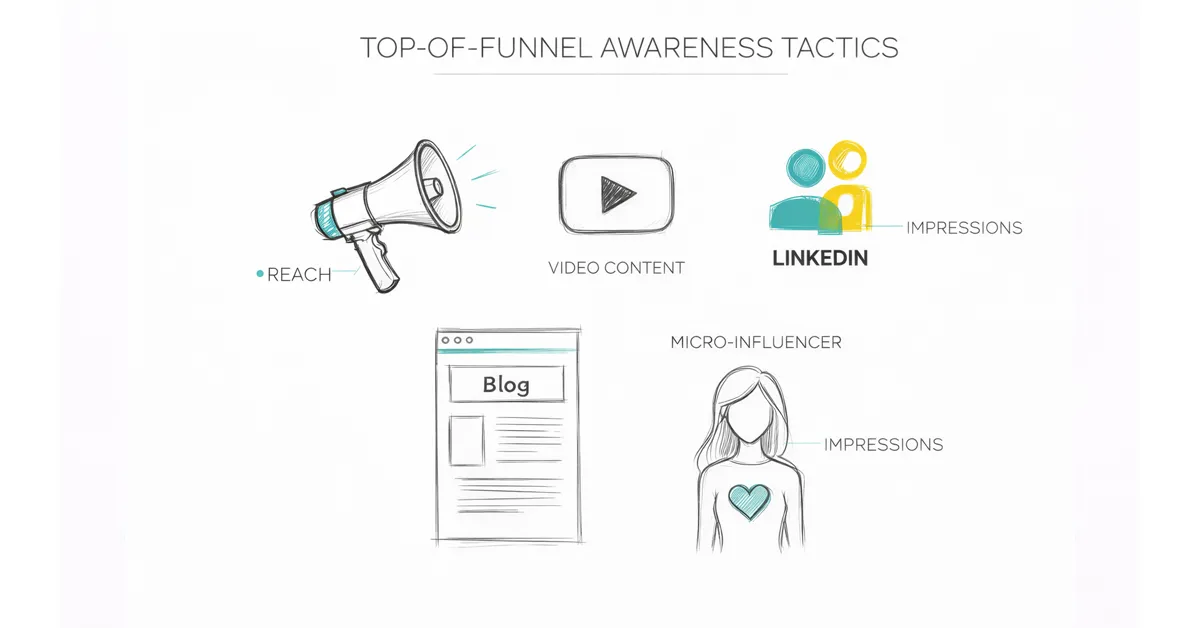
This initial investment in building brand visibility fuels the rest of your full funnel marketing strategy. By creating a broad pool of people who are now aware of the problem, you ensure your mid and bottom-funnel activities have a consistent stream of engaged individuals to nurture and eventually convert.
Paid advertising is the fastest way to get your message in front of the right people. At this stage, your budget is best spent on channels designed for broad reach and high engagement, not immediate sales.
Meta & YouTube Video Campaigns: Video is second to none for storytelling and grabbing attention. A short, engaging video ad on Meta (Facebook & Instagram) or a skippable YouTube ad can introduce your brand to thousands of potential customers for a relatively low cost. The focus is on memorable content that shines a light on a common pain point.
LinkedIn for B2B Audiences: For businesses targeting other businesses, LinkedIn is non-negotiable. You can target specific job titles, industries, and company sizes to ensure your content reaches key decision-makers. Think less about "buy now" and more about sharing insightful articles or sponsoring valuable content.
As a hands-on paid ads specialist, I always advise clients to treat this spend as an investment in their future pipeline. Success here is not measured in leads, but in reach, engagement, and building brand recognition.
While paid ads deliver immediate reach, organic content builds long-term authority and attracts a highly relevant audience. SEO-optimised content is the bedrock of any effective awareness strategy.
Your goal is to become the go-to resource for the problems your customers face. When they search for answers, your brand should be the one providing them.
Creating high-value blog posts, guides, and articles that directly address your audience's questions attracts problem-aware search traffic. This not only builds brand awareness but also establishes your business as a credible expert, making the journey towards a sale much smoother down the line. You can find out more by reading our guide to strategic content marketing.
Influencer marketing has moved far beyond celebrity endorsements. Partnering with relevant UK micro-influencers, those with smaller, highly engaged followings, can build authentic visibility far more effectively than some traditional ads. They lend their credibility to your brand, giving you a warm introduction to an audience that already trusts them.
The UK influencer marketing sector has grown substantially, with 69% of UK consumers making purchases after seeing an influencer promotion. This shows these partnerships can drive real business results that go beyond simple awareness. For a deeper look, you can explore UK influencer marketing statistics here.
It is vital to set realistic expectations and track the right metrics for this stage. Applying bottom-funnel KPIs like Cost Per Lead will only lead to frustration and poor decisions. Instead, you need to focus on indicators that measure how effectively you are capturing attention.
Here is a breakdown of the right channels for this stage and what you should be measuring.
| Channel | Primary Objective | Key KPIs |
|---|---|---|
| Paid Social (Meta, YT) | Maximise reach and brand exposure | Impressions, Reach, Video Views |
| LinkedIn Ads (B2B) | Reach professional decision-makers | Reach, Impressions, CTR |
| SEO & Content | Build organic visibility and authority | Organic Traffic, Keyword Rankings |
| Influencer Marketing | Build authentic brand trust and reach | Audience Reach, Engagement |
By focusing on these metrics, you can accurately gauge the health of your awareness campaigns. This allows you to make data-driven decisions to keep the top of your funnel full, ensuring the rest of your marketing machine has the fuel it needs to run effectively.
You have grabbed your audience's attention at the top of the funnel. That is a great start. But this is where the real work begins. The middle of the funnel (MOFU) is where that initial flicker of interest is nurtured into genuine intent. It is a stage many businesses skip in the chase for quick wins, yet it is precisely where you build trust and prove your expertise.
Think of it this way: the top of the funnel gets you on their radar. The middle of the funnel makes you the only logical choice. Get this part right, and the prospects you worked so hard to attract will not drift away. They will move closer to a decision, with you as their guide.
The easiest way to start nurturing is to talk to people who already know who you are. Paid retargeting on platforms like Meta and Google lets you bring back previous website visitors with content that goes a level deeper.
Someone who skimmed an introductory blog post is not ready for a hard sales pitch. But they are the perfect audience for an ad offering a more detailed guide, a case study, or a webinar on that exact topic. You are no longer a stranger; you are a helpful authority reinforcing your value.
A critical goal in the middle of the funnel is to shift the relationship from passive to active. You want to move them from being an anonymous website visitor to a known contact on your email list. The best way to do this is by offering a high-value asset in exchange for their details, a lead magnet.
Effective lead magnets for this stage are not generic. They solve a specific problem.
The aim is to provide something so genuinely useful they are more than happy to trade their email address for it. That single action signals a much higher level of interest and, crucially, gives you a direct line to continue the conversation.
At this point, your prospects are weighing up their options. They have questions, doubts, and concerns. Your content needs to answer these before they are even fully formed in their minds.
The core of a middle-funnel content strategy is to anticipate your prospect's internal dialogue. What are they worried about? What do they need to understand better? What proof do they need to see to feel confident?
By creating content that tackles these points head-on, you build immense trust. You stop being just another vendor and become a trusted advisor who genuinely understands their challenges. This educational approach is what positions you as the clear expert in your field.
The metrics here shift away from broad reach and impressions. Instead, we focus on tangible signs of engagement and intent. Success is not measured in sales just yet, but in how effectively you are guiding people through their journey.
Here is a simple way to track your MOFU performance:
| Channel/Tactic | Primary Objective | Key Performance Indicators |
|---|---|---|
| Paid Retargeting | Re-engage warm audiences | CTR, Landing Page Views |
| Lead Magnets | Capture contact information | Conversion Rate, CPL |
| Email Nurturing | Build relationships and educate | Open Rate, CTR |
| Value-Driven Content | Establish expertise and trust | Time on Page, Scroll Depth |
By focusing on KPIs like Cost Per Lead (CPL) and lead magnet downloads, you get a clear, commercial view of how your full funnel marketing is turning awareness into a pipeline of qualified prospects. This is how you build a predictable growth engine, not just a list of random clicks.
This is where the interest you have built converts into business. At the bottom of the funnel (BOFU), your job is crystal clear: turn all that hard-won interest into actual, profitable business. These prospects have done their homework. They have read your content, they trust your expertise, and now they are weighing up their final options.
It is time for your marketing to become direct, commercially focused, and geared entirely towards getting them to take action. The goal is to make choosing you the easiest and most logical decision they can make. Every ad, landing page, and call-to-action from here on out needs to remove friction and guide these warm leads over the finish line.
When someone is ready to buy, their search habits change dramatically. Gone are the broad, informational questions. Instead, they start typing specific, commercial keywords that signal an immediate need. This is the moment a razor-sharp paid search campaign becomes your most powerful tool.
You need to focus your budget on the keywords that scream intent. Think terms like:
These are not people just browsing; they have a problem and they are looking for the solution right now. Your ad copy needs to be just as direct, packed with compelling offers and clear next steps like "Get a Free Quote" or "Book Your Consultation Today." We are not educating anymore; we are converting.
While many see social media as a top-of-funnel playground, it is an incredibly powerful tool for closing deals when you use it for retargeting. This is where you serve direct-response ads to people who have already visited your website, downloaded one of your guides, or engaged with your posts.
These audiences are already warm, so your social ads need to reflect that. It is time for strong, unambiguous calls-to-action.
At this stage, your messaging must shift from providing value to prompting a decision. Vague CTAs like "Learn More" should be replaced with decisive instructions such as "Request a Quote," "Schedule a Call," or "Buy Now."
This direct approach respects the journey they have been on. They know who you are and what you do, so your job is simply to make it as easy as possible for them to take that final step.
A UK-based accountancy firm was getting decent traffic to its website but was struggling to turn those visitors into actual sales meetings. They had a classic bottom-of-funnel problem.
We implemented a targeted LinkedIn Lead Gen Form campaign aimed squarely at Finance Directors in the tech sector, a group who had already engaged with their content. The ad creative was simple and direct, offering a "Free Tax Efficiency Audit" in exchange for their details, all without leaving the LinkedIn platform.
The results were immediate:
This shows how focusing your bottom-of-funnel efforts on a specific, high-intent audience with a frictionless conversion process can deliver serious commercial results. It is a perfect example of how a well-executed full funnel marketing strategy translates directly into revenue. When you are measuring success here, you need to be relentless about tracking metrics like CPA, conversion rate, and Return on Ad Spend (ROAS).
A full-funnel marketing strategy is only as good as your ability to measure its impact and fund it correctly. Moving from sporadic lead generation to a cohesive, journey-led approach requires a shift in how you think about both your metrics and your money. It is about valuing the entire process, not just the final click that leads to a sale.
Get this right, and you transform your marketing from an unpredictable expense into a reliable growth engine. You will have the clarity to invest with confidence, knowing exactly how your top-of-funnel activities are fuelling your bottom-line results.
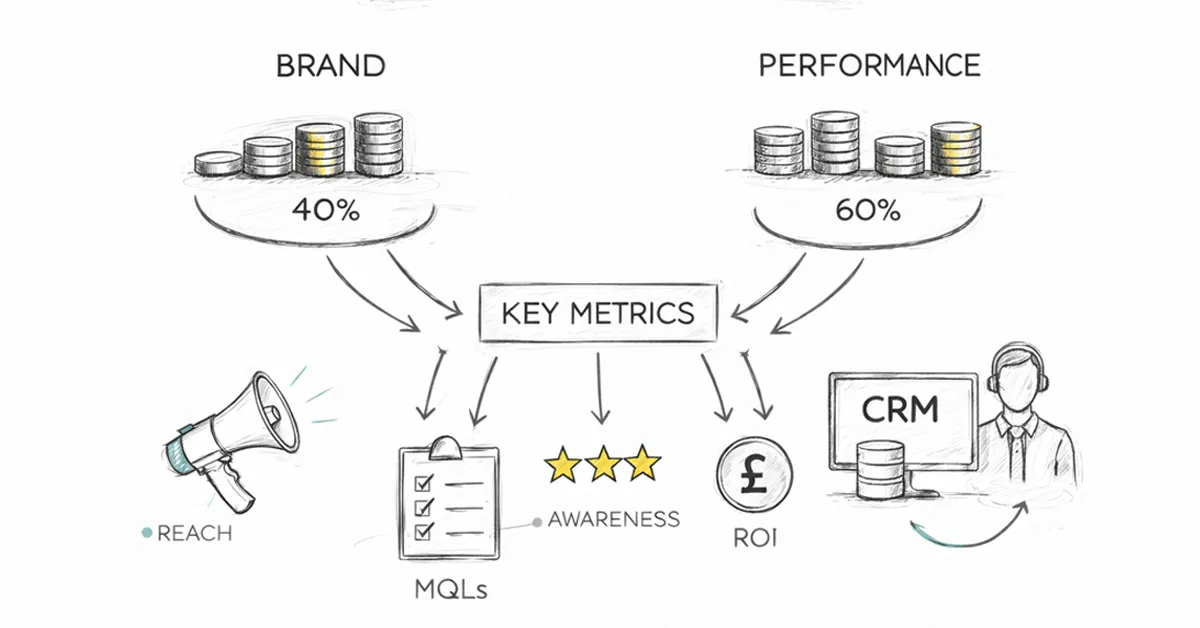
One of the biggest mistakes businesses make is applying bottom-funnel KPIs to top-of-funnel campaigns. Judging a brand awareness video on its direct Return on Ad Spend (ROAS) is like judging a marathon runner by their first 100-metre split. It completely misses the point of the exercise.
Success demands a blended view of performance. Each stage of the funnel has a different job to do, and therefore needs its own distinct set of Key Performance Indicators (KPIs).
You cannot measure an awareness campaign with a conversion metric. The goal of top-of-funnel activity is to build a future audience, and your KPIs must reflect that objective. Focusing only on immediate sales will cause you to underinvest in the very activities that create long-term demand.
To properly gauge the impact of your campaigns, you also need to get to grips with cross-channel marketing attribution, which helps you understand which touchpoints contribute most to the final sale.
Here is a simple framework to make sure you are assigning the right KPIs to each stage and measuring what truly matters.
To get started, you need to hold each stage of your funnel accountable for the right outcomes. This table breaks down the primary goal for each stage and the key metrics you should be tracking.
Full Funnel KPI Framework
| Funnel Stage | Primary Goal | Key Performance Indicators |
|---|---|---|
| Top (Awareness) | Maximise reach and build brand visibility | Impressions, Reach, Video Views |
| Middle (Consideration) | Nurture interest and generate qualified leads | Cost Per Lead (CPL), CTR |
| Bottom (Decision) | Drive conversions and generate revenue | CPA, Conversion Rate, ROAS |
Using this framework brings clarity to your reporting. It stops you from making knee-jerk decisions and ensures your brand-building efforts are valued just as much as your sales campaigns.
Budgeting for a full-funnel strategy means moving away from a purely performance-based model. You have to feed the top to get results at the bottom.
As a starting point, a balanced approach often involves dedicating around 50-60% of your budget to brand-building (top and middle funnel) and 40-50% to direct response (bottom funnel). This split ensures you are consistently filling your pipeline with new prospects while still having the resources to convert those who are ready to buy now.
In the UK, social media advertising spend is projected to hit £9.95 billion, showing how much businesses are investing in awareness and consideration. For SMEs, a practical starting point for paid social testing can be as little as £200-£300 per month to validate what works before scaling up.
Remember, your budget must cover more than just ad spend. You also need to account for the essential tools, like CRMs and analytics platforms, that make full-funnel execution possible.
To track a customer from their first interaction to the final purchase, you need the right tools. Thankfully, you do not need a complex or expensive setup, but a few components are non-negotiable for any business serious about full-funnel marketing.
By integrating these tools, you create a closed-loop system. This setup gives you a complete view of the customer journey, empowering you to make smarter, data-driven decisions that drive sustainable business growth.
Even with the best framework, turning theory into practice always brings up questions. Here are some straight answers to the most common queries I hear from UK business owners, designed to give you the clarity and confidence to get started.
There is no magic number, but a sensible starting point for a small business wanting to test paid channels is around £500-£1,000 per month. This lets you make a meaningful investment in both brand awareness (like Meta video ads) and direct response (like Google Search ads) without over-committing your resources.
The real key, though, is how you allocate it. A balanced approach usually means dedicating 50-60% of your budget to top and middle-funnel activities and the remaining 40-50% to the bottom. This ensures you are consistently building an audience for tomorrow while still capturing the demand that exists today.
This is the big question. While your bottom-of-funnel campaigns can start generating leads within weeks, the true power and ROI from a full-funnel approach are measured in months, not days.
The goal is to see this as a long-term investment in building a predictable growth engine. A little patience at the start pays off massively with more sustainable and cost-effective results down the line.
Yes, absolutely. A full funnel marketing strategy is about mindset and smart prioritisation, not a massive budget or a huge team. For a small business, it just means starting smart and focusing on one or two high-impact channels per stage.
For instance, a startup could begin with a simple, focused plan:
The strategy scales as you do. The most important thing is to start building that foundation from day one, making sure every part of your marketing works together, no matter how small your initial efforts are.
Ready to build a marketing strategy that delivers predictable, long-term growth? As a hands-on paid ads specialist and marketing consultant, Gilkes Media partners directly with founders to design and execute commercially focused plans. Book your free, no-obligation consultation today and let’s build your growth engine together. Find out more at https://gilkesmedia.co.uk.
