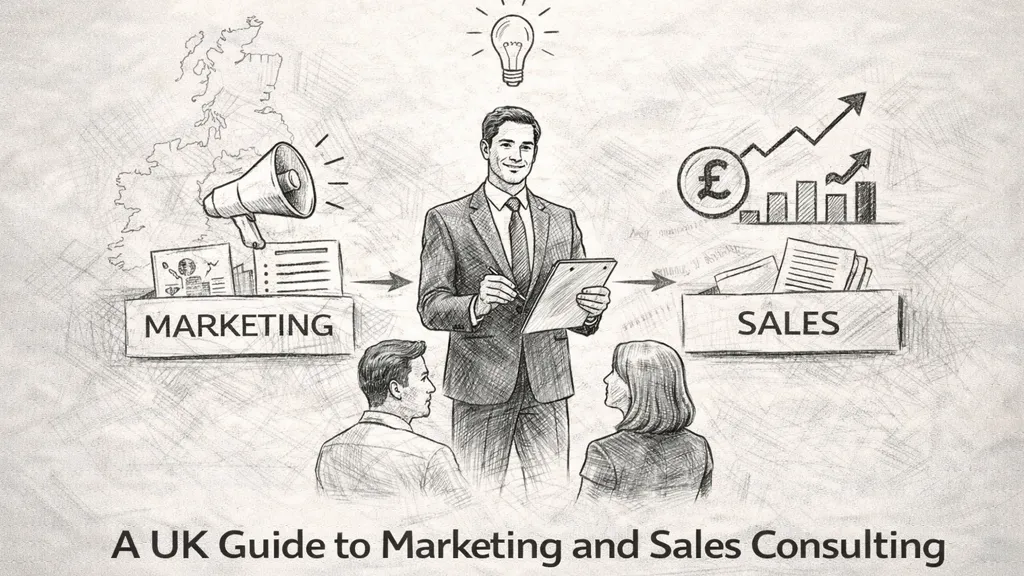
At its core, marketing and sales consulting is about getting two of the most critical parts of your business to stop working against each other and start pulling in the same direction. Think of it like a relay race. Marketing runs the first leg, handing the baton [a lead] to Sales. A consultant makes sure that handover is smooth, fast, and that both runners are sprinting towards the same finish line: revenue.
In far too many businesses, marketing and sales operate on different planets. Marketing is judged on generating leads, often through channels like paid ads and SEO, while Sales is responsible for turning those leads into paying customers. The problem? A huge gap often forms between them, leading to wasted ad spend, frustrated teams, and a confusing experience for potential customers.
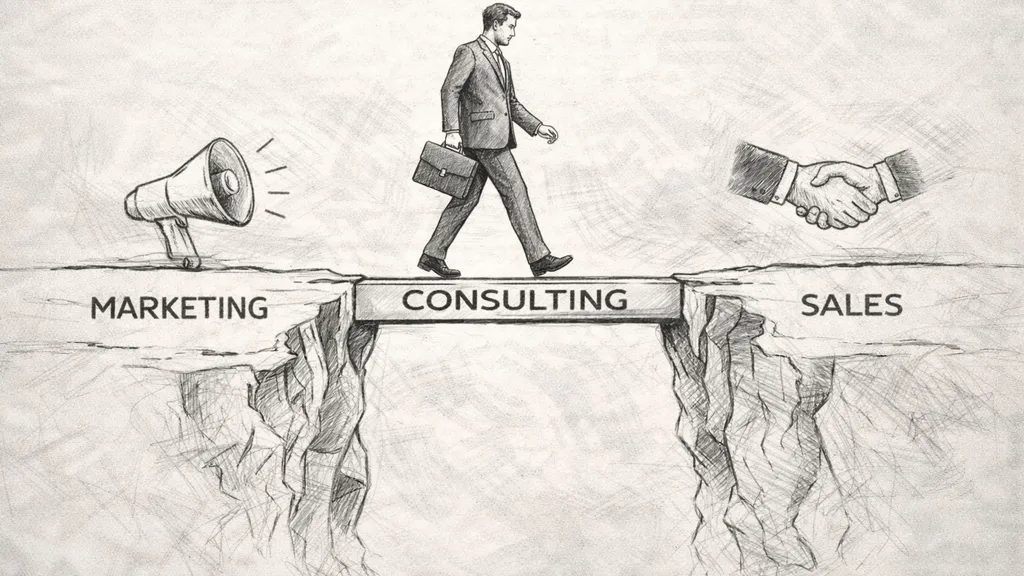
This is precisely where marketing and sales consulting adds its value. As a consultant who specialises in paid advertising, my job is not just to generate clicks; it is to architect your entire revenue engine. I make sure every pound you invest in marketing is directly tied to a measurable sales outcome.
To get to grips with this, let’s look at the difference between how siloed teams work and how a consultant brings them together.
| Focus Area | Traditional Siloed Approach | Integrated Consulting Approach |
|---|---|---|
| Primary Goal | Marketing: Lead volume. Sales: Closed deals. | A single, shared goal: revenue growth. |
| Lead Quality | Marketing sends over everything; Sales complains about poor quality. | A clear, co-created definition of a "sales-qualified lead". |
| Accountability | When targets are missed, each team blames the other. | A unified reporting structure where everyone owns the final number. |
| Customer Journey | Disjointed. Messaging changes between marketing and sales. | A smooth customer experience from first click to final sale. |
| Budget | Marketing spend is a cost. Sales is a revenue generator. | Marketing spend is a direct investment in the sales pipeline. |
This table shows a fundamental shift in thinking. You move from having two separate departments with conflicting priorities to one cohesive commercial team driven by a single purpose.
When your teams are disconnected, the issues that arise are not just minor annoyances. They are serious commercial roadblocks that I see holding back UK SMEs and startups time and time again.
Recognising these symptoms is the first step:
A consultant's primary job is to replace this friction with a single, unified commercial strategy where both marketing and sales are aligned on the same goal: measurable revenue growth.
A marketing and sales consultant brings an objective, senior-level perspective to diagnose and fix these deep-rooted problems. It is not about just running a few more ads or hiring another salesperson. It is about building a system that works. This is a central part of my strategic marketing consultancy work, where we build the bridge connecting marketing activity directly to commercial success.
The process always starts by getting both teams in the same room to agree on who the ideal customer is and what their journey looks like. We create a crystal-clear definition of a "qualified lead," establishing a concrete handover from a marketing touchpoint to a sales conversation. This ensures marketing is not just measured on the number of leads, but on its direct contribution to the sales pipeline.
While this holistic view is key, there are also specialised disciplines within this field, such as sales enablement, which focuses on equipping sales teams with the right tools and content. You can explore that further by reading What Is Sales Enablement Consulting?.
The commercial impact of getting this right is enormous. Companies with tightly aligned revenue teams see 19% faster growth and close up to 67% more deals. For a scaling UK business, those numbers are not just nice-to-haves; they represent a clear pathway to dominating your market. This data shows that a unified strategy is no longer a luxury, it is essential for any company with serious growth ambitions.
Bringing in a marketing and sales consultant means senior, hands-on involvement rather than being another account number at a big agency: strategic clarity, personal accountability, and a partner invested in your commercial results. We cover the full breakdown of what that looks like in practice in our guide to marketing consultancy services.
A good engagement should never feel like a leap of faith. It should run through clear, collaborative phases, from high-level understanding through to hands-on execution, with no black boxes along the way. See the full four-phase engagement breakdown in our guide to marketing consultancy services.
Vanity metrics like follower counts or a traffic spike mean nothing unless they move your bottom line, so the right approach tracks commercially meaningful KPIs tied to revenue and pipeline instead. Our guide to marketing consultancy services sets out the specific KPIs worth tracking.
Let’s talk about how much marketing and sales consulting actually costs. It is the most important question, and understanding the different ways to work with a consultant is vital before you invest a single penny.
There is no "one-size-fits-all" price list. The right approach depends entirely on your business, where you are now, and where you want to be. My job is to be completely transparent about this, structuring a partnership that delivers real value and a clear return on your investment.
Here are the three main ways we can work together, with a breakdown of the costs you can expect in the UK market. This way, we can focus on what truly matters: getting you results.
A project-based engagement is exactly what it sounds like: we tackle a specific, one-off challenge with a clear start and finish line. This is the perfect fit if you have a well-defined problem you need solved or an initiative you need an expert to get off the ground.
Think of it like bringing in a specialist to build a new kitchen. They have a clear brief, they execute the work to a high standard, and once the job is done, the engagement is complete.
This model works best for things like:
Fees are typically fixed and agreed upfront, so you have total certainty over your budget. Projects of this nature generally fall into the £4,000 to £15,000+ range, depending on the scope and complexity.
A monthly retainer gives you ongoing access to senior-level strategic guidance and hands-on support. This model is ideal when you need consistent expertise to steer your marketing and sales but are not ready for the cost and commitment of a full-time senior hire.
It is like having a trusted commercial advisor on speed dial who is also actively involved in driving your growth, month after month. It is a partnership that adapts as your business priorities change.
A retainer transforms a consultant from a temporary problem-solver into a long-term strategic partner who is deeply invested in your commercial success.
For a closer look at the specific activities covered, you can explore the full range of marketing consultancy services we offer. UK retainers typically start from £2,500 per month and scale based on the level of involvement your business needs.
This is the most integrated form of consulting. As a fractional leader, I act as your part-time Head of Marketing or Commercial Director, embedding myself within your leadership team for one or two days a week.
This is perfect for ambitious SMEs and startups that need senior strategic leadership to build and manage a growth function but cannot yet justify a full-time executive salary. I take ownership of the strategy, manage your team or agencies, and hold full accountability for hitting your revenue targets.
To make it easier to see how these options stack up, I have put them into a simple table.
This table summarises the common engagement models, outlining where they fit best for most SMEs and providing an idea of the costs involved to help you plan your budget.
| Consulting Model | Best Suited For | Indicative Monthly Cost (GBP £) |
|---|---|---|
| Project-Based | Specific, one-off initiatives with a clear start and end. | N/A (Fixed project fee) |
| Retainer-Based | Ongoing strategic guidance and execution support. | £2,500 – £7,000+ |
| Fractional Leadership | Part-time strategic leadership and team management. | £3,000 – £8,000+ |
Choosing the right model is the first and most critical step. It aligns our expectations from day one, defines exactly what we are going to achieve, and structures your investment for a clear, measurable return.
A well-run first 90 days moves logically from audit and quick wins through to a repeatable growth engine, so you see progress well before the full strategy is bedded in. For the complete first-90-days playbook, see our guide to marketing consultancy services.
Deciding to bring in a consultant is a big step. It is an investment, and you are right to have questions before you commit.
I get it. That is why I have put together answers to the most common queries I hear from business owners. This will help you figure out if a consultant is the right move for you and what a real partnership should look like.
The right time to hire a consultant is not about your company’s size. It is about the growing pains you are feeling. If any of these sound familiar, it is a strong signal that you need an expert on your side.
If you are nodding along, an external expert can bring the objective view needed to find the root cause and build a fix that works.
This is a critical distinction. They both play a role in growth, but they are not the same. Understanding the difference ensures you get the right help for your specific needs.
An agency provides the hands to do the work. A consultant provides the senior mind to make sure the right work gets done.
Let's break that down.
| Aspect | Marketing Sales Consultant | Traditional Agency |
|---|---|---|
| Role | Your strategic partner and senior advisor. | A team of specialists to execute tasks. |
| Focus | The "Why" and the "What." They set the strategy. | The "How." They implement the agreed tasks. |
| Accountability | Personal accountability for commercial outcomes (ROI). | Accountable for delivering services (e.g., ad clicks). |
| Involvement | Deeply embedded, working directly with leadership. | Often managed by a junior account manager. |
As a consultant at Gilkes Media, I provide that senior, hands-on partnership. It is the polar opposite of the high-volume, task-based model you find at many large agencies. Your strategy is driven by my commercial experience, not delegated to a junior.
Choosing the right consultant is the most important decision in this process. Your success hinges on their expertise, their approach, and their commitment. Use this checklist to cut through the noise and find a partner who will deliver real, measurable results.
At Gilkes Media, my entire approach is built on this foundation: senior expertise, personal accountability, and a relentless focus on the numbers that matter to your bottom line. If you are ready to build a predictable growth engine, let's talk.
