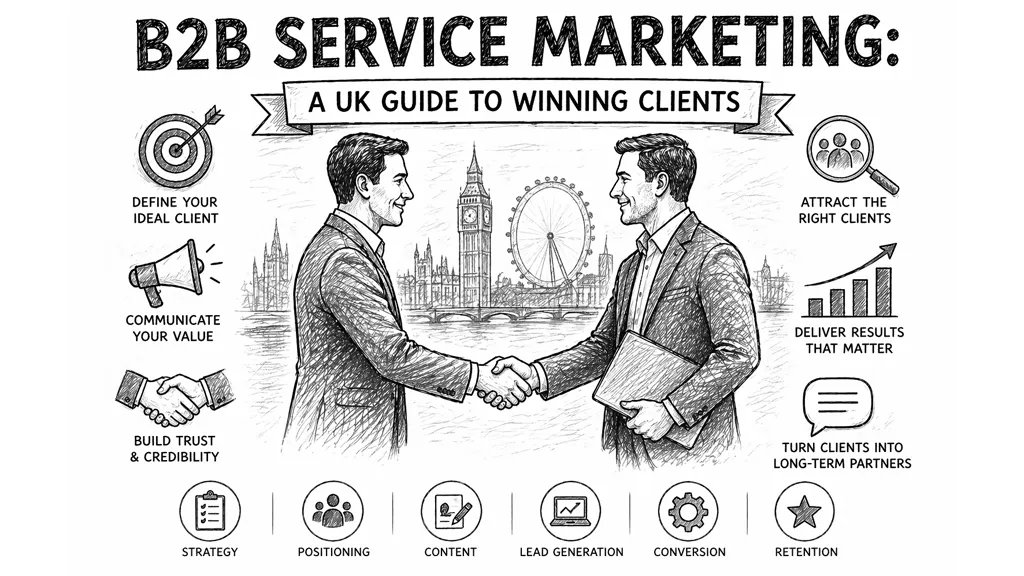
If you're running a service business, this probably feels familiar. Referrals come in waves, the pipeline looks fine one month and thin the next, and marketing activity generates attention without enough qualified conversations.
That’s where most founders get stuck with b2b service marketing. They’re not selling a simple product with a fixed feature set. They’re selling expertise, judgement, delivery capability, and an outcome the buyer often can’t fully evaluate until after the work starts.
The good news is that demand is there. The UK B2B eCommerce market was valued at approximately £22 trillion in 2024 and is projected to reach £25.2 trillion by 2026, reflecting stronger reliance on digital channels for service procurement in sectors such as professional services and technology, according to SellersCommerce’s B2B marketing statistics. Buyers are already looking online. The issue usually isn’t whether demand exists. It’s whether your business shows up with a credible offer, a clear message, and a conversion path that makes commercial sense.
UK service firms are operating in a market with real opportunity, but the bar is higher than many teams realise. Buyers don’t just want visibility. They want confidence.
A founder in consulting, finance, SaaS, construction, or healthcare often faces the same commercial problem. The business has capability, the team delivers strong work, and clients stay when they come in. But lead flow is inconsistent, sales cycles drag, and marketing feels disconnected from revenue.
Service buyers now research providers long before they speak to anyone. They compare firms on relevance, authority, responsiveness, and perceived risk. If your marketing only says what you do, it won’t do enough. It has to show why you're a safer and smarter choice than the alternatives.
That matters more in a market this large. As noted earlier, the UK B2B eCommerce market is already substantial, and digital procurement is becoming more normal for service selection, especially in professional services and technology.
Most underperformance in b2b service marketing comes down to one of these issues:
Practical rule: If your marketing doesn’t make the sales conversation easier, it isn’t doing enough.
The firms that win don’t necessarily shout the loudest. They reduce buyer uncertainty better than competitors do.
That means clearer positioning, stronger proof, tighter targeting, and disciplined execution. It also means accepting that service marketing is not a branding exercise in isolation. It’s a commercial system. Every page, campaign, email, and follow-up process should help move a prospect from interest to trust to enquiry.
For UK SMEs, that’s the shift that matters. Stop treating marketing as a collection of tactics. Start treating it as the mechanism that turns capability into predictable demand.
A product business markets something tangible. A service business markets a promise.
That sounds obvious, but it changes almost everything. When someone buys software, machinery, or office equipment, they can compare features, specifications, pricing tiers, and delivery terms. When they buy a service, they’re buying confidence in your thinking, your process, and your ability to deliver the result without creating more problems.
In b2b service marketing, the buyer is assessing risk as much as value. They’re asking questions like:
Those questions sit behind almost every enquiry form, call, and proposal request.
Service marketing isn’t mainly about promoting activity. It’s about reducing uncertainty.
| Aspect | B2B Service Marketing | B2B Product Marketing |
|---|---|---|
| What is being sold | Expertise, process, outcomes, trust | Features, specifications, functionality |
| Buyer concern | Delivery risk and fit | Product suitability and price comparison |
| Proof required | Credibility, case examples, authority, responsiveness | Demos, technical specs, comparisons |
| Conversion path | Longer trust-building journey with multiple touchpoints | Often more direct evaluation and selection |
Service firms often make the mistake of writing copy as if they’re selling a product catalogue. They list capabilities, package names, and broad claims about quality. Buyers read that and learn very little.
Stronger service messaging does three things well:
Names the problem clearly
Buyers engage when they feel understood. If your messaging speaks in generic terms, it won’t land.
Shows how you think
A good service page should make your approach feel structured and credible. Tools like HubSpot, Salesforce, GA4, or a clear reporting framework can help make your process more concrete.
Links the work to business outcomes
Founders don’t buy campaigns, audits, or workshops for their own sake. They buy lead flow, efficiency, revenue, better conversion, or lower commercial risk.
Trust in service marketing is built before the proposal stage. Usually through a mix of:
A product can often rely on demonstration. A service has to rely on interpretation and proof.
If you market a service like a commodity, buyers compare on price. If you market it like specialist expertise, buyers compare on confidence.
That is the mindset shift. You don’t need louder marketing. You need marketing that helps a buyer believe your team is worth the conversation.
Most service firms define their target market too loosely. They say they work with SMEs, or with professional services, or with ambitious businesses. That isn’t enough to build campaigns that convert.
Good b2b service marketing starts with sharper segmentation. Not just by sector, but by need, urgency, growth stage, and buying context.
A fast-growth technology SME and an established healthcare business may both need lead generation, but they don’t need the same plan. According to Bain’s perspective on underserved small business markets, segmenting B2B service clients by needs and growth stage, rather than only by industry, leads to higher loyalty and conversion. In practical terms, fast-growth UK tech SMEs often need paid ads to enter the market quickly, while established healthcare firms tend to prioritise SEO for longer-term, compliance-focused lead generation.
That distinction matters because channel choice, messaging, and offer design should follow commercial reality, not a generic persona slide.
A simple way to segment is to combine:
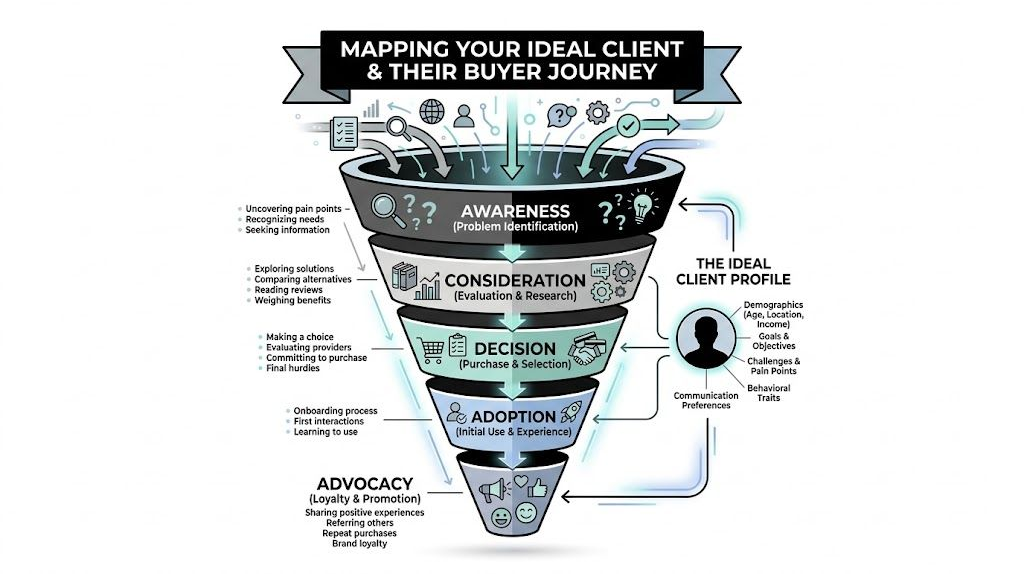
This visual is a useful reference point when shaping that journey:
You don’t need a huge research project. You need clarity on the questions that affect buying behaviour.
The strongest client maps usually come from sales calls, lost deal notes, proposal feedback, and CRM patterns. If your sales team keeps hearing the same objections, your marketing should address them earlier.
Service buyers don’t move neatly from awareness to decision. They pause, compare, disappear, return, and involve more people. That means your content and campaigns need to support several stages at once.
At this point, buyers are problem-aware but not provider-ready. They need educational content that names the issue and frames the cost of inaction.
Useful assets include:
Now they’re comparing approaches. Many firms then remain too vague.
Use content that helps buyers assess fit:
This stage is about reducing final friction. Buyers want reassurance that the engagement will be well run.
That means:
Buyers don’t only ask, “Can you do it?” They ask, “Will working with you feel low risk?”
Build your audience map around one core segment first. For example, construction scale-ups with a clear lead generation issue, or healthcare firms needing compliant long-term visibility. It’s easier to refine one buyer journey properly than to run weak campaigns across five different audiences.
If your targeting is broad, your message becomes bland. If your segmentation reflects real buying behaviour, your marketing starts to feel relevant quickly.
A strong strategy does one job well. It decides where to focus, what to say, and how to turn effort into pipeline without wasting budget.
Most service firms don’t struggle because they lack ideas. They struggle because they spread those ideas too thinly. They try SEO, paid social, occasional email, some content, maybe a webinar, and a redesign. Nothing is joined up, and nothing gets enough commitment to work properly.
Before choosing channels, define the business reality. Ask:
If the business can only handle a modest number of qualified opportunities each month, a narrow strategy often beats a broad one. More leads aren’t automatically better if the pipeline gets clogged with poor fit enquiries.
Some service firms win best by targeting a defined set of high-value accounts rather than chasing volume. That’s where Account-Based Marketing, or ABM, is often the better model.
In the UK, ABM can increase pipeline velocity by a median of 23% and reduce the sales cycle by an average of 18% for B2B service firms, according to Yeager Marketing’s review of B2B marketing metrics.
That doesn’t mean every SME should default to ABM. It means ABM is worth serious consideration if:
Broader demand generation tends to work better when the service is easier to explain, the market is larger, and buying intent can be captured through search or social without heavy customisation.
Commercial view: A strategy is only good if your team can execute it consistently for long enough to learn from it.
No ad account fixes weak positioning. If your offer sounds interchangeable with ten competitors, paid media merely helps more people ignore you faster.
Your positioning should answer four questions clearly:
| Question | What a strong answer sounds like |
|---|---|
| Who is this for | A specific type of business with a defined problem |
| What problem do you solve | A commercial issue, not a vague service category |
| Why choose you | A credible difference in approach, focus, or expertise |
| Why now | A reason the buyer should act rather than delay |
If those answers are fuzzy, fix that before scaling spend.
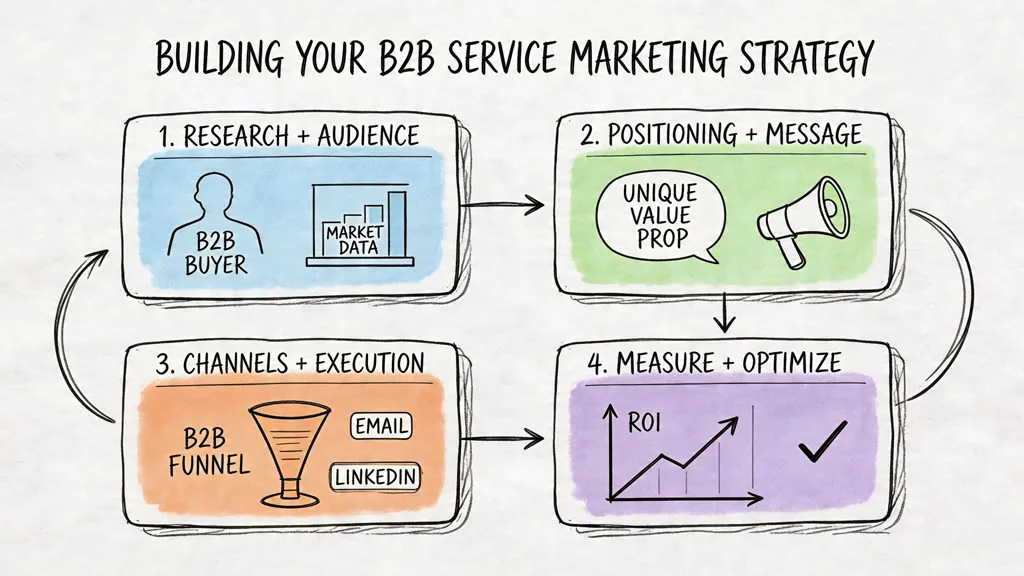
A practical b2b service marketing strategy usually needs four layers working together:
Audience focus
Pick the segment that offers the best combination of fit, demand, and commercial value.
Offer clarity
Package the service around a business problem and a clear outcome.
Channel role
Decide which channels create demand, which nurture it, and which convert it.
Measurement plan
Track success against pipeline and revenue, not just activity.
A useful starting point is a simple planning framework like this guide on how to create a marketing strategy. The point isn’t to produce a long document. It’s to make sensible choices before money gets spent.
What works is focus, consistency, and a strategy that matches your sales reality.
What doesn’t work is trying to look busy across every channel while the core offer remains vague. Founders often think variety reduces risk. In practice, fragmented execution usually creates it.
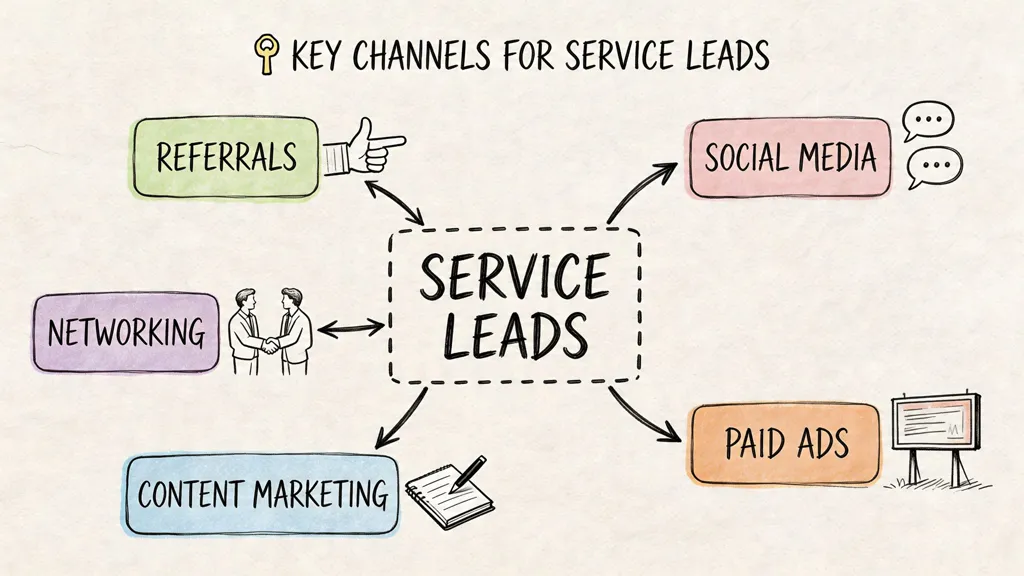
Channel choice matters, but channel role matters more. In b2b service marketing, every channel should have a job. Some create visibility. Some capture intent. Some build trust over time. Some help convert a warm opportunity into a serious conversation.
For UK B2B service firms, lead generation consumes over half of the marketing budget for 58.2% of marketers, while email is used by 66% and paid social by 58% according to eMarketer’s brand marketing data for 2025. That lines up with what many service businesses already know. Pipeline pressure drives spending decisions.
SEO works well for service firms when the buyer already knows the problem and is searching for a provider or a solution path.
The mistake is treating SEO as a blog publishing exercise with no commercial intent. Service SEO needs pages that match how buyers search when they’re close to action. That usually means:
SEO is slower than paid acquisition, but it compounds when done properly. It also tends to bring in prospects with stronger intent because they were already looking.
Google Ads are useful when demand exists and speed matters. This is often the best route for firms that need enquiries sooner and have a clear, commercially relevant offer.
Paid search works best when:
It works poorly when firms bid on broad terms with generic messaging and then send traffic to a homepage. That setup burns budget and creates the illusion of market activity without meaningful pipeline.
LinkedIn is valuable when your buyer profile is clear but search intent is less immediate. It’s particularly useful for specialist services, account targeting, and senior decision-maker reach.
The best campaigns usually focus on:
That next step doesn’t always need to be a hard sales enquiry. It can be a guide, a briefing, or a short call if the audience needs warming up first.
For a useful outside perspective on channel selection and execution in this space, these professional services lead generation strategies from Cloud Present are worth reviewing alongside your own plan.
Email remains one of the most practical channels because it supports long sales cycles without forcing premature sales conversations.
It is especially useful for:
What works in email is relevance and timing. What doesn’t work is sending generic newsletters full of company updates nobody asked for.
A better structure is:
| Email type | Best use | Common mistake |
|---|---|---|
| Lead nurture | Move prospects from interest to conversation | Sending content with no clear next step |
| Re-engagement | Reopen older opportunities | Writing as if the buyer remembers everything |
| Insight-led | Build authority in a niche | Making it too broad to feel useful |
Many founders assume referrals sit outside marketing. They don’t. Referrals often happen because the market already understands what your business is known for.
You can strengthen referral flow by making it easier for people to describe and remember you. That means:
Referral-driven firms often underinvest in marketing because referrals have carried them so far. The risk is inconsistency. Marketing gives you a second engine.
Running SEO, Google Ads, LinkedIn, cold outreach, webinars, and organic social with limited internal capacity usually leads to weak execution across all of them.
Search traffic, LinkedIn audiences, and email subscribers don’t respond to the same framing. Intent changes. Messaging should too.
A channel can generate leads, but if the landing page is weak or sales follow-up is slow, performance drops quickly.
Good channels don’t rescue weak offers. They amplify whatever is already true.
A practical setup for many service firms is:
If you need a service-specific view of paid acquisition and digital channel planning, this guide to digital marketing for professional services is a useful reference.
The main point is simple. Don’t ask which channel is best in the abstract. Ask which channel fits your buyer, your sales process, and your commercial objective right now.
A surprising amount of b2b service marketing still gets judged on the wrong numbers. Traffic rises. Clicks improve. Reach looks healthy. Then the leadership team asks the only question that matters. Is this producing revenue?
That’s the right question. Service firms should measure marketing by its contribution to pipeline quality, deal progression, customer acquisition efficiency, and payback.
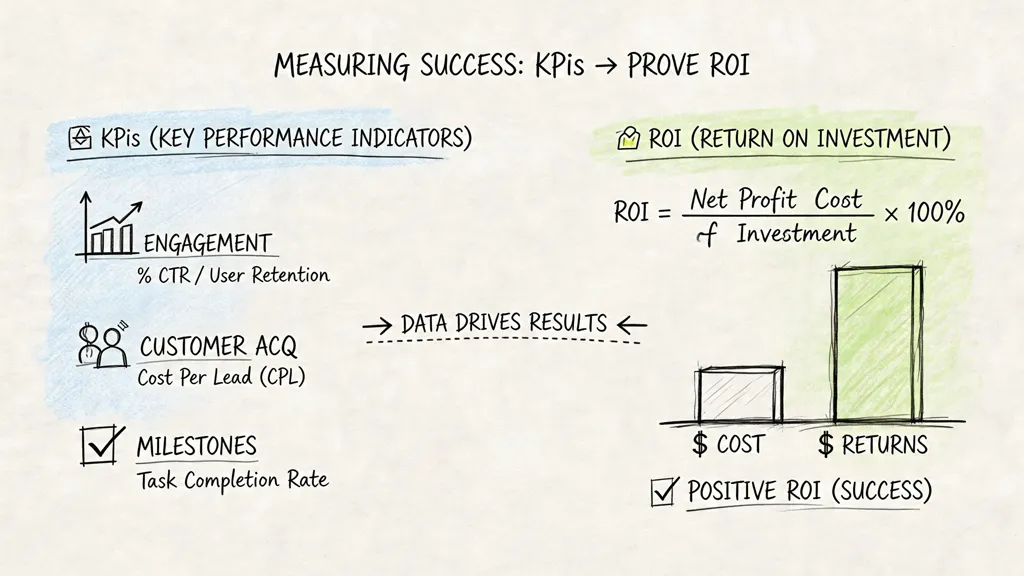
For UK B2B marketing services firms, the average CAC payback period is 11.2 months, while top-performing firms achieve under 9 months, often by using multi-touch attribution to move budget into stronger-performing channels such as combined SEO and paid search, according to Stirista’s guide to B2B data and marketing outcomes.
That one benchmark is useful because it forces a more serious conversation. Marketing isn’t just about acquiring leads. It’s about how quickly the business recovers the cost of winning those customers.
This tells you how long it takes for gross profit from a customer to cover the cost of acquiring them. It’s one of the clearest indicators of whether your marketing model is economically sound.
If lead volume rises but conversion weakens, the problem may be targeting, qualification, or sales process quality rather than channel performance.
Service buying journeys often involve several touchpoints. Looking only at last-click reporting misses how content, paid media, email, and direct outreach work together.
If good leads stall, revenue slips even when top-of-funnel numbers look healthy. This is why marketing and sales must review movement through the pipeline together.
Useful discipline: Report metrics that a finance lead would care about, not just metrics a platform dashboard makes easy to display.
Some metrics still have diagnostic value, but they should not be your success story on their own.
A practical setup usually includes GA4, a CRM such as HubSpot or Salesforce, and a disciplined way of recording source, campaign, lead quality, and deal outcomes. You don’t need perfect attribution on day one. You need consistent attribution.
A good weekly review asks:
| Question | Why it matters |
|---|---|
| Which channels are producing qualified pipeline | Prevents budget from following vanity performance |
| Where are leads slowing down | Shows whether the issue is marketing or sales execution |
| Which offers convert best | Helps refine messaging and targeting |
| How quickly do we recover acquisition cost | Keeps growth commercially grounded |
For a more direct framework on attribution and commercial measurement, this guide on B2B lead generation strategy is worth keeping close.
The core principle is straightforward. If a metric doesn’t help you make a better budget, channel, or sales decision, it probably isn’t a top KPI.
The hard parts of b2b service marketing are usually predictable. That’s good news, because predictable problems can be managed.
Service firms often assume a long sales cycle means marketing isn’t working. Usually it means the buyer needs more confidence, more internal agreement, or a better reason to act now.
Practical fixes include:
A lot of service businesses say they are trusted, bespoke, results-driven, and client-focused. Buyers see that language everywhere.
A better route is to narrow the promise. Speak to a defined buyer with a defined commercial problem. Need-based segmentation is especially useful here because it forces sharper messaging than broad sector labels ever will.
Founders often know they need content, but they don’t have time for a constant publishing treadmill. The answer isn’t more random content. It’s fewer, stronger pieces with commercial purpose.
Focus on content that helps sales:
Crowded markets aren’t always bad markets. Often they contain lazy positioning and poor specialisation.
One underused route is to focus on underserved niches, especially where regulation, compliance, or operational complexity creates demand for specialist support. That kind of specificity can make a service business easier to remember and easier to buy from.
The challenge isn’t that the market is crowded. It’s that too many firms still sound interchangeable.
The practical pattern is this. Don’t treat these issues as proof that marketing won’t work. Treat them as signals that the strategy needs tighter focus, better execution, or stronger alignment with how buyers choose.
If your lead flow is inconsistent, don’t start by adding more tactics. Start by tightening the fundamentals.
Define the audience more precisely. Clarify the commercial problem you solve. Match channels to intent. Support sales with better follow-up and stronger content. Then measure success in pipeline and payback, not platform vanity metrics.
That’s how b2b service marketing becomes commercially useful. Not louder. Not more complicated. Just more focused, more accountable, and more relevant to the way service buyers make decisions.
If you’re reviewing your current marketing, the quickest win is usually an honest audit. Where are good prospects dropping out, which channels are pulling their weight, and where is the message still too vague to convert?
If you want a clear, no-pressure view of what to fix first, Gilkes Media offers a free consultation with Jason Gilkes. It’s a practical session focused on your goals, your pipeline, and the channels most likely to generate measurable return.
