You're probably seeing one of two problems right now.
Either you're spending more on lead generation than you were a year ago and the quality still feels inconsistent, or you're publishing content that gets a bit of traffic but hardly any serious enquiries. Both issues usually come from the same mistake. The business treats content as a visibility exercise, not as a sales system.
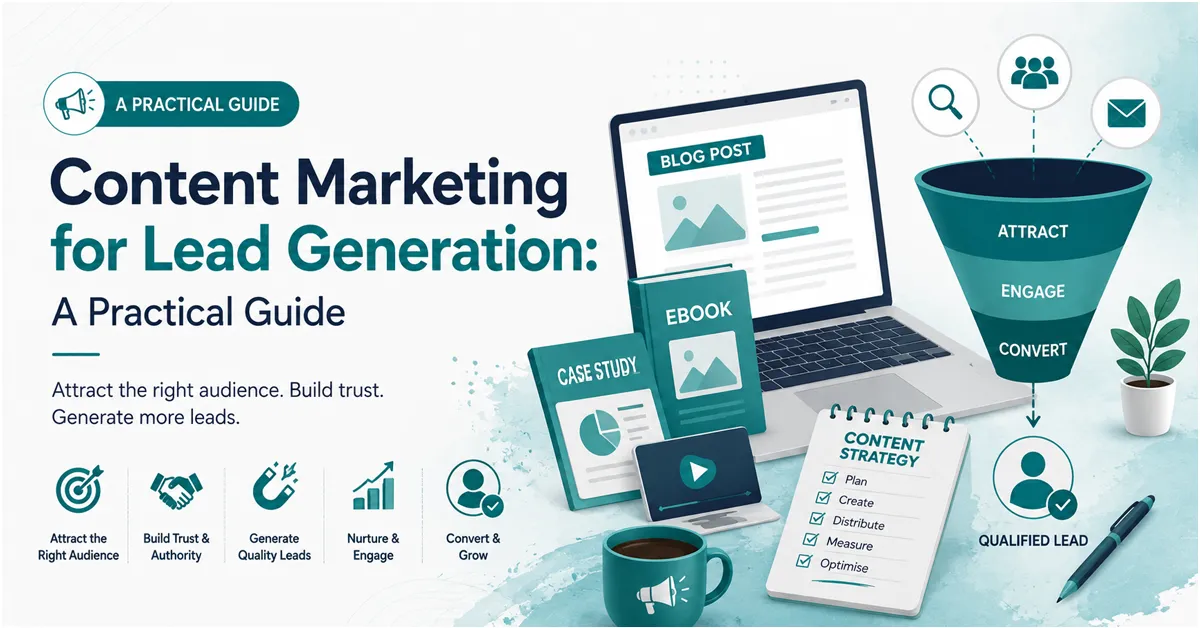
For UK SMEs, content marketing for lead generation works when it's tied to commercial intent. That means building content around real buying questions, clear calls to action, proper landing pages, and follow-up that moves people towards a conversation. It does not mean churning out blog posts and hoping Google sorts the rest.
The businesses that get traction from content usually stop asking, “What should we post this week?” and start asking, “What information does a buyer need before they feel confident enough to enquire?” That shift changes everything.
A lot of UK businesses are stuck renting attention.
They rely on Google Ads, paid social, referrals, outbound outreach, or a mix of all four. Those channels can work well, but they become fragile when they're your only source of pipeline. If lead costs rise, volume drops, or quality slips, the whole acquisition model starts wobbling.
That's where content earns its place. Not as a branding extra, and not as a junior marketing task, but as an asset-building system. Good content keeps attracting buyers after it's published, supports sales conversations, and answers objections before someone ever fills in a form.
The commercial case is strong. 72% of companies say content marketing boosts lead generation, while 58% of marketers say it generates sales and revenue. Content also generates more than 3x as many leads as outbound marketing while costing 62% less, according to Taboola's content marketing statistics roundup.
That matters because most SMEs don't have unlimited room for waste.
Buyers do more research before speaking to sales. They compare providers, scan service pages, read proof, look for pricing signals, and try to work out whether you understand their problem. If your business doesn't provide that information, they'll get it elsewhere.
Content marketing for lead generation works when you publish with a clear job in mind:
Content should reduce friction in the buying process. If it only increases page views, it's not doing enough.
A lot of content underperforms because it sits too far away from revenue.
Common examples include:
Useful content isn't measured by how much you publish. It's measured by whether it helps the right person take the next step.
Before you write anything, map the buyer journey properly.
Most businesses skip this and jump straight into keywords or content ideas. That usually leads to disconnected articles, weak landing pages, and CTAs that don't match intent. A content-led lead generation system starts with the buyer, not the calendar.
Forget fluffy personas for a minute. You need something more practical.
Ask:
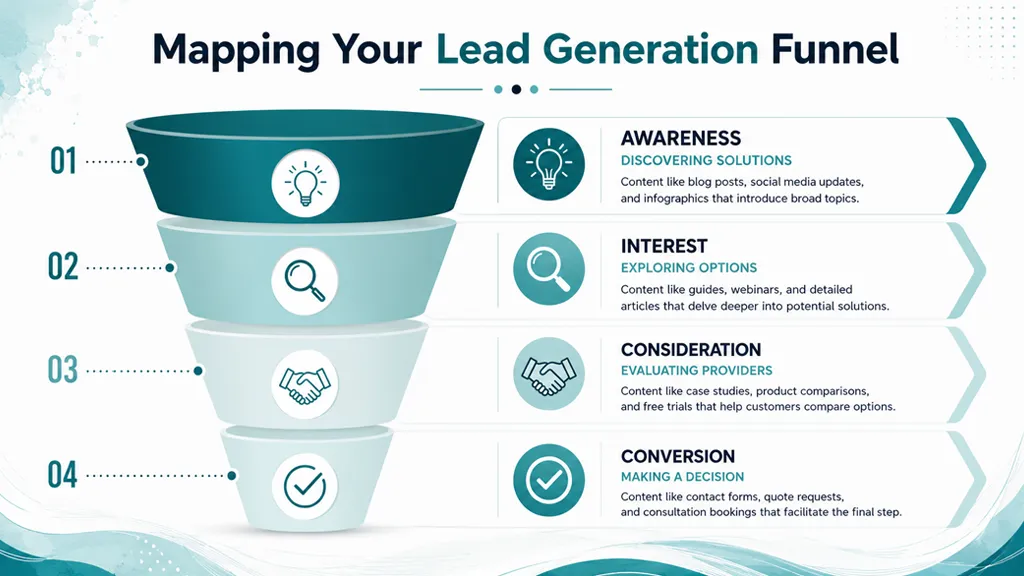
A workable funnel usually looks like this.
| Funnel stage | Buyer mindset | Best content angle | Likely next step |
|---|---|---|---|
| Awareness | “I know there's a problem” | Educational articles, explainers, short videos | Read more or join email list |
| Interest | “I'm exploring options” | Guides, comparisons, deeper service content | View solution pages |
| Consideration | “I'm shortlisting providers” | Case studies, FAQs, process pages, objections content | Book a call or request details |
| Conversion | “I'm ready to act” | Landing pages, forms, consultation pages, pricing context | Enquire |
That's the difference between strategic content and random publishing. Every asset needs a job.
A topic on its own isn't enough. Intent tells you what the page should do.
Someone searching for general advice needs education. Someone searching for service-specific help or comparing providers needs conversion-focused content. If you send both people to the same type of page, one of them will bounce.
Practical rule: Match the CTA to the question the visitor is trying to answer, not the action you want to force.
A clean funnel map should also show where email, retargeting, and sales touchpoints fit in. That's where a broader full-funnel marketing approach becomes useful, especially if you're trying to connect SEO, paid media, and lead nurturing into one system instead of running them in silos.
Use this four-part filter before approving any content idea:
If a content idea fails two or more of those tests, it probably doesn't deserve production time.
Not all content deserves equal effort.
If your aim is lead generation, the content closest to a buying decision usually produces value faster than broad awareness content. That doesn't mean top-of-funnel material is useless. It means many SMEs overinvest in it because it feels easier to produce and safer to publish.
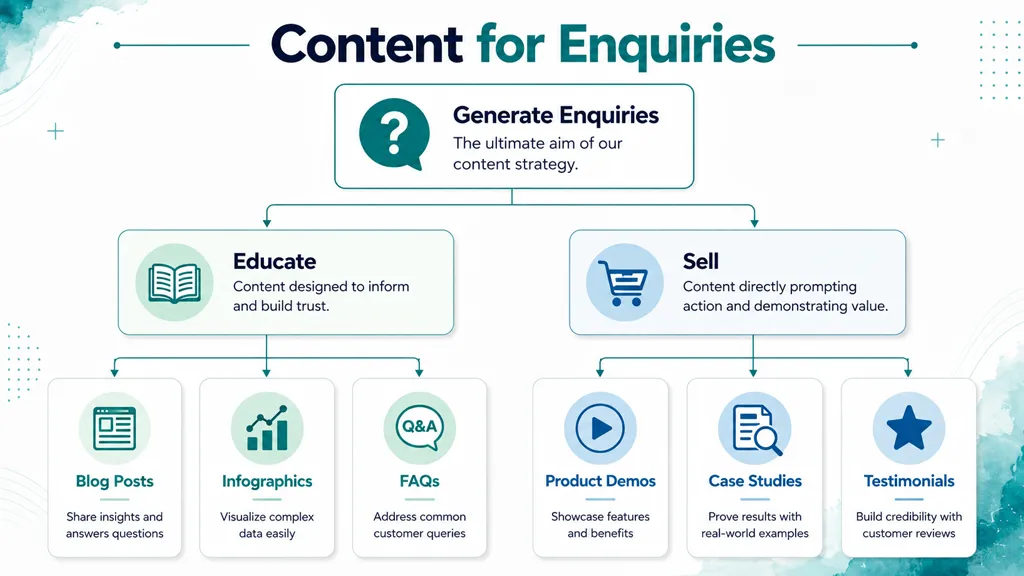
The highest-performing content often looks less glamorous. Service pages. Comparison pages. Case studies. FAQ pages. Landing pages built around a specific problem. These assets answer commercial questions and move people forward.
If your website has weak conversion content, don't start with another general blog post.
Start here instead:
These pieces help buyers qualify themselves. They also help your sales team spend less time repeating the basics.
Top-of-funnel content has a role when it's connected to a conversion path.
A useful article should lead naturally to the next relevant asset. That might be a guide, a case study, a service page, or a contact route. The mistake is publishing educational content that ends with a dead-end CTA like “get in touch” when the reader clearly needs more confidence first.
A stronger structure looks like this:
| Content type | Primary purpose | Best CTA |
|---|---|---|
| Blog article | Answer early-stage question | Read a deeper guide or related service page |
| Guide or checklist | Build trust and capture intent | Download, subscribe, or view solution page |
| Case study | Prove capability | Request consultation |
| Service page | Convert decision-stage traffic | Enquire or book a call |
Industry benchmark data supports this conversion-first approach. Content marketing generates more than three times as many leads as outbound marketing while costing 62% less, and a 2026 survey reports that 74% of companies credit strong content with significantly improving their lead generation success.
The point isn't to create more content. It's to create more useful content.
That usually means writing pages that:
If you're using AI to speed up drafting, research support, or repurposing, use it carefully.
Buyers don't enquire because a page was well formatted. They enquire because the page reduced uncertainty.
Publishing content and waiting for organic traffic is too slow for most SMEs.
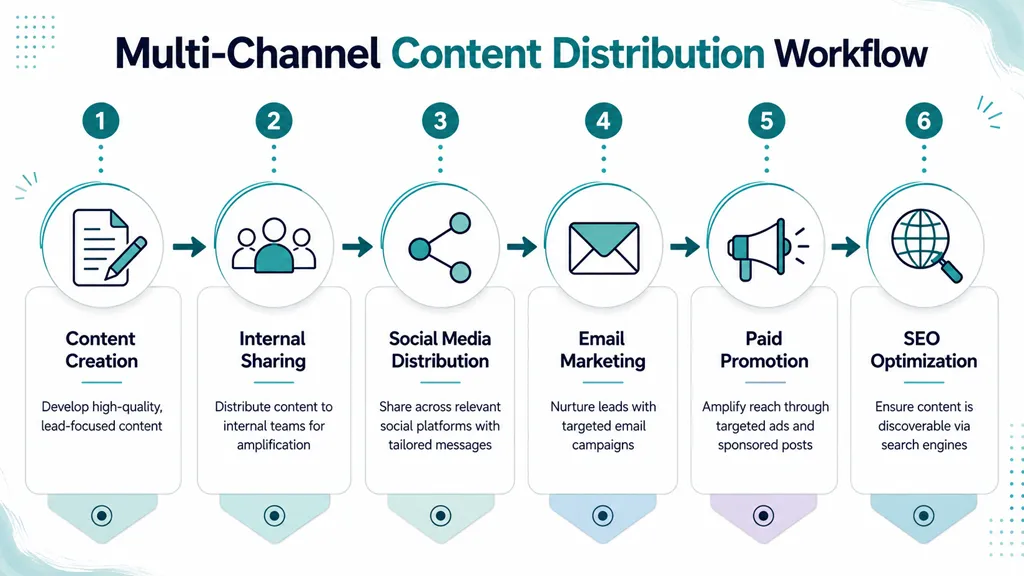
Search matters, but relying on SEO blog traffic alone leaves too much on the table. A stronger model combines search intent, paid amplification, and email nurturing so each asset works harder across multiple channels.
A practical UK workflow is to set a SMART lead goal, map the decision-maker's search intent, build conversion assets with gated CTAs, and pair them with email automation and paid distribution on Google and LinkedIn for retargeting high-intent visitors.
SEO should support the pages most likely to influence revenue.
That means optimising:
Too many content plans start with broad informational keywords and never make it down to the pages that convert. Search visibility is useful, but visibility without intent won't pay the bills.
Visitors often won't convert on their first visit. That's normal.
If someone reads a key article, visits a service page, or spends time on a case study, they've shown intent. Retargeting lets you bring them back with more relevant messaging. For B2B firms, LinkedIn often helps when you need to stay visible in a professional buying context. Google remarketing is useful when buyers continue researching and need repeated exposure before enquiring.
Content and paid media should work together, not compete. A good content asset lowers friction. Paid distribution keeps it in front of people who already showed interest.
Email is still one of the most practical ways to nurture leads who aren't ready today.
Don't build long, fragile sequences that only make sense if someone reads every message in order. Instead, send standalone emails that point to useful resources, answer common objections, and offer the next sensible action.
A simple nurture flow might include:
This short video gives a helpful overview of the wider content distribution mindset.
SEO captures active demand, but it takes time.
Paid distribution creates speed, but stops the moment you stop funding it.
Email helps build familiarity, but only after someone opts in.
Used together, they make content marketing for lead generation far more resilient. One asset can rank, be retargeted, feed email sequences, support sales outreach, and strengthen conversion pages across the site.
A lot of lead generation breaks at the handover point.
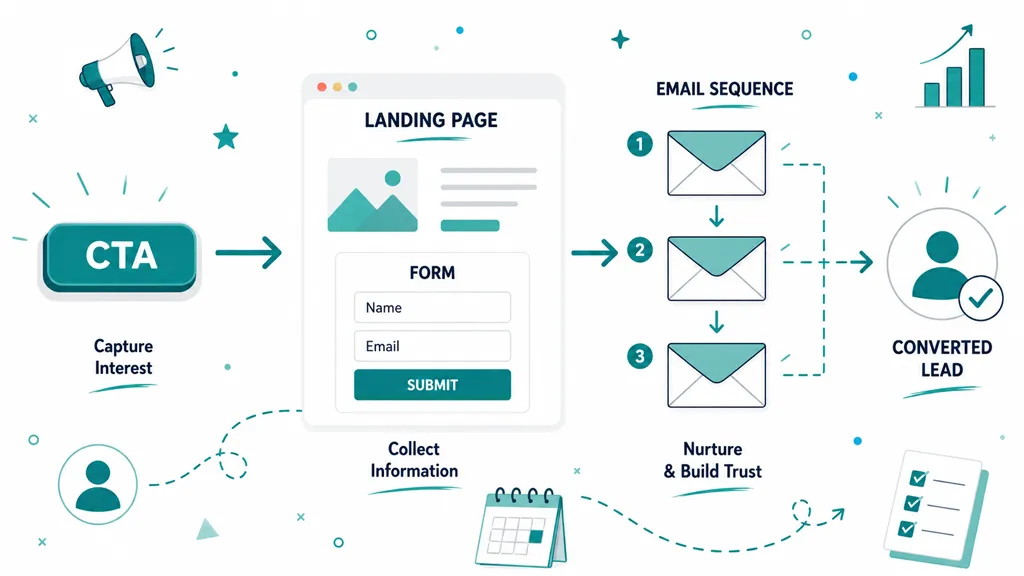
The content is fine. The traffic is decent. Then the CTA is vague, the landing page is clumsy, the form asks for too much, and the follow-up arrives late or not at all. That's where potential enquiries disappear.
Here, UK businesses need to be more selective.
Generic advice often pushes gated content as the default. In practice, that can backfire. Buyers are more cautious about sharing details, especially if the value exchange feels weak or the form appears too early. A UK-specific concern is whether gating still works well when consent expectations are stronger and trust is harder won. Leadpages highlights this trade-off, noting that the decision to gate or ungate should be strategic and based on the value of the asset and the desired action.
That's the right test.
Use ungated content when the buyer needs education, reassurance, or proof before they're willing to identify themselves. Use gated content when the asset is substantial enough to justify the ask.
Gate the asset if all three are true:
Leave it ungated if:
If you gate basic information, buyers often assume the sales process will be equally awkward.
Your landing page should continue the promise made by the content or ad that sent the visitor there.
That means alignment on headline, offer, proof, and CTA. Don't send someone from a detailed educational article to a generic contact page and expect strong conversion. Give them a page that reflects what they were just reading and offers a logical next step.
A high-intent landing page usually includes:
| Element | What it should do |
|---|---|
| Headline | Confirm relevance immediately |
| Supporting copy | Explain the problem solved and who it's for |
| Proof | Add case studies, testimonials, or trust signals |
| CTA | Ask for one clear action |
| Form | Keep fields to what's genuinely necessary |
Getting the lead isn't the finish line. It's the start of qualification.
Someone who downloads a guide may need a nurture route. Someone who requests a consultation may need a fast human response. Someone who visits multiple decision-stage pages may need retargeting with proof-led messaging.
A more complete lead flow should connect forms, CRM stages, email triggers, and sales follow-up. If you want a practical framework for that handover, these lead nurturing best practices are a useful reference point.
The best websites make this feel simple. Fast pages, clear structure, useful CTAs, and minimal friction do more for lead generation than clever copy alone ever will.
If all you track is traffic, you'll end up praising content that doesn't produce revenue.
Page views, impressions, and social engagement can be helpful signals, but they don't prove commercial value. A content-led lead generation strategy should be judged on whether it creates qualified opportunities and contributes to sales.
A simple reporting view should include:
That changes the conversation. You stop asking which article got the most clicks and start asking which content brought in the best enquiries.
Commercial view: A page that generates fewer leads can still be more valuable if those leads are closer to a deal.
You don't need an enterprise stack to get clarity.
A practical monthly report can be built around three groups:
| Reporting area | What to review | Why it matters |
|---|---|---|
| Acquisition | Which pages and channels brought visitors in | Shows demand sources |
| Conversion | Which CTAs and landing pages turned visits into leads | Shows friction and intent match |
| Outcome | Which leads progressed, closed, or stalled | Connects marketing to revenue |
Many businesses understand that their “best” content isn't their most viewed content. Instead, it's the content that shortens the path to an enquiry.
Once you know which assets attract qualified leads, you can decide where to invest next. That might mean improving service pages, producing stronger case studies, tightening forms, or shifting paid budget towards retargeting instead of cold traffic.
If you want a broader framework for connecting activity to commercial return, this guide on digital marketing for lead generation is worth reviewing.
Content should earn its keep. If a page attracts attention but never helps move someone towards a sale, it needs a different role or it needs replacing.
Content marketing works best as one channel inside a wider plan rather than a strategy on its own. If you want the fuller picture of how it fits alongside paid ads, SEO and outreach, our guide to digital marketing for lead generation covers the whole channel mix.
It depends on the channel mix and the strength of your existing website. SEO-led content usually takes longer than paid amplification, but conversion-focused assets such as service pages, case studies, and landing pages can improve enquiry quality much sooner if you already have traffic.
Usually the content closest to a buying decision. Case studies, service pages, comparison pages, FAQs, and strong landing pages tend to outperform generic blog content when the goal is enquiries rather than reach.
No. Gate only when the asset offers enough value to justify the ask. If the information should be publicly available to build trust, support SEO, or answer a common buying question, keep it open.
Yes, but only if they stay focused. A small business doesn't need endless content. It needs the right content, a clear CTA structure, basic nurture flows, and sensible distribution across search, email, and paid channels.
Treating content as separate from sales. If content doesn't answer objections, support decision-making, and point people towards a next step, it won't generate consistent leads.
If you want a practical lead generation system rather than more disconnected marketing activity, Gilkes Media helps UK businesses build content, SEO, paid ads, and conversion-focused websites around commercial outcomes. The work is hands-on, strategic, and geared towards generating qualified enquiries, not vanity metrics.
