
Most "how to generate leads" articles read like they were written for one specific industry and then stretched awkwardly to cover everyone else. This one is deliberately different.
Whether you run a local trade business, a professional services firm, an e-commerce store, or a B2B company selling into other businesses, the ten tactics below apply.
Some cost nothing but time. Others need a modest budget. All ten can produce a measurable result within weeks, not months.
We've ordered them roughly from fastest and cheapest to set up through to the ones that need a bit more budget or planning, so you can start today with whichever fits your current resources.
Industry matters less here than most business owners assume. The fundamentals, how fast you respond, how easy you make it to refer you, and how clearly you ask for the next step, apply whether you sell kitchen renovations, accountancy services, or software subscriptions.
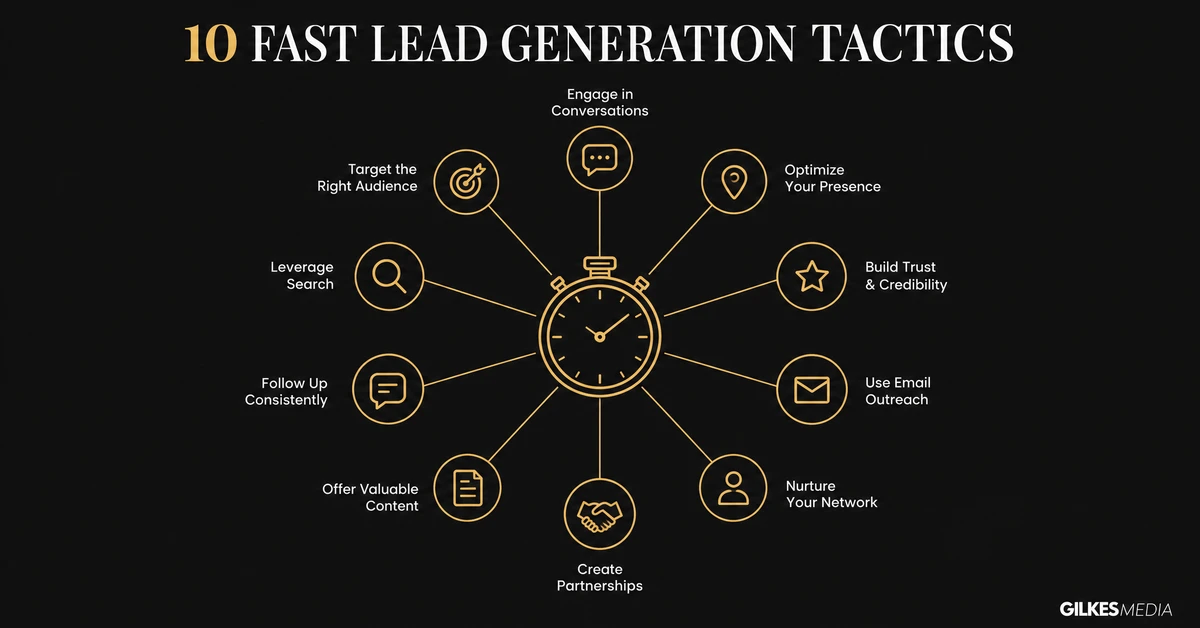
Before the detail, here's the honest comparison: what each tactic typically costs to start, how quickly it tends to produce a result, and which type of business it suits best.
| Tactic | Typical cost to start | Time to first result | Best for |
|---|---|---|---|
| 1. Faster lead response | Free-£50/mo (alerts/tools) | Days | Any business already getting enquiries |
| 2. Google Business Profile | Free | 1-4 weeks | Local and service-area businesses |
| 3. Referrals and reviews | Free-£100/mo | 2-6 weeks | Any business with happy customers |
| 4. Email list reactivation | Free-£50/mo | 1-2 weeks | Any business with an existing list |
| 5. Personal LinkedIn activity | Free | 3-8 weeks | B2B and professional services |
| 6. Referral partnerships | Free | 4-8 weeks | Local trades, B2B services |
| 7. A sharp lead magnet | £0-£1,000 one-off | 2-4 weeks | B2B and considered-purchase businesses |
| 8. Website live chat | £0-£80/mo | Days | Any business with website traffic |
| 9. Targeted Google Ads | £500+/mo ad spend | 1-2 weeks | Any business, high buyer intent |
| 10. Retargeting ads | £150+/mo ad spend | 1-3 weeks | Any business with existing traffic |
None of these tactics is the "best" one in isolation. The right starting point depends on what you already have: existing traffic, an email list, happy past customers, or none of the above yet.
A brand-new business with no list and no traffic yet will naturally lean on the free, relationship-based tactics first, while an established business with years of past customers sitting idle might get its fastest win from tactic 4 alone.
The table is a starting reference, not a rigid rule. Your own results will vary by sector, average order value, and how well each tactic is actually executed, which is exactly why the detail under each one below matters as much as the summary above.
This is the fastest, cheapest lead generation tactic on this list, because it doesn't generate a single new lead. It just stops you losing the ones you already have.
If you only do one thing from this list today, make it this one. It's free, it takes an afternoon to fix, and the research consistently shows it has the single biggest impact on conversion of any tactic here.
For evenings and weekends, even a simple automated acknowledgement ("thanks, we'll call you back by 9am") measurably reduces the chance a lead moves on to a competitor before you've had a chance to respond.
If you track nothing else from this list, track response time itself for the next thirty days. Most businesses are surprised by how often "we usually respond quickly" doesn't match what actually happens once it's measured.
If your business serves customers in a specific area, a complete, active Google Business Profile is one of the few genuinely free lead sources left.
The gap between a neglected profile and a properly maintained one is large. Yext's performance data found the best-performing 10% of profiles generate roughly three times more customer actions than the lowest-performing 10%.
Replying to every review, including the occasional negative one, calmly and professionally, also signals to future customers that a real person is paying attention, which matters as much for conversion as the star rating itself.

Most businesses rely on referrals happening by accident. Making the process systematic, asking every satisfied customer at a consistent point, rather than hoping it occurs to them, is one of the highest-return tactics on this list.
A widely cited Harvard Business Review analysis found referral programmes deliver roughly four times the return on investment of standard digital advertising, since there's no media cost and the trust is already built in.
Pick one consistent moment to ask, such as immediately after a successful project or a positive support interaction, and make it genuinely easy: a direct review link, a simple "do you know anyone else who'd benefit" question, or a small, honest incentive where appropriate.
A referral costs nothing to generate and arrives pre-trusted. The only reason most businesses don't get more of them is that nobody actually asks, consistently, at the right moment.
Most businesses sit on a list of past enquiries, old customers, and newsletter subscribers who haven't engaged in months. That list is a genuinely free lead source, not dead weight.
Make sure every unsubscribe link and consent record stays compliant with UK GDPR as you do this, since a reactivation campaign is also a good moment to clean up a list that's drifted out of date.
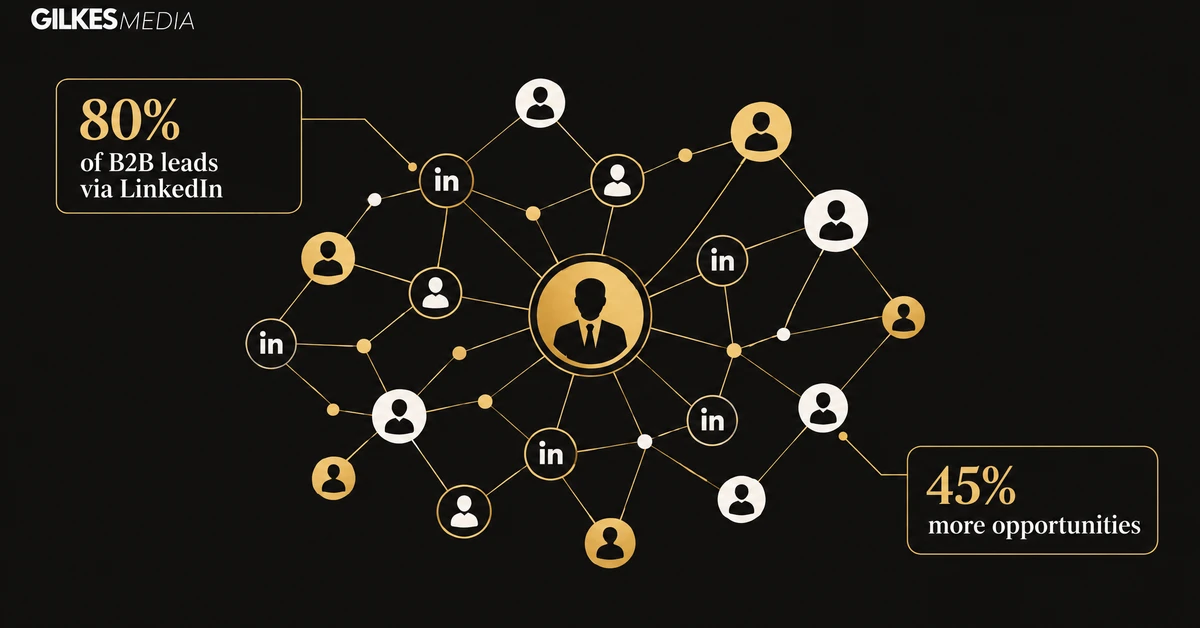
For B2B and professional services businesses, LinkedIn is one of the clearest wins on this list, provided it's a person posting, not a faceless brand page.
Sprout Social's research found 80% of B2B leads generated through social media come via LinkedIn specifically. LinkedIn's own Social Selling Index research found that leaders on the index create 45% more opportunities and are 51% more likely to hit their sales quota than low scorers.
The platform's own data also shows personal profiles generate roughly 2.75 times more impressions than company pages, with engagement rates around five times higher. People engage with people, not logos.
The posts that tend to perform best are specific rather than general: a real project outcome, a mistake you learned from, or a clear opinion on something happening in your industry.
A vague "excited to share some news" post rarely earns the same engagement as something with genuine substance behind it.
Start with two or three posts a week sharing genuine opinions, lessons, or results from your own work, rather than reposting company announcements. Comment thoughtfully on posts from people in your target audience before posting yourself; it builds visibility faster than posting alone.
A founder or salesperson posting consistently as themselves will usually outperform the company page entirely. LinkedIn's own data backs this up, not just marketing folklore.
This works in almost every industry: find a business that serves the same customer at a different stage, and agree to refer each other's work.
The strongest version of this tactic goes both ways in practice, not just on paper. A quarterly coffee or call with each partner, even a short one, keeps the relationship active and means referrals actually get mentioned rather than quietly forgotten after the first introduction.
A generic "sign up for our newsletter" box converts poorly. A specific, useful resource tied directly to a real buying decision converts far better.
HubSpot's data shows gated eBooks typically convert below 0.9%, while interactive tools, quizzes, and templates convert at 5.2% or higher. A large-scale analysis of over 650,000 forms by Formstack found general lead forms convert at around 11%, and contest or giveaway forms at 35%.
A survey of 214 B2B executives by ClickyDrip found webinars were the format decision-makers were most willing to register for (51%), ahead of research reports (50%), white papers (48%), and standard eBooks (44%).
The common thread: a calculator, checklist, template, or short assessment that solves one specific problem beats a long, generic PDF almost every time. See our guide to B2B lead magnets for worked examples by industry.
Think of the one question your sales team gets asked most often before someone buys, and build a simple tool, checklist, or calculator that answers it directly. A single well-targeted resource like this will usually outperform a broad, generic guide covering everything at once.
Promote it through the channels you're already building elsewhere on this list: a pinned LinkedIn post, a mention in your email reactivation sequence, or a prominent link from your Google Business Profile, rather than treating it as a standalone project with no distribution plan.
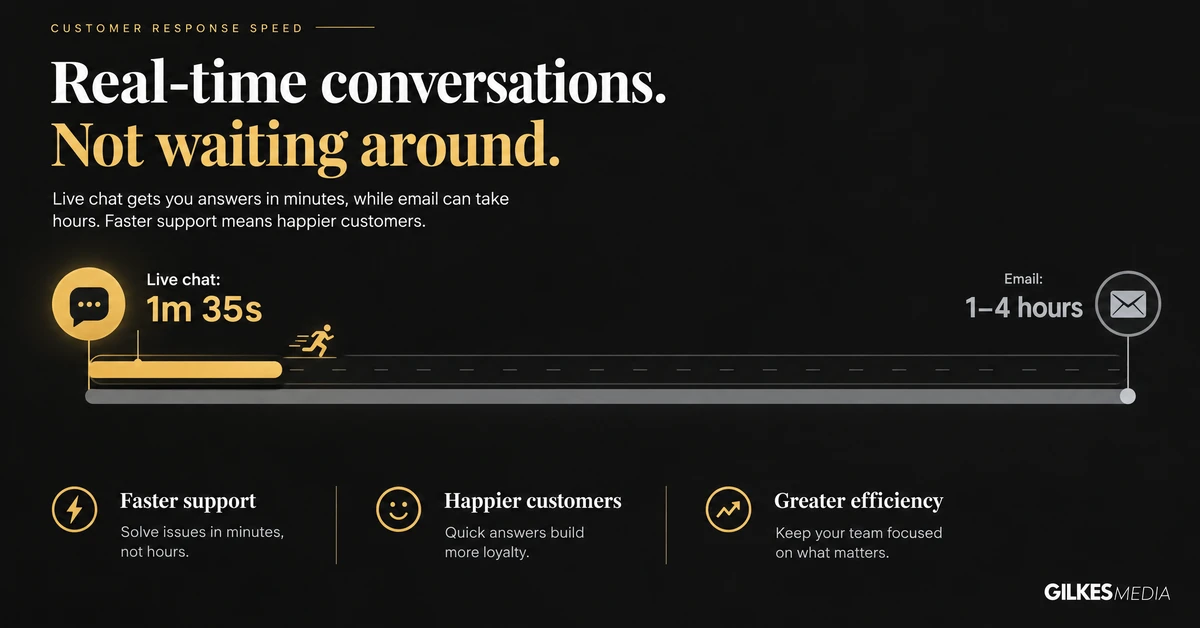
Live chat catches the visitor who's interested right now but not quite ready to fill in a contact form or pick up the phone.
The cheapest version of this tactic is simply a basic chat widget staffed by whoever is free during the day.
The more advanced version, a genuinely conversational AI assistant that qualifies and books in leads around the clock, is a bigger step but suits businesses with a steady stream of similar, repeatable questions.
If you're weighing up a basic chat widget against a fuller AI-driven nurturing setup, our guide to choosing an AI lead nurturing provider covers the real cost and capability differences.
A visitor who has a question answered in ninety seconds converts very differently to one who emails and waits until tomorrow. Live chat closes that gap almost entirely.
Of every tactic here, paid search captures the highest-intent buyer: someone actively typing exactly what they want into Google, right now.
The speed advantage is real: unlike SEO or content, a well-structured campaign can start generating leads within days of launch. The quality advantage depends entirely on keyword and audience targeting discipline, which is where most small accounts waste the majority of their early budget.
Start with a handful of tightly matched, high-intent keywords rather than a broad list. A narrower campaign with a clear, relevant landing page consistently outperforms a wide one with generic ad copy, both on cost per click and on actual lead quality.
The people most likely to convert next are usually the ones who already visited your site and left without converting. Retargeting puts your business back in front of them.
This is also genuinely cheap to run. Because the audience is small and already warm, retargeting budgets of £150-£300 a month can run meaningfully alongside a larger prospecting campaign, often at a lower cost per lead than any other paid channel on this list.
The one real requirement is traffic to retarget in the first place, so this tactic works best once at least one or two of the others on this list are already sending people to your site.
A worked example: if your prospecting campaign converts at the 1.5% industry median, 1,000 visitors produce roughly 15 leads. Applying that same traffic to a retargeting audience at the 3.8% median more than doubles that to around 38 leads, from the same underlying visitor numbers.
Retargeting consistently produces a lower cost per lead than cold prospecting, because you're reminding an already-interested visitor rather than persuading a stranger from zero.
Trying to run all ten at once is the single biggest mistake we see. Pick two or three, run them properly for a month, then add more.
We see the same handful of mistakes repeatedly across businesses trying to generate leads quickly, regardless of industry or budget size.
That last point is worth dwelling on. A tactic that produces fewer but much more qualified leads, such as a well-targeted referral partnership, can easily beat a high-volume channel that fills your pipeline with enquiries that never convert.
Fixing your lead response time is the fastest genuine win, since it's free and takes an afternoon. After that, optimising your Google Business Profile and setting up a referral request process both tend to show results within a few weeks.
Faster lead response, referral requests, email list reactivation, and live chat all apply regardless of sector, since every business that takes enquiries can use them. Platform-specific tactics like LinkedIn suit B2B best, while Google Business Profile suits local and service-area businesses.
Several of the fastest tactics on this list, including faster response times, referral requests, and Google Business Profile optimisation, cost nothing but time. Paid tactics like Google Ads or retargeting typically need a minimum of £150-£500 a month to produce a reliable flow of leads.
Start free. Fixing response time, requesting referrals, and optimising your Google Business Profile cost nothing and often improve results from paid ads later too, since a slow response process wastes expensive paid traffic.
It varies by tactic. Faster response times and live chat can show a difference within days. Referrals, email reactivation, and retargeting typically take two to six weeks. LinkedIn activity and referral partnerships usually take four to eight weeks to build real momentum.
Interactive tools, calculators, and templates tied to a specific decision convert far better than generic eBooks or newsletter sign-ups. Research shows interactive formats can convert at over 5%, compared to under 1% for generic gated eBooks.
Yes. Research shows 41% of customers prefer live chat over email or phone, and businesses offering it see measurable increases in both conversion and average order value, largely because questions get answered in minutes rather than hours.
Two or three at a time, run properly, beats attempting all ten at once. Start with faster response handling plus one or two of the free organic tactics, then add more once those are running smoothly.
