If you've started looking into AI lead nurturing for your business, you've probably noticed the pricing pages all read differently. This is a young, fast-growing market.
The range of what gets sold under the same name is wide enough that two "AI lead nurturing" quotes can differ by a factor of ten and both be honest.
This guide is for the point after you've decided AI lead nurturing is worth exploring, and before you've picked who builds or runs it.
We'll cover what you're actually buying, the checks that separate a system that pays for itself from one that quietly annoys your prospects, and the questions worth asking before anyone gets a signature.
None of this assumes you'll end up working with an agency, let alone with us. It's written so you can make a good decision either way.
There's a clear path at the end if you'd rather talk it through than keep researching alone.
Before comparing providers, it helps to know that "AI lead nurturing" isn't one product. It's a label covering three genuinely different setups, and most buyer confusion comes from comparing a quote for one against a quote for another.
We've written a fuller explainer on what AI lead nurturing actually is if you want the mechanics. Here's the buyer-relevant version.
A platform with built-in lead scoring, behavioural tracking and AI-generated follow-up messages, sold as a monthly subscription. You configure it, write the content, and manage the scoring model yourself.
It's the cheapest route in, and the one where the quality ceiling depends entirely on how much time your team can actually give it.
Someone maps your buyer journey, writes the sequence content, configures the scoring against your real sales data, and hands you a working system. This is usually a one-off project fee.
What you do with it afterwards, tune it or leave it alone, is up to you.
The software, the build, and ongoing management rolled into one retainer. Someone is watching performance, adjusting the model, and refreshing content on a schedule, rather than leaving it to drift.
This tends to be the option that keeps improving after launch, because that's the part a DIY setup almost never gets round to.
Knowing which of these three a provider is actually offering, before you compare their price to anyone else's, will save you most of the confusion in this market. A £150-a-month quote and a £2,000-a-month quote aren't competing offers, they're usually different products wearing the same name.
"AI lead nurturing" covers three different products, software you run, a managed build, or a full agency service, and most pricing confusion comes from comparing quotes across categories rather than within one.
AI adoption among UK SMEs has moved fast. Research from the British Chambers of Commerce, run with Atos and analysed alongside the University of Essex's ESRC Centre for Micro-Social Change, put active AI adoption among UK small and medium businesses at 54% in 2026.
That's up from 35% in 2025, 25% in 2024 and 23% in 2023. It's a genuine shift, not a headline.
It also means the number of vendors selling AI lead nurturing has grown faster than the number of people who've run one of these systems for two years and learned what breaks. A crowded, young market is exactly where a compelling demo and a genuinely good product get harder to tell apart.
The same research found adoption is uneven: larger SMEs and B2B professional services are ahead, while smaller and consumer-facing businesses lag behind. If you're in that second group, you're not late.
You're simply earlier in a decision that a lot of your competitors haven't made carefully yet either. None of that is a reason to rush.
It's a reason to be more deliberate than the market average, because the market average right now is moving quickly and not always checking its own work.
B2B professional services firms leading that adoption curve tend to be the ones already comfortable with CRM data and structured sales processes. That happens to be exactly the precondition that makes AI lead nurturing work well.
If that describes your business, you're in a genuinely good position to benefit, provided the vendor you choose matches that maturity rather than selling you a generic template.
If you're earlier in that journey, the practical implication isn't to wait. It's to weight your provider choice towards one that will help you build the underlying process, clean CRM data, a clear buyer journey, defined lead stages.
That beats one that assumes the groundwork is already in place and simply plugs software on top of a gap.
Every provider will show you a clean demo. Demos are designed to work. What you need is a way to check the things a demo doesn't show you, before you're locked into a contract. Here's the checklist we'd want if we were the ones buying.
Four of these deserve more than one line, because they're where most disappointing AI lead nurturing projects actually go wrong. We've covered them below.
A quick way to tell a strong answer from a weak one on lead scoring specifically: a strong provider can point to the exact behaviours feeding a score, page visits, email opens, time on your pricing page, and explain why each one was chosen.
A weak one describes the model as "proprietary AI" and moves on. That single answer often tells you more about a provider than an hour of feature demos.
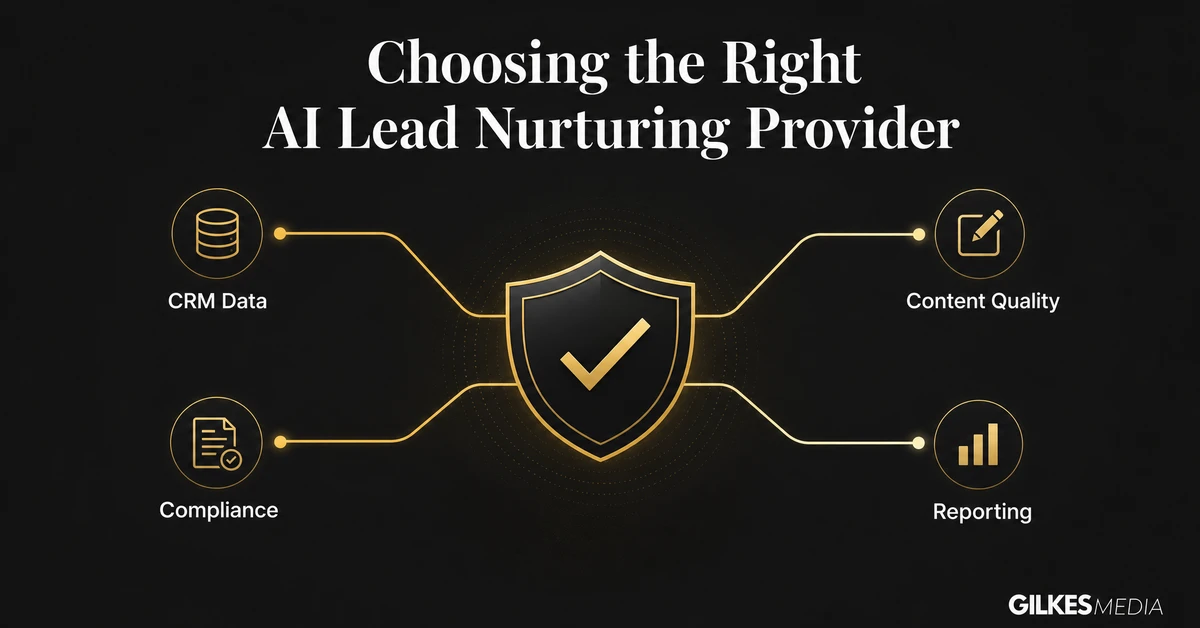
A system that can't read your CRM properly can't score leads against what actually happened to them, whether they bought, went quiet, or turned out to be a poor fit.
Ask for a specific, named integration with your exact CRM and ad platforms, not a general assurance that "most systems connect fine."
Generic AI-written follow-up reads like generic AI-written follow-up, and prospects notice. Ask to see three real message examples the system has actually sent to a real lead, not templates from a sales deck.
If a provider can't produce these, that tells you something. It's also worth asking who reviews and approves new message content before it goes live.
A system that lets AI-generated copy ship to real prospects with no human sign-off is waiting for an embarrassing edge case, and every provider who's run one long enough has a story about it.
Long minimum terms aren't automatically a problem, but a long term combined with no clear way to export your lead scoring history and message logs is a real one.
You should be able to leave with your data intact, even if you'd rather not leave at all.
Open rates and click rates are easy to report and easy to make look good. Ask specifically how the system reports on leads that became sales conversations.
And ask how it separates its own effect from leads that would have converted anyway.
The checks that matter most are the ones a demo won't show you: real CRM integration, real message examples, a clean exit if it doesn't work, and reporting on actual sales outcomes rather than opens and clicks.
This is the section most buyers skip, and the one most worth reading before you sign anything. UK data protection law around automated decision-making changed under the Data (Use and Access) Act 2025, and lead scoring is exactly the kind of activity it covers.
The Information Commissioner's Office published updated draft guidance on automated decision-making and profiling on 31 March 2026, following a consultation.
The broad shift gives businesses more flexibility to use automation and AI, provided real safeguards are in place, rather than the stricter default the old rules leaned towards.
The safeguard that matters most for lead nurturing is what the ICO calls meaningful human involvement. A person approving whatever the algorithm recommends isn't enough.
The ICO's guidance is explicit that the person involved needs real authority, needs to understand the basis of the automated output, and needs to be genuinely able to challenge or override it.
In practice, that means a lead scoring model that quietly decides who your sales team calls back and who gets left in an automated sequence forever needs a human who can actually see and question that decision, not just a dashboard nobody looks at.
The other safeguards worth asking a provider about directly: transparency with the people being scored or messaged, a mechanism for someone to request human intervention, the ability to contest a decision, and a data protection impact assessment for anything higher-risk.
We've written a longer, dedicated piece on AI lead nurturing and GDPR if you want the full detail.
A provider who can answer these questions without hesitation has done this before. One who looks blank, or tells you it's "not really relevant for marketing," is telling you they'll leave the compliance work to you after you've already paid them.
None of this needs to be intimidating. Most small and mid-sized businesses using AI lead nurturing sensibly are not running high-risk automated decisions in the sense the ICO is most concerned with, recruitment and credit decisions sit at the sharper end of that.
But a lead scoring model that decides who your sales team never calls back is still a decision about a person. Treating it that way from the start is both the compliant approach and, generally, the one that produces a better system.
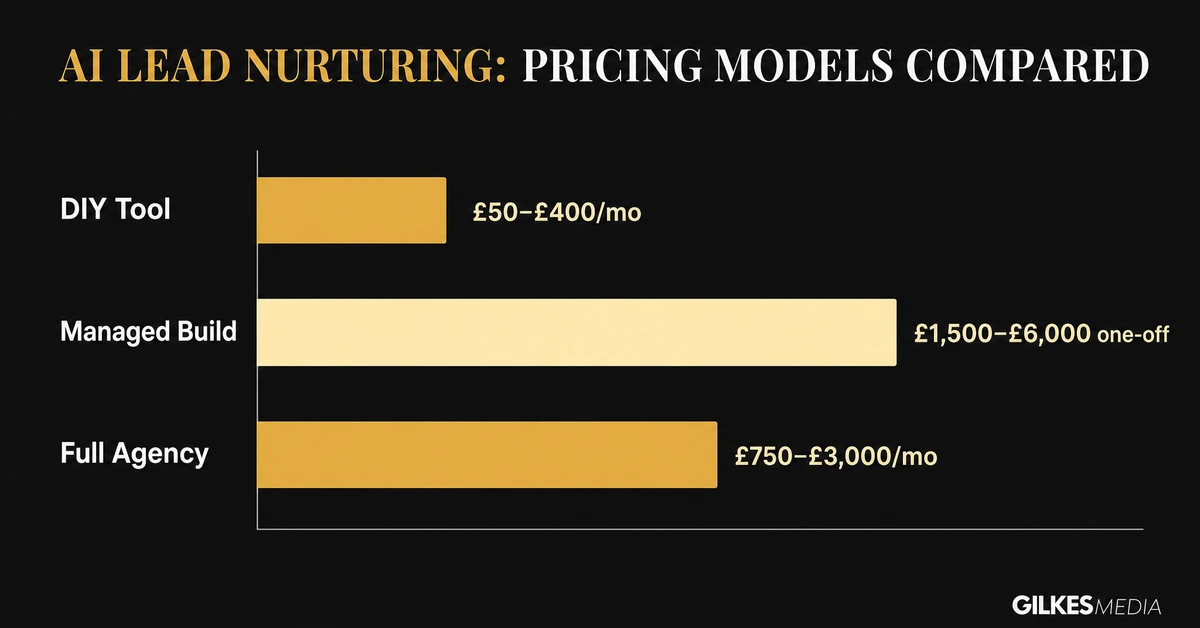
Once you know which of the three models in Section One a provider is actually offering, the next question is which one fits your business. Realistic 2026 UK price bands, based on our own client work, are set out below.
| Model | Typical UK cost | Who does the work | Best fit |
|---|---|---|---|
| DIY software subscription | £50 to £400 a month | You, in-house | Businesses with marketing skill and time to spare in-house |
| Managed build (one-off) | £1,500 to £6,000 project fee | Agency or consultant, then you | Businesses that want it built properly once, then run it themselves |
| Full agency-run service | £750 to £3,000 a month | Agency, ongoing | Businesses with meaningful lead volume and no in-house capacity to tune it |
We've broken these bands down in more depth, including exactly where the hidden costs tend to sit, in our full AI lead nurturing cost guide. The short version: the DIY option is only cheap if your time is genuinely free, and it rarely is.
A useful rule of thumb: if you can't name the person internally who'll own tuning the system in six months, don't buy the DIY option.
Either budget for a managed build, or accept that the software subscription will quietly go stale, which is the most common way these projects fail.
The three models aren't better or worse versions of each other, they suit different businesses. Pick based on who will actually own the ongoing tuning, not just the sticker price.
A good provider will welcome these questions. A weak one will get vague, change the subject to the platform's features, or tell you that "clients don't usually ask that." Take the second reaction seriously.
On red flags, three come up more than any others. A provider who can't explain their pricing structure clearly, who won't give you a reference client in your rough sector or size, or who describes their scoring model as proprietary and leaves it there.
None of these are unreasonable to ask about, and a provider worth working with will have straightforward answers ready.
If you're comparing this against building the case in-house rather than hiring anyone, it's also worth reading how AI chatbots actually compare to a human sales team, since the honest answer is more nuanced than either camp usually admits.
Numbers make this decision easier than most people expect, so here's a worked example using published research rather than invented figures.
Say your business generates 60 leads a month across your website and ads, and your sales team currently gets round to a genuine response within a few hours on a good day, longer on a busy one.
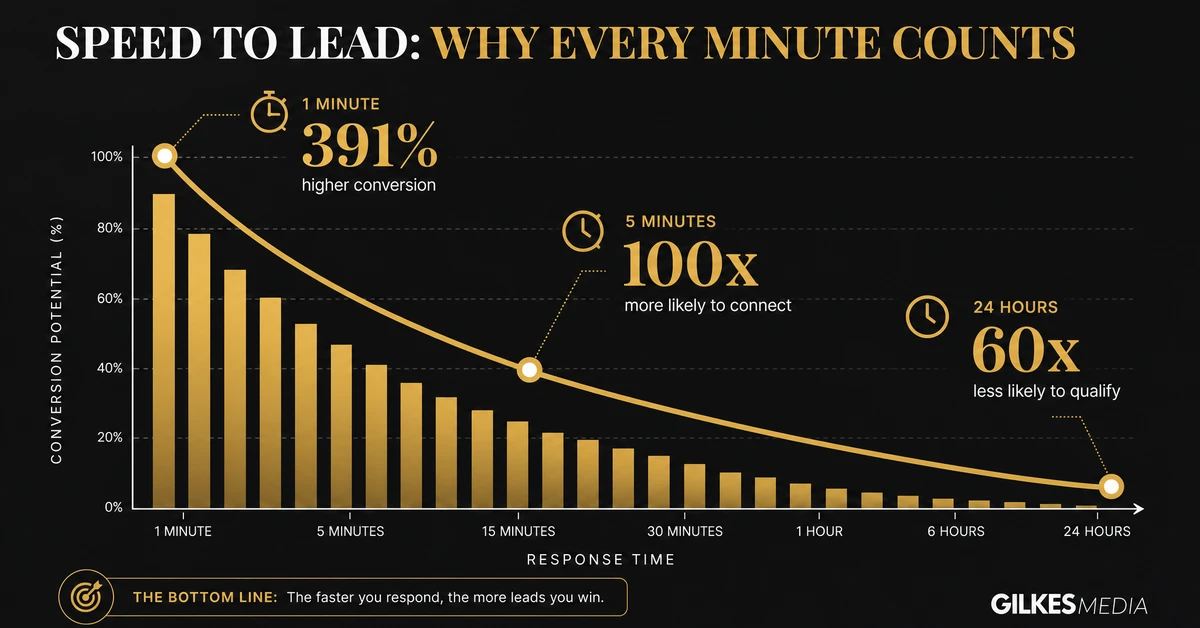
A widely cited study of over 2,000 US companies, often called the original lead response management research, found that responding within an hour made a business seven times more likely to have a meaningful conversation with a lead than responding later.
The same research found that waiting 24 hours made a business roughly 60 times less likely to qualify that lead at all. Separate research from Velocify found responses within one minute produced a 391% higher conversion rate than slower responses.
We've covered the full picture, including a source-by-source breakdown, in our speed to lead guide.
If even a handful of those 60 monthly leads are currently going cold overnight or over a weekend before a human gets to them, that's a real cost.
An AI system that sends a genuinely useful, personalised first response within minutes isn't a nice-to-have. It's closing the single gap the research says matters most.
Put a rough number on it: if instant, relevant follow-up recovers even three or four extra qualified conversations a month that would otherwise have gone to a faster competitor, and your average customer is worth anything meaningful, that adds up fast.
A £750 to £1,500 monthly investment in a properly managed system pays for itself well before the end of the first quarter. That's the calculation worth doing with your own numbers before you buy anything, not after.
This is also the test to apply to any provider's own case studies. Ask them to show the before-and-after response time, not just the before-and-after conversion rate.
The research is clear about which one is actually driving the result.
Speed to first response is the single best-evidenced driver of AI lead nurturing's return on investment. Run the numbers on your own lead volume before buying anything, and ask any provider to show response-time evidence, not just conversion-rate claims.
In the interest of a straight answer rather than a sales pitch: if you have a genuinely simple sales process and low lead volume, and someone in-house who's comfortable with software and has real time to give it, a good DIY tool can work perfectly well.
Plenty of small businesses run this successfully.
Where a managed build or full agency service tends to win is anywhere the sales process has real complexity: multiple products, several audience segments, a sales team that needs qualified leads rather than raw ones.
Or anywhere nobody in-house has the marketing background to write nurture content that doesn't sound automated.
The honest failure mode on both sides is the same: a system nobody keeps tuning. A DIY tool goes stale because nobody has time. A managed build goes stale because the agency delivered it and moved on to the next client.
The question to ask any provider, DIY platform or full-service agency, is who is responsible for noticing when it stops working, and what they'll actually do about it.
There's also a real cost to picking the wrong model that rarely shows up in a pricing comparison. Ripping out a badly configured DIY tool after eight months and starting again with an agency, or the other way round, costs you months as well as money.
Getting the model right at the start is worth more than a small saving on the monthly fee.
At Gilkes Media, we run AI lead nurturing as an ongoing, managed service rather than a build-and-leave project, precisely because the tuning is where most of the actual performance gain happens over time.
If that's the model you're leaning towards, our AI lead nurturing service page covers how we approach it.
It's worth saying plainly: AI lead nurturing isn't the right next step for every business. A good provider should tell you that too, even if it costs them the sale.
A few signs it's premature.
If your lead generation itself is inconsistent, some months busy, some months nearly silent, fixing that comes first. AI lead nurturing multiplies whatever volume you already have.
It can't create leads that don't exist, and a quiet month will feel exactly as quiet with an AI system running as without one.
If your offer or pricing genuinely varies deal to deal, with no repeatable pattern a system could learn from, a scoring model has very little real signal to work with.
It'll produce numbers, but they won't mean much.
And if you get fewer than perhaps ten or fifteen genuine leads a month, the maths in the worked example above changes. A managed system still costs roughly the same whether you send it five leads or five hundred.
At very low volume, the DIY option, or simply tightening up your own response process by hand, is often the more sensible starting point.
Almost every provider will offer, or agree to, some form of pilot if you ask directly.
It's worth insisting on one rather than signing a twelve-month contract on the strength of a demo alone.
A sensible pilot runs for 60 to 90 days, long enough to see a genuine pattern rather than one lucky week.
It should be scoped against a small number of agreed metrics decided before it starts, not chosen afterwards to flatter whatever happened.
A provider who resists a structured pilot, or wants a long minimum term before you've seen it work on your own leads, is asking you to take more risk than they're willing to take themselves.
That asymmetry is worth noticing before you sign, not after.
Insist on a structured 60 to 90 day pilot with an agreed baseline and clear targets set in advance, rather than signing a long contract on the strength of a demo alone.
Realistic bands run from £50 to £400 a month for a DIY software subscription, £1,500 to £6,000 as a one-off fee for a managed build, and £750 to £3,000 a month for a full agency-run service. The right band depends on your lead volume and how much of the ongoing tuning you want handled for you.
It depends on lead volume and how much is currently being lost to slow follow-up. If leads regularly wait hours or go cold overnight, the response-time research suggests it's very likely worth it. If you get a handful of leads a month and respond within minutes already, the case is weaker.
Ask to see real message examples sent to real leads, how your data can be exported if you leave, how a lead scoring decision can be challenged, who the named person on your account will be, and for a reference client of a similar size or sector.
It can, provided the provider builds in meaningful human involvement, transparency about automated decisions, and a route for someone to challenge or contest a decision, as set out in the ICO's updated guidance on automated decision-making under the Data (Use and Access) Act 2025. Ask any provider how they handle each of these directly.
A DIY tool is software you configure and run yourself, priced as a subscription. A managed service includes the strategy, content and ongoing tuning as part of the price, usually as a monthly retainer, and tends to keep improving after launch rather than being left to drift.
No. It's a multiplier on a sales process that already works, handling the volume and speed a human team can't match at scale, but it isn't a substitute for a person on complex, high-value or relationship-driven deals.
A straightforward managed build typically takes two to four weeks, covering mapping your buyer journey, writing sequence content, configuring scoring against your CRM data, and testing against real leads before it goes live. Complex, multi-segment setups take longer.
Unclear pricing structure, no reference client willing to talk to you, and a scoring model described only as "proprietary" with no real explanation of how it works. A provider confident in their product will answer all three without hesitation.
If you've read this far, you're already doing more due diligence than most businesses do before signing an AI lead nurturing contract.
That's exactly the right instinct for a decision that's genuinely hard to reverse cheaply once you're a few months in.
If it would help to talk through your own lead volume, current response times and what a properly managed system would realistically cost for your business, we offer a free, no-pressure discovery call.
You can see how we approach it on our AI lead nurturing service page, or go straight to book a call with us. We'll give you a straight answer, even if that answer is that you don't need us yet.
