
AI lead nurturing raises a genuine question we hear in nearly every conversation about it. Is this actually allowed under GDPR, and what happens if it goes wrong?
It's a fair question. Automated systems that process personal data and decide how and when to contact people sit squarely within GDPR's scope. Getting this wrong carries real regulatory and reputational risk.
The good news is that AI lead nurturing, done properly, is genuinely compliant. The specific things that make it compliant are straightforward enough for any UK business to implement, without needing a dedicated legal team.
Automated marketing isn't new. Email automation and basic drip sequences have existed and been broadly GDPR-compliant for years.
What's changed with AI-driven lead nurturing is the addition of automated decision-making. A system now decides what to say, when to say it, and sometimes whether to treat a lead differently based on inferred characteristics. This brings in specific GDPR provisions around automated decision-making and profiling that a simple scheduled email sequence doesn't necessarily trigger in the same way.
This doesn't mean AI lead nurturing is inherently riskier, provided you implement it properly. It means the specific things you need to get right are somewhat different. These are worth understanding clearly, rather than assuming your existing email marketing compliance automatically covers a more sophisticated automated system.
Lawful basis for processing.
Every piece of personal data your AI lead nurturing system processes — name, email, behavioural data like pages visited or emails opened — needs a clear, genuine lawful basis. Most commonly, this means consent or legitimate interest, depending on how you collected the data and what you're using it for.
A lead who filled in a form explicitly agreeing to marketing communications gives you a straightforward consent basis.
A lead whose behavioural data you're using to personalise follow-up, without that same explicit agreement, needs a more careful legitimate interest assessment. This is worth getting right at the point of data collection, rather than retrofitting it later.
Transparency about automation. UK GDPR requires you to tell people, in clear, plain language, when an automated system is processing their data. It also requires that you tell them specifically about any automated decision-making that has a legal or similarly significant effect on them.
For most lead nurturing scenarios, the effect isn't legally significant in the strict regulatory sense — receiving a follow-up email isn't comparable to an automated credit decision. However, being transparent about the fact that automation personalises and times your communications is still good practice. It's increasingly an explicit expectation too, not just a legal minimum to scrape past.
Where automated processing has a more significant effect on someone, GDPR gives individuals the right to request human review. They don't have to accept a purely automated decision.
In practice, for most lead nurturing systems, this means making sure there's a genuine, easy way for a lead to reach an actual person. A lead shouldn't get stuck in an automated sequence indefinitely, with no clear route out. That's good practice for conversion as well as compliance.
Data minimisation. Collect and process only the data your lead nurturing system genuinely needs to do its job well. Don't collect everything a system is technically capable of tracking, simply because the technology makes it easy to do so.
A system that tracks and stores considerably more behavioural data than it actually uses to personalise anything meaningful is taking on data protection risk and storage cost. It gets no corresponding genuine benefit in return.
The right to be forgotten and easy opt-out.
Every automated sequence needs a genuine, functioning, easily findable unsubscribe or opt-out mechanism. It also needs a clear internal process for actually removing someone's data on request, within the required timeframe. That's not the same as just suppressing future emails while their data continues sitting in the system indefinitely.
This is a common gap we find when auditing a client's existing setup. The unsubscribe button works, but the underlying data deletion process behind it doesn't happen properly or promptly.

| GDPR principle | What it means for AI lead nurturing |
|---|---|
| Lawful basis | A clear basis (usually consent or legitimate interest) for every piece of data processed |
| Transparency about automation | Being clear that automation is involved in how communications are personalised and timed |
| Right to human intervention | A genuine, easy way for a lead to reach an actual person |
| Data minimisation | Only collect and process what the system genuinely needs, not everything it's technically capable of tracking |
| Right to be forgotten and easy opt-out | A working unsubscribe mechanism and a real process for deleting data on request |
What's changed isn't automated marketing itself, but automated decision-making - a system deciding what to say and to whom based on inferred characteristics. This brings in specific GDPR provisions that a simple scheduled email sequence doesn't trigger. Every piece of personal data your system processes needs a clear, genuine lawful basis, most commonly consent or legitimate interest, depending on how you collected it.
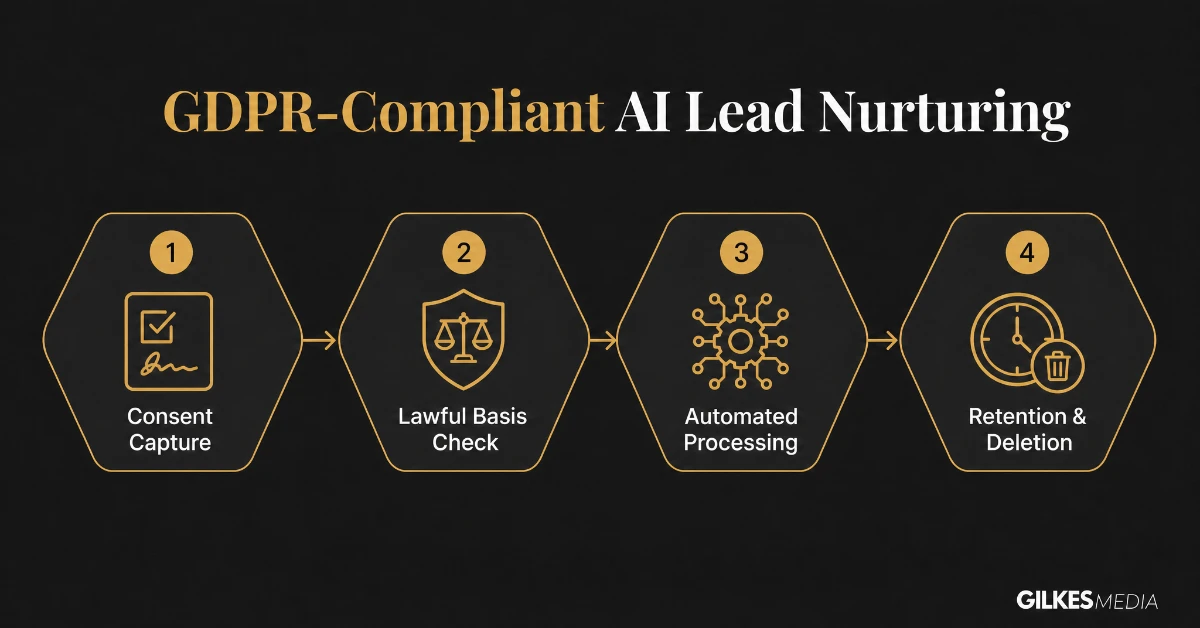
Clear, specific consent language at the point of capture.
Rather than a generic "I agree to marketing" checkbox, use clearer language that specifically mentions automated, personalised follow-up. This gives leads a genuinely informed understanding of what they're agreeing to. It also gives your business a stronger, more defensible consent record if anyone ever questions it.
A documented lawful basis assessment.
For any data you use in ways beyond the most basic email follow-up — particularly behavioural tracking used to personalise content or timing — keep a brief, genuine documented assessment of why you believe you have a lawful basis. This is good practice: it costs little to produce upfront, and it matters considerably if a complaint or audit ever happens.
Data retention limits actually built into the system.
Rather than letting data sit indefinitely by default, set a defined retention period. After this period, either genuinely re-permission inactive leads or delete them. This keeps your data holding proportionate to actual need, which is better GDPR practice. As a practical side benefit, it also keeps your lead database cleaner and more useful, rather than cluttered with years of dead contacts.
This matters especially early on. When a system first goes live, have a real person periodically review a sample of the automated communications it sends. This catches both compliance issues and simply bad or tone-deaf messaging before it reaches hundreds of leads unreviewed.
Our guide on AI chatbots versus a human sales team covers where automation genuinely works well, and where a human still needs to be directly involved. That's a distinction that matters as much for compliance and quality as it does for conversion.
A genuinely easy route to a human.
Every automated sequence should make it simple and obvious for a lead to reach a real person if they want to. This might be a reply-to address that's actually monitored, a clear phone number, or an explicit "speak to someone" option. Avoid a system that keeps a lead cycling through automation with no visible way out.
A one-click unsubscribe should actually stop all automated sequences immediately, not just the current one. A straightforward way to request full data deletion matters just as much. These are both basic requirements that a surprising number of AI nurturing setups still get wrong, through poor integration between tools.
Flag it when a lead has been in an automated sequence for an extended period without any human review. Also flag it when behaviour suggests distress or a complaint, rather than genuine interest. This keeps a human meaningfully in the loop, rather than leaving a lead to cycle through automation indefinitely with nobody checking in.
Buying or scraping lists without proper consent.
Feeding a purchased or scraped contact list into an AI lead nurturing system compounds a data protection problem that existed before you even added the automation. The underlying lawful basis for processing that data was often shaky or absent from the start.
Automation doesn't fix a bad data source. It just processes bad data faster and at greater scale, which is worse, not better.
Over-personalisation that feels invasive rather than helpful.
A system that references specific, detailed behavioural data too explicitly can create a real trust problem, even where the underlying data processing is technically compliant. Mentioning the exact page someone viewed at a specific time can feel like surveillance, rather than genuine, helpful relevance.
There's a meaningful difference between personalisation that feels useful and personalisation that feels unsettling. It's worth genuinely testing your own messaging from the recipient's perspective before it goes live at scale.
Under UK GDPR, individuals can request a copy of the data a business holds about them. A business running an AI lead nurturing system needs a genuine, working process to retrieve and provide this. That includes any behavioural or inferred data the system holds, not just the basic contact details sitting in a CRM's obvious fields.
Assuming a vendor's compliance covers you automatically. You might be using a third-party platform to run your AI lead nurturing. However, their own compliance as a data processor doesn't automatically make your use of it compliant.
You remain the data controller, responsible for lawful basis, transparency, and proper handling of individual rights requests. It's worth genuinely understanding this division of responsibility with any vendor, rather than assuming their marketing claims about compliance cover your own obligations.

Clear, specific consent language that mentions automated, personalised follow-up gives a genuinely informed understanding and a stronger, more defensible consent record than a generic "I agree to marketing" checkbox. Feeding a purchased or scraped list into an AI system compounds a data protection problem that existed before the automation was added. Automation doesn't fix a bad data source — it amplifies it.
A checkbox promising "occasional updates," followed by a daily automated sequence, creates a mismatch. It undermines the entire consent basis, regardless of how the sequence itself performs. The language at signup needs to genuinely describe what a lead is agreeing to, not a softened version of it.
Marketing stacks accumulate integrations over time. It's common for lead data to flow into a new AI tool added for one specific feature, without anyone revisiting whether that tool's own data practices and DPA are in place. Auditing the full chain of tools that touch lead data, not just the primary nurturing platform, catches this before it becomes a genuine problem.
Before any new nurture sequence goes live, run it through this short check:
A UK B2B services firm was running an AI-driven lead nurturing sequence. It personalised follow-up emails based on which service pages a lead had visited, and how long they'd spent on each.
The system worked well commercially — response rates were noticeably better than their previous generic email sequence. But a review ahead of a wider rollout turned up several genuine gaps.
The original consent checkbox on their contact form said only "I agree to be contacted," with no mention of automated or personalised follow-up specifically. They were storing behavioural data indefinitely, with no retention policy at all.
The firm also had no clear, tested process for handling a data subject access request, had one arrived.
None of these issues meant the system needed scrapping. They meant it needed proper governance built around it before scaling further.
The firm rewrote the consent language to be specific and clear about the automated, personalised nature of the follow-up.
The firm implemented a twelve-month retention policy. It either re-permissioned inactive leads through a genuine re-engagement campaign, or removed them from the system entirely.
It also put a simple, documented internal process in place, for handling any future access or deletion request within the required statutory timeframe.
The changes didn't affect the system's commercial performance, since none of them touched the actual personalisation or messaging driving the better response rates.
What changed was the risk profile sitting behind that performance. The system moved from one that worked well but rested on shaky compliance foundations, to one that was equally effective and considerably more defensible if anyone ever questioned it.
Before any new sequence launches, run a quick self-check. Can you point to exactly where you got consent, is there an obvious opt-out, and would you be comfortable explaining this to the contact themselves? One B2B firm's genuinely effective, better-performing sequence still turned up real consent gaps on review - commercial success and compliance aren't the same check.
There's a practical, commercial reason to take this seriously beyond regulatory risk alone.
A single serious data protection complaint, or a widely publicised misstep involving automated marketing, can do real, lasting damage to a business's reputation. That damage lands with exactly the audience it's trying to win over: prospective clients evaluating whether they trust you with their own data and relationships.
Treat compliance as integral to how you build the system, rather than as a constraint you fight against or bolt on reluctantly. This protects the very case for using AI lead nurturing in the first place. The commercial upside depends entirely on prospects trusting the business enough to engage with it.

None of this needs a large legal budget to get right, provided you approach it deliberately from the outset, rather than retrofitting it after a complaint or audit forces the issue.
A single serious data protection complaint can do lasting reputational damage with exactly the audience you're trying to win over - prospective clients deciding whether to trust you with their data. The practical checklist comes down to a few things: genuine consent language, a documented lawful basis, defined retention limits, and an easy route to human contact built into every sequence.
The Information Commissioner's Office has published detailed guidance on AI and data protection. It's genuinely worth reading directly if you're implementing any AI-driven marketing system at meaningful scale, rather than relying purely on secondhand summaries, including this one.
It's written in reasonably plain language. It also covers the automated decision-making provisions in more depth than a single article like this one can.
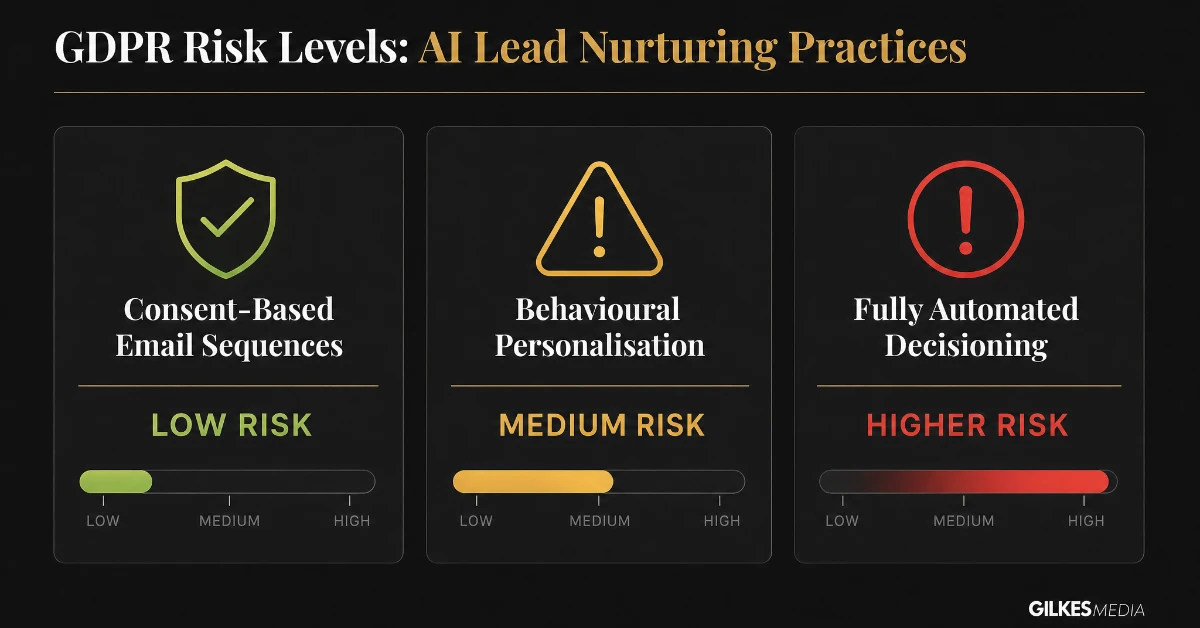
Most AI lead nurturing sits comfortably outside UK GDPR’s strictest rules. However, one specific provision, Article 22, is worth understanding precisely, rather than assuming it does not apply.
Article 22 gives people the right not to be subject to a decision based solely on automated processing, including profiling, that produces a legal effect or similarly significantly affects them. Deciding what marketing email to send next does not meet this bar. Automatically declining someone as a "low value lead" and removing all further sales contact without any human review arguably does.
Lead scoring that informs which leads a salesperson prioritises is standard practice and low risk. A fully automated system that silently deprioritises or excludes leads from any further contact, with no human ever reviewing the decision and no way for the lead to challenge it, sits far closer to Article 22’s restriction. It deserves a specific, documented look before you deploy it that way.
Ask: does a human ever see and can meaningfully override what the automation decided about this specific lead? If yes, consistently, the automated decision-making risk is low. If the honest answer is no, the system needs a genuine legal review before wider rollout, not just a general awareness that GDPR exists.
The compliance burden does not disappear just because a third-party platform is doing the automated work. As the data controller, the business commissioning the nurturing sequences remains responsible for how it handles that data.
Data transferred outside the UK or EU needs an adequate legal transfer mechanism in place. Many mainstream marketing platforms already handle this properly. However, it's worth confirming this explicitly rather than assuming it, particularly for a smaller or newer AI-specific tool that may not have gone through the same scrutiny as an established CRM.
Some platforms use customer data to improve their underlying models unless a business actively opts out. This is a genuinely important question to ask directly during vendor selection. Using a client’s lead data to train a third party’s general-purpose model, without clear disclosure, sits awkwardly against GDPR’s purpose limitation principle.
Any vendor processing personal data on a business’s behalf needs a Data Processing Agreement in place. This sets out what they can and cannot do with the data. A reputable platform will have a standard one ready; the absence of one, or reluctance to provide one, is itself a meaningful red flag worth taking seriously.
AI lead nurturing is not inherently non-compliant, but it needs the same lawful basis, transparency and data minimisation principles as any other marketing activity, applied properly to the specific automated system in use.
Usually yes for marketing communications generally, and specific, clear language about automation makes that consent more defensible than a generic marketing checkbox.
Not in most cases, since lead scoring typically informs a human salesperson’s prioritisation rather than making a solely automated decision with significant effect. Fully automated exclusion of leads from any contact, with no human review, is the scenario that needs closer legal attention.
Personal data transferred outside the UK or EU needs an adequate legal transfer mechanism in place. Confirm this directly with the vendor rather than assuming their marketing claims about compliance cover it.
Only as long as there is a genuine, ongoing business reason to. A documented retention policy, with data actually deleted or anonymised once that reason no longer applies, is what the ICO expects to see, not an assumption that longer is automatically safer.
For a straightforward, consent-based email sequence, following the practices in this guide is usually sufficient. For anything approaching fully automated decision-making with real consequences for leads, a proper legal review is worth the cost before launch, not after a complaint.
The businesses that get the most value from AI lead nurturing, and avoid the compliance risk, are the ones that build genuine compliance in from the start, as part of good practice. They don't treat it as a legal afterthought to worry about only if a complaint arrives.
This isn't just risk avoidance. Transparent, well-governed automation that respects a lead's data, and gives them a genuine route to a human, tends to convert better too. It builds trust, rather than the faint unease a poorly handled automated system can create.
Our guide on what AI lead nurturing actually is, and our breakdown of AI lead nurturing cost, are worth reading alongside this. They'll help if you're weighing up whether and how to implement this for your business.
If you're considering AI lead nurturing, you'll want to make sure whatever you build is genuinely compliant from day one, rather than something to worry about retrofitting later. That's exactly the kind of conversation worth having early.
Our AI lead nurturing service is built with proper data protection practice as standard, not an optional add-on.
Get in touch through our contact page for a free discovery call. We'll talk through what a genuinely compliant, effective setup would look like for your business.
The ICO's own guidance on AI and data protection is genuinely worth reading directly at meaningful scale, rather than relying on secondhand summaries. The businesses that get the most value build compliance in from the start, as good practice, not a legal afterthought. Transparent, well-governed automation tends to convert better too, since it builds trust rather than faint unease.
The vendor due diligence and Article 22 questions above work best when you raise them during procurement, before signing a contract. Raising them later, as a legal afterthought once a tool is already embedded in the sales process, makes them difficult to unwind. Adding two or three specific compliance questions to a standard vendor evaluation checklist costs nothing, and catches most of the genuine risk early.
Marketing and legal or compliance teams often operate somewhat separately during tool selection. Marketing focuses on features, and typically brings legal in only once there's a contract to review. Involving both from the start of AI nurturing tool selection, even briefly, tends to surface these questions naturally, rather than requiring a dedicated compliance project after the fact.
None of this needs to slow down a genuinely useful AI nurturing rollout by much. A short checklist covering lawful basis, consent language, vendor DPA status, and the Article 22 human-oversight question above resolves most of the genuine risk. Work through it once before launch, and it takes an afternoon rather than a drawn-out legal process.
Businesses that treat this as a routine, proportionate step, rather than either an afterthought or an overwhelming legal exercise, tend to get both the compliance right and the nurturing programme launched. They don't have to choose between speed and doing it properly.
Getting this right also protects the business case for AI lead nurturing itself. A well-publicised complaint or regulatory enquiry about automated marketing does more lasting damage to a business's ability to use these tools than any single compliance gap would on its own. That's exactly why the modest upfront effort covered in this guide is worth treating as a genuine priority, rather than a box-ticking exercise.
Treat compliance as part of the design of an AI lead nurturing programme from the first conversation about it, not as a separate workstream running alongside the marketing build. Do this, and most of the genuine risk covered throughout this guide simply never materialises in the first place.
That is the real payoff of doing this properly from the outset: a nurturing programme that keeps working and keeps scaling. You never have to pause or rebuild it because a compliance gap surfaced after the fact.
Build it right once, and the compliance side of AI lead nurturing stops being a recurring worry. It becomes simply one more well-understood part of running the programme.
That is a far better position for any UK business to be in. It beats discovering the gaps only once a regulator, or a frustrated lead, points them out directly.
