
If you've searched for this term, there's a decent chance someone in a sales meeting used the phrase "AI lead nurturing" already. You nodded along without being entirely sure what it meant. You're not alone.
It's one of those phrases that gets thrown around a lot in 2026 marketing circles. It's often attached to a tool that costs a fortune and does a fraction of what it promises.
So let's start with what it actually is, strip out the buzzwords, and look at how it works. Just as importantly, we'll look at what it's good for and where it falls short.
At its core, lead nurturing is nothing new.
It's the process of staying in touch with someone who's shown interest in your business but isn't ready to buy yet. You give them the right information at the right moment, so that when they are ready, you're the obvious choice.
Marketers have been doing this since long before "AI" was a buzzword. They've used drip email sequences, retargeting ads, and a well-timed phone call from a sales rep.
What's changed is the "AI" part.
AI lead nurturing uses machine learning and, increasingly, generative AI. Together, these do three things that used to require a human sitting at a desk making judgement calls all day.
That's the honest version. It's not a robot that closes deals for you.
It's a system that watches what a lead does. That includes the pages they visit, the emails they open, the content they download, and how long they spend on your pricing page. It then uses that behaviour to decide the next best action. No one has to manually spot the pattern and act on it every single time.
What it isn't: a magic fix for a broken sales process. It's also not a replacement for a sales team on high-value or complex deals. And it's not something you can bolt onto a bad website and expect miracles from.
If your lead generation is inconsistent or your offer isn't clear, AI lead nurturing will just automate the confusion faster. It's a multiplier on a process that already works, not a fix for one that doesn't.
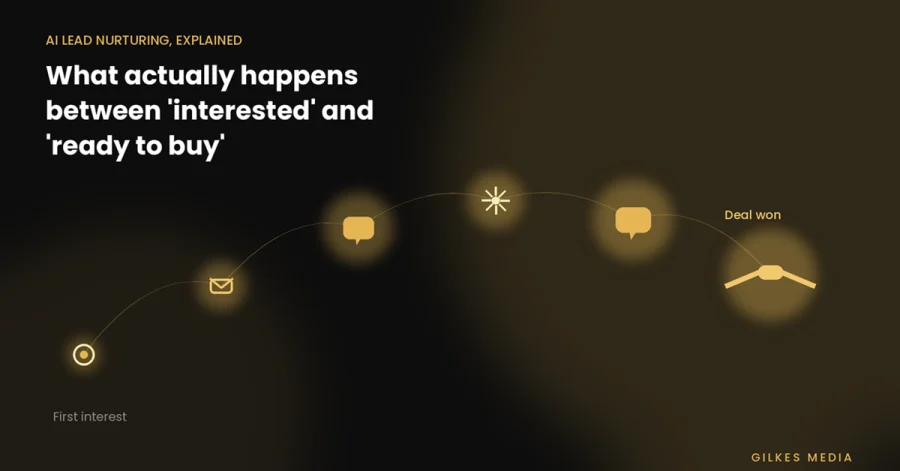
You might already have an email automation tool, such as Mailchimp, ActiveCampaign or HubSpot's basic workflows. If so, you might be wondering what the fuss is about.
Fair question. On the surface, they look similar. Someone fills in a form, and a sequence of emails goes out over the following days or weeks.
The difference is in how the decisions get made and how personal the follow-up actually is.
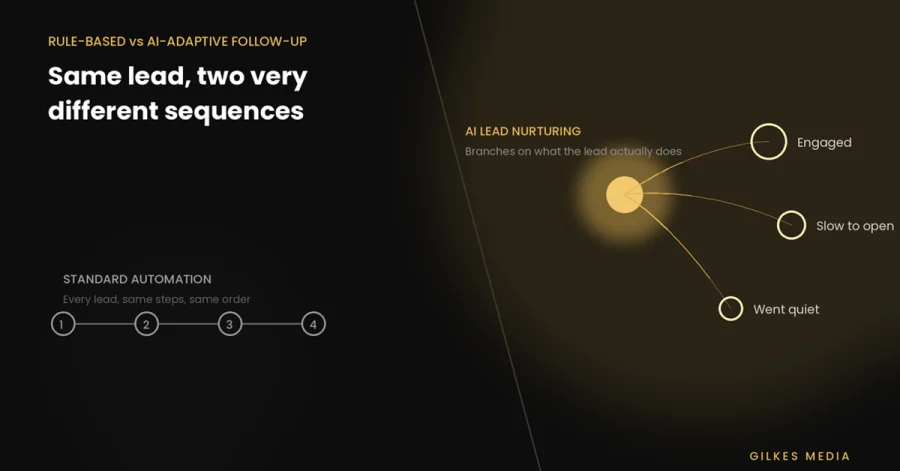
Standard email automation is rule-based. You set it up once: if someone downloads the guide, send email A three days later, then email B a week after that. Then hand them to sales if they click a link.
It works, but it's fixed.
Every lead who downloads that guide gets the exact same sequence, in the exact same order. That's true whether they're a small business owner browsing on their lunch break. It's just as true for a procurement manager at a 200-person company doing serious due diligence.
AI lead nurturing changes the follow-up based on what each individual lead is actually doing, close to real time.
If a lead opens every email but never clicks through, the system might switch to a different content angle. It won't just keep repeating what isn't working.
When a lead suddenly visits your pricing page three times in two days, the system treats that as a signal to escalate. That might mean a more direct message, a flag to a human, or both.
Should a lead go quiet for three weeks, the system can hold back. It won't hammer them with more emails that will just get marked as spam.
Our guide on marketing automation for small business is worth reading here. It'll help you decide whether you even need the AI layer yet. Or it'll show you whether solid rule-based automation would cover most of what you need, for a fraction of the cost.
Genuinely, for a lot of small businesses with a simple sales process, it would.
AI lead nurturing earns its cost once you've got enough lead volume and enough variation in buyer behaviour. At that point, a single fixed sequence stops being good enough.
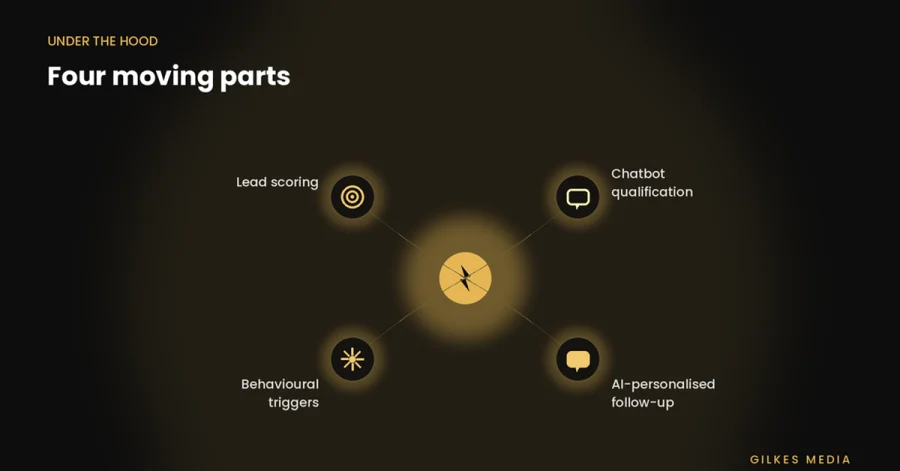
Strip away the marketing language and there are four moving parts.
It helps to see this laid out rather than described abstractly. Here's a realistic example for a B2B services business, say a firm offering commercial fit-out or a similar considered-purchase service.
A prospect downloads a guide from a LinkedIn ad. Within two minutes, an AI chat message opens on the thank-you page. It asks three quick qualifying questions: rough project size, timeline, and whether they're the decision-maker.
If they're a strong fit with a near-term timeline, the system triggers an immediate notification to a human salesperson. It also passes along a summary of what's known. And it schedules a personalised follow-up email referencing the specific guide topic and their stated timeline. That email goes out within the hour rather than the next working day.
Weaker-fit leads, or early-stage researchers, enter a longer nurture sequence instead. That means three emails over two weeks, each referencing a different aspect of the guide they downloaded. The system watches engagement throughout.
When they open and click consistently, the system moves them into the "sales-ready" track earlier than the default schedule.
If engagement drops off, the system slows the cadence rather than pushing harder. More emails to someone who's disengaging usually makes things worse, not better.
Three months later, that second group might still not have converted, but they keep opening emails. If so, the system can flag them for a different kind of touch. That might be a case study relevant to something new in their industry, or an invitation to a webinar. Either way, that beats repeating the same three emails on a loop.
None of this required a person to notice the pattern in real time. Nor did it need someone to manually build a dozen different email sequences to cover every combination.
That's the actual value: not that it's smarter than a good salesperson. It's that it's consistent, fast, and scales without you having to hire more people to keep up with lead volume.
AI lead nurturing earns its cost fastest for businesses with a decent, steady flow of inbound leads. That's especially true when a human can't realistically give each one immediate, tailored attention, and when the sales cycle has more than one touchpoint. If you're weighing this up against simply hiring, our guide comparing AI chatbots versus a human sales team is worth a look. It covers which actually converts more B2B leads.
That covers a lot of B2B service businesses and SaaS companies. It also covers higher-ticket B2C purchases, like home improvements or financial services, where nobody buys on the first visit.
It's also a strong fit if your current problem is specifically about speed and consistency of follow-up. That's a different issue from the quality of your offer.
This solves a real, measurable problem if leads are going cold because nobody gets to them fast enough. It also helps when your team is great with the leads they do follow up on, but inconsistent about which ones get chased.
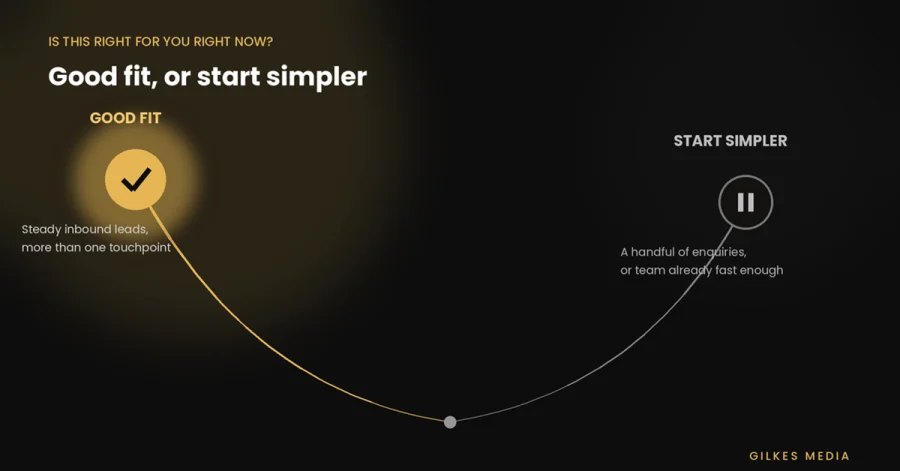
You might be getting just a handful of enquiries a week. If your team can genuinely give each one proper attention within the hour, you probably don't need this yet.
Our lead nurturing best practices guide will get you most of the benefit without the added cost and complexity.
It's also not the right starting point if your actual problem is lead quality or volume rather than follow-up. No amount of clever nurturing fixes leads that were never a good fit in the first place.
That's a targeting and offer problem. It's worth being honest with yourself about which one you're actually dealing with, before you spend money on the wrong fix.
Your sales process might depend heavily on relationship and trust built over a long, high-value negotiation, such as enterprise software or complex B2B contracts. Anything where the deal is decided in a room rather than an inbox fits this pattern. Here, AI nurturing works best when it keeps things warm between human conversations, rather than replacing them.
More on exactly where that line sits in our piece on AI chatbots versus a human sales team.
| Good fit if… | Hold off (or start simpler) if… |
|---|---|
| You get a steady, ongoing flow of inbound leads | You're only getting a handful of enquiries a week |
| Your sales cycle has more than one touchpoint before someone buys | Your sales process is short, simple and fast to close |
| The real problem is speed and consistency of follow-up, not lead quality | Your team can already give every lead proper attention within the hour |
| Leads are going cold because nobody gets to them fast enough | The issue is your offer or lead quality, not response time |
Pricing for AI lead nurturing varies more than most services. That's because you're really paying for two different things. One is the software doing the scoring and messaging. The other is the strategy and setup that makes sure it's actually saying the right thing to the right person.
A basic DIY tool subscription might run to a few hundred pounds a month. A fully managed setup, built and run by an agency, sits considerably higher. That's once you account for strategy, copywriting, and ongoing tuning.
We've broken the real numbers down properly in our guide to AI lead nurturing cost. It's genuinely useful to know what you're likely to pay before that conversation with a supplier. If you're rolling this out for a UK audience, our guide to AI lead nurturing and GDPR is worth a look. It covers how to automate this without breaking the rules.
Once you are clear on what AI lead nurturing actually involves, the next question is usually price. Our guide to AI lead nurturing cost in the UK breaks down what businesses actually pay in 2026.
Set realistic expectations and this tends to deliver real, measurable results.
What it won't do is turn a mediocre offer into a great one. Nor will it make up for weak targeting further up the funnel. It's a follow-up and qualification engine, not a substitute for good strategy.
Get the strategy right first. Then this becomes one of the most valuable things you can add on top of it.
If you're weighing this up for your own business, the honest next step is working out where your leads are actually falling through. Is it speed, consistency, or quality of follow-up? Work that out before deciding how much of this you need.
That's a conversation worth having before you buy any tool. It's exactly the kind of thing we work through with clients on our AI lead nurturing service. It's useful to talk it through with someone directly, if that helps.
Once you understand what AI lead nurturing involves, the next step is picking the right partner to build it. Our guide to choosing an AI lead nurturing provider covers what to look for and the questions worth asking before you sign anything.
Contact Gilkes Media today for a free, no-obligation consultation. Together we can work out whether AI lead nurturing is a good fit for your business.
