Imagine you could hire a digital assistant who works 24/7, never misses a follow-up, and delivers a perfect customer experience every single time. That is the reality of marketing automation for small business. It is a strategic way to handle repetitive, time-consuming tasks, freeing you up to focus on what really matters: growth.
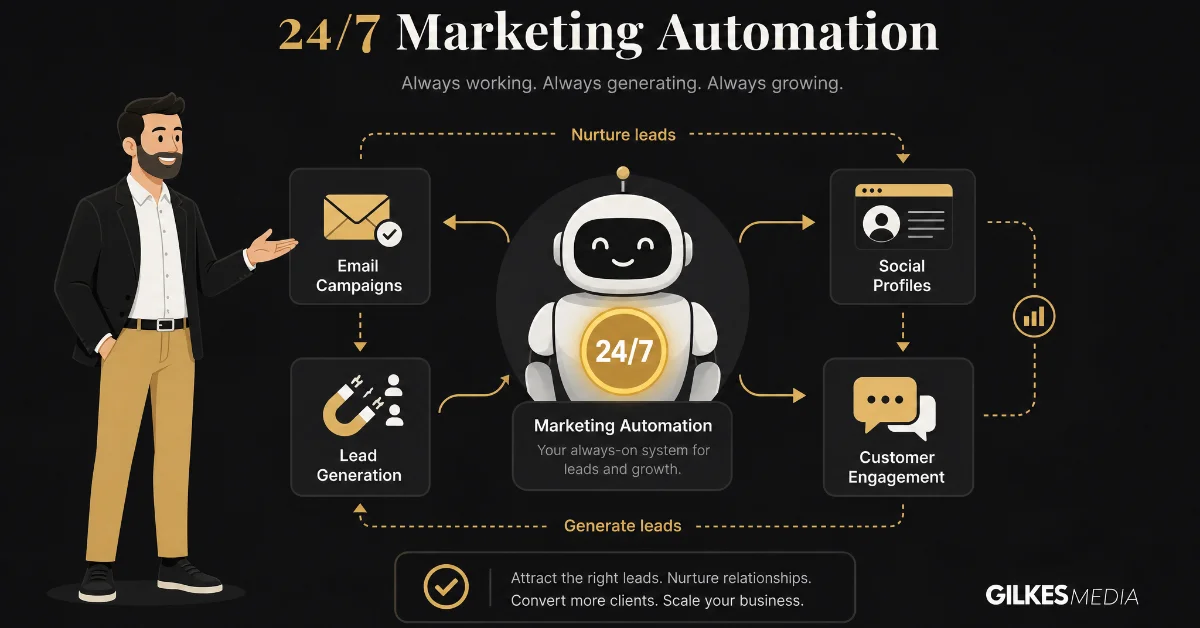
At its core, marketing automation is about using software to manage your marketing activities automatically. Instead of manually sending every welcome email or trying to remember to follow up with a warm lead, you build a system that does it for you. This is not just about email. It is a powerful approach that connects your website, social media, and sales processes into one intelligent, cohesive system.
This is a game-changer for small businesses, which are almost always short on time and resources. As a hands-on consultant, I see countless owners juggling everything at once. Automation steps in as your most reliable employee, ensuring no lead is forgotten and every new customer receives a professional welcome.
Think about the journey a new lead takes. Without automation, you might get a form submission, manually add the contact to a spreadsheet, and then hope you remember to email them a few days later. With automation, you build a workflow that handles this entire process instantly and flawlessly.
But this system can deliver far more than a simple email. To really grasp its potential, it helps to explore related concepts like customer service automation, which applies the same principles to handling client queries and support tickets. The goal is always the same: improve efficiency and deliver a better experience.
The current investment landscape in the UK highlights why this is so critical. Small and medium-sized enterprises (SMEs) are set to invest a staggering £35.1 billion in marketing, with 33% prioritising it over other business areas. Yet, a massive 73% of these businesses are unsure if their marketing is even effective. This creates the perfect opportunity for automation to deliver measurable, undeniable ROI.
For a small business, automation is not a luxury; it is a competitive necessity. It allows you to compete with larger companies by delivering a consistent, professional, and personalised experience at scale, without needing a huge team to manage it.
By bringing in marketing automation, you are not just buying software; you are investing in a more efficient and profitable way of doing business. The practical advantages are clear and almost immediate:
Understanding what marketing automation is is one thing. Building a rock-solid case for it comes down to the one thing that truly matters in business: return on investment. As a marketing consultant, my job is to help business owners look past the shiny features of a tool and focus squarely on the commercial results it can deliver.
The decision to bring in marketing automation cannot be driven by trends. It must be a strategic move tied directly to making your business more efficient, generating better leads, and paving the way for scalable growth. For small businesses, where every pound and every hour is precious, the impact must be crystal clear.
The most immediate and obvious return you will see from automation is time. Think about the hours your team spends every week on repetitive, manual tasks like sending welcome emails, copying new enquiries into a spreadsheet, or chasing up quotes. Now, let’s put a real cost to that time.
If a team member on a £40,000 salary spends just five hours a week on that kind of admin, that is over £5,000 a year spent on work a system could do instantly. That is five hours they could have spent on strategic planning, talking to high-value clients, or closing deals.
Automation is not about replacing your people; it is about liberating them. It frees up your most valuable asset, your team’s expertise, to focus on the high-value activities that actually generate revenue, not just administrative upkeep.
Automating these processes does not just save money; it introduces a level of speed and consistency that is impossible to achieve manually. This radical efficiency is the foundation on which all other commercial gains are built.
How many potential sales fall through the cracks because of slow or inconsistent follow-up? A lead that is warm today can be ice-cold by next week. Marketing automation for small business fixes this by making sure every single lead gets the right communication at the right time.
An automated lead nurturing sequence can take a prospect from initial curiosity to being ready to buy. This could look like:
This methodical, consistent approach means more of your hard-won enquiries turn into paying customers. It is a known fact that nurtured leads make 47% larger purchases than non-nurtured leads, which has a direct impact on your bottom line.
Imagine your most successful marketing campaign suddenly doubles your lead volume overnight. It sounds great, but without an automated system, that surge of interest would quickly overwhelm your team, leading to missed opportunities and a poor customer experience.
Automation provides the framework for you to grow without breaking. It allows you to handle an ever-increasing number of leads with the same resources, ensuring your operational capacity never puts a ceiling on your commercial ambitions. Whether you get ten leads a month or ten thousand, the system executes flawlessly every time.
This is where a consultant’s perspective becomes so important. We can help you map out workflows not just for today, but for the business you want to be in two years' time. If you are thinking about how these strategic pillars apply to your own business, learning more about what marketing consultancy involves can bring clarity to building a growth-focused plan.
When you build the commercial case around these three pillars of efficiency, lead nurturing, and scalability, it becomes obvious. Marketing automation is not an expense; it is a strategic investment in a more profitable, resilient, and growth-ready business.
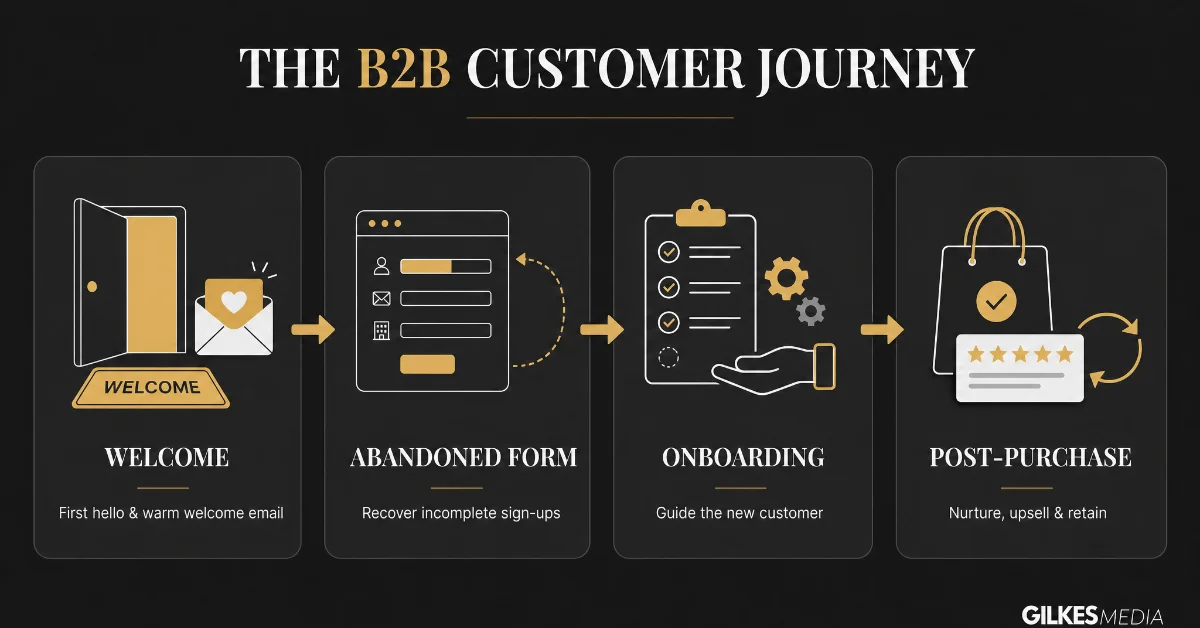
This is where theory becomes practice. The real value of automation comes when you start building specific, high-impact workflows. These are not complex, abstract models; they are practical plays that any small business can implement to see immediate, measurable results.
As a performance-driven consultant, I always advise clients to start with the highest-impact activities first. Let’s walk through four essential automation workflows that deliver clear returns, using real-world examples to show exactly how they work.
Think of this as your digital handshake. The welcome sequence is arguably the most important workflow you can build, as it sets the tone for the entire relationship. Its goal is simple: make an immediate, professional impression and start building trust from the first interaction.
Example Scenario: A local construction firm gets an enquiry via the 'Request a Quote' form on their website.
This first touchpoint is critical. Research shows that leads who receive a welcome email show 33% more long-term brand engagement. Automating it ensures this happens perfectly every time, 24/7.
How many potential leads start filling out a form on your website and then get distracted? The abandoned form recovery workflow is designed to recapture this lost interest. It is a simple but incredibly effective way to recover revenue you never knew you were losing.
Example Scenario: A prospective client for a financial advisor starts filling out a detailed "Free Pension Review" form but leaves the page before clicking submit.
Winning a new customer is only half the battle; keeping them is where the real profit is made. A structured onboarding sequence ensures your new clients feel valued and understand how to get the most from your service, which is vital for long-term retention.
This is a core part of building a strong client relationship. Developing a solid strategy around this is central to effective B2B email marketing, as it sets the stage for future communication and loyalty.
Example Scenario: A business owner signs up for a new accounting software subscription.
Your happiest customers are your best marketers. This workflow automates the process of gathering feedback, generating reviews, and encouraging repeat business after a sale is complete.
Example Scenario: A customer buys a bespoke piece of furniture from an online store.
To bring this all together, here is a quick-reference table summarising the most impactful automation sequences for small and medium-sized businesses in the UK. This should give you a clear picture of what to build first and how to measure its success.
| Workflow Name | Primary Business Goal | Key Metrics to Track (KPIs) |
|---|---|---|
| Welcome Sequence | Nurture new leads & build trust | Open Rate, Click-Through Rate (CTR), Lead-to-Opportunity Conversion Rate |
| Abandoned Form Recovery | Recapture lost leads & increase conversions | Recovery Rate (forms completed), Form Conversion Rate Lift |
| Customer Onboarding | Improve retention & reduce churn | User Engagement Rate, Product Adoption Rate, Customer Churn Rate |
| Post-Purchase Follow-Up | Generate reviews & drive repeat business | Review Generation Rate, Repeat Purchase Rate, Customer Lifetime Value (LTV) |
These four workflows are the foundation of a smart automation strategy. By starting here, you focus your efforts on the actions that directly contribute to lead generation, customer satisfaction, and ultimately, revenue growth.
Picking the right software for your marketing automation can feel overwhelming. The market is flooded with options, and they all promise to change your business overnight. As a consultant, my first piece of advice is always the same: ignore the hype and build a simple decision-making framework based on what you actually need.
The goal is not to buy the platform with the most features. It is to find the best fit: a solution that delivers real value without saddling you with needless complexity or cost. A tool that is too complicated becomes an expensive spreadsheet you never use. A tool that is too simple will be outgrown in six months. The sweet spot is finding the right balance for today, with one eye on tomorrow.
This all starts with an honest look at your current operations and where you want to go. Do not get distracted by shiny 'nice-to-have' features like AI content writers if your most pressing need is simply to nurture leads from a website contact form.
Before you even glance at a single platform, you must define what you actually need the software to do. A feature is only worth paying for if it solves a real problem or opens a genuine opportunity for your business. Create a simple checklist of your absolute must-haves versus your wants.
Choosing a platform is a strategic decision, not a technical one. The right software should feel like a natural extension of your sales process, automating the repetitive work so you can focus on building relationships and closing deals.
The UK market for marketing automation software is incredibly strong, which is great news for SMEs. The UK's CRM software market alone is projected to hit £4.1 billion in 2025, largely driven by small businesses adopting affordable, user-friendly tools. This growth means you have excellent options at every price point.
To get a broader market overview, this guide to the best marketing automation tools for small business is a fantastic starting point.
For most UK SMEs I work with, the choice usually boils down to a few key players:
Once you have your requirements list and you have sized up the main contenders, the last step is to get hands-on. Almost every platform offers a free trial or a live demo. Use it.
Do not just click around. Actually try to build one of your essential workflows. Can you create your 'Welcome Sequence' easily? How intuitive does the process feel? Check their customer support. Is it UK-based? Are they quick to respond? Good support is worth its weight in gold when you hit a technical snag.
This hands-on approach will give you a much better feel for a platform than any sales page ever could. Make your choice based on how it works in practice, not just what it says on a feature list.
Knowing the theory is one thing, but putting marketing automation into practice is where the profit is. Many small businesses put this off, worried it will be a huge, complex project. It does not have to be. As a consultant, I guide clients through a clear, phased roadmap designed to get quick wins and build momentum without the technical headaches.
This is not about trying to do everything at once. It is about a methodical, step-by-step approach that guarantees you see a tangible return from your first efforts, creating a solid foundation you can build on. By breaking it down, a massive project becomes a series of simple, manageable tasks.
First, we must get the groundwork right. Rushing this stage is the single most common mistake I see, and it always causes problems later. The goal here is simple: get the basic technical elements in place so your new platform can collect data and communicate with your audience properly.
Think of it as wiring a house before you start fitting the light fixtures. It is the essential, unseen work that makes everything else possible.
With the foundations solid, it is time to get your first win on the board. The key here is to keep it simple. Do not try to build ten complicated workflows at once. Just pick one high-impact sequence and get it live.
For most businesses, the best place to start is a lead nurture or 'welcome' campaign. It is designed to target new enquiries right when they are most engaged and almost always has an immediate impact on conversion rates. A well-built first workflow also does wonders for confidence and proves the value of automation to the whole team.
The infographic below shows a simple process for choosing the right software to build this first workflow.
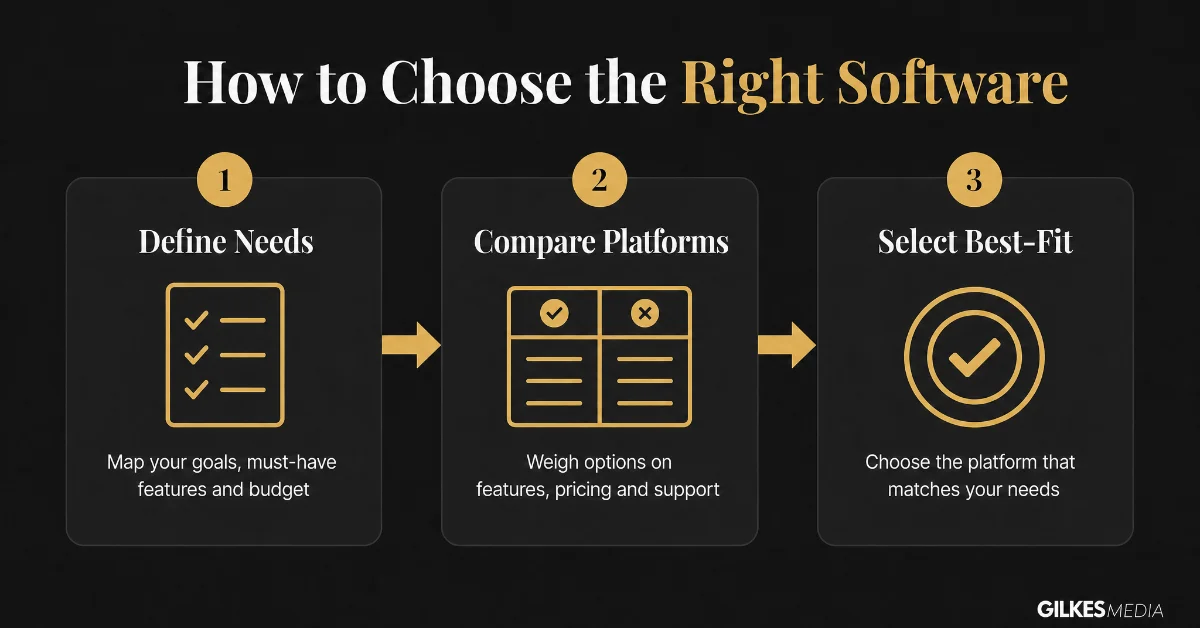
This visual reinforces that a structured approach, from defining what you need to selecting the best-fit platform, is the most direct route to a successful rollout.
Once your first workflow has been running for a few weeks, you will have valuable data to look at. This is where you move from setup to strategy. The goal is to figure out what is working, what is not, and why.
Dive into your key metrics. Are people opening the emails? Are they clicking the links? Are those leads turning into sales? Use this data to make small, informed tweaks. Maybe a subject line needs a rewrite, or the timing between emails is not quite right. This constant loop of analysis and optimisation is how you extract maximum value from your efforts.
This process is at the heart of any effective growth plan. If you are looking for more guidance here, our guide on how to create a marketing strategy provides a much more detailed framework.
After you have successfully launched and fine-tuned your first workflow, you can start to expand. Use everything you learned from that initial campaign to decide what to build next. If your welcome sequence was a hit, perhaps a customer onboarding sequence or a review generation campaign is the logical next step.
This phased expansion stops you from getting overwhelmed and ensures every new workflow you build is based on proven results, not guesswork. The payoff can be huge; UK SMEs using intelligent marketing tools report a 42% higher customer engagement rate, a 37% reduction in acquisition costs, and an incredible 58% improvement in marketing ROI. To see more data on this, you can discover more insights about intelligent marketing tools on shapethemarket.com.
Following this methodical approach transforms marketing automation from a simple tool into a core driver of profitable, scalable growth for your business.
Embarking on marketing automation for a small business is full of potential, but I have seen a few common mistakes stop progress in its tracks. After years of hands-on work in this space, I see the same pitfalls trip up even the most well-meaning business owners.
Dodging them is the secret to getting a fast, tangible return on your investment.
The most frequent error? Over-complicating things from day one. It is tempting to build elaborate, multi-stage workflows that cover every possible scenario. But complexity is the enemy of execution. You end up with a tangled system that is a nightmare to manage and even harder to diagnose when something breaks.
Another classic mistake is diving in without clear, measurable objectives. "Automating our marketing" is not a goal; it is a vague wish.
A real goal sounds like this: "Increase our lead-to-consultation conversion rate by 15% in the next quarter" or "Generate 20% more Google reviews from customers who purchased in the last 30 days."
Without a specific outcome in mind, you have no way of knowing if your efforts are paying off. This leads to frustration and the false conclusion that automation itself is the problem, when the real issue was the lack of a clear target.
The most successful automation strategies I have implemented for clients always start with a single, high-impact goal. We pour all our initial energy into nailing that one outcome. This proves the concept, builds momentum, and gives us the confidence to expand.
Your automation system is only as good as the data you feed it. Many businesses dump their entire contact list in without cleaning it first. This is a recipe for bounced emails, terrible engagement rates, and skewed reporting.
Likewise, sending a generic, one-size-fits-all message to your entire database is the fastest way to land in the spam folder and alienate your audience.
A few quick fixes can prevent these headaches:
By steering clear of these common errors and focusing on simple, high-impact wins, you can skip the painful learning curve. Start with a crystal-clear goal, keep your database clean, and build your automated workflows one logical step at a time. That is the path to sustainable, profitable growth.
If you are exploring marketing automation for the first time, you probably have a few questions. Here are straight answers to the things UK business owners ask me most often.
This is the big one, and the honest answer is: it depends entirely on what you need.
You can get started with entry-level tools like Mailchimp or Brevo for as little as £15-£30 a month. These are great for basic welcome emails and simple sequences if your contact list is small.
For something with more power, such as sophisticated workflows, CRM integration, and detailed behaviour tracking, you will be looking at platforms like ActiveCampaign. For a small business, this typically falls in the £50 to £150+ per month range. The key is to see it as an investment that should pay for itself by converting more leads.
Not at all. It is a common misconception, but the two are worlds apart.
Email marketing is a single action. You write a newsletter, you schedule it, and you send it to your list. It is a broadcast.
Marketing automation is a complete system. It uses email, but it is constantly working in the background, triggered by what your customers do. When someone downloads a guide from your website, the system automatically sends them a thank-you email, adds a tag to their profile, and starts a five-part educational sequence, all without you lifting a finger. One is a manual task; the other is an intelligent, automated process.
Absolutely. In fact, it is essential that you do.
Every reputable marketing automation platform is built to integrate with popular website builders like WordPress, Squarespace, and Shopify. It is usually as simple as adding a small piece of tracking code to your site. Once that is done, the software can see which pages people visit, track form submissions, and start triggering your automated workflows.
You will see some results almost immediately.
A simple automated workflow, like a welcome email for new enquiries, can be set up in an afternoon. Straight away, your response times improve and your business looks more professional.
The bigger commercial returns, like a noticeable jump in your lead-to-customer conversion rate, usually start to show within the first 30 to 90 days. This is when your system has had enough time to gather data, and your nurture sequences have had a chance to guide prospects toward making a decision.
Ready to build a marketing automation engine that saves you time and drives real, measurable growth? As a paid ads specialist and marketing consultant, I offer hands-on guidance to help you choose the right platform, map out your strategy, and get everything running smoothly with full accountability.
