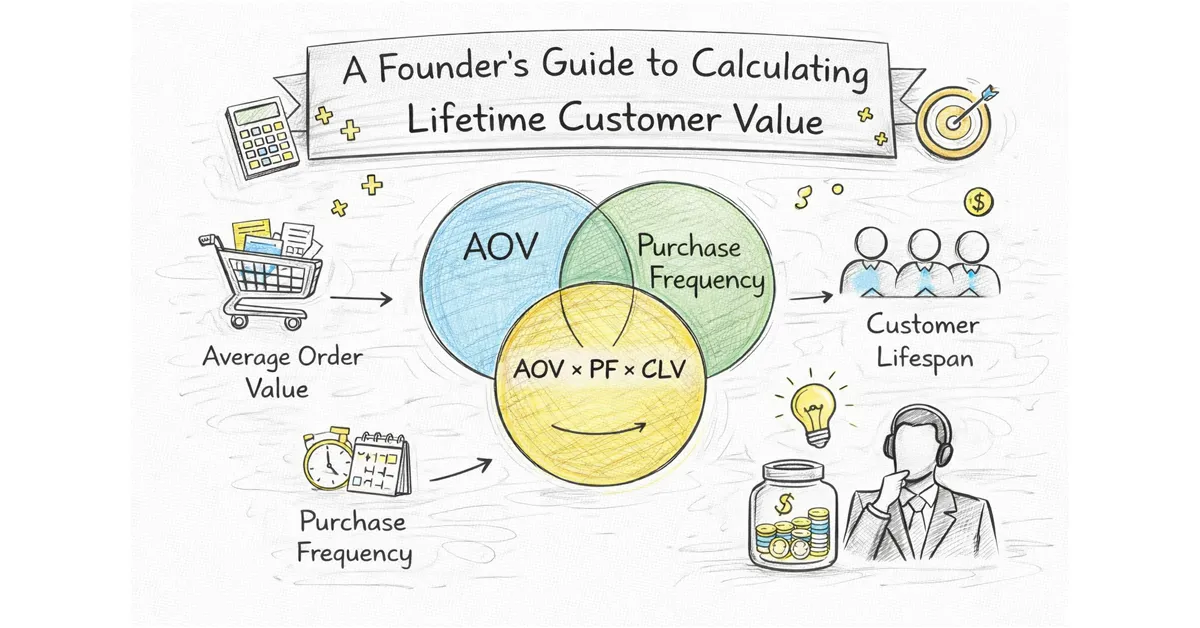
Calculating Lifetime Customer Value is about forecasting the total revenue you can realistically expect from a single customer over the entire time they do business with you. It is a shift in perspective, moving beyond the first sale to get a strategic view of what a customer is truly worth over months or even years.
In a world where the cost of acquiring a customer seems to climb every quarter, focusing only on the initial transaction is a losing game. The real engine of sustainable growth is not just winning new customers; it is understanding the long-term profitability of the ones you already have.
This is exactly why calculating Lifetime Customer Value (LTV) is not just a "nice-to-have" metric anymore. It is the foundation for almost every strategic decision you will make in your marketing.
Once you know your LTV, your marketing budget stops feeling like an unpredictable expense and starts behaving like a calculated investment in future revenue. It gives you the clarity to justify ad spend, properly allocate budgets between channels like Google and Meta, and build a much more resilient business model.
Without a firm grip on LTV, every pound you spend on marketing is essentially a gamble. You might be spending £100 to acquire a customer who only ever generates £80 in profit for you. On the flip side, you might shy away from spending £200 to acquire a customer, completely unaware that the average person you bring in goes on to generate £1,000 in profit.
LTV provides the commercial context for your entire acquisition strategy. It finally answers the critical question: "How much can we actually afford to spend to acquire a customer and still be profitable?"
This knowledge is what allows you to scale intelligently. It informs everything from your pricing and product development to your investment in customer service. Businesses that operate with a clear understanding of their LTV can make bolder, more informed decisions, confidently investing in the channels that attract high-value customers. You can learn more about connecting your marketing efforts to real revenue by reading our guide on calculating customer acquisition cost.
Ultimately, a strong focus on LTV creates a powerful feedback loop that drives long-term success. Getting this metric right allows you to:
To really appreciate its importance, it is worth understanding exactly What Is CLTV and why it is often called the key to SaaS growth. By embedding this metric into the heart of your operations, you move away from chasing short-term tactics and start building a genuinely valuable and enduring business.
Once you understand why LTV is so critical, the next logical step is figuring out how to calculate it. There is not a single, universal formula; the right method for your business depends on the data you have, your business model, and what you plan to do with the final number. The goal here is not complexity for its own sake, but practical accuracy.
We will walk through three distinct ways to calculate lifetime customer value. We will start with a simple, back-of-the-envelope approach and move towards more sophisticated models that give you much deeper strategic insight. Each comes with clear formulas and real-world examples in GBP (£).
This is the most straightforward way to get a directional sense of your LTV. It is perfect for newer businesses or those with limited historical data. It provides a quick, high-level average that can immediately inform your initial marketing budget decisions.
The formula relies on three core metrics:
The calculation itself is pretty simple:
Simple LTV = (Average Purchase Value) x (Average Purchase Frequency Rate) x (Average Customer Lifespan)
Let’s apply this to a hypothetical UK-based subscription box company:
LTV = £30 x 12 x 2.5 = £900
This figure tells you that, on average, each new subscriber is worth £900 in revenue over their entire relationship with your business. It is a powerful starting point for setting your Customer Acquisition Cost (CAC) targets.
The simple average method is useful, but it treats all customers as one homogenous group. In reality, customer behaviour changes over time. Customers you acquired during a Black Friday sale might behave very differently from those who came through a brand campaign in March.
This is where cohort analysis comes in. A cohort is just a group of customers who started their relationship with your business during the same period, like "January 2023 Customers" or "Q2 2023 Customers". Calculating LTV by cohort gives you a much more accurate picture of past performance.
To do this, you just track the cumulative revenue from a specific cohort over time.
| Month | Jan 2023 Cohort Revenue | Cumulative Revenue |
|---|---|---|
| Month 1 | £5,000 | £5,000 |
| Month 2 | £4,200 | £9,200 |
| Month 3 | £3,800 | £13,000 |
| Month 12 | £1,500 | £35,000 |
If the January 2023 cohort had 100 customers, their 12-month historical LTV would be £35,000 / 100 = £350.
By comparing the LTV of different cohorts, you can see the direct impact of marketing campaigns, product changes, or pricing adjustments on long-term customer value. For Shopify brands looking for a detailed walkthrough, it is worth exploring guides on calculating customer lifetime value the smart way.
While historical LTV is brilliant for understanding past behaviour, it does not help you forecast the future. Predictive LTV modelling uses your historical transaction data and behavioural patterns to forecast how much revenue a new customer is likely to generate. This is the gold standard for strategic planning.
Predictive models can range from simple formulas to complex machine-learning algorithms. A common and accessible formula uses your Gross Margin (GM) to focus on profitability, not just revenue.
Predictive LTV = (Average Monthly Transactions x Average Order Value x Average Customer Lifespan) x Gross Margin
Let's imagine an e-commerce store with the following metrics:
First, you calculate the annual value: (0.5 transactions/month x 12 months) x £80 = 6 x £80 = £480 per year.
Next, find the total lifetime revenue: £480/year x 3 years = £1,440.
Finally, apply the gross margin: £1,440 x 0.60 = £864 (Profit LTV).
This tells you that each new customer is projected to generate £864 in actual profit, giving you a highly accurate figure to base your marketing spend on. In a challenging market, this level of precision is vital.
Key Takeaway: Start with the simple average LTV for a quick baseline. As you gather more data, progress to historical cohort analysis to understand past trends. Ultimately, your goal should be to implement a predictive model to make forward-looking, profit-driven decisions about your marketing investments.
This decision-making process helps you focus your efforts where they will have the biggest impact.
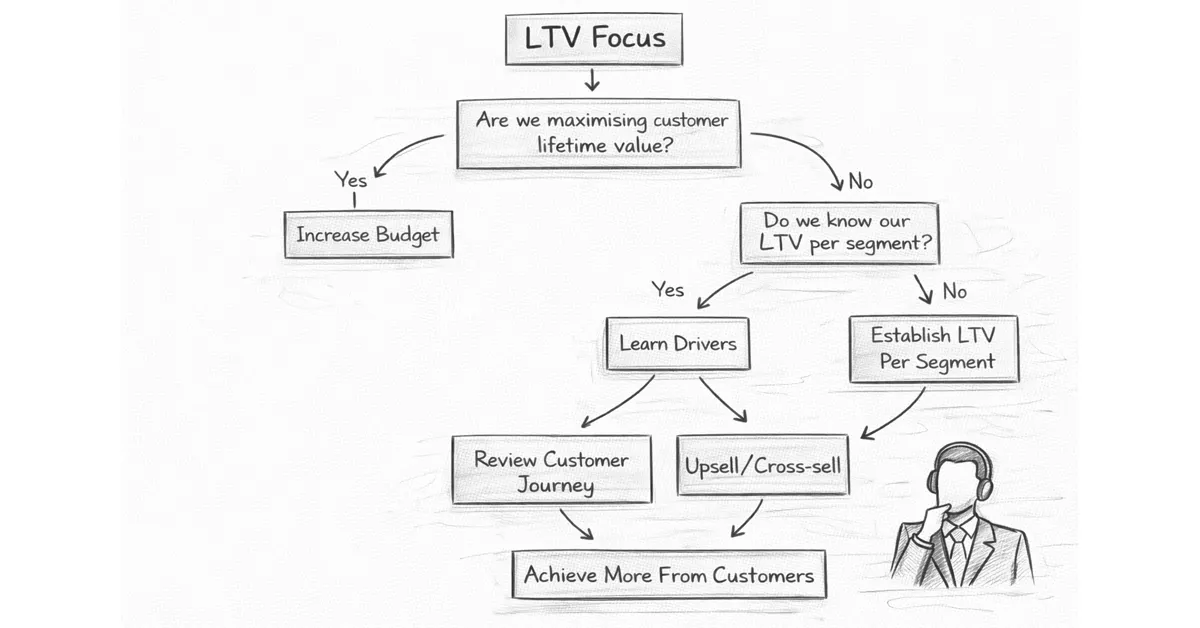
The flowchart illustrates a simple but powerful framework: if your LTV is low, your priority should be digging into the "why". If your LTV is healthy, the focus shifts to confidently scaling your acquisition efforts. Choosing the right calculation method is the first step in this strategic process.
Calculating customer lifetime value gives you a powerful number, but that number is only truly useful when you put it in context. Its most important partner is another critical metric: your Customer Acquisition Cost (CAC).
Think of it this way. Knowing your LTV is like knowing how much fuel is in your car's tank. Knowing your CAC is like knowing how much fuel you burn per kilometre. You need both to figure out how far you can actually go.
When you connect these two metrics, you stop treating your ad spend as a hopeful expense and start treating it as a predictable investment in long-term, sustainable growth. The relationship between them, the LTV to CAC ratio, is arguably one of the most important health checks for any business, especially if you are investing in paid advertising on platforms like Google or Meta.
The LTV to CAC ratio measures the total value a customer brings to your business compared to what it cost to get them in the door. It answers the simple, vital question: "For every pound we spend to get a new customer, how many pounds do we get back over their lifetime?"
Calculating it could not be simpler:
LTV to CAC Ratio = Lifetime Value / Customer Acquisition Cost
Let's say your average LTV is £900 and your CAC is £300. Your ratio is 3:1. This means for every £1 you spend on acquisition, you can expect to get £3 back in gross profit. This is widely seen as the benchmark for a healthy, scalable business.
A ratio below 1:1 means you are actively losing money with every new customer. A ratio between 1:1 and 3:1 suggests you are breaking even or making a tiny profit, leaving you with no room for error or reinvestment.
This ratio is the key to setting intelligent budgets for your paid media campaigns. Once you understand it, you can move away from guesswork and start making data-driven decisions about your allowable Cost Per Acquisition (CPA). For a deeper dive into the specifics of this metric, check out our guide on calculating customer acquisition cost.
A healthy 3:1 ratio gives you a solid framework for setting realistic campaign budgets and CPA targets. If your LTV is £600, a 3:1 target means you can afford to spend up to £200 to acquire a new customer. This £200 now becomes your maximum allowable CAC.
This number then drives your entire bidding strategy on platforms like Google Ads or Meta Ads. When you know you can spend up to £200 per acquisition, you can compete far more confidently in ad auctions, because you know exactly where your profitability line is drawn.
It gets even more powerful when you apply it to different customer segments.
This segmented approach stops you from overspending on low-value customers or missing out by underbidding for your most profitable ones. The UK e-commerce sector shows just how crucial this focus on value is. In 2024, per capita spending reached a strong £391, highlighting the market's depth even as overall growth stabilised. This has led forward-thinking businesses to pivot from pure acquisition to calculating customer lifetime value for more sustainable gains. You can find more details in The UK E-commerce Payment Trends Report from Antom.
The final piece of this strategic puzzle is the payback period. This metric tells you how long it takes to recoup the money you spent to acquire a customer. It is a crucial cash flow consideration. Even a profitable LTV to CAC ratio can put a serious strain on a business if the payback period is too long.
To work it out, you just need your CAC and the average monthly revenue per customer.
Payback Period (in months) = CAC / (Average Monthly Revenue per Customer x Gross Margin)
Let's use a quick example. Your CAC is £200, your average customer spends £50 a month, and your gross margin is 60%.
This means it will take you just under seven months to earn back the money you spent acquiring that customer. For most businesses, especially those with tight cash flow, aiming for a payback period of under 12 months is a very sensible goal.
By combining LTV, CAC, and the payback period, you create a complete financial model for your customer acquisition. You know what a customer is worth, how much you can afford to spend, and how long it will take to get your money back. This is the foundation of any truly performance-driven marketing strategy.
Calculating your LTV gives you a baseline, but the real value comes from actively working to improve it. Think of the calculation as the diagnosis; these strategies are the treatment. This is where you shift from analysis to action, implementing tactics that directly influence the variables in your LTV formula.
The goal here is to build a business that grows from the inside out. By strengthening customer relationships, you generate more predictable, profitable revenue. These are not just fluffy marketing activities; they are commercial strategies designed to improve retention, increase average order value, and ultimately extend how long a customer stays with you.
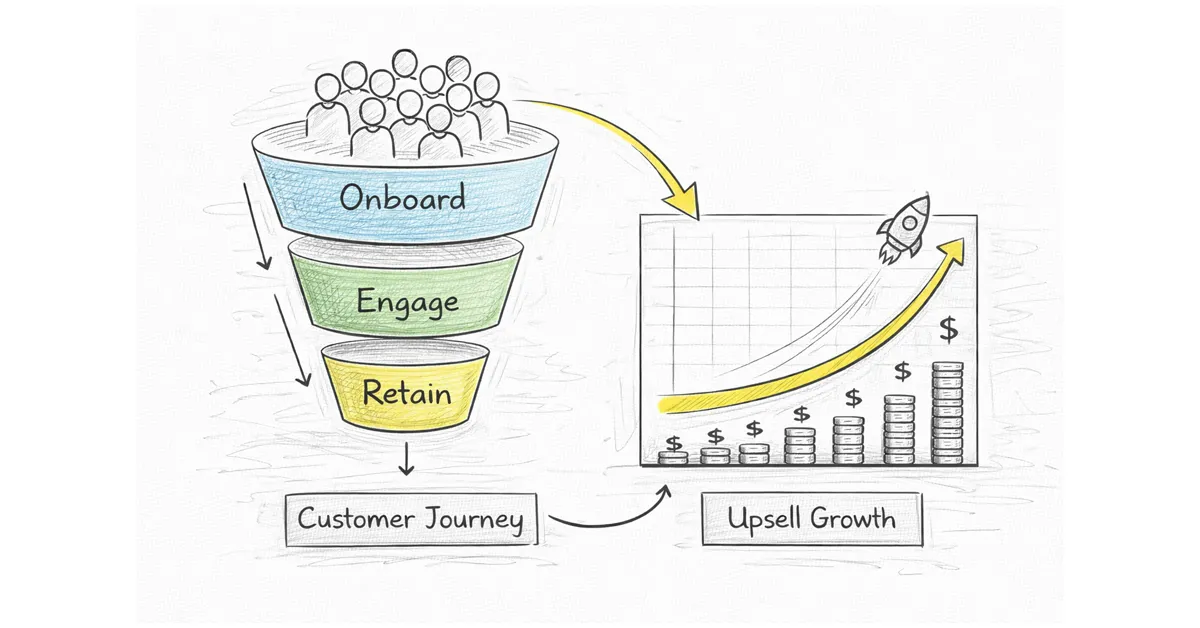
The first 30-90 days of any customer relationship are absolutely critical. A confusing, clunky, or underwhelming onboarding experience is one of the fastest ways to cause early churn, which completely demolishes your LTV.
Your one job during this period is to guide new customers to their first "aha!" moment as quickly and smoothly as possible. This is the point where they truly grasp the core value of what you offer and feel confident they made the right choice.
To sharpen up your onboarding, try these moves:
A solid onboarding process makes customers feel valued from day one and sets the stage for a long-term, profitable relationship.
Once a customer is successfully onboarded, your focus shifts to encouraging repeat business and increasing their average spend. This is done through relevant, timely communication, not generic marketing blasts that get ignored.
Use the data you have to segment your customer base and send them offers that actually make sense. For example, a customer who bought a specific product might be the perfect candidate for a related accessory a month later. Our guide on lead nurturing best practices offers more detailed strategies for building these kinds of relationships.
Effective upselling and cross-selling directly increase the Average Purchase Value, a key component of your LTV calculation.
Smart communication is about delivering the right message to the right person at the right time. It shows you understand their needs, which builds the trust required for them to spend more with you over time.
This personal touch is more important than ever. UK brands are facing a stark reality: 83% of loyal consumers feel undervalued by the companies they buy from. This reveals a huge opportunity for businesses that choose to prioritise genuine retention. You can find more insights in the SAP Emarsys' Customer Loyalty Index 2024.
Your current customers are your most valuable source of market research. They can tell you exactly what you are doing right, where you are falling short, and what you could offer to make them stay longer and spend more.
Ignoring this is a guaranteed way to increase churn. You need a systematic process for collecting, analysing, and, most importantly, acting on what your customers are telling you. This is essential for long-term LTV growth.
Here is a simple framework for managing feedback:
| Feedback Type | Collection Method | Actionable Outcome |
|---|---|---|
| Product/Service Issues | Support tickets, surveys | Prioritise bug fixes, product updates |
| New Feature Ideas | Customer interviews | Inform your product roadmap |
| Pricing Concerns | Churn surveys | Review your pricing tiers |
| Positive Experiences | Testimonials, reviews | Create case studies, social proof |
When you actively listen and show customers you are acting on their input, you turn them into partners. This deepens their loyalty, makes them less likely to churn, and ultimately provides a powerful, sustainable lift to your customer lifetime value. It transforms your LTV from a static number into a dynamic metric you can consistently improve.
Even with the best intentions, it is surprisingly easy to get your LTV calculations wrong. After years of working directly with founders and marketing teams, I have seen the same handful of mistakes derail otherwise solid growth strategies.
An inaccurate LTV is more than just a bad number on a spreadsheet; it leads to poor decisions on ad spend, flawed budgeting, and missed opportunities. Getting these details right from the start will save you a world of pain down the line.
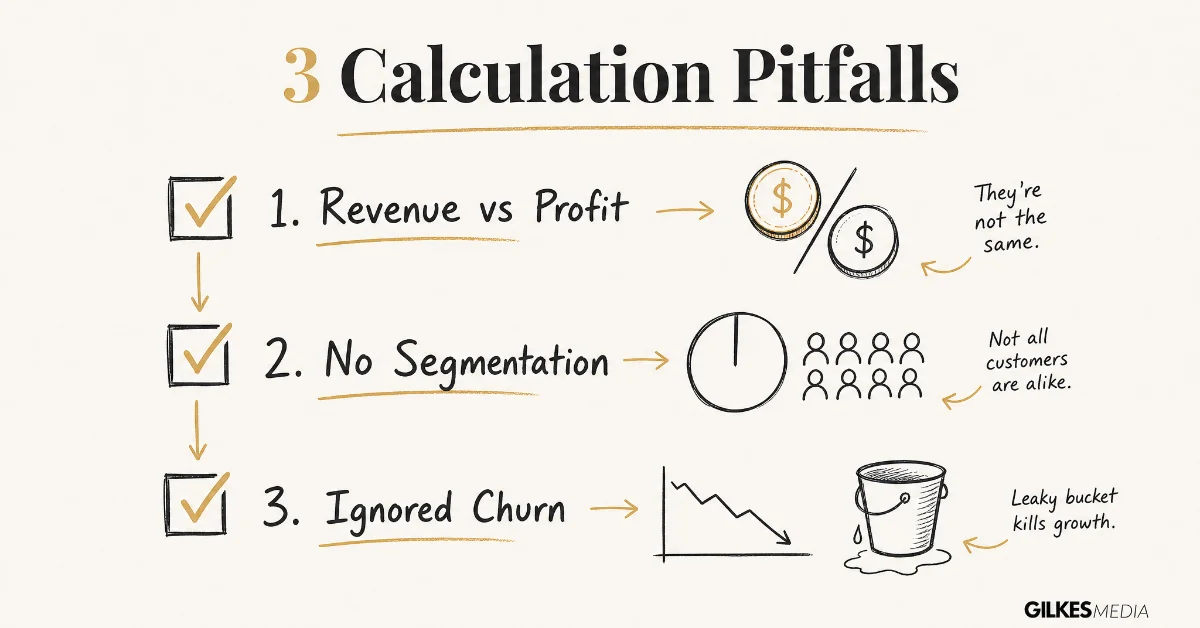
This is, without a doubt, the most frequent and dangerous error I see. Calculating LTV using total revenue paints a dangerously optimistic picture of what a customer is actually worth to your business.
Think about it: a customer who generates £1,000 in revenue but costs you £800 to serve is only worth £200 in profit. If you base your ad spend on that £1,000 figure, you will quickly find yourself spending far more to acquire a customer than they will ever return in actual profit.
The Fix: Always, always subtract your Cost of Goods Sold (COGS) from the revenue figure. Your LTV calculation must be based on gross profit or contribution margin. This simple adjustment shifts your focus from vanity metrics to genuine profitability and ensures your marketing spend is grounded in commercial reality.
Treating all your customers as one big, happy family will mask crucial insights. Your LTV is not a single number; it is a collection of different values for different types of customers.
Customers acquired through a high-intent Google brand search campaign will almost certainly have a different LTV from those who came in via a cold Meta prospecting campaign. Without segmentation, you have no way to identify your most valuable customer types and double down on acquiring more of them.
An aggregated LTV hides both your best and worst-performing customer cohorts. The real strategic value lies in spotting the differences between them and acting on that intelligence.
The Fix: As a starting point, segment your customers by acquisition channel. From there, you can layer on other attributes for a much clearer picture:
Many simple LTV models either assume a customer stays forever or just pluck an arbitrary lifespan out of the air, like "three years". This completely ignores the reality of customer churn, the rate at which customers stop doing business with you.
Ignoring churn will dramatically inflate your LTV. If 20% of your customers leave each year, their effective lifespan is a lot shorter than you might think.
The Fix: Calculate your churn rate and use it to determine a more realistic customer lifespan. A simple but effective way to estimate this is with the formula: 1 / Churn Rate. For instance, if your annual churn rate is 25% (0.25), your average customer lifespan is 4 years (1 / 0.25).
This small step ensures your projections are anchored to actual customer behaviour, not wishful thinking. If your business is new and lacks historical data, use industry benchmarks as a conservative starting point and refine the numbers as you grow.
Right, you have got the theory down. You know what LTV is and why it matters. But understanding a concept and actually using it to drive commercial results are two very different things.
This is not a one-off task you can tick off a list and forget about. Think of it as an ongoing discipline, a routine that sharpens your marketing strategy, gives you real confidence in your financial forecasting, and ultimately builds a much more resilient business.
The goal now is to get this out of the spreadsheet and into your everyday operations. This is your practical roadmap to making LTV a core part of how you make decisions.
You do not need a team of data scientists or expensive software to get started. All it takes is a focused effort to organise what you already have and commit to a regular rhythm of analysis.
Use this as your starting point:
Find and gather your core data points. First things first, locate the essential metrics: average purchase value, purchase frequency, and customer lifespan. Pull this data from wherever it lives: your CRM, e-commerce platform, or accounting software. The goal right now is just to get a baseline, even if it is not perfect.
Pick your starting calculation method. Do not let complexity paralyse you. If you are new to this, the Simple Average LTV formula is the perfect place to start. It is quick, straightforward, and gives you a directional figure you can immediately weigh against your Customer Acquisition Cost (CAC). As you get more comfortable, you can move on to a historical cohort analysis.
Establish a regular reporting rhythm. LTV is not a static number; it moves with your business. Schedule time to recalculate it quarterly. This simple habit will help you spot trends, measure the impact of your marketing, and see how things like seasonality affect customer behaviour. Make it a standing agenda item in your marketing meetings.
By committing to these three steps, you turn LTV from an abstract concept into a tangible, working metric. This is what gives you the clarity to make smarter, profit-driven decisions about where to invest your marketing budget for maximum long-term growth.
This process answers the most critical questions you face: which customers are your most valuable, which channels bring them in, and exactly how much you can confidently spend to get more of them.
At Gilkes Media, we partner with founders to implement these very strategies, turning data into a performance-driven marketing plan. If you want hands-on, expert guidance to align your marketing spend with clear growth objectives, book a free consultation with us today.
