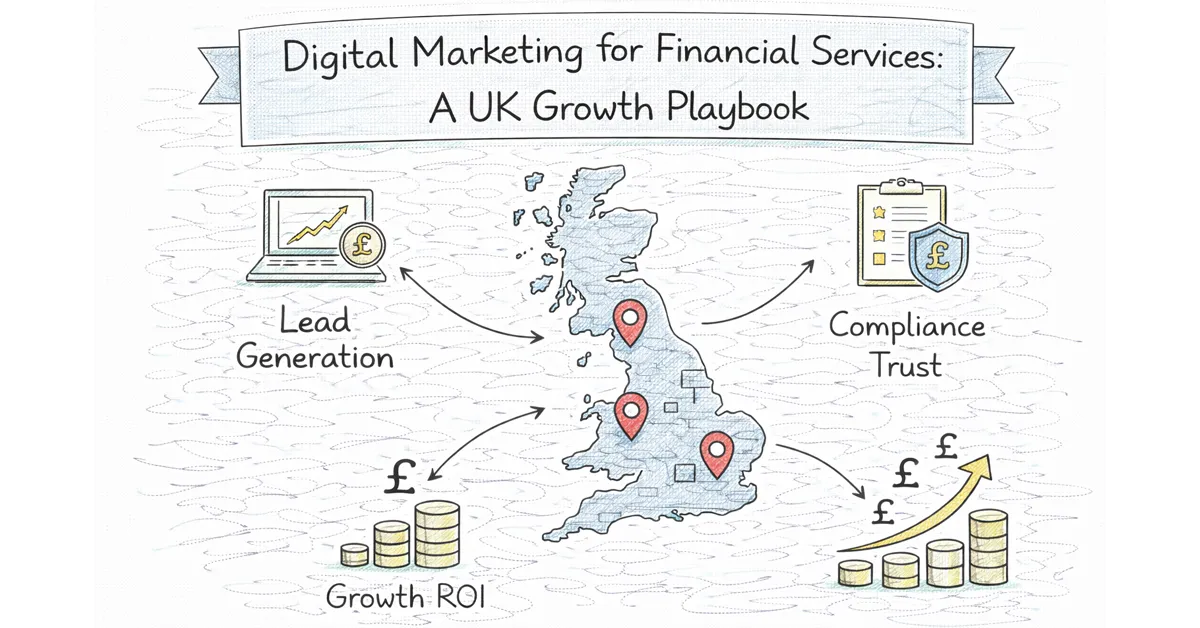
In financial services, digital marketing is not just another channel. It is the primary engine for finding new clients and growing your business. Success requires navigating strict compliance, building deep client trust, and proving a measurable return on every pound spent.
The old rulebook for marketing in the UK financial services sector is broken. Client acquisition costs are soaring, FCA Consumer Duty regulations demand a higher standard of care, and customers expect a smooth digital experience. Outdated, scattergun tactics are simply destined to fail.
This guide is not a high-level, theoretical overview. It is a practical, hands-on playbook for founders and marketing leaders who need to drive tangible, commercially focused growth.

We will move beyond generic advice to build a high-performance marketing operation, piece by piece. The focus is on a strategy that connects every action back to a real business outcome. As a consultant who has personally managed over £3,000,000 in ad spend, I have seen exactly what separates the firms that struggle from those that scale efficiently.
An effective marketing strategy in this sector is built on a few core pillars. It is not about running a few ads or posting on social media. It is about creating a systematic, repeatable process for attracting and converting the right kind of clients.
Throughout this playbook, we will cover:
This is the exact framework I use to scale my clients' operations. It is built for senior decision makers who need a clear, accountable path to growth, free from agency fluff and focused entirely on results.
For any firm marketing financial services in the UK, compliance is not just a box-ticking exercise. It is the absolute foundation of every single campaign. The Financial Conduct Authority (FCA) does not just write the rulebook; it enforces a standard of consumer protection that dictates exactly how you can attract and speak to clients. Ignoring these rules is not just risky. It is a direct threat to your reputation, your permissions, and your bottom line.
The entire framework hangs on one core principle: all financial promotions must be ‘clear, fair and not misleading’. This is not a vague guideline. It is a strict mandate that applies to every piece of content you publish, from a two-word Google Ad headline to a detailed investment guide or a quick social media update.
True compliance is not a final check before you hit 'publish'. It is a mindset that needs to be embedded into your marketing workflow from the very beginning. Thinking this way from the first draft saves you from expensive rewrites, regulatory headaches, and brand damage down the line.
When you are creating any digital asset, you need to keep these points front and centre:
The FCA's goal is simple: to make sure consumers can make informed decisions. Your marketing should be built to educate and clarify, not persuade by exaggerating the good bits and omitting the bad. When you treat compliance as a tool for building trust, it stops being a burden and becomes a genuine competitive advantage.
The real challenge for marketers is turning these high-level principles into everyday actions. How do you actually check if that new landing page or LinkedIn campaign meets the FCA’s standards? It starts by asking the right questions before anything sees the light of day.
This decision tree shows the fundamental choice every firm is facing. You either commit to a modern, digital-first approach or you risk becoming irrelevant.
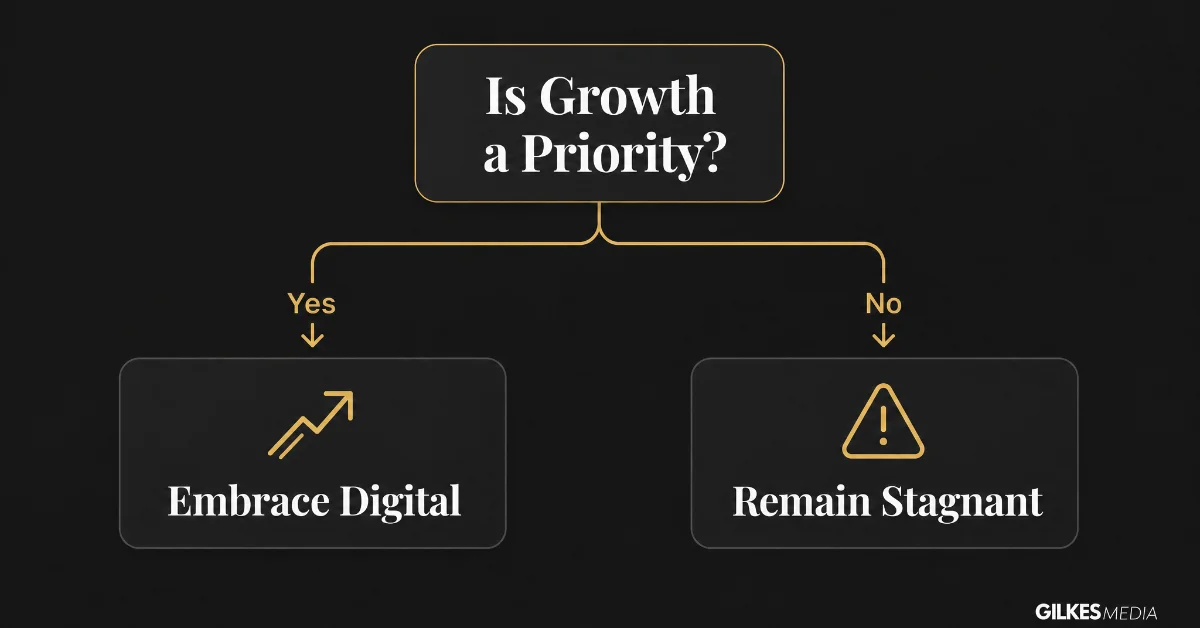
As the visual makes plain, if growth is on the agenda, then embracing a digital marketing strategy is not really a choice anymore. It is a necessity.
To help with this, I have put together a simplified checklist for reviewing digital ads. Think of it as a practical framework for your team to quickly audit campaigns and catch common compliance mistakes before they become a real problem. From my experience as a marketing consultant, this kind of proactive review is a simple step that far too many firms overlook.
| Compliance Checkpoint | Key Question | Practical Example |
|---|---|---|
| Clarity | Could any part of this advert be misunderstood by our target client? | An ad saying "Maximise your pension" is too vague. A clearer, compliant version is "Explore pension strategies to potentially grow your retirement fund." |
| Fairness & Balance | Are the risks given equal prominence to the potential rewards? | If an ad highlights a potential 10% annual return, the associated risk warning must be equally visible, not buried in faint, small-print text. |
| Misleading Information | Have we used any statements that promise a specific outcome? | Never use absolute statements like "You will achieve financial freedom." Instead, try: "We help you create a plan for your financial goals." |
| Target Audience | Is this promotion appropriate for the audience it is reaching? | A high-risk investment product should never be advertised on a platform or with messaging aimed at financially vulnerable people. |
By weaving this thinking into your team's process, you stop just avoiding penalties. You start building a brand that clients genuinely see as transparent, trustworthy, and on their side. That is the ultimate goal of effective, and compliant, digital marketing in financial services.
If you need high-quality leads quickly, paid advertising is the fastest way to get them. But it is a high-stakes game. In financial services, large budgets can disappear in days without a crystal-clear, compliant strategy driving every click.
Success here is not about "boosting posts". It is about engineering a predictable system for winning new clients. A system where every pound spent is tracked, justified, and delivers a measurable return on investment.
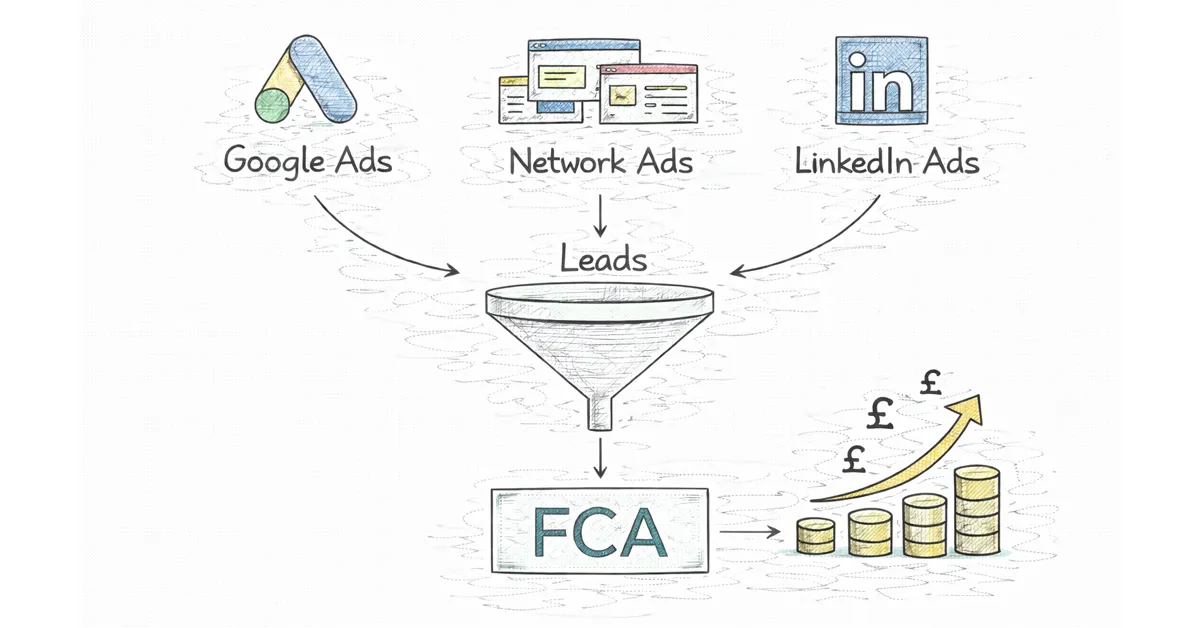
Not all ad platforms are created equal, especially within the complexities of the finance sector. Your choice should come down to two simple questions. Who is your ideal client, and what problem are you solving for them? For most firms, this means choosing between search-intent platforms like Google Ads and professional networks like LinkedIn.
Choosing the right channel is the first and most critical strategic decision. The table below outlines the main platforms to help you decide where to focus your budget.
| Platform | Primary Use Case | Targeting Strength | Key Compliance Note |
|---|---|---|---|
| Google Ads | Capturing active search intent for specific financial products (e.g., mortgages, ISAs). | Keyword-based, targeting users actively seeking solutions. | Ad copy must be fair, clear, and not misleading. Avoid promising returns. |
| LinkedIn Ads | Reaching specific professionals based on job title, industry, or company size. | Demographic and firmographic, ideal for B2B or HNW individuals. | Content must be professional and provide genuine value, not a hard sales pitch. |
| Meta Ads | Building brand awareness and reaching niche consumer demographics. | Interest and behaviour-based, effective for mass-market financial products. | Strict policies on credit, loans, and investment. High rejection rates are common. |
| YouTube Ads | Educating prospects on complex topics and building brand trust through video. | Audience and intent-based, powerful for demonstrating expertise visually. | Video content must clearly state risks and avoid exaggerated claims. |
Each platform has its place. Mastering one or two that align with your client profile will always be more effective than spreading your budget too thinly across all of them.
The UK financial services sector is investing heavily in digital ads. Ad spend in banking and lending is projected to increase by 20% in 2025. Keywords are some of the most expensive, with clicks often costing over £30. However, the average conversion rate is a healthy 5.1%, proving that a sharp strategy can deliver real performance. For SME leaders, the opportunity for growth is clear, but it requires meticulous campaign management.
The secret to managing high costs is precision, not a bigger budget.
Compliance is your licence to operate. Every single ad, landing page, and call to action must be signed off by a compliance officer before it goes live. Your messaging has to be clear, fair, and not misleading, with any risks given the same prominence as potential benefits. There are no shortcuts.
Moving beyond basic keywords is what separates average campaigns from the high-performance engines that drive serious growth. It is not just about finding people searching for a relevant term; it is about getting your message in front of the right people.
On LinkedIn, this means digging deeper than job titles. Target members of specific professional groups, focus on employees at a curated list of companies, or retarget individuals who have engaged with your company page. This ensures every penny of your budget is spent reaching your most valuable potential clients.
On Google, you should use Custom Audiences. This allows you to build audiences of people who have recently searched for your top competitors or visited specific industry news sites. You can then show your ads to this highly relevant group, even when they are not actively searching for your exact keyword. It is a game-changer.
Ultimately, to build a high-ROI engine, you must think beyond clicks and leads. The most successful firms are those that create video ads that convert, turning ad spend into a tangible pipeline. This demands a creative mindset focused on grabbing attention in seconds and delivering clear, educational value. At Gilkes Media, our specialist paid search service is built on these exact principles: precision, compliance, and a relentless focus on ROI.
Paid advertising is excellent for immediate traffic, but organic search (SEO) builds sustainable, long-term growth. In financial services, ranking on Google is not about stuffing keywords into a page. It is about proving your firm has undeniable authority and can be trusted completely.
It is a marathon, not a sprint. But the prize is a steady stream of high-quality, inbound leads that costs far less to acquire over time.
A modern SEO strategy for this sector goes beyond simple on-page tweaks. It focuses on what Google’s algorithms, and more importantly, your potential clients, truly value. This comes down to a principle known as E-E-A-T: Experience, Expertise, Authoritativeness, and Trustworthiness.
For any financial services firm, this is not just a guideline. It is the entire game.
Your content must do more than list your services. It needs to solve real problems, answer tricky questions, and prove you have deep, specialist knowledge. It's no surprise that high-growth firms understand this, with 31.4% making thought leadership a priority, compared to just 16.7% of their no-growth competitors.
This approach creates a library of valuable assets that positions your firm as the go-to resource for your ideal clients, building trust long before they contact you.
In SEO, authority relates to the signals that tell Google you are a recognised and respected voice in your field. Trustworthiness assures both users and Google that your advice is safe, reliable, and puts their best interests first.
For financial services, E-E-A-T is not a marketing tactic; it is a reflection of your regulatory and professional duty. Google's standards are exceptionally high because it classifies finance as a 'Your Money or Your Life' (YMYL) topic, where bad information can have serious, real-world consequences.
To meet this standard, you must be meticulous.
Getting these on-page elements right is non-negotiable.
| Signal Element | How to Implement It | The Business Impact |
|---|---|---|
| Author Bios | Every article must be credited to a real, qualified author with their own detailed bio page. | Shows Google you have credible experts, boosting your content's authority. |
| Credentials | Prominently display qualifications (e.g., Chartered Financial Planner) and FCA registration. | Builds immediate trust with prospects and satisfies Google's strict YMYL criteria. |
| About Us Page | Detail your firm's history, its mission, and the team's collective experience. | This humanises your brand and provides crucial context for your firm's authority. |
Additionally, building a strong profile of backlinks from reputable financial sources is critical. A link from the Financial Times or a respected industry journal acts as a powerful vote of confidence. You earn these through digital PR, writing guest articles, and creating original research that others want to cite.
For a deeper dive into structuring these elements, you can learn more about on-page SEO best practices in our comprehensive guide.
Dominating search results is about building a digital footprint that mirrors your real-world expertise and credibility. It requires a sustained, strategic effort, but the result is a powerful, self-sustaining lead generation asset that builds immense brand equity and drives profitable, long-term growth.
In financial services, content is not a brochure. It is an active tool for building trust and guiding prospects through a complex, high-stakes decision. The goal is not just to publish articles and hope for the best. It is to create a systematic, repeatable process that turns a flicker of interest into a qualified sales opportunity.
This is where a well-structured lead generation funnel comes in. Think of it as a deliberate journey you create for potential clients. You use high-value content to capture their details, then an automated sequence nurtures that relationship. The system ensures that when your team finally speaks to a prospect, they are already educated, engaged, and genuinely interested in your services.
A successful funnel aligns specific content with the different stages of a prospect's decision-making process. You cannot just offer a "free consultation" to someone who has only just started their research; it is too soon. Instead, you need to provide real value at every step, gradually building your credibility.
The most effective content formats solve a specific, high-value problem for your ideal client.
The core principle is simple. Your content must be more valuable than the data you are asking for in return. A generic, one-page PDF will not suffice. A comprehensive, 20-page guide that saves a founder hours of complex research absolutely will.
A funnel provides structure, connecting your traffic sources like paid ads or SEO to your sales team in a logical, automated flow. This is crucial for making sure no lead is wasted and every prospect receives a consistent, professional experience.
The process usually involves driving traffic to a dedicated landing page, where a compelling offer captures the prospect's information. From there, an automated email sequence takes over, building the relationship long before a sales call is ever needed.
This simple diagram outlines the foundational principles of building Expertise, Authority, and Trust, the very elements your funnel content must demonstrate.

Each piece of content in your funnel should be designed to strengthen these pillars, moving a prospect from general awareness to genuine consideration of your services.
Once someone downloads your guide or signs up for your webinar, the real work begins. An automated email sequence is your tool for building a relationship at scale. This is not about sending a sales pitch every other day. It is about continuing to provide value.
A typical four-email nurture sequence might look like this:
The UK's financial technology sector is set for explosive growth, with revenues expected to hit £34.7 billion by 2026. In this climate, top-tier FinTechs are aiming for conversion rates of 5% to 10%. Success like that depends on sophisticated, data-driven funnels, not guesswork. You can find more insights about the UK FinTech market from ibisworld.com.
By systemising this process, you transform your marketing from a series of ad-hoc campaigns into a predictable engine for generating qualified leads. Your sales team can then focus their energy where it matters most: on valuable conversations with educated, engaged prospects who are already convinced of your expertise.
Without solid measurement, marketing is just guesswork. In financial services, where every pound of your budget must be justified, guesswork is a serious commercial risk. This section is about cutting through the noise of vanity metrics like 'impressions' or 'likes' to focus on the key performance indicators (KPIs) that actually drive business growth and profitability.
The goal here is simple: build a clear, data-driven feedback loop. This gives you the confidence to double down on what is working, cut the campaigns that are draining your budget, and give your leadership team a transparent view of marketing’s return on investment.
To move from hopeful guesses to strategic investments, your entire focus needs to be on three core metrics. These are the numbers that connect your marketing activity directly to your profit and loss statement.
A simple rule for a sustainable growth model is to ensure your LTV is at least three times your CPA. If it costs you £1,000 to acquire a new client, that client should be worth at least £3,000 to the business over their lifetime.
Your metrics are only as reliable as the data feeding them. Setting up accurate conversion tracking is not a technical afterthought; it is a foundational requirement for any serious digital marketing strategy in financial services.
You need to configure goals in Google Analytics and conversion actions in Google Ads to track every valuable user action. This includes not just the final "contact us" form submission but also micro-conversions like downloading a guide or watching a webinar. This level of detail shows you precisely which campaigns, ads, and keywords are driving revenue.
This data-first approach has become even more important since the introduction of Consumer Duty regulations. In the UK market, trust and customer experience are key differentiators. According to YouGov research, 51% of Britons now believe banks are better at protecting them from harm, a notable increase from 40% in 2023. However, customer service satisfaction has only inched up from 60% to 63%. This highlights a gap that a data-informed, client-centric marketing strategy is perfectly positioned to fill. You can discover more insights about UK financial services trends on YouGov.
Once you have accurate tracking in place, you can start making much smarter decisions with your budget. Instead of allocating funds based on what feels right, you can use a performance-driven model rooted in hard data.
This table provides a simple framework for tracking the most important metrics and the strategic questions they help you answer.
| KPI | What It Measures | The Strategic Question |
|---|---|---|
| Cost per Lead (CPL) | The marketing cost for one initial enquiry. | Are my ads and landing pages efficient at generating interest? |
| Cost per Acquisition (CPA) | The total marketing cost to secure a new client. | Are we acquiring new business at a profitable rate? |
| Lead-to-Client Rate | The percentage of leads that become clients. | How effective is our sales process at converting opportunities? |
| Customer LTV | The total net profit from an average client. | How much can we afford to spend to win a new client? |
To truly understand the impact of your strategies and ensure ongoing success, effective metrics and reporting are paramount for business growth.
When you monitor these KPIs, your budget allocation becomes a logical, data-backed process. If one campaign is delivering clients at half the CPA of another, you have a clear, undeniable signal to shift your investment.
This creates a powerful cycle of continuous improvement. You test, measure, learn, and reinvest in the channels and strategies that deliver the best results. For a deeper analysis of this process, check out our guide on how to measure marketing ROI effectively.
A strategy is only as good as its implementation. This playbook gives you the framework, but turning these ideas into action needs a clear, prioritised plan. Let's map out how to structure your efforts and build momentum from day one.
The goal here is simple: move from theory to execution. We will follow a logical sequence of tasks designed to build a much more powerful digital marketing function for your firm.
Right now, the focus should be on foundational tasks. These are the quick wins that deliver immediate value and set you up for long-term success. Think of these as your non-negotiables for the coming month.
With those foundations firmly in place, you can now start building the systems that allow for scalable, repeatable growth.
This structured approach transforms your strategy from a document into a tangible, results-driven operation. For firms seeking senior support to accelerate this process, a no-obligation consultation with Gilkes Media can help define a bespoke plan tailored to your specific growth targets.
These principles show up across other trust-led sectors too. See our guides to digital healthcare marketing and marketing construction companies for how we've applied them elsewhere.
Here we tackle the most common questions that arise when building a digital marketing strategy for a financial services firm. Let's get straight to the practical answers.
Compliance is not a box-ticking exercise; it is the absolute bedrock of financial marketing. Every promotion you run must be clear, fair, and not misleading. There is no grey area.
What does this mean in practice?
Your internal sign-off process is your strongest line of defence. Every ad, landing page, and email must be approved by a qualified compliance officer before a single penny is spent. Build a simple checklist and ensure your team uses it for every new campaign.
There is no magic number. The best way to determine this is to work backwards from what the business needs to achieve. Start by defining how many new clients you need each month and what the average lifetime value of a client is. That gives you a target Cost Per Acquisition (CPA) to aim for.
For paid ads in a competitive space like finance, you will need a test budget of at least £2,000 to £5,000 per month. Anything less and you will not gather enough data to make smart decisions about what is working. SEO, on the other hand, is less about direct ad spend and more of a long-term investment in expertise and time.
This depends on your immediate business needs versus your long-term ambitions.
If you need a predictable flow of leads right now, paid advertising is the clear winner. A well-built campaign can start delivering qualified traffic and enquiries within days.
If your priority is to build a sustainable, long-term asset that drives down your cost-per-lead over time and builds serious brand authority, then SEO should be your focus.
Ultimately, a mature strategy uses both. We often see firms use paid ads to get immediate results and test their messaging, while simultaneously investing in a solid SEO programme that will pay dividends for years to come.
At Gilkes Media, we specialise in creating these kinds of results-driven, compliant marketing strategies. If you need a senior, hands-on partner to help you navigate these challenges and accelerate your growth, get in touch for a no-obligation consultation. Learn more at https://gilkesmedia.co.uk.
