A winning marketing strategy for a startup is not about having the biggest budget; it is about making the smartest decisions from day one. It all comes down to defining your commercial goals, getting under the skin of your ideal customer, and crafting a message so precise it feels like it is speaking directly to them.
This foundational work is what separates rapid, sustainable growth from mere activity. It ensures every pound you spend is a calculated investment, not a hopeful guess.
Before you spend a single pound on ads or sign a contract with a marketing agency, you need to lay the groundwork. This is the strategic bedrock upon which all successful campaigns are built, yet it is the step most early-stage founders rush past in their eagerness to "do marketing".
They get distracted chasing vanity metrics like social media followers instead of focusing on what actually moves the needle: revenue and customer acquisition.
Without this groundwork, your marketing efforts will feel disconnected, inefficient, and expensive. You will end up wasting cash targeting the wrong people with a message that does not land. A strong foundation ensures every activity is aligned, strategic, and set up for the best possible return.
To help you get started, this simple framework breaks down where to focus your energy first.
| Priority | Core Activity | Business Outcome |
|---|---|---|
| 1. Goals | Define commercially focused marketing objectives. | Aligns all marketing activity to revenue and growth. |
| 2. Customer | Create a detailed Ideal Customer Profile (ICP). | Ensures you target the right people who will actually buy. |
| 3. Messaging | Craft clear positioning and core value propositions. | Makes sure your message resonates and stands out. |
Getting these three elements right before you launch any campaigns will save you an incredible amount of time, money, and frustration down the line.
First, what does success actually look like for the business? Vague objectives like "increase brand awareness" are useless here. Your marketing goals must be tied directly to tangible commercial outcomes.
Think in terms of:
By setting clear, commercially focused goals, you create a North Star that guides every decision you make. This is a core part of the strategic marketing consultancy we provide, ensuring every action is accountable to the bottom line.
You cannot market to everyone. Trying to is the fastest way to burn through your startup capital. The single most critical exercise for any new business is defining its Ideal Customer Profile (ICP).
This is not just a quick sketch of demographics. It is a deep, detailed description of the exact type of company and individual that gets the most value from your product, and in turn, provides the most value back to you.
A well-defined ICP is your most powerful filter. It tells you who to target, what to say, and where to find them. Just as importantly, it tells you who to ignore. This focus is what separates high-growth startups from those who burn through their cash reserves.
To lay a solid groundwork, understanding proven small business growth strategies is essential, and defining your ICP is the first real step in that process. This clarity prevents you from pouring your budget into audiences that will never convert.
Once you know exactly who you are talking to, you need to figure out what to say. Your messaging has to resonate deeply with your ICP's specific pain points, challenges, and aspirations. It needs to answer one fundamental question from their perspective: "Why should I care?"
Your core message must articulate three things simply and powerfully:
This is not about listing features. It is about connecting your solution to their desired outcome in a way that is clear, compelling, and immediately positions you as different from your competitors. This messaging becomes the consistent thread running through your website, ad copy, sales emails, and content.
Recent data shows a major shift in how businesses are investing. UK small businesses are increasing their digital marketing budgets, with 63% planning a rise in spending. While overall marketing budgets are set to grow by 3.3%, digital-specific investment is projected to jump by a much larger 7.3%.
This highlights a clear move towards channels with measurable ROI, making a focused foundational strategy more critical than ever. Get the basics right, and you will be perfectly positioned to make that increased spend count.
You have your goals, your customer profile, and your messaging nailed down. Now comes the big decision: where do you actually spend your time and money?
This is where so many startups go wrong. They try to be everywhere at once. A bit of Facebook, some Google Ads, maybe a blog post here and there. This approach stretches your resources dangerously thin and pretty much guarantees you will get mediocre results across the board.
The goal is not to use every channel available. It is to pick the one or two that will give you the fastest, most sustainable results for your business, right now. This choice needs a framework, not guesswork. You have to weigh up the commercial realities of each channel, from the instant traffic of paid search to the slow-burn authority you get from content marketing.
Let’s build a focused, manageable marketing mix that lines up with your budget, timeline, and business model.
This decision tree gives you a simple flow for connecting your strategy to your channel selection.
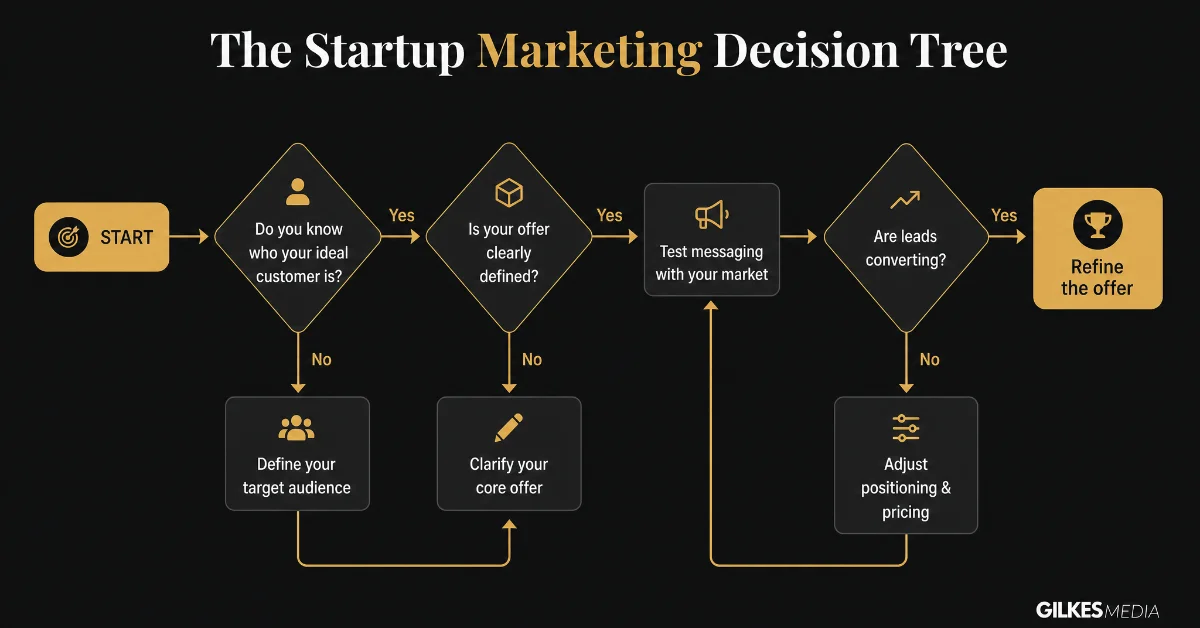
As you can see, choosing a channel is the logical output of knowing your goals and customer inside out. It is never the starting point.
Your first major decision is how to balance paid and organic channels. Neither is better than the other; they just serve different purposes and work on different timelines.
As a paid ads specialist, I see the power of both every day. Paid ads give you the speed and data you need to learn fast, while organic builds the long-term, defensible moat that creates sustainable growth.
To put this into perspective, here is a quick comparison of what to expect from some of the most common early-stage channels.
| Channel | Typical Time to ROI | Upfront Cost | Best For |
|---|---|---|---|
| Google Ads | 1-3 months | Medium to High | Capturing high-intent demand immediately; validating offers. |
| Social Media Ads | 1-3 months | Low to Medium | Building awareness; targeting specific demographics and interests. |
| SEO & Content | 6-12+ months | Low (if DIY) to High | Building a long-term, compounding asset; establishing authority. |
| Cold Outreach | 1-2 months | Low to Medium | Highly targeted B2B lead generation; getting direct feedback. |
This table highlights the trade-offs. If you need leads next month, SEO is not your answer. If you want to build a sustainable brand over the next two years, relying only on paid ads is a risky strategy.
To move from theory to action, let's filter potential channels through three practical lenses: your customer, your product, and your resources.
The best startup marketing strategy is not the one with the most channels; it is the one with the highest degree of focus on the channels that actually matter. Your job is to find the sweet spot where your customers are and where you can genuinely win.
For many UK startups, a mix of social media and local search is a powerful, budget-friendly starting point. Social media is central to UK strategy, used by 84% of professionals. For small businesses, Facebook still dominates with 76% adoption, followed by Instagram (63%) and LinkedIn (43%).
And do not ignore local. With nearly 46% of all Google searches having local intent, optimising your presence is critical, especially when you consider that 28% of those searches lead to a purchase within 24 hours.
Once you have a hypothesis about your top one or two channels, you need to test it without blowing your budget. Set aside a small, fixed amount (say, £500 - £1,500) and a defined timeframe (like 30 days) to run a disciplined experiment.
The goal here is not a massive ROI. It is to gather data and answer some crucial questions:
This approach turns marketing from a blind expense into a data-gathering exercise. You make small, calculated bets to see what works before you go all-in. To learn more about this approach, read our guide on using digital marketing for lead generation. This process lets you double down on what is working and cut your losses on what is not, ensuring every pound is working as hard as it possibly can.
A marketing strategy without a budget and clear KPIs is just a wish list. It is the commercial engine that turns your plans into predictable growth, but so many founders treat it as an afterthought. You need to know exactly what you're spending, what you expect back, and how you will measure success along the way.
This is not about getting bogged down in complex financial modelling. It is about setting up a practical framework to allocate your funds intelligently, prioritise high-impact activities, and track the metrics that genuinely move the needle.
There is no magic number for a startup marketing budget. Instead of pulling a figure out of thin air, your budget should be a direct reflection of your commercial goals.
Let's look at a few practical ways to approach this.
Whichever method you land on, the most important part of your budget is not the total number, it is how you allocate it. Set aside at least 15-20% of your total budget for a 'test and learn' fund. This is your engine for experimenting with new channels or messaging to find what really works.
This disciplined approach ensures you are not just spending money; you are investing it in growth.
Once your budget is locked in, you need to define how you will measure performance. Forget vanity metrics like impressions, clicks, and follower counts. On their own, they are useless. They do not tell you if your marketing is actually making you money.
A solid startup marketing strategy zeroes in on KPIs that are directly tied to revenue and the overall health of the business.
Your core KPIs should tell a clear story, moving from the initial cost of acquiring a customer to their long-term value. To do this properly, you have to get comfortable with calculating your marketing ROI to ensure your efforts are paying off.
| KPI | What It Measures | Why It Matters |
|---|---|---|
| CAC | Customer Acquisition Cost: Total marketing spend divided by new customers acquired. | This is the fundamental measure of your marketing efficiency. A rising CAC is an early warning sign that something is wrong. |
| LTV | Lifetime Value: The total revenue a single customer generates over their entire relationship with you. | This is the other side of the CAC coin. Your business is only viable if your LTV is significantly higher than your CAC. |
| LTV:CAC Ratio | The ratio between Lifetime Value and Customer Acquisition Cost. | This is the ultimate health check for your business model. A ratio of 3:1 or higher is the gold standard for a sustainable business. |
| Conversion Rate | The percentage of visitors who take a desired action (e.g., sign up, make a purchase). | This measures the effectiveness of your messaging and user experience. Small improvements here can have a huge impact on your CAC. |
Focusing on these metrics moves the conversation from "How much traffic did we get?" to "How profitable is our customer acquisition?" This is the shift that separates the businesses that scale from those that simply run out of cash. For a deeper dive, check out our guide on creating a marketing strategy effectively.
This commercial focus is central to our work as marketing consultants and paid ads specialists. We build simple, powerful dashboards that track these KPIs, giving you a clear, real-time view of what is working and what is not. This transparency enables us to make data-driven decisions together, optimising your spend to accelerate growth and maximise your return on investment.
In a startup, your ability to learn and adapt quickly is far more valuable than a rigid, five-year plan. The market moves too fast for that. Your initial assumptions about your customers, messaging, and channels are almost certainly wrong in some way.
This is why the best marketing strategies are built on a foundation of rapid, disciplined experimentation.
This is not about throwing ideas at the wall to see what sticks. It is an agile, methodical process of making small, calculated bets to gather data, validate your assumptions, and systematically de-risk your growth strategy before you commit a significant budget.
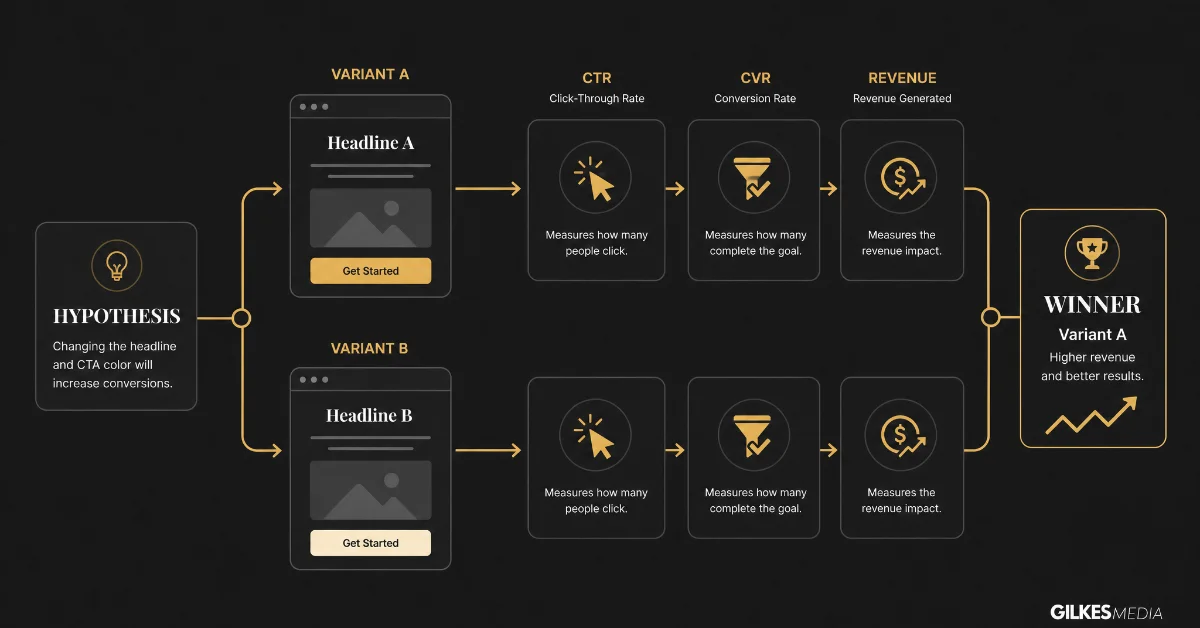
This hands-on, iterative process is the engine that drives sustainable growth. It replaces guesswork with evidence, allowing you to double down on what works and cut what does not with total confidence.
Every marketing action you take should start as a testable hypothesis. It is a simple structure that forces clarity and ensures every pound spent has a purpose. It transforms vague ideas like "let's try Facebook ads" into a structured, measurable test.
A strong hypothesis always follows this format: "If we [take this action], then [this specific outcome] will happen, because [this is our reasoning]."
Let's look at a few real-world examples:
This framework turns marketing from a purely creative exercise into a scientific one. Each test is designed to teach you something specific about your customer, your messaging, or your market.
With a clear hypothesis in hand, the next step is to design a clean, low-cost test. The goal here is to get a clear signal with the minimum viable investment of time and money. As a performance-focused consultant, this is a process I implement with every client to protect their budget and accelerate learning.
Here is a simple framework for running your tests:
The purpose of an early-stage marketing experiment is not immediate ROI; it is validated learning. The data you gather from a 'failed' test is often more valuable than the leads from a successful one, as it tells you what not to do and saves you from making a much bigger, more expensive mistake later.
Once your test is complete, you analyse the data against that one success metric you defined earlier. The outcome is binary: did you prove or disprove your hypothesis?
This continuous cycle of hypothesising, testing, analysing, and scaling is the heartbeat of an effective startup marketing strategy. It systematically builds a playbook of proven tactics, ensuring your marketing becomes more efficient and predictable over time.
Paid advertising is great for speed and data, but sustainable, long-term growth comes from building assets you own and relationships you can count on. For a startup, this means looking past immediate clicks to focus on strategic alliances and a powerful content engine.
These two pillars, partnerships and content, work together to build brand authority, drive organic traffic, and create a competitive moat that is tough for anyone else to copy.
While paid channels are like renting an audience, a strong content and partnership strategy is like owning your own source of traffic. It requires an upfront investment of time but pays compounding dividends for years. It is how you punch above your weight and build a brand that lasts.
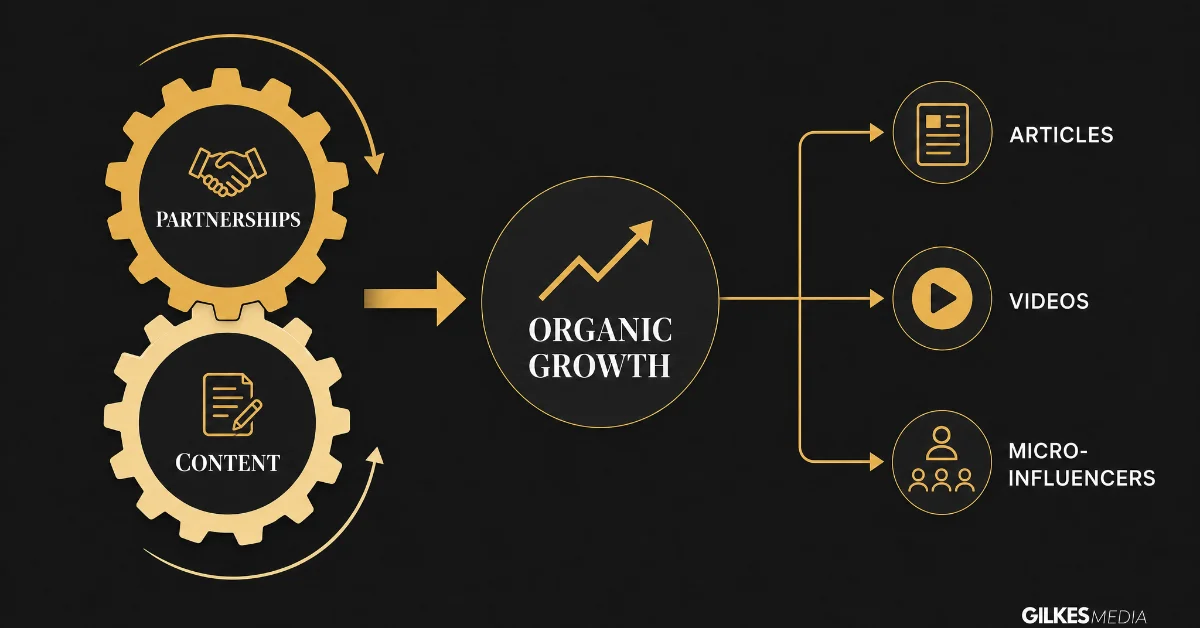
As a startup, your network is limited. Partnerships are a capital-efficient way to tap into someone else’s established audience, borrowing their trust and credibility to accelerate your own growth. This is not about complex enterprise-level deals; it is about finding simple, mutually beneficial collaborations.
Consider these practical partnership models:
The key to successful partnerships is to focus on genuine value exchange. Your offer must be compelling not just for the end customer, but for the partner themselves. A successful collaboration solves a problem or creates an opportunity for both sides.
Content marketing is the process of creating and distributing valuable, relevant articles, guides, and resources to attract and retain your target audience. When you get it right, it becomes your most powerful, long-term lead generation asset.
The goal is to answer your ICP's most pressing questions so effectively that you become their go-to resource. This strategy is not about random blog posts. It demands a structured approach.
A strong content marketing strategy for startups is not an optional extra; it is a core component of sustainable growth. UK businesses are increasingly recognising this, with 65% now using content marketing as part of their strategy. For businesses that are heavily invested, 31% of B2C marketers allocate at least half their budget to content and SEO.
Furthermore, nearly a quarter of all marketing professionals (23%) believe content marketing is the single most impactful element of their multi-channel strategy. You can read the full research on marketing priorities to understand its central role. This positions content not as an expense, but as a primary investment in building a long-term, defensible business asset.
The fundamentals here apply beyond the startup stage too. Our guide to marketing strategy development covers the process in more general terms, and our guide to marketing strategy for small businesses covers it for teams past the earliest stage.
Navigating the world of startup marketing can feel like trying to find your way in the dark. Founders often wrestle with the same core challenges: where to put a tight budget, which channels to actually trust, and when it is the right time to bring in professional help.
Here are some of the most common questions we hear, with clear, commercially focused answers to help you move forward.
There is no single magic number here. While a common benchmark for early-stage companies is to set aside 10-20% of projected annual revenue, I find that a far more strategic approach is to ditch arbitrary percentages and focus entirely on performance.
Start with a small, ring-fenced test budget, maybe a few thousand pounds, to validate just one or two high-potential channels. Your only goal at this stage is to find a repeatable, profitable path to acquiring customers.
Once you have data showing that you can spend £1 and get £3 or more back in customer lifetime value, the question completely changes. It is no longer about how much you should spend, but how much you can afford to invest into a growth engine that you know works. This data-driven mindset is at the very heart of an effective marketing strategy.
The "best" channel is always the one where your Ideal Customer Profile (ICP) is most active and receptive. Do not try to be everywhere. For many B2B startups, this usually points towards a focused combination of LinkedIn and Google.
The key is to pick one or two of these channels and test them rigorously. Spreading your budget too thin by trying to be everywhere at once is a classic startup mistake. Focus wins.
Hiring your first marketer is a massive decision, and the timing is critical. A common trigger is when the founding team finds themselves spending more than 25% of their own time on marketing activities, and it is becoming a clear bottleneck to growth.
In the very beginning, founders must lead the marketing. This direct involvement provides invaluable, unfiltered insights into what customers are struggling with and which messages actually resonate. You cannot outsource that initial learning.
Your first marketing hire should not be a narrow specialist. You need a 'T-shaped' marketer. Someone with a broad understanding across several channels but deep, hands-on expertise in the one or two that have shown the most promise in your early experiments.
This profile ensures they can hit the ground running, optimising what is already working while also having the strategic vision to identify and test new growth opportunities. They need to be a practical operator, obsessed with commercial outcomes, not just campaign activity.
At Gilkes Media, we partner with founders and leadership teams to provide that senior, hands-on expertise from day one. If you need a clear, commercially focused strategy and accountable execution to drive your growth, let's talk.
