
Most founders don't start looking for a small business digital marketing consultant because everything is going well. They start looking when marketing feels busy but commercial progress feels flat.
You've run Google Ads for a few months. You've posted on LinkedIn or Instagram. You may even have an SEO provider sending reports full of impressions, ranking movements and click graphs. Yet enquiries are inconsistent, sales quality is mixed, and nobody in the business can say with confidence what should happen next.
That's usually the core problem. Not a lack of tactics. A lack of direction, ownership and operational follow-through.
A stalled marketing engine rarely looks dramatic from the outside. It looks like a business doing lots of small things that never join up.
One week you're tweaking ad copy. The next, someone's redesigning a homepage banner. Then a sales dip triggers a rush to “do more social”. None of it is irrational. It's just disconnected.
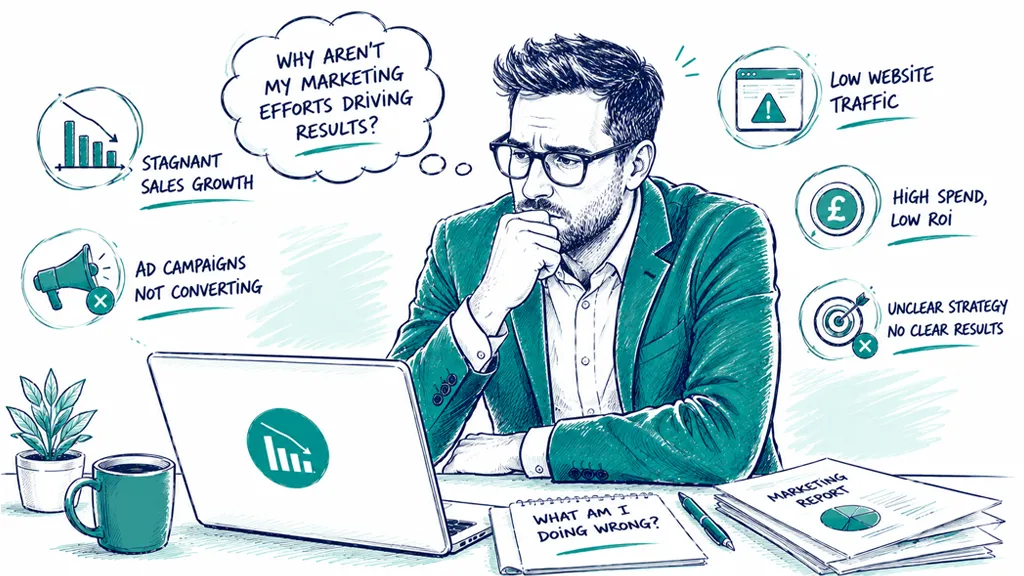
The first warning sign is often stalled lead flow. Not necessarily zero enquiries, but no clear pattern. Some months look decent. Others collapse. The pipeline depends too heavily on referrals, repeat business or founder-led networking.
Another common sign is wasted effort across too many channels. A business might be paying for ads, posting on social media, updating the website and commissioning blogs, but none of it is tied to one commercial goal. Traffic goes up, yet sales don't move in the same direction.
According to the Department for Business and Trade's Small Business Survey, only 43% of small businesses in Great Britain had an employee responsible for marketing or sales in 2023, which means most firms don't have dedicated specialist internal resource to manage this properly.
A consultant earns their keep when they stop random acts of marketing and turn activity into a system.
Founders often assume the answer is better execution. Sometimes it is. More often, the deeper issue is that nobody has stepped back and decided what marketing is supposed to do, which channels deserve budget, and what the business can realistically support operationally.
A local service business in the UK might need enquiries from a specific radius, not national traffic. A B2B firm might need fewer leads but better-qualified ones. An e-commerce business might need stronger conversion from existing traffic before increasing spend.
That's why a good small business digital marketing consultant isn't just another pair of hands. They create order. They decide what matters now, what can wait, and what should be cut.
If any of the points below feel familiar, external strategic help is usually justified:
None of these problems are fixed by adding more marketing noise. They're fixed by better choices, better tracking and better execution discipline.
Hiring badly is expensive in a way many founders underestimate. You don't just lose fees. You lose time, momentum and confidence in the channel itself.
A freelancer may be useful for delivery. An agency may be useful for scale. A true consultant should be able to diagnose the commercial problem first, then recommend the right mix of strategy, execution and measurement.
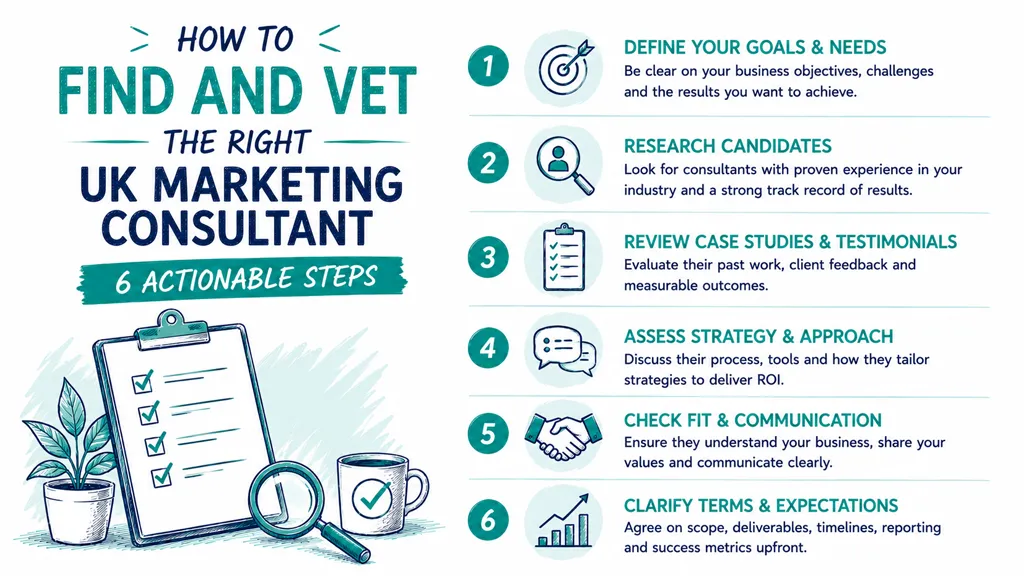
The best screening happens before you speak to anyone. Review their site, their positioning and the questions they ask.
A consultant who talks only about channels often thinks in outputs. A consultant who asks about margin, sales process, lead handling and operational constraints is more likely to think in outcomes.
Use this checklist:
If you're still comparing consultant and agency routes, this guide on how to choose a digital marketing agency helps sharpen the decision.
A polished pitch tells you very little. Useful interview questions create pressure in the right places.
Ask these instead:
How would you measure success for our business in the first 90 days?
Good answers focus on tracking, lead quality, sales feedback and early prioritisation.
What would you stop doing first if you joined us?
Serious consultants can identify waste quickly.
Where do businesses like ours usually get implementation wrong?
This reveals whether they've seen the operational side, not just the marketing side.
Talk me through a campaign that underperformed and what changed afterwards.
You want honesty, diagnosis and adaptation, not perfection theatre.
What would you need from us internally for this to work?
Strong consultants know that client-side delays can kill performance.
A weak consultant sells certainty. A strong one sets boundaries, explains dependencies and tells you what they can't fix without internal cooperation.
Hiring test: if they promise results without asking about sales process, website conversion, CRM handling or fulfilment capacity, they're guessing.
The cheapest option is often the one that creates the most waste. The most expensive option isn't automatically the safest either.
Pricing only makes sense when tied to scope, decision speed and the level of senior input you need. Some businesses need strategic oversight and monthly steering. Others need a focused audit, a rebuild of paid campaigns, or a consultant who acts like a part-time marketing lead.
Below is a practical way to compare the usual arrangements.
| Model | Typical UK Cost (GBP) | Best For | Considerations |
|---|---|---|---|
| Monthly retainer | Often lower than a full-service agency retainer | Ongoing oversight, channel management, regular reporting | Check what is strategy versus hands-on delivery |
| One-off project fee | Varies by scope | Audits, tracking setup, landing page strategy, campaign rebuilds | Good for defined problems, weaker for ongoing accountability |
| Day rate | Varies by seniority and scope | Workshops, planning sessions, leadership support | Useful for focused input, but progress can stall between sessions |
| Fractional consultant model | Varies by time commitment | Businesses needing senior marketing leadership without a full-time hire | Requires internal responsiveness to get value from the advice |
One benchmark matters here. Specialised consultants are often 40-60% cheaper than full-service agency retainers, while agency retainers can range from £5,000-£15,000+ monthly, which makes senior-level optimisation more accessible to SMEs.
A proper contract should remove ambiguity, not create it. If the document is vague, the relationship usually becomes vague too.
Check for these points before signing:
A founder-led business with no internal marketer often struggles with pure strategy retainers. The consultant may produce a sharp roadmap, but nobody implements it. In that case, a hybrid model works better. Strategy plus selected execution support.
A business with an established internal team may need the opposite. Less delivery. More scrutiny, prioritisation and performance management.
Don't buy a bigger package than your business can use. Buy the level of support your team can act on consistently.
Good pricing should feel commercially rational. You should understand what decisions the consultant will own, what they'll influence, and what still sits with your team.
Hiring a consultant isn't the finish line. It's the point where accountability starts.
Many engagements go wrong in the first month for a simple reason. The business assumes access equals progress. It doesn't. Giving someone access to Google Ads, GA4, Search Console and the website backend won't fix a confused offer, a slow approval process or a team that can't action recommendations.
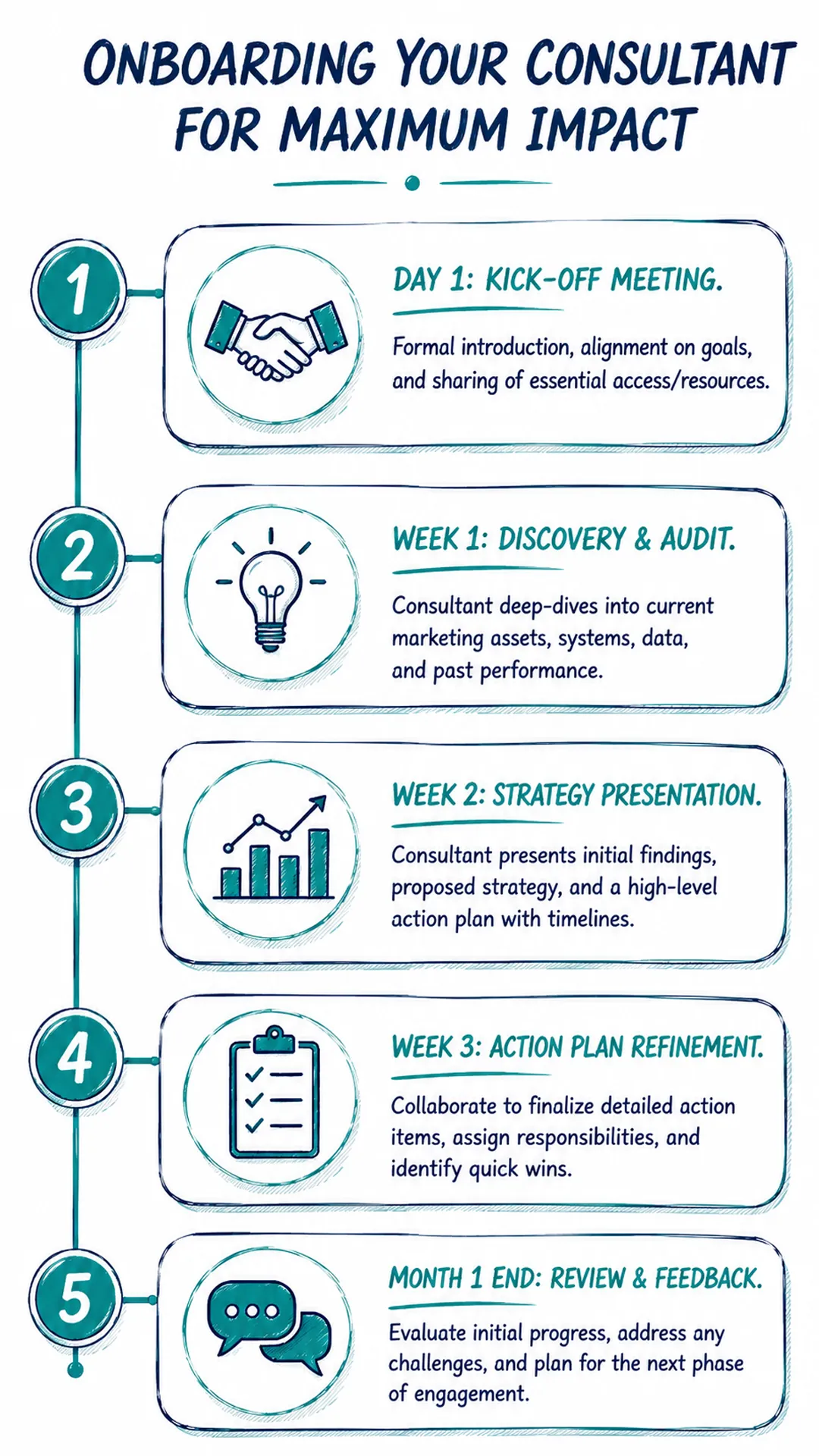
The opening month should create working rhythm, not just information transfer.
A sensible onboarding structure usually includes:
If you need a framework for building those foundations internally, this resource on how to build a marketing strategy is a practical place to start.
Founders often stumble at this point. They hire well, receive sensible recommendations, then struggle to implement because everyone is already overloaded.
That's especially relevant for SMEs with uneven digital capability. A consultant's value often lies in sequencing, prioritisation and hands-on support that works around internal capacity bottlenecks, not just producing channel advice.
The cleanest onboarding includes a few rules from day one:
A consultant can prioritise the work. Your business still needs a way to get the work done.
When onboarding is handled properly, strategy becomes operational. When it's handled badly, strategy becomes a document nobody revisits.
A consultant should never hide behind activity. If you're paying for advice or management, you need to know whether the work is improving commercial performance.
That means moving past metrics that look impressive in reports but don't help a founder make decisions. More clicks don't automatically mean more revenue. Higher impressions don't prove market traction. A traffic spike can be worthless if it produces poor leads.
The most useful approach is simple. Start with the business outcome, then track backwards.
For most small firms, the stack should connect:
UK businesses with a formal marketing plan are 6.7 times more likely to report marketing success, and the practical takeaway is to tie spend to pipeline quality rather than clicks.
A good monthly review should answer a handful of hard questions:
| Question | Why it matters |
|---|---|
| Which channels produced qualified leads? | Shows where budget is earning attention that can convert |
| What happened after the enquiry? | Stops marketing being judged on form fills alone |
| Which landing pages or service pages converted best? | Helps direct future spend and content updates |
| What should be cut, improved or scaled next month? | Turns reporting into action |
That logic applies whether the work sits in SEO consultancy, paid ads management, or a lead generation website. Different channels, same standard. They should all contribute to enquiries, sales opportunities and profit.
A more detailed guide to paid search analytics can help if you're tightening reporting across multiple channels.
Traffic is only valuable when it turns into commercially useful action.
Be cautious when a consultant leads with follower growth, impressions or generic engagement. Those numbers can have context, but they are not the scorecard.
What matters more is whether the right people arrived, converted and progressed. For a local trades firm, that may mean qualified quote requests from the right postcode areas. For a B2B consultancy, it may mean booked meetings with suitable decision-makers. For an e-commerce brand, it means sales, repeat purchase behaviour and margin-aware performance.
The consultant's job is to make those connections visible. If they can't, you're buying motion instead of progress.
They diagnose where marketing is underperforming, decide what matters most, and help the business improve acquisition, conversion and measurement. That can include SEO strategy, Google Ads structure, landing page recommendations, conversion tracking, reporting, campaign prioritisation and sales alignment.
The good ones don't just tell you which channels exist. They tell you which ones deserve budget now, which ones can wait, and what your team can realistically execute.
Sometimes yes, sometimes no.
A consultant is usually the better fit when you need senior judgement, commercial clarity and a more direct working relationship. An agency can make sense when you need wider delivery capacity across several channels at once. The mistake is assuming bigger always means better. For many SMEs, the actual need is sharp prioritisation and accountability, not a large service menu.
Budgeting depends on scope, urgency and how much internal support you already have. Some firms need an audit and a roadmap. Others need ongoing strategic input plus channel execution.
The useful question isn't “what's the cheapest option?” It's “what level of support can we realistically use well?” If your internal team is stretched, a lower-cost strategy-only arrangement can still be poor value because nothing gets implemented.
You don't need a perfect setup, but you do need enough clarity to work productively. That usually means:
If those basics are missing, a consultant can still help, but part of the work will be building operational order first.
Because the market is dominated by smaller firms competing for attention in increasingly digital buying journeys. SMEs account for 99.9% of the UK business population, and UK internet sales made up 26.7% of total retail sales in January 2024, which is why smaller companies need clear guidance on where to invest limited budgets online.
That environment rewards focus. Businesses that know their audience, track performance properly and act consistently tend to make better use of every pound spent.
Useful progress often starts before headline results do. Better tracking, clearer channel priorities, stronger landing pages and improved lead handling can appear early. Revenue impact usually depends on sales cycle length, offer strength, existing traffic levels and how quickly your team can implement changes.
That's why the first signs to look for are usually improved clarity and better decision-making, followed by stronger lead quality and more consistent conversion performance.
If you're weighing up whether now is the right time to bring in outside support, our own marketing consultancy service at Gilkes Media offers a free consultation to help you assess the gap between your current marketing activity and the commercial outcomes you require. It's a straightforward way to clarify priorities, pressure-test your approach, and decide what should happen next.
