
Link building has more bad advice attached to it than almost any other part of SEO. Partly, that's because a lot of it was written for a version of Google that no longer exists. It's also because there's a genuine cottage industry selling shortcuts that range from ineffective to actively dangerous for your site.
If you're a UK business trying to work out what's actually worth doing in 2026, this is a straight answer. It's based on what genuinely moves the needle versus what's a waste of money or a real risk.
Despite years of predictions that links would stop mattering, they remain one of the strongest signals search engines use. Search engines rely on them to judge whether a page is genuinely trustworthy and authoritative on its subject.
A link from another site is, in effect, a vote of confidence. Google's systems still weight this heavily when deciding which pages deserve to rank. The newer AI-driven answer engines that increasingly cite sources weight it just as heavily when choosing which pages to mention.
What's changed isn't whether links matter, it's how much scrutiny goes into judging whether a link is genuine.
The volume-based approach that worked a decade ago meant acquiring as many links as possible regardless of quality or relevance. That approach doesn't just fail to help anymore, it actively risks harm.
Google's systems are considerably better now at identifying unnatural link patterns. As a result, businesses still chasing volume over quality are increasingly the ones quietly losing rankings rather than gaining them.
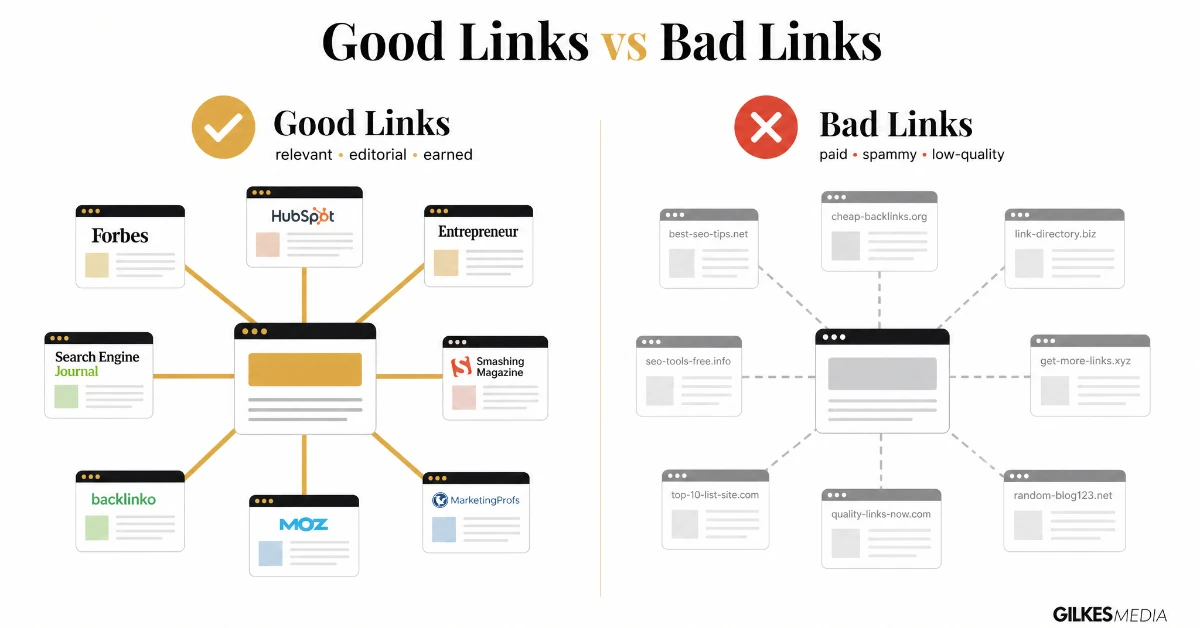
Links from genuinely relevant, real sites with real audiences. A link from a site that covers your industry, has real readers, and would plausibly link to you organically, carries real weight. That's because your content is genuinely useful to their audience.
A link from a directory of ten thousand unrelated sites with no real traffic carries close to none. That's true regardless of what its domain authority metric claims.
Links earned because the content deserves them.
Genuinely original research, a useful free tool, a uniquely detailed guide, or first-hand data all give other sites a reason to link on their own. They want to reference this kind of content because it saves them the work of producing it themselves. That makes it the most durable link-building strategy that exists, because it doesn't depend on convincing anyone of anything.
They link to it because it's useful to their own readers.
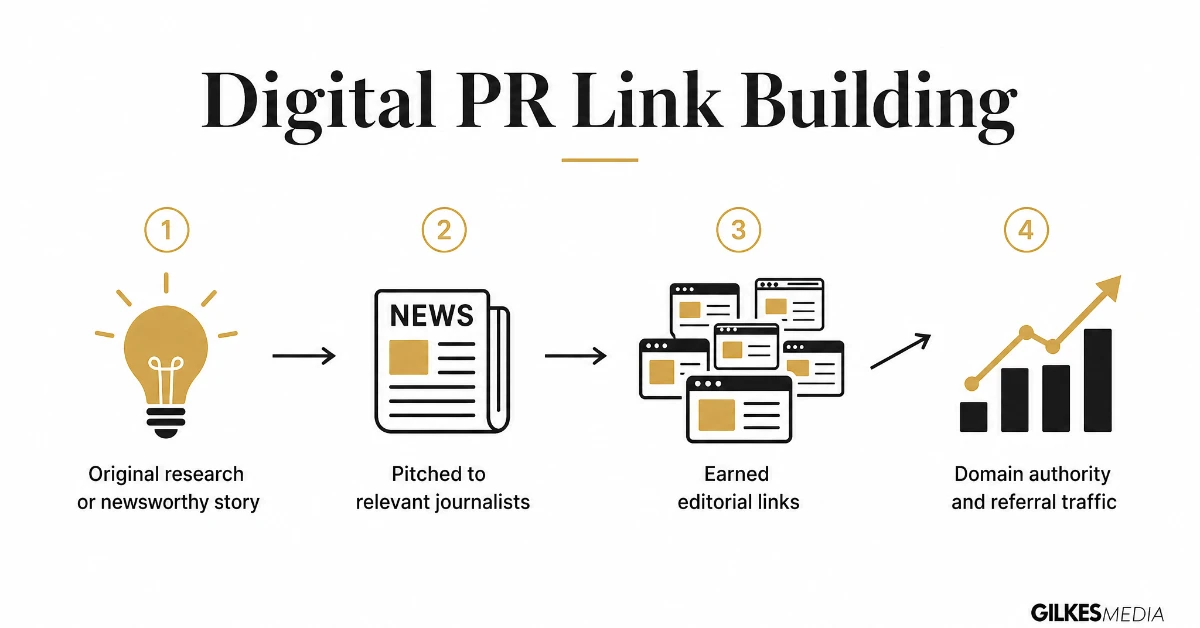
Links from digital PR and genuine media coverage.
A well-pitched story, survey, or piece of original data can catch a journalist or industry publication's attention. When they pick it up and link to it as a source, that carries genuine authority. That's because it's an editorial decision made independently, rather than a link placed as a transaction.
This is more work than buying a link, and considerably more valuable and durable as a result.
Suppliers, partners, industry bodies, local business associations, and complementary businesses you have real working relationships with will often link to you if asked. There's a genuine, honest reason for the link to exist beyond SEO value alone.
These tend to be overlooked because they don't feel like "proper" link building, but they're low-risk and genuinely relevant.
Guest content on genuinely relevant, editorially reviewed publications. Contributing a genuinely useful, original piece to a publication your target audience actually reads can produce a strong, relevant link. That's especially true when the publication has an editorial process, rather than a pay-to-publish arrangement.
The distinction that matters is whether the publication would say no to low-quality content. If they'll publish anything for a fee, the link carries little value and some risk.

Links remain one of the strongest trust signals search engines and AI answer engines use, even now. What's changed isn't whether they matter, but how much scrutiny goes into judging where they come from. A link from a genuinely relevant site with a real audience carries real weight. A link from a directory of ten thousand unrelated sites doesn't, whatever its metrics claim.
Original research, genuinely useful tools, and detailed, well-researched guides earn links because other sites want to reference something genuinely valuable to their own readers. This is the most durable form of link building, since the links keep coming in long after the content is published, without ongoing outreach effort.
| Worth pursuing | Avoid entirely |
|---|---|
| Links from genuinely relevant sites with real audiences | Paid link schemes and link farms |
| Links earned because the content genuinely deserves them | Reciprocal link exchanges run at scale |
| Digital PR: a well-pitched story or original data journalists want to cite | Comment spam and forum link drops |
Networks of sites built or acquired purely to host paid links are often on expired domains, chosen for their leftover authority. This is a well-known pattern that Google actively works to detect and devalue. A business relying on this approach is building on ground that can be taken away at any point. The only warning is usually a sudden, unexplained ranking drop.
Start with content genuinely worth linking to.
Before any outreach, make sure you have something that gives someone a real reason to link to it. That might be original data, a genuinely useful tool or calculator, or an unusually thorough guide. It could also be first-hand expertise expressed in a way that's hard to find elsewhere.
Outreach for mediocre, generic content that reads like dozens of other pages on the same topic is considerably harder and less effective. That's true whatever the pitch.
Identify realistic, relevant targets.
Skip the generic list of "high domain authority" sites to approach regardless of fit. Instead, build a list of sites that genuinely cover your industry or serve your target audience. These are the sites that would plausibly find your specific content useful to their own readers.
A smaller, well-targeted list produces better results than a large, generic one.
Pitch honestly and specifically. A generic templated email sent to two hundred sites at once is easy to spot and easy to ignore.
A short, specific pitch gets a meaningfully better response rate than a generic one. It should reference the actual site, explain why your content would be useful to their specific audience, and avoid overselling. That's because it reads like it was actually written by a person who looked at their site.
A link-building report showing "40 new links this quarter" tells you nothing useful on its own. You need to know whether those links came from genuinely relevant, real sites.
Track the sites themselves alongside any raw count. Look at their relevance to your industry, and whether they have genuine traffic and an editorial process. The count alone can hide a batch of low-quality links doing more harm than good.
Be patient and consistent. Genuine link building is slower than any paid shortcut, and that's precisely why it works.
A steady, ongoing process of creating genuinely link-worthy content and building real relationships over months and years produces a durable, defensible link profile. A purchased batch of low-quality links will never produce that.

Paid link schemes and link farms are explicitly against Google's link spam policies. The short-term bump they offer isn't worth the risk of a manual action that's hard to recover from. Before any outreach, make sure you have content genuinely worth linking to. That could be original data, a useful tool, or first-hand expertise that's hard to find elsewhere.
Digital PR means pitching genuinely newsworthy stories, original research, or useful data to journalists and industry publications. It has become one of the more effective link-building approaches, because it produces the links search engines trust most. Those links are editorial, contextually relevant, and impossible to buy directly.
A well-run digital PR campaign around a piece of original research relevant to your industry can produce genuinely valuable links. It can do this in a single campaign, more effectively than months of generic outreach.
This does require a genuine story, survey data, a novel angle, or a timely connection to current events in your industry. It's not enough to send a press release announcing your own news, because journalists have little independent reason to cover that.
The investment is in the story and the pitching, not in paying for placement. The resulting coverage tends to be considerably more durable and valuable than anything purchased directly.
Genuine link building through content and outreach isn't free. It takes real time to produce link-worthy content, and to genuinely research and pitch relevant sites. However, it's considerably more cost-effective over time than paid link schemes. That's once you account for the real risk those schemes carry.
A manual action from Google for unnatural links can take months to recover from, even after you've disavowed or removed every bad link. The lost traffic and revenue during that recovery period dwarfs whatever the cheap link package cost upfront.
If you're evaluating a link-building proposal from an agency or freelancer, ask them specifically how they'll acquire the links.
A vague answer is worth treating with real scepticism. So is a promise of a specific large number of links for a low fixed fee. Genuinely good link building doesn't scale that cheaply or predictably.
Our technical SEO audit checklist is a useful starting point for checking that your site's foundation is solid. Do this before investing meaningfully in any link-building campaign. A technically weak site undermines the value of even genuinely good links pointing to it.

Digital PR means pitching genuinely newsworthy stories or original research to journalists. It produces the editorial, contextually relevant links search engines trust most. A single well-run campaign can outperform months of generic outreach. Genuine link building isn't free, but it's considerably more cost-effective long-term than paid schemes. That's once you account for the real risk of a manual action.
Consistency matters more than any single big win. A short monthly routine keeps outreach moving without it becoming a full-time job:
A UK-based professional services firm we've worked with had roughly a dozen backlinks before any structured link-building work. Most were from directories with little relevance or authority.
Rather than pursuing a large volume target, we focused on producing one genuinely useful piece of original content. That content was a practical calculator relevant to a common decision their prospective clients faced. We pitched it specifically to the handful of trade publications and local business sites their actual target audience reads.
Over six months, this produced twelve new links, a fraction of what a volume-based purchased package might have promised. However, every one of them came from a genuinely relevant, real site with actual readers.
The measurable effect on rankings for the firm's priority commercial keywords was considerably stronger than anything the old directory links had produced. That's precisely because relevance and genuine authority mattered more than raw count.
This is consistently the pattern: a small number of genuinely good links outperforms a large number of low-quality ones, often dramatically.
Consistency matters more than any single big win. A short monthly routine of a few relevant outreach emails and one piece of genuinely link-worthy content keeps things moving. It doesn't need to become a full-time job. One professional services firm went from a dozen low-relevance directory backlinks to real editorial links. It did this by focusing on one genuinely useful original piece, rather than chasing volume.
Link building works best as part of a properly integrated strategy rather than a standalone activity bolted on separately.
Our SEO content strategy guide covers how to plan content genuinely capable of earning links naturally. That's different from generic content, which needs aggressive, artificial promotion just to gain any traction at all.
You might not be sure whether your current link profile is helping, or quietly holding you back. Or you might want a properly considered link-building approach built around genuine relevance rather than volume. Either way, that's exactly the kind of thing worth an honest conversation about before committing budget.
Our SEO service includes link building built on the principles above. It's not a volume-based package that puts your site at risk for the sake of a bigger number on a monthly report.
Get in touch through our contact page for a free discovery call. We'll take an honest look at your current backlink profile and what's genuinely worth doing next.
Not every link carries equal weight. Understanding the mechanics behind why makes it far easier to tell a genuinely good link-building opportunity from a waste of time.
A link from a moderately-sized site that genuinely covers your industry typically passes more real value than a link from a huge, generic site. That's especially true when the generic site has no topical connection to your business. Search engines weigh contextual relevance heavily. That's why a well-placed link from a smaller trade publication often outperforms a generic high-authority directory listing.
A link placed naturally within the main body of an article, surrounded by genuinely relevant editorial content, generally carries more weight. That's more than a link buried in a footer, sidebar, or author bio. This is one reason genuinely earned editorial links from digital PR consistently outperform paid placements. Those placements are designed purely to insert a link.
A handful of links from genuinely relevant, well-trusted, real sites in your industry will typically do more for your search visibility. That's more than a large volume of low-quality, unrelated links can offer. Chasing link volume as a metric in itself, rather than genuine relevance and quality, is a common mistake. It's one of the most common ways UK businesses waste link-building budget.
A single link from a site your actual customers read is worth more. It's worth more than a hundred links from sites nobody in your industry has ever heard of.
Link building spend needs the same accountability as any other marketing investment. However, the right metrics take longer to show movement than a paid ads campaign.
Referring domains - the number of distinct websites linking to you, not the raw link count - are a more meaningful measure of progress than total backlinks. That's because one site can link to you many times without adding much new authority. Organic traffic and keyword ranking movement on the specific pages you've been building links to, over that same period, matter too. Together, they tell you whether the links are actually translating into visibility.
Tools like Ahrefs and Semrush make referring-domain tracking straightforward without building your own spreadsheet from scratch. Our comparison of the best SEO tools for small business covers where platforms like these earn their cost. It also covers where a free tool does the job just as well.
A paid ads campaign can show results within days. Link building typically needs several months before ranking movement becomes clearly visible. That's because search engines need time to discover, crawl, and factor new links into their ranking calculations. Even once rankings do start shifting, they rarely move in a straight line.
Most UK businesses running a consistent, genuine link-building effort should see the first meaningful ranking movement within three to six months. More substantial authority gains build over six to twelve months of sustained activity. Anyone promising first-page rankings from link building within a few weeks is either overpromising. Or they're relying on the kind of risky tactics this article recommends avoiding.
There is no fixed number. What matters far more than a link count target is the relevance and quality of the sites linking to you relative to your competitors for the specific terms you want to rank for. A smaller number of genuinely strong, relevant links regularly outperforms a large number of weak ones.
For a business that depends on organic search visibility long-term, no. Google's link spam policies explicitly target paid links that pass ranking value, and a manual action penalty can take months to recover from even after every problematic link has been removed or disavowed, with real revenue lost during that recovery period.
Digital PR means pitching genuinely newsworthy stories, original research, or useful data to journalists and industry publications, earning coverage and links as a natural result of that coverage rather than asking directly for a link. It tends to produce higher-quality, more editorially genuine links than direct outreach asking sites to simply add a link.
Most businesses see initial ranking movement within three to six months of consistent, genuine link-building activity, with the strongest gains typically building over six to twelve months. This is considerably slower than paid advertising, which is one reason many businesses underinvest in link building despite its longer-term value.
Yes, provided the approach is realistic for the budget available. A smaller business is better served by a handful of genuinely relevant, well-targeted links each quarter than by an expensive agency retainer promising high volume, since quality and relevance matter more than sheer link count at any budget level.
Often, yes, though it takes time. Identifying and disavowing genuinely toxic links through Google Search Console's disavow tool can help recover from a previous poor link-building effort, though recovery is rarely instant and a business should expect a gradual improvement over weeks or months rather than an immediate reversal.
Nobody enjoys hearing that the right approach is slower than the shortcut. But link building is one of the clearest examples in SEO of the shortcut genuinely costing more in the end, not less.
A purchased batch of low-quality links might show a small, temporary bump. Or it might do nothing at all, beyond wasting the fee. Either way, it leaves a link profile that a future algorithm update or manual review can penalise. That can undo months of otherwise good work.
Genuine, relevant links, earned through real content and real relationships, don't carry that risk. They tend to keep paying off for years, rather than needing replacement or disavowal later.
You might be weighing a link-building proposal right now. If the numbers they're promising feel too good for the price they're asking, trust that instinct.
Link building works best folded into a genuinely integrated content strategy, rather than bolted on separately. It should be built around content capable of earning links naturally. This is one of the clearest examples in SEO where the shortcut costs more in the end. A purchased batch of low-quality links might show a small bump, or do nothing at all. Either way, it leaves a link profile that needs cleaning up later.
One pattern worth watching for in 2026 is how AI-driven search summaries and answer engines choose which sources to cite. Early evidence suggests these systems still lean heavily on the same trust signals traditional search rankings have always used. Those signals are genuine authority, topical relevance, and a track record of other credible sources citing them. That means the fundamentals of good link building remain just as relevant, even as the way people search continues to shift.
This also means a business that has spent years building genuine, relevant links and editorial mentions is better positioned for whatever search looks like next. That could be traditional blue links, AI-generated summaries, or something not yet fully established. Businesses that chased shortcuts and low-quality link volume instead have comparatively little foundation to build on when the rules shift again. And the rules tend to shift fairly often.
It is also worth being honest with any agency or freelancer offering link-building services about what "success" actually looks like. A monthly report showing a large number of new links added means very little on its own. Ask specifically about the relevance and real traffic of the sites those links come from. And be wary of any provider unwilling to name the actual sites they plan to secure links from before the work begins.
Here's a reasonable rule of thumb for a UK small or mid-sized business: budget for quality over quantity. Expect the first genuine ranking movement within a few months, rather than a few weeks. And treat any offer of guaranteed rankings, or suspiciously large link volumes at a low monthly cost, as a warning sign rather than a bargain.
Link building rewards patience and genuine effort more than almost any other part of SEO. It punishes shortcuts more severely too. Get the fundamentals right: relevance, genuine editorial merit, and a realistic timeline. Do that, and the links you build will keep earning their value for years. A paid placement, by contrast, would have expired or been penalised out of existence long before then.
If you'd rather have that groundwork built by people who do this daily, that's a conversation we're always happy to have. They can show you exactly which sites they plan to target before any work begins.
Whatever stage your link profile is at right now, the same principles apply. That's true whether you're starting from nothing, or trying to recover from a previous agency's risky shortcuts. Prioritise relevance over raw volume, and favour earned editorial links over paid placements. And give the process the months it genuinely needs to show results, rather than judging it against a paid-ads timeline it was never going to match.
Link building also works best as one part of a wider approach, rather than in isolation — it rarely rescues a site still undermined by weak on-page SEO fundamentals. Get those right first, then let earned links compound the results.
That combination - relevance, editorial quality, and realistic patience - is what separates link building that genuinely moves a UK business up the rankings. The alternative just spends budget without ever really changing anything.
If nothing else, take one thing from this article. Audit any link-building activity you're currently paying for against these standards, before renewing it for another quarter.
