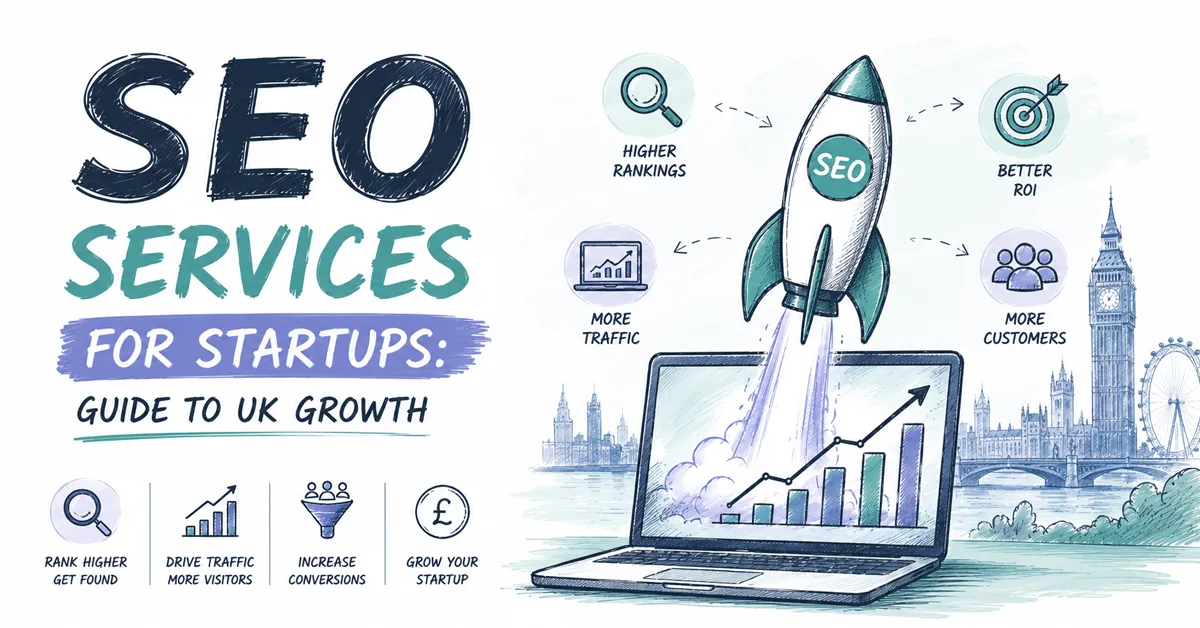
You’re probably weighing the same trade-off most founders face. Put budget into paid channels that can drive leads this month, or invest in SEO that takes longer to show up on a dashboard.
That’s the wrong framing.
Paid ads are useful. They can be a strong growth lever when the offer, targeting and economics are right. But if all your acquisition depends on rented attention, you’ve built a system that stops working the moment you stop paying. SEO is different. Done properly, it builds an owned asset that keeps attracting demand, supports your sales process, and lowers your dependence on paid media over time.
For startups, that matters. Cash discipline matters. Lead quality matters. Proving efficiency matters. And if you want a marketing engine that becomes more valuable as the business matures, seo services for startups deserve serious attention.
A founder launches paid search on Monday, sees clicks by Tuesday, and can point to spend in the dashboard by Friday. SEO does not give that kind of instant feedback. It gives you something more useful. A repeatable way to turn your website into an acquisition asset that keeps producing after the campaign ends.
That matters more than speed alone.
For an early-stage company, SEO improves three commercial outcomes at once. It helps the right buyers find you, gives them better reasons to trust you, and increases the odds that a visit turns into a demo request, trial, or sales conversation. Good on-page SEO best practices support all three.
This is the part many founders miss. SEO is easier to defend financially than it first appears, especially in the UK where boards and investors want a clear line between channel spend and revenue. Paid media usually wins the short-term attribution argument because the numbers show up faster. SEO wins the efficiency argument once you measure it properly against lead quality, assisted conversions, branded search growth, and the reduction in paid dependency over time.
SEO should be treated as a revenue asset with measurable contribution, not a publishing task handed to marketing when there is spare time.
If you're reviewing broader actionable strategies for startup growth, SEO should sit beside paid acquisition and outbound as a core part of demand capture. It serves a different commercial job. It reaches buyers who are already looking, often at the moment they are comparing options or trying to solve a clear problem.
A startup website should do real commercial work. It should:
The usual mistake is delay.
Teams launch with thin service pages, weak site structure, no search intent mapping, and no baseline reporting. Then they spend months buying traffic to pages that were never built to rank or convert. The result is not just missed organic growth. It is poorer ROI across other channels too, because the website cannot do its share of the work.
Start early. Keep the scope tight. Build the pages that match real buyer intent, set up measurement properly, and treat SEO as part of your acquisition model from the start.
A lot of founders buy SEO without knowing what they’re buying. That’s how you end up paying for rank reports, vague deliverables, and blog posts no one reads.
Good seo services for startups are built around a few core disciplines. Not fifty disconnected tasks. A small number of essentials, executed properly.
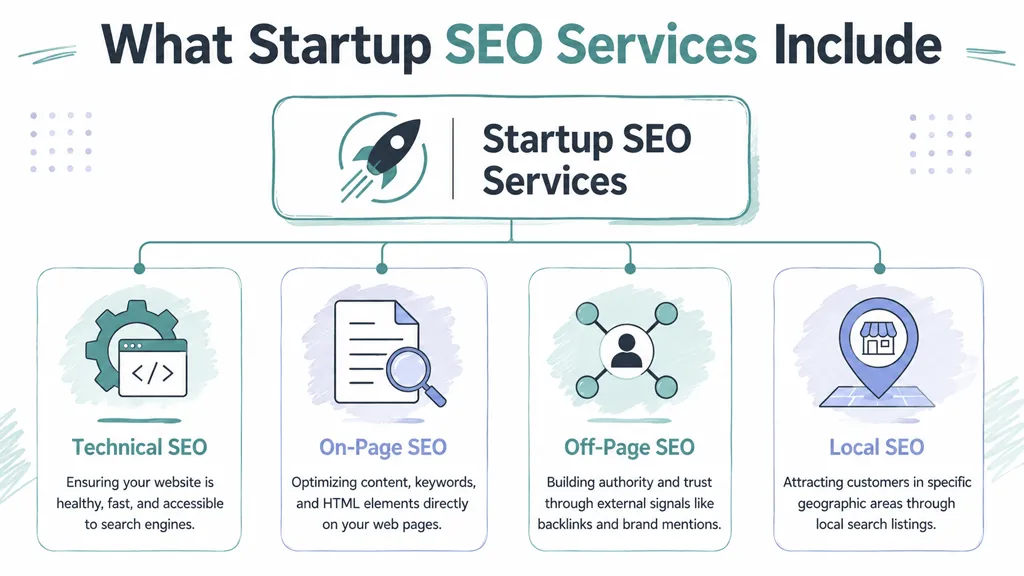
This is the foundation. If the site is slow, difficult to crawl, or badly structured, everything built on top of it becomes harder.
Core Web Vitals optimisation is a critical ranking factor, especially with mobile-friendliness accounting for over 53% of all internet traffic. For startups, that means technical work should focus on:
If your website has broken links, redirect chains, duplicate content, or weak internal structure, fix that first.
On-page SEO is where strategy meets the page itself. It covers the things buyers and search engines both see.
That includes headings, page titles, internal links, copy structure, and how clearly the page matches search intent. If you want a sensible benchmark for page-level execution, these on-page SEO best practices are the kind of fundamentals every startup site should get right.
This work matters because ranking the wrong page, or sending mixed signals about intent, wastes traffic.
Content is where many startups go off course. They publish generic articles because someone told them SEO means “posting regularly”.
It doesn’t.
Content should answer real buying questions, support your offer, and target terms with commercial relevance. That usually means:
Practical rule: If a piece of content doesn’t help a prospect understand the problem, evaluate the options, or trust your solution, it probably shouldn’t be a priority.
Authority still matters. If no credible websites reference your brand, you’ll find it harder to compete.
That doesn’t mean buying links. It means earning mentions, building relationships, and creating content worth citing. For location-based businesses or firms targeting defined service areas, local visibility also matters.
A real SEO service should improve your site, your pages, your content, and your authority. If one of those is missing, the service is incomplete.
Startups don’t need an oversized SEO programme. They need a sequence.
The right roadmap keeps the team focused on what matters now, instead of spreading effort across dozens of low-impact tasks.
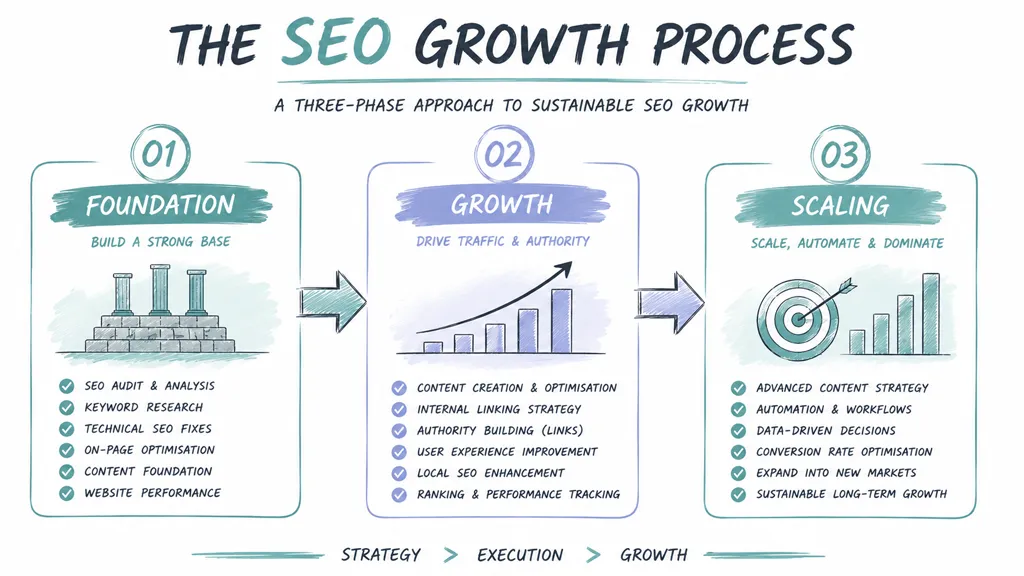
Early-stage SEO should begin with diagnosis, not content production. Before anyone writes a page, you need to know what’s broken, what the market is searching for, and where competitors are weak.
A proper starting point is a structured review of the site. If your team needs a framework, a comprehensive website audit methodology is a sensible reference for what to examine.
The first priorities are:
Effective startup SEO services must identify long-tail, niche-specific keywords and map user intent behind searches. Startups that conduct competitor keyword analysis can exploit gaps and improve their chances of ranking for achievable, high-intent terms.
The outcome here isn’t traffic. It’s clarity.
Once the technical base is stable and keyword priorities are clear, build the pages that can win business.
That usually means a mix of core commercial pages, supporting educational content, and internal linking that helps both users and search engines understand the site. If you need a practical toolkit for the execution side, these best free SEO tools are useful for lean in-house teams.
Focus on:
A simple explainer can help align the team on the process:
At this stage, many startups either gain momentum or stall.
By this point, you should have enough data to stop guessing. You’ll see which pages attract qualified visits, which topics bring the wrong audience, and where prospects drop out. The next step is refinement.
Here the work becomes more commercial:
Don’t scale content because you’re busy. Scale what has shown commercial intent and conversion potential.
The roadmap matters because SEO rewards disciplined sequencing. Start with foundations, build targeted assets, then optimise with evidence.
How you resource SEO matters almost as much as the strategy itself. A weak setup slows execution, muddies accountability, and usually creates a reporting mess.
There are three realistic options. Build in-house, hire an agency, or work with a specialist consultant.
| Factor | In-House Hire | Marketing Agency | Specialist Consultant |
|---|---|---|---|
| Best for | Businesses ready to build internal capability | Teams needing wider delivery support | Founders wanting senior guidance and commercial focus |
| Accountability | Can be high, but depends on leadership and support | Often split across account managers and delivery teams | Usually direct and clear |
| Speed of execution | Slower at first while hiring and onboarding | Can be fast if the agency has strong processes | Fast on strategy, selective on execution |
| Strategic depth | Varies by hire quality | Varies widely | Usually strongest when you need senior decision-making |
Hiring internally works when SEO is becoming a long-term operational function, not just a growth experiment. You’ll need enough budget, enough content demand, and enough management support to make that person effective.
The risk is obvious. One hire rarely covers technical SEO, content strategy, CRO thinking, analytics, and authority building equally well.
Agencies are often the right fit when volume matters. If you need steady content production, technical implementation support, outreach, and reporting under one roof, an agency can provide that structure.
But many startups buy too early. They pay for capacity before they’ve nailed the strategy.
A specialist consultant is usually the smartest choice when you need direction, prioritisation, and commercial judgement before scaling execution. That’s especially true if you already have a developer, content writer, or internal marketer who can help implement the plan.
A useful way to think about the broader trade-off is this comparison of in-house marketing vs agency. The same principle applies to SEO. Don’t buy the biggest model. Buy the one that matches your stage.
The best SEO partner for a startup isn’t the one with the largest team. It’s the one that gives you the clearest priorities and the least wasted effort.
A founder approves paid search on Monday and can see clicks by lunchtime. SEO does not work like that. In a startup, the question is whether organic search is creating pipeline at a lower acquisition cost over time, and whether you can prove it clearly enough to defend the budget in a board meeting.
That is why weak SEO reporting kills good SEO programmes. If your report stops at rankings and traffic, finance sees a cost centre. If your report shows qualified leads, sales influence, and revenue contribution, SEO earns its place as a growth channel.
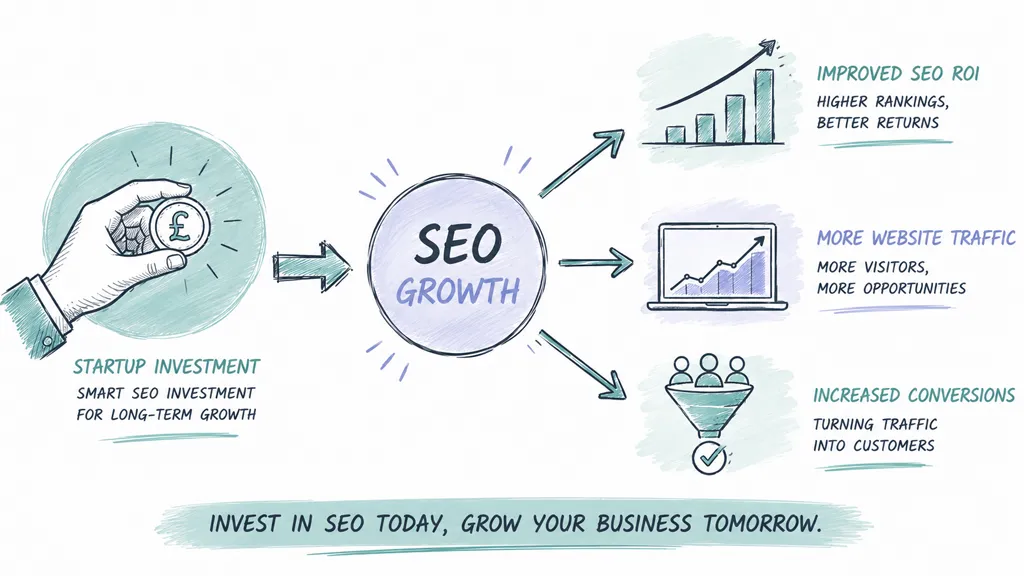
Early-stage companies often over-report visibility metrics because they are easy to pull and easy to present. They matter, but they sit upstream from value.
Your SEO dashboard should connect search performance to commercial outcomes. Track these in order:
This order matters. It gives you a clean chain from attention to income, which is the only chain a founder should care about.
Attribution breaks down when it gets too complicated. Start with a model your marketing lead and sales team will keep updated every month.
Use this framework:
For UK startups, this matters more than many teams realise. Founder-led sales, longer B2B buying cycles, and traffic from multiple channels make last-click reporting especially misleading. If you rely on a basic last-click view, paid search will look stronger than it is and SEO will look weaker than it is.
SEO usually follows a lag, then a lift. The first wins often show up in crawlability, indexing, and early ranking gains. Commercial impact tends to arrive later, once the right pages build visibility for high-intent searches.
A sensible way to judge progress is by phase:
This is the part founders need to hear plainly. If you expect SEO to behave like paid media in week one, you will cut it before it starts compounding.
Traffic growth looks good in a slide deck. It does not pay salaries.
Calculate SEO ROI against outcomes that affect the business:
If organic brings in leads that close faster, buy larger packages, or stay longer, your ROI is stronger than a surface-level channel report suggests. That is why startups should judge SEO against margin and payback, not vanity growth charts.
A useful monthly SEO report should answer three questions with no waffle:
Anything less is weak reporting.
Board-level view: present SEO as an asset that builds pipeline and reduces dependency on rented channels. In a UK startup, that is the strongest case for continued investment. Paid media gives speed. SEO builds durable demand capture you do not have to repurchase every month.
If you want SEO to survive budget scrutiny, measure it like a commercial system, not a content activity.
Founders usually don’t fail with SEO because they ignored it completely. They fail because they followed bad advice, spread effort too thin, or chased shortcuts.
It’s tempting to go after the biggest, broadest terms in your category. They look impressive in a spreadsheet and feel strategically important.
They’re often the wrong place to start.
Startups usually get faster traction from narrower, high-intent searches that map to specific problems, services, or buyer situations. Broad keywords attract noise and usually favour stronger domains.
A blog full of generic top-of-funnel posts won’t save a weak site structure or unclear offer. If the content doesn’t support discovery, consideration, or conversion, it becomes publishing for publishing’s sake.
Ask one question before approving any topic. Does this help the right buyer move closer to a decision?
This one is expensive because it’s easy to miss until growth stalls.
While many teams focus on content, a failure to address technical issues can be fatal. Startups need clean site architecture and should use tools like Screaming Frog to find broken links and other issues that waste crawl budget, which affects how quickly new content is found and ranked. In plain English, if your site is messy, search engines and users both struggle.
If someone promises rankings quickly, asks few commercial questions, and leads with link volume, walk away.
Cheap backlinks can create long-term risk. The better route is slower and more credible. Build pages worth linking to, earn relevant mentions, and focus on authority that makes business sense.
Paid ads can produce signal quickly. SEO usually takes longer because you’re building visibility, trust, and authority over time.
That doesn’t make SEO weak. It makes it different.
If SEO feels disappointing after a few months, the problem is often prioritisation, not the channel itself.
The startups that get value from SEO are usually the ones willing to do the unglamorous work properly.
You check paid ads in the morning and see clicks, spend, and leads. SEO feels less obvious, so it gets pushed down the list.
That’s a mistake.
For a startup, SEO is not just a traffic channel. It is a lower-cost route to qualified demand, stronger brand credibility, and better marketing efficiency over time. In the UK, where founders are under pressure to justify every line of spend, that matters. Organic search gives you an asset you can measure, improve, and attribute against pipeline, rather than renting attention month after month.
Treat SEO like part of your revenue model.
Prioritize the pages intended to generate enquiries or demos. Verify that they are indexable, fast, clear, and designed around the terms your buyers use. If your core pages are weak, publishing more content will not fix the problem.
Agree on what counts as SEO ROI
Define the conversions that matter. Form fills, booked calls, demo requests, qualified leads, and sales opportunities are all better measures than raw traffic. Set this up properly so you can compare organic search with paid channels on the same terms.
Build a 90-day plan with priorities and owners
Focus on the work most likely to produce commercial movement first. That usually means fixing key pages, tightening site structure, improving measurement, and publishing a small number of high-intent assets. Founders do not need a long SEO wishlist. They need a sequence.
SEO becomes much easier to defend when you can show how organic visits turn into pipeline and revenue. That is the standard to hold it to.
If you want a hands-on, commercially focused view of where SEO fits in your wider growth strategy, Gilkes Media can help. Jason Gilkes works directly with founders and leadership teams to clarify priorities, connect SEO with paid acquisition and lead generation, and build practical plans that stand up to budget scrutiny. If you need senior input without agency bloat, it’s a sensible place to start.
