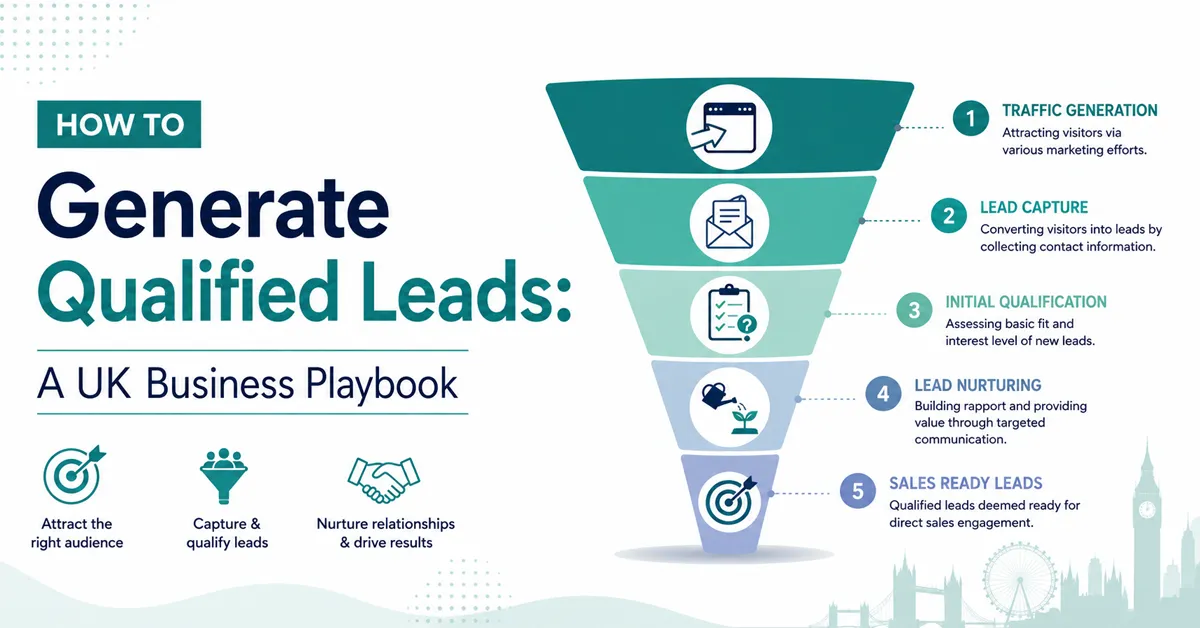
Most businesses don't have a lead problem. They have a qualification problem.
The pattern is familiar. The CRM fills up. Form submissions come in. Paid campaigns report conversions. Sales still says the leads are poor, follow-up gets patchy, and too much time goes into enquiries that were never likely to buy. That's where lead generation usually goes wrong. It focuses on activity, not commercial fit.
If you want to know how to generate qualified leads, stop thinking in terms of channels first. Build a system. That system needs four things working together: the right audience, the right acquisition channels, the right capture process, and a clear way to score and route enquiries. Without that, even decent traffic turns into wasted ad spend and sales friction.
For UK businesses, this matters even more. Compliance affects how you collect and nurture leads, buyer trust is harder won, and generic outreach is easier to ignore. A lead only has value if it can move through the funnel properly and end up as revenue.
A bloated pipeline is not a healthy pipeline.
A lot of SMEs keep asking how to get more enquiries when the better question is whether the current enquiries are worth paying for. UK businesses still over-focus on lead volume and under-answer the question of which leads are worth paying for. The ICO reported in 2024 that complaints about nuisance marketing remain a persistent issue, which underlines the point that better qualification is often more profitable than more traffic.
Most lead generation fails before a campaign even launches. The target audience is too broad, too vague, or based on assumptions. If your website says you work with “all businesses”, your marketing will attract all sorts of interest, including the kind that goes nowhere.
Your Ideal Customer Profile, or ICP, should work like a filter. For a UK business, that usually starts with practical firmographic questions:
Industry fit
Which sectors are commercially viable for you? Construction, finance, healthcare, legal, SaaS, local trades and professional services all behave differently.
Business size
Are you targeting owner-managed firms, growing SMEs, or larger organisations with a more layered buying process?
Location
Do you want leads from a specific city, region, or the whole UK? Geography affects logistics, sales coverage, service delivery, and search behaviour.
Decision-maker role
Who usually signs off? Founder, operations director, marketing manager, commercial lead, or office manager?
A useful ICP narrows the field. It doesn't try to please everyone.
Firmographics tell you whether an account looks right on paper. They don't tell you why someone would enquire.
That's where a buyer persona matters. Keep it grounded. You don't need a glossy document with invented personality traits. You need to understand:
Practical rule: if your targeting can't explain both who the buyer is and why they're searching now, it's not ready.
For example, a managing director at a regional construction firm might not want “better marketing”. They want steadier enquiries, less reliance on referrals, and fewer time-wasting quote requests. That changes your messaging, offer, landing page copy, and even the questions you ask on a form.
If you need a broader primer before tightening your criteria, this guide to what lead generation in marketing means is a useful starting point. It helps separate raw enquiry volume from a proper lead generation process.
Once the ICP exists, use it everywhere.
That includes:
The key is not to collect more names. It's to build a pipeline of prospects you can help, at a price point that makes sense, with a buying process you can close.
Once you know who counts as a good lead, channel choice gets easier. You're no longer asking where you can get clicks. You're asking where your best prospects show intent.
For most UK businesses, three inbound routes do the heavy lifting: SEO, paid ads, and content marketing. They don't do the same job, and treating them as interchangeable usually creates poor results.
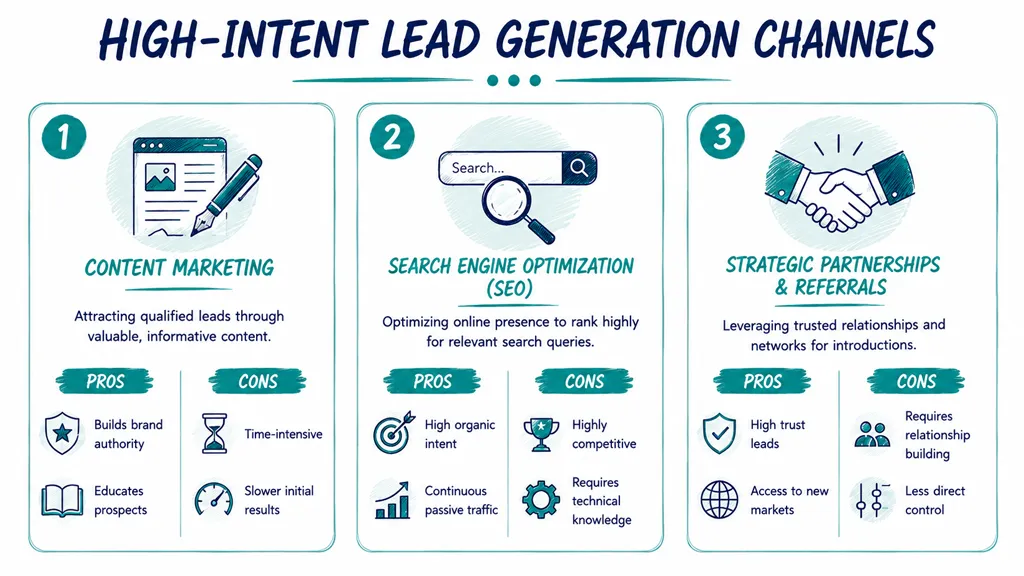
SEO is the channel that rewards patience and precision. If someone searches for a service with a clear commercial need, there's already intent in the query. You're not interrupting them. You're showing up at the moment they're trying to solve a problem.
That matters in the UK because search behaviour is integral to buying journeys, and Google remains dominant in the market. Strong SEO landing pages, tightly focused service pages, and useful content can pull in enquiries that are far closer to sales readiness than broad awareness campaigns.
SEO works best when:
Your service has active search demand
If buyers already search for what you do, SEO can become a reliable lead source.
You can commit to depth
Thin pages won't hold up in competitive sectors. You need clear service pages, supporting content, and solid on-page structure.
You want a long-term asset
Good rankings aren't instant, but they can reduce dependence on paid acquisition over time.
Paid search is often the quickest route to lead flow because it lets you target high-intent queries immediately. That's useful if you need pipeline now, are entering a new market, or want to validate demand before investing heavily in long-term SEO.
Paid social is different. It can work well for lead generation, especially when the offer is strong, but it usually captures demand earlier in the journey. That means your qualification process has to be tighter.
A simple comparison helps:
| Channel | Best for | Main strength | Main risk |
|---|---|---|---|
| SEO | Sustainable inbound demand | High-intent organic discovery | Slower to build |
| Google Ads | Fast commercial visibility | Immediate reach on active searches | Waste if search terms and landing pages are loose |
| Meta or LinkedIn ads | Demand creation and retargeting | Audience targeting and follow-up | Lower intent if the offer is generic |
If the keyword, ad, and landing page don't match the same buyer need, paid traffic gets expensive quickly.
Content is often treated as a soft brand activity. Done properly, it acts as a pre-qualification tool.
For UK businesses, content marketing generates around three times more leads than traditional outbound marketing while costing roughly 62% less. The practical reason is simple. Search-driven leads tend to arrive with stronger intent because they are actively seeking a solution.
Good content doesn't chase vanity traffic. It answers commercially relevant questions:
That content helps buyers self-select. It also makes later sales conversations easier because the lead arrives better informed.
Strategic partnerships, referrals, and outbound prospecting can still produce excellent leads, especially in niche sectors. They're often strongest when used to support an inbound system rather than replace it.
If your team is building outbound lists or refining account targeting, a review of best sales prospecting tools can help you tighten the process. The caveat is simple. Prospecting without a clear ICP and qualification model usually just creates more names, not more revenue.
Traffic is only valuable if your site turns intent into action.
A lot of businesses spend money getting visitors to a page that isn't built to convert. The message is vague, the form asks odd questions, the trust signals are weak, and the call to action feels like an afterthought. When that happens, even relevant traffic leaks away.
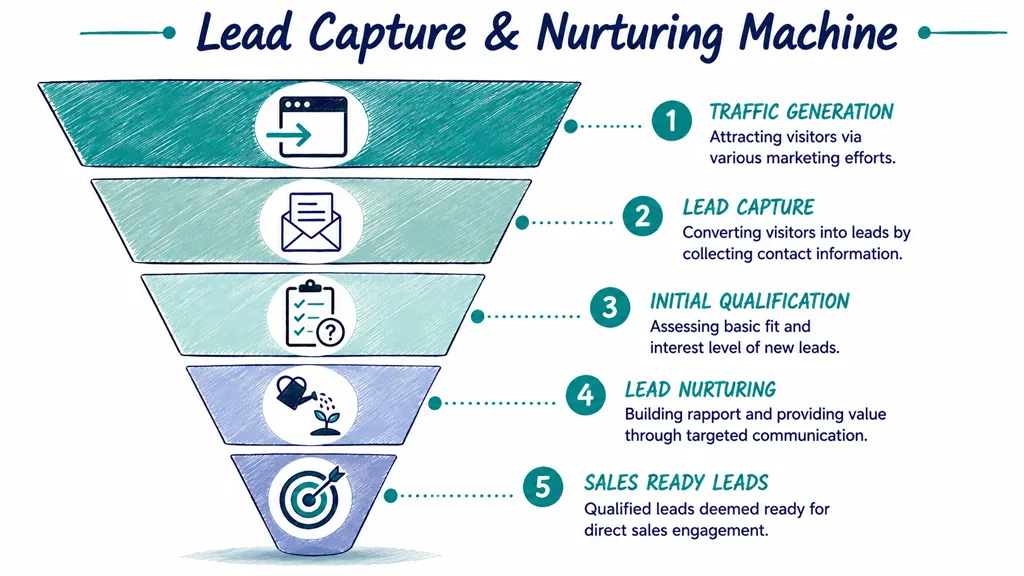
A strong landing page has one job. Make it easy for the right person to take the next step.
That usually means:
A clear headline
State what you do and who it is for. Clever wording rarely beats clarity.
A relevant offer
“Book a consultation”, “request a quote”, “get an audit”, or “speak to a specialist” all suit different buying stages.
Visible trust signals
Industry experience, sector relevance, testimonials, accreditations, or proof of process all help reduce friction.
A sensible form
Ask only for what you need to qualify and follow up properly.
A professionally built site matters here. Design isn't cosmetic. It affects trust, usability, page speed, mobile performance, and how easily people can understand your offer. If your website is cluttered or dated, some buyers will leave before they ever become a lead.
Lead forms shouldn't be treated like a bucket for email addresses. They should help filter quality.
Useful fields often include business name, role, service need, and a short message about the enquiry. In some sectors, budget range or project timeframe can be helpful too. The point is not to make forms long for the sake of it. The point is to capture enough context that sales can prioritise properly.
A short form can increase lead volume. It can also increase rubbish. The right form length depends on deal value and sales effort.
For businesses improving this process, these lead nurturing best practices are worth reviewing because form design and nurture logic should be built together, not separately.
This short walkthrough gives a useful visual overview of how a funnel should move from enquiry to sales-ready lead:
In the UK, compliance is not a side note. Under UK GDPR and PECR, lead generation workflows should treat consent capture as a technical requirement. A compliant form should separate marketing consent from terms acceptance and store a timestamped record, as outlined in this UK lead generation compliance guidance.
That means:
Separate consent from general acceptance
Don't roll everything into one checkbox.
Record what the user agreed to
You need a clear audit trail.
Only trigger nurture where appropriate
Marketing automation should respect consent status.
Not every good-fit lead is ready to buy on day one. That doesn't make them low quality. It means your follow-up needs structure.
Useful nurture sequences usually include educational emails, case studies, FAQs, service explanations, and timely prompts to re-engage. Email remains important in the UK because it continues to deliver strong returns when list quality and targeting are handled well. The businesses that get value from it don't blast the same message to everyone. They segment, personalise, and follow up with relevance.
At this stage, most of the wasted spend gets fixed.
A lead becomes commercially useful when you can judge two things consistently. Are they a fit for the business? And have they shown enough intent to justify sales time? If either part is missing, qualification becomes guesswork.
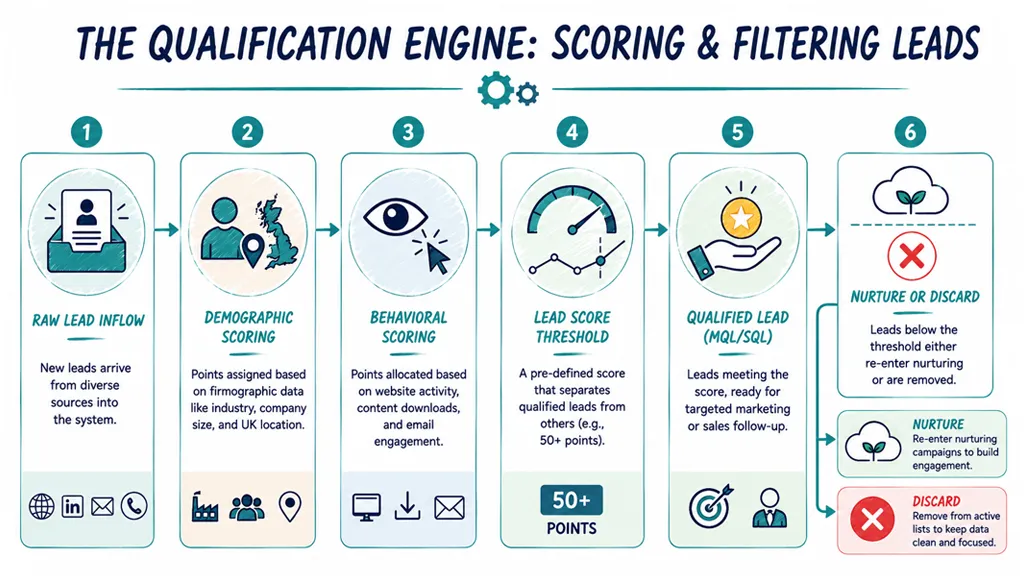
For UK B2B firms, effective qualification relies on a repeatable scoring model that combines firmographic fit with behavioural intent, rather than gut feel alone.
Think of it in two layers.
Fit signals tell you whether the business is the kind of account you want:
Intent signals tell you how serious they appear to be:
Weak engagement should not be overweighted. An email open on its own tells you very little. A pricing-page visit plus a detailed form submission tells you far more.
You don't need a complex CRM architecture to start. You need clear thresholds.
| Stage | Meaning | Typical signs |
|---|---|---|
| MQL | Good fit with early engagement | Relevant company, right role, some site interaction or content engagement |
| SQL | Good fit with buying intent | Strong enquiry, later-stage page views, clear project need, ready for contact |
An MQL is worth marketing attention. An SQL is worth prompt sales action.
Don't let sales decide qualification from scratch every time. Give them a system, then let them apply judgement inside it.
A basic points model works well for SMEs because it creates discipline without adding too much admin.
You might score things like this:
Firmographic match
Give positive weight to target sectors, UK-based businesses, relevant decision-makers, and company sizes you know you can serve well.
High-value actions
Add points for visiting service pages, requesting a consultation, or submitting a detailed enquiry.
Negative indicators
Reduce points for poor-fit roles, non-UK entities, vague messages, or free email domains where they suggest low business intent.
What matters is consistency, not complexity. Review scored leads against actual outcomes and adjust the model over time.
For a niche example outside mainstream B2B, these real estate lead qualification methods show the same underlying principle. Strong qualification systems combine context, behaviour, and next-step readiness rather than relying on one surface-level signal.
A qualified lead can still die in the gap between marketing and sales.
This is one of the most expensive breakdowns in the funnel because by the time a lead reaches SQL status, the acquisition cost has already been paid. If nobody follows up properly, or if the handoff lacks context, your marketing budget has done its job and the business still loses.
B2B data in the UK decays at around 30% per year, meaning almost one-third of contact data can become outdated annually. That is one reason handoff speed matters. Delays create missed calls, cold trails, and records that become less useful by the week.
A fast handoff process should include:
Automatic CRM assignment
The right salesperson or team gets the lead immediately.
Context with the notification
Include source, score, submitted form details, and the pages viewed before conversion.
A defined response window
If everyone assumes someone else will pick it up, nobody does.
Sales should not receive a name, an email address, and a vague message saying “interested in services”. They need the backstory.
That includes:
This changes the quality of the first conversation. Instead of asking generic discovery questions, sales can respond to an actual buying context.
The handoff isn't complete when sales receives the lead. It's complete when the outcome comes back into reporting.
That means every SQL should eventually be marked as accepted, rejected, progressed, or closed. Once you have that feedback, marketing can improve targeting, tighten forms, adjust scoring rules, and stop paying for low-value segments.
A business that measures only leads generated will keep repeating bad traffic decisions. A business that measures downstream quality gets sharper over time.
If you judge lead generation by raw volume, you'll optimise for the wrong thing.
A cheap lead isn't cheap if sales can't use it. A high lead count isn't a win if the pipeline doesn't convert. That's why the most useful reporting starts further down the funnel.
Focus on commercially meaningful KPIs such as:
Cost per MQL
This shows what it costs to generate leads that match your target profile and show early interest.
Cost per SQL
This is usually far more useful than basic cost per lead because it reflects quality, not just activity.
Lead-to-sale conversion rate
This shows whether your qualification and handoff process are working.
Source-to-revenue reporting
This tells you which channels contribute to pipeline and closed business.
A proper measurement framework should connect spend, lead quality, sales progression, and revenue. If you need a practical benchmark for doing that, this guide on digital marketing for lead generation is a helpful place to start.
Vanity metrics still mislead a lot of teams.
That includes:
The stronger approach is simple. Spend more where qualified leads become revenue. Cut what creates admin, noise, and false positives.
If you'd rather bring in outside expertise for some or all of this, our guide to lead generation services for UK businesses covers what's available and what it costs. And if your business fits a particular bracket, our guides to lead generation for small business and B2B lead generation strategy cover the more targeted approaches.
A qualified lead is usually a prospect that fits your target customer profile and has shown enough intent to justify follow-up. That means they are the right kind of business, the right sort of contact, and they have taken a meaningful action such as requesting a quote, asking for a consultation, or engaging in depth with a relevant service page.
It depends on timing and business model. SEO is often stronger for long-term, compounding demand capture. Paid ads are often better when you need faster visibility or want to test offers quickly. The strongest setup usually uses both, with SEO building durable inbound demand and paid campaigns filling short-term gaps or scaling proven offers.
Enough to filter obvious poor-fit enquiries, but not so many that you create unnecessary friction. Lower-value services often need shorter forms. Higher-value or more complex services usually benefit from extra qualifying detail.
If you want consistency, yes. You can start small, but without a CRM it becomes much harder to track source, score, follow-up status, and sales outcomes. That makes optimisation slower and more subjective.
Some improvements happen quickly. Better targeting, better forms, and faster handoff can lift quality early. SEO and content-led qualification take longer because they depend on asset building and search visibility. The key is to treat quality improvement as an ongoing system, not a one-off campaign tweak.
They buy traffic before defining what a good lead looks like. That usually creates a funnel full of noise, a frustrated sales team, and reporting that looks busy but says very little about revenue.
If your business is getting enquiries but too many of them are poor fit, slow to close, or wasting sales time, Gilkes Media can help you build a cleaner lead generation system. From SEO and paid ads to conversion-focused websites and practical marketing strategy, the focus is simple: attract the right prospects, qualify them properly, and turn marketing spend into measurable growth.
