You've probably seen this play out already. A campaign goes live, clicks start coming in, money leaves the account, and the phone stays quiet. Or leads arrive, but they're the wrong people, in the wrong place, asking for the wrong thing.
That's usually the moment small business owners decide one of two things. Either paid ads don't work, or the platforms are built to confuse them.
Neither is quite right. Paid ads for small business can work very well, but only when they're treated as a commercial system rather than a button you press for traffic. Google, Meta, and LinkedIn are distribution channels. They amplify what's already there. If the offer is weak, the targeting is lazy, the landing page is poor, or tracking is missing, they'll amplify waste just as efficiently as they amplify demand.
The core problem isn't usually the platform. It's the lack of a plan that connects spend to revenue.
A lot of small businesses start with the wrong question. They ask, “How much should I spend?” before they ask, “What am I trying to buy?” If the answer is vague, such as more visibility, more traffic, or getting our name out there, the campaign often drifts into vanity metrics. Clicks rise. Impressions look healthy. Revenue stays flat.
That's dangerous in the UK small business market because competition is far from niche. The government's Business Population Estimates for 2025 show 5.5 million private sector businesses in the UK, with 99.9% classed as small businesses and 5.44 million counted as SMEs. When that many firms are fighting for attention, broad, untargeted advertising isn't brave. It's inefficient.
Most weak campaigns break in the same places:
Practical rule: If you can't explain exactly what a campaign is supposed to produce, you won't know whether to keep it, fix it, or stop it.
There's also a management issue. Small businesses often run paid ads in bursts. They launch when sales slow down, panic when results wobble, then pause before the platform has enough stable data to guide decisions. Good paid media is disciplined. It needs enough structure to learn, but enough scrutiny to cut waste early.
Paid ads start performing when they follow a simple commercial logic:
That's the playbook. Not glamorous, but profitable.
Most wasted ad spend happens before the first click. It happens in the planning.
Small businesses often treat strategy as a luxury, something for larger firms with bigger teams and longer meetings. In practice, strategy is the cheapest part of paid advertising because it prevents expensive mistakes. A campaign built on a weak objective or vague customer profile can burn through budget very quickly.
Pick the result that matters most right now. Not five goals. One.
If you're a local service business, that might be qualified enquiries for a specific service. If you're in B2B, it may be booked discovery calls with a defined type of prospect. If you run e-commerce, the focus might be first-time purchases for a priority product line.
Good objectives are specific enough to guide decision-making. “More traffic” won't help you choose a platform, write an ad, or judge success. “Generate qualified leads for our commercial roofing service in Manchester” will.
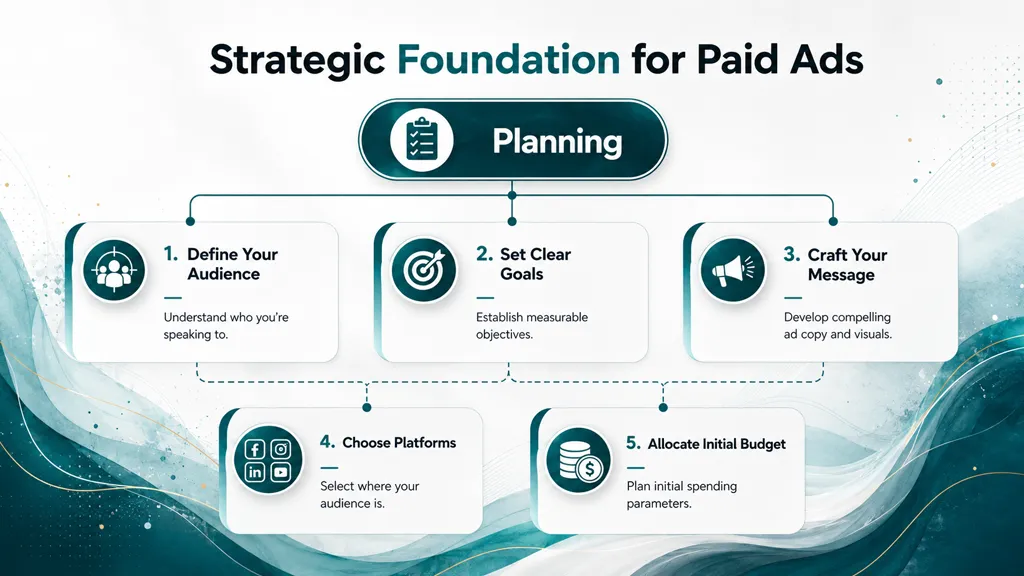
Most owners know their customers in broad terms. That isn't enough for paid media.
You need to know what they're worried about, what they compare you against, what language they use, and what would make them act now rather than later. A managing director looking for outsourced finance support doesn't search, click, and convert in the same way a homeowner looking for an emergency locksmith does.
Ask practical questions:
The ad account gets better when these answers get sharper.
A useful planning exercise is to map message by audience segment. One service, one audience, one landing page angle. That's far more effective than trying to speak to everyone with generic copy.
For a deeper framework on this, the article on how to create a marketing strategy is worth reading before any campaign goes live.
This short video also gives a useful overview of the thinking that should happen before launch.
A lot of paid ads read like internal company descriptions. Buyers don't care that you're passionate, trusted, or bespoke unless you translate that into something useful.
Write to the decision in front of them.
The best campaign structures usually start on a whiteboard, not inside the ad platform.
The right platform depends on buyer behaviour. That's the first filter.
If somebody is already searching for a service, Google is often the best place to capture that intent. If buyers don't yet know they need you, Meta can create demand and keep you visible. If the sale is high value, relationship-led, and tied to job role or sector, LinkedIn becomes far more relevant.
Digital advertising in the UK is already massive. According to the IAB UK / PwC Adspend study, internet advertising spend reached £35.5 billion in 2023, with search advertising at £16.9 billion and online display at £13.7 billion. Small businesses aren't experimenting in a fringe channel. They're operating in the main advertising market.
| Platform | Best For | Audience | Typical UK Cost |
|---|---|---|---|
| Google Ads | Capturing active intent and high-conviction searches | People already looking for a product or service | Varies by sector, keyword competition, geography, and account quality |
| Meta Ads | Building demand, retargeting, visual offers, local awareness | People who match interests, behaviours, or previous site engagement | Varies by audience quality, creative strength, objective, and competition |
| LinkedIn Ads | B2B lead generation, niche targeting by role, sector, or company type | Professional audiences, decision-makers, and specific business functions | Usually higher than broader social platforms, but often justified for high-value B2B offers |
If you're a UK service business with clear search demand, start with Google. Somebody searching for “accountant for contractors Leeds” or “commercial electrician Birmingham” is far closer to action than somebody idly scrolling a social feed.
If you sell a visually strong product or an offer people don't actively search for, Meta often earns its place. It's particularly useful for retargeting people who've visited your website, engaged with your content, or started considering options without enquiring.
LinkedIn deserves serious attention when deal values are high and the audience is narrow. For specialist B2B firms, the cost of getting in front of the right operations director, finance lead, or founder can be commercially sensible even when platform costs feel higher.
The common mistake is trying to be on all three at once. That usually weakens data, creative, budget, and management focus.
Pick the platform that matches the shortest path to revenue. Then earn the right to expand.
For businesses starting with search-led demand, this guide to Google Ads for small business is a useful next step.
Start where buyer intent is clearest. Expansion is easier than rescue.
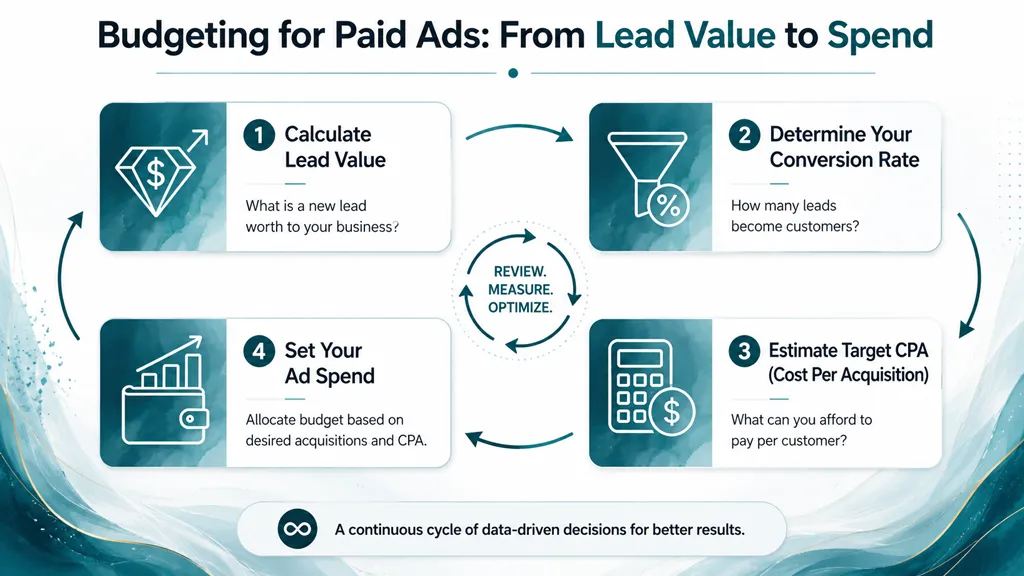
The budget question is usually framed badly. It shouldn't be “What's the minimum I can spend?” It should be “What can I afford to pay for a customer, and what does that mean for lead cost?”
That shift changes everything. It turns paid ads from a gamble into a buying model.
Start with the commercial basics. What is a new customer worth to your business, either immediately or over a sensible customer lifetime? Then ask what proportion of qualified leads usually become customers. Once you know those two things, you can set an acceptable cost per lead range.
For example, if a customer is worth a healthy amount to the business and your sales process converts well, you can tolerate a higher cost per lead than a business with small margins and low close rates. That sounds obvious, but many campaigns ignore it and choose a budget based on comfort rather than maths.
Account structure matters because it creates control. If everything is bundled together, you can't tell what's driving results.
A clean setup usually separates campaigns by meaningful business lines, such as:
This doesn't mean making the account complicated. It means making performance visible.
The first is setting one monthly budget and hoping the platform finds efficiency on its own. Platforms can automate a lot, but they still need strong inputs, clear conversion signals, and human judgement.
The second is scaling too broadly. If one ad group, audience, or location is working, expand around that success. Don't increase spend across everything and assume the result will hold.
A realistic paid ads plan for small business is usually narrower than people expect. Fewer campaigns. Tighter geography. More discipline. Better visibility into where profit is coming from.
A paid ad is a promise. The landing page has to keep it.
Many campaigns break here. The ad speaks directly to a problem, the user clicks with intent, and then lands on a generic homepage with too many menu options, weak copy, and no obvious next step. The click wasn't wasted because the platform failed. It was wasted because the journey broke.
Think about the user journey in plain terms.
A business owner sees an ad for outsourced HR support aimed at growing companies. The ad talks about reducing admin pressure and getting practical advice without building an in-house team. They click. If the page they land on opens with a vague agency slogan and a long list of unrelated services, confidence drops immediately.
That's why message match matters. The headline on the landing page should continue the conversation the ad started. The offer should be the same. The call to action should feel like the next logical step, not a hard turn into something else.

A landing page doesn't need to be clever. It needs to remove friction.
Focus on the essentials:
A homepage usually tries to do too many jobs. A landing page should do one.
There's also a commercial point many firms miss. Improving the page often lifts campaign performance more reliably than endlessly rewriting ads. Better pages help every click work harder. That's why conversion-focused web design isn't separate from paid media. It's part of paid media.
If your ads are sending traffic to pages that were never built to convert, the account is carrying a problem the website created.
Running paid ads without tracking is expensive guesswork. You might get lucky for a while, but you won't know why results improved, why they dropped, or which changes mattered.
Many small businesses often misunderstand the situation. They look inside the ad platform, see clicks and impressions, and assume the campaign is healthy. However, the key question is simpler. Did the ads generate profitable actions?
At minimum, you need to record the actions that matter commercially. For most small businesses, that means form submissions, phone calls, booked meetings, purchases, or qualified lead events. A pixel or tag is just the mechanism that helps platforms and analytics tools recognise those actions.
If somebody clicks an ad, visits a page, and then submits an enquiry, that event should be visible. If a campaign is generating a lot of visits but no meaningful business action, you need to see that quickly.
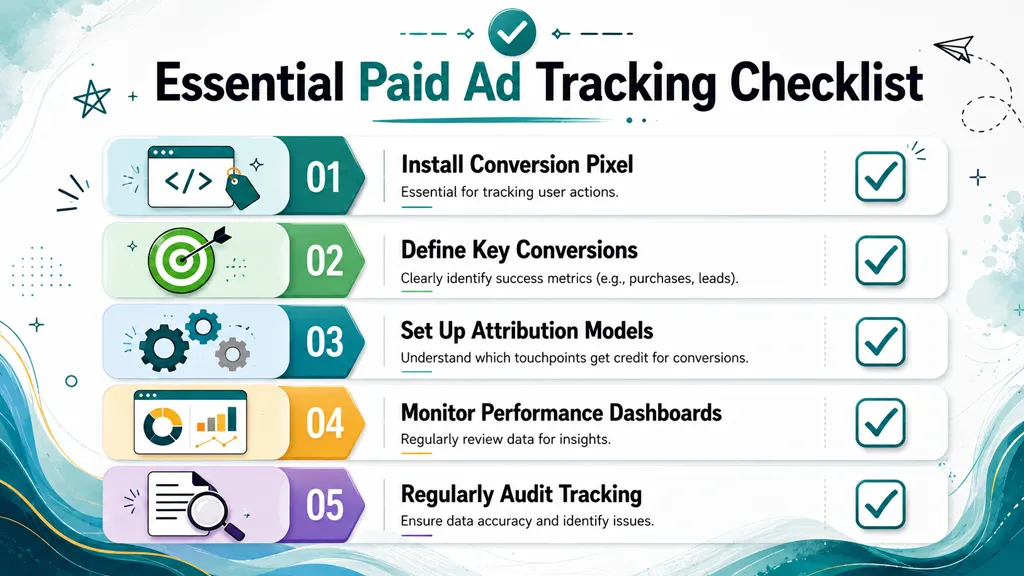
Google's own guidance and specialist PPC practice both point to the same principle. Set a tightly defined objective, track conversions from day one, and test before you scale. Specialist PPC guidance also recommends reserving 10–20% of spend for testing and reviewing performance weekly. That testing only means something if the data is dependable.
Without stable tracking:
That's why setup work matters so much. GA4, Google Tag Manager, platform pixels, call tracking where relevant, and sensible UTM usage all create visibility. None of that is exciting. All of it is necessary.
Attribution sounds more complicated than it needs to be. You're trying to understand which touchpoints contributed to the enquiry or sale.
A prospect might find you through a Google search, come back later through a remarketing ad, and convert after a direct visit. If you ignore that path, you may cut a channel that's assisting profitable outcomes.
The point isn't to chase perfect attribution. Most small businesses don't need that. They need reliable enough attribution to make sensible budget decisions.
If you want to tighten this up commercially, this guide on cost per acquisition and how to lower it is a strong starting point.
If conversion tracking isn't stable, every optimisation decision sits on weak evidence.
Paid ads can start generating traffic quickly, but useful performance data takes longer than a few days of activity. The early period is for validation. You're checking whether the offer resonates, whether the targeting is tight enough, whether the landing page converts, and whether tracking is accurate.
For small businesses, the better question is not “How fast can I get clicks?” It's “How fast can I get reliable signal?” That depends on budget, demand, sales cycle, and how cleanly the campaign is set up.
If your service has clear existing demand, you can often learn quickly. If you're asking a colder audience to engage with a more considered offer, expect a slower path to confidence.
You can run them yourself if you're prepared to learn the platforms, install proper tracking, review search terms, write decent copy, and make disciplined decisions. The problem isn't access. It's management quality.
A lot of owner-managed campaigns fail because they get checked only when something goes wrong. Paid media usually needs regular attention, especially in the early stage. Search queries drift. ads fatigue. Landing pages underperform. Conversion issues appear after website changes.
A sensible middle ground is to keep strategic ownership in-house but get specialist help with setup, tracking, and initial structure. That avoids expensive beginner errors while keeping commercial control with the business.
There isn't a universal answer. A good cost per lead is one that allows you to acquire profitable customers after sales conversion, fulfilment costs, and overhead are considered.
That means two businesses in the same town can have very different acceptable lead costs. One may close leads efficiently and deliver a high-value service. Another may have lower margins, weaker conversion rates, or a longer sales process. Judging both by the same lead cost would be misleading.
The right benchmark is internal. Work backwards from customer value and close rate, then decide what a lead can be worth to you.
A useful weekly routine keeps campaigns under control without turning management into overreaction.
Check:
Monthly reviews should be less tactical and more commercial.
Look at:
Paid ads for small business aren't hard because the tools are impossible. They're hard because they force clarity. Weak offers get exposed. Vague positioning gets exposed. Poor websites get exposed. That's frustrating, but it's useful. Once those issues are fixed, the platforms become much more predictable.
If you want a clearer route from ad spend to qualified enquiries, Gilkes Media helps UK businesses build paid ad strategies around commercial outcomes, not vanity metrics. That includes campaign planning, Google Ads and paid social management, SEO support to strengthen long-term visibility, and conversion-focused websites that turn paid traffic into real opportunities.
