
If you are running a small business in the UK, it is easy to see marketing as just another expense. But Google Ads is not like other marketing channels. It is a direct investment in a predictable growth engine.
Why? Because it puts your business in front of high-intent customers who are actively searching for your products or services right now. This is not about interrupting people on social media; it is about being the answer they are already looking for.

Many business owners treat marketing as a cost centre. Paid search advertising, however, is fundamentally different. You are not trying to create demand; you are there to meet it at the exact moment a customer has a problem to solve.
This is the key. When a homeowner in Manchester searches for an "emergency plumber near me," or a founder in London looks for "small business accounting software," they have a clear and immediate need. Google Ads places your business directly in their path at that critical decision-making moment.
The economic impact here in the UK is significant. Google Search and Ads are responsible for an incredible £118 billion in economic activity, supporting over 1 million businesses. For SMEs, it is a gateway to local, national, and even global markets, helping UK businesses export over £20 billion in goods and services each year.
To help you connect the platform's features to real-world business outcomes, here is a quick breakdown:
| Key Feature | What This Means for Your Business |
|---|---|
| Intent-Based Targeting | You reach customers who are actively looking for a solution, not just browsing. This means higher quality leads from day one. |
| Local Search Dominance | You can pinpoint specific towns, cities, or postcodes, ensuring your budget is spent attracting customers in your service area. |
| Measurable Performance | Every click, call, and form submission can be tracked. You know exactly what your Return on Ad Spend (ROAS) is. |
| Total Budget Control | You set your daily and monthly limits. There are no surprise bills, giving you predictable and scalable marketing spend. |
This table shows how Google Ads is not just about getting clicks; it is about building a system that drives tangible results for your business.
To succeed with Google Ads, you have to shift your mindset from seeing it as an expense to seeing it as an investment. A well-managed account is a scalable and predictable engine for generating leads and sales.
Think about the commercial realities:
At Gilkes Media, we build paid search campaigns with one goal in mind: delivering a tangible commercial return. Your ad budget is not a speculative spend; it is a direct investment in acquiring customers and growing your bottom line.
By focusing on the right keywords, compelling ad copy, and a frictionless user experience, your business can turn search queries into profitable customer relationships. We specialise in creating and managing these kinds of high-performance paid search ads.
Successful Google Ads campaigns are won long before you spend your first pound. The single biggest mistake I see small businesses make is rushing onto the platform without a clear plan, which almost always leads to a wasted budget and frustration.
Getting this initial planning phase right is the most important part of the entire process. Think of it like building a house. You would not start ordering bricks and windows without detailed architectural plans. Your campaign is no different. It needs a solid foundation built on clear goals, a sensible budget, and a real understanding of your customers and competitors.
The very first question I ask any new client is simple: "What does success actually look like for your business?" The answer cannot be a vague goal like "more traffic." It needs to be a specific, measurable outcome that directly contributes to your bottom line.
For most small businesses using Google Ads, your main objective will fall into one of these buckets:
Your objective dictates every single decision you will make, from the keywords you target to the ad copy you write. A campaign designed to generate £20 e-commerce sales looks completely different to one built to capture a £5,000 consulting lead. Get this right, and you are already miles ahead of the competition.
“How much should I spend?” is the million-pound question. But the answer is not about picking a number out of thin air. Instead, let's work backwards from your goals.
Here is a simple framework to follow:
For example, if you know a new customer is worth £1,000 in profit, you might decide you are happy to pay up to £200 to acquire them. To get 10 new customers a month, your target ad spend would be £2,000. Your starting budget is for testing that assumption. Once you prove you can get customers profitably, you can scale your investment with confidence.
Keyword research is not just about finding popular search terms; it is about understanding buyer intent. You need to find the exact phrases people type into Google when they are ready to make a decision, not just when they are looking for information.
Think in terms of commercial intent:
| Intent Level | Example Keyword | Searcher's Mindset |
|---|---|---|
| Low (Informational) | "how to fix a leaky tap" | "I am looking for DIY info. I am not ready to hire anyone yet." |
| Medium (Consideration) | "best plumbers in Bristol" | "I am researching my options and comparing different companies." |
| High (Transactional) | "emergency plumber Bristol cost" | "I have a problem right now and need to hire someone. I am ready to act." |
While informational keywords are great for blog content, your Google Ads budget should be laser-focused on medium and high-intent keywords. These are the search terms that actually deliver leads and sales. Use tools like Google's Keyword Planner, but always apply this commercial filter to every term you consider.
Finally, you need to know who you are up against. Who is already bidding on your most valuable keywords? What are they saying in their ads? And what happens after you click?
You can do this ethically just by searching for your main keywords on Google and taking notes.
This is not about copying your rivals. It is about spotting gaps in the market. If everyone else is shouting about "low prices," maybe you can win by focusing on "expert service" or "24/7 availability." This foundational work ensures your campaign is built for profitability from day one.
With your strategy sorted, it is time to build your first campaign. This is where theory meets execution, and it is the point where most small businesses either win or lose. We will focus on building a tightly structured campaign that is geared for performance from day one, avoiding the common mistakes that burn through your budget.
Getting this initial setup right is non-negotiable. A messy campaign structure is like building a house on a shaky foundation. It is guaranteed to crumble, costing you money and delivering poor results. Let’s build it properly from the start.
Google gives you many options, but for a small business wanting direct leads or sales, the choice really boils down to two: Search and Performance Max (PMax).
My advice for new advertisers is almost always the same: start with a Search campaign. It gives you the control you need to test your keywords, ads, and landing pages methodically. Once you have a profitable Search campaign running and generating at least 30-50 conversions a month, then you can think about adding a Performance Max campaign to scale up.
The real secret to a high-performing Search campaign lies in its structure, specifically, your ad groups. An ad group is simply a container for a set of related keywords and the ads they trigger. The single biggest mistake I see is people throwing hundreds of different keywords into one giant ad group.
Do not do that. Instead, you need to create small, tightly-themed ad groups. Each one should focus on a single, specific theme, product, or service.
For instance, a construction company in Manchester should not have one ad group for everything. A much better structure looks like this:
This structure guarantees your ads are hyper-relevant to what someone is searching for. This boosts your Quality Score, which in turn lowers your costs and improves your click-through rate (CTR).
One of the most powerful tools for a small business in Google Ads is controlling exactly where your ads show up. Do not just target the "United Kingdom" or even a whole city if you only serve specific postcodes.
You can get incredibly specific, targeting by:
And here is a critical tip: under ‘Location options’, always select "Presence: People in or regularly in your targeted locations". This stops your ads from showing to people who are just interested in Manchester but are not actually there. This one setting alone will save you a huge amount of wasted ad spend.
This flowchart shows the foundational process for setting up a campaign: starting with clear objectives, a defined budget, and targeted keywords.
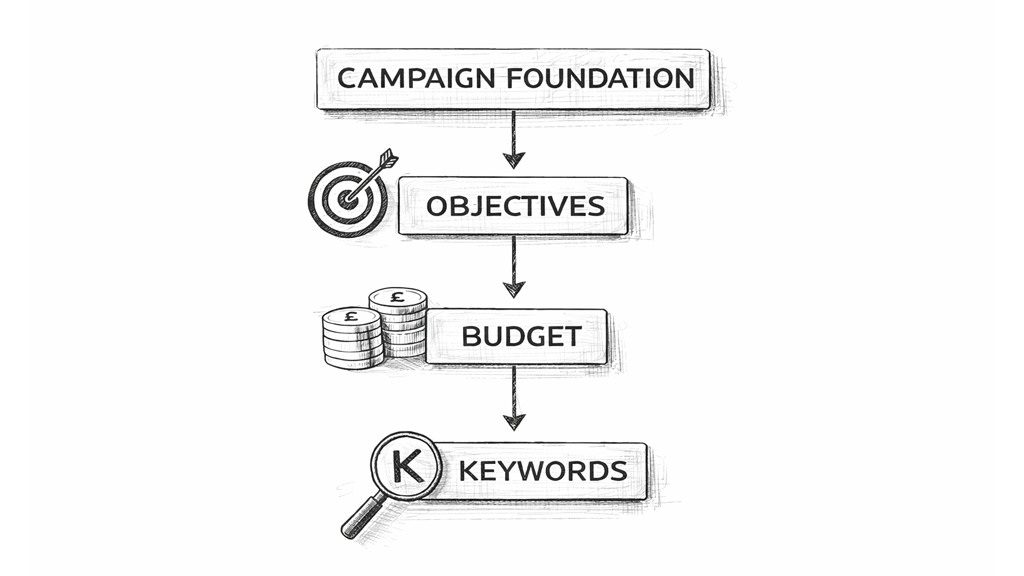
This visual reinforces that successful campaigns are built in a logical sequence. Each step builds on the last, ensuring you have a solid structure from the ground up.
Your ad is your three-line elevator pitch to a potential customer. It needs to be sharp, persuasive, and speak directly to their problem.
A great ad always does three things:
Let’s say you are a financial advisor targeting "retirement planning advice". A strong ad would say something like: "Expert Retirement Planning Advice. Secure Your Future With a Free Consultation. Plan Your Retirement With Confidence. Call Us Today."
Understanding industry benchmarks is also vital for running a profitable campaign. Small to mid-sized businesses are investing heavily in PPC, with many spending £7,500 to £8,300 monthly. This is because UK-specific data shows paid search delivers a 200% average ROI. For sectors like business services, click-through rates (CTRs) hold strong at around 4-6%.
The process of managing these campaigns is detailed and demands specialist knowledge. If you are curious about how we handle this day-to-day, you might find our approach to PPC management for small businesses insightful. By launching with this level of expertise from the very beginning, you are setting your campaign up for success, not just survival.
Spending money on Google Ads without measuring the return is like flying a plane blind. You feel the engine running, but you have no idea if you are heading towards your destination or a mountainside. This is where we switch on the instruments.
We will translate confusing platform metrics into the language of business growth: profit and Return on Investment (ROI). The goal here is simple: accountability. Every pound you invest must be held responsible for delivering a tangible result.
First things first: you absolutely must set up conversion tracking. A conversion is any valuable action a user takes after clicking your ad. Without this, you are just paying for website traffic, not business outcomes.
For most small businesses, the conversions that matter are:
A fundamental part of accurate measurement is installing the relevant tracking code in Google Analytics. This snippet is what connects your website activity back to your ad campaigns, letting you see exactly which keywords, ads, and audiences are driving results.
Do not skip this. Without accurate conversion tracking, you cannot calculate your cost per lead, your return on ad spend, or make any intelligent decisions about your budget. It is the single most important technical element of a profitable Google Ads account.
Once tracking is live, you can finally ignore the vanity metrics and focus on the Key Performance Indicators (KPIs) that directly impact your bottom line. These are the numbers you should be watching closely.
To make sense of your dashboard, it is crucial to understand what each key metric tells you about your financial performance. This table breaks down the most important KPIs and why they are so vital for measuring your marketing ROI.
| Metric (KPI) | What It Measures | Why It Matters to Your Business |
|---|---|---|
| Cost Per Conversion | The average cost to generate one lead or sale from your ad spend. | This is your Cost Per Lead (CPL) or Cost Per Acquisition (CPA). It tells you if you are acquiring customers at a profitable price. |
| Conversion Rate | The percentage of ad clicks that result in a conversion. | A low conversion rate often signals a problem with your landing page or a mismatch between your ad and your offer. Fixing it can dramatically improve ROI. |
| Return On Ad Spend (ROAS) | The total revenue generated for every pound spent on advertising. | This is the ultimate measure of profitability. A ROAS of 5:1 means you are generating £5 in revenue for every £1 you spend. |
Focusing on these KPIs shifts the conversation from clicks and impressions to profit and loss. To go even deeper, you can learn more about how to measure marketing ROI in our dedicated guide.
Knowing what ‘good’ looks like gives you crucial context. It is important to remember that performance varies wildly by industry, but understanding general benchmarks helps set realistic expectations for your campaigns.
Recent data shows just how much customers rely on Google Ads. A whopping 80% of people trust PPC ads, with 63% having clicked on them. In the UK, Google's dominant 93.51% search market share means your ads can reach almost everyone actively looking for a solution.
As you analyse your own data, keep an eye on average benchmarks. Across all industries, we typically see a click-through rate (CTR) of around 6.11% and a conversion rate averaging 7.04% for Google Search ads.
These numbers are not just trivia; they show that users trust and act on ads, making Google a primary acquisition channel for competitive small businesses. By setting up tracking correctly and focusing on the right KPIs, you can finally make decisions based on real performance data, holding your marketing spend accountable and ensuring it drives genuine business growth.
Part of optimising a campaign is protecting the budget you already have. If your cost per lead keeps drifting up for no obvious reason, it is worth ruling out click fraud before assuming your targeting or offer has stopped working.
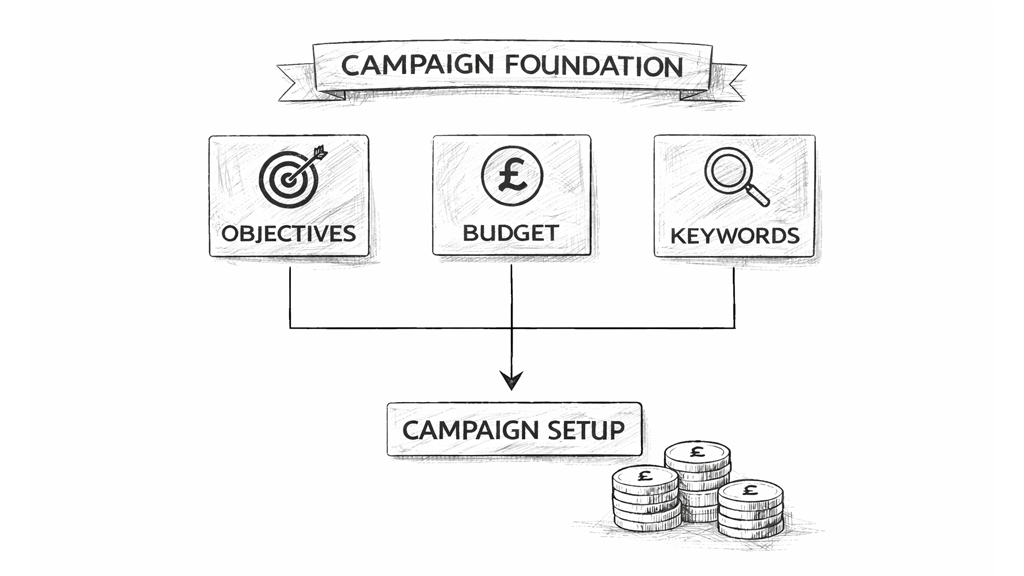
Launching your Google Ads campaign is not the finish line; it is the starting block. The real profit is not found in the initial setup but in the disciplined, intelligent optimisation that follows.
This is where stagnant accounts get left behind and where smart businesses build a true growth engine. A great campaign is a living thing, and it needs consistent attention to trim waste, double down on what works, and adapt to performance data.
One of the most powerful and underused optimisation tasks is reviewing the Search Term Report. This report is a goldmine. It shows you the exact search queries people typed into Google just before clicking your ad.
Your job here is to hunt for and exclude irrelevant searches by adding them as negative keywords.
Aggressively curating your negative keyword list every week is non-negotiable. It is the fastest way to slash wasted spend and improve the quality of your traffic, which directly lowers your cost per lead.
Your ad copy is your frontline salesperson. But even the best-written ad has room for improvement, which is why you should always be A/B testing. The principle is simple: run two slightly different ads against each other and let the data decide which one performs better.
You can test any element, but the big ones are:
The goal is to find winning messages that systematically improve your click-through rate (CTR) and conversion rate. A tiny uplift in these metrics can have a huge impact on your overall ROI.
A campaign that is not being actively A/B tested is a campaign that is leaking profit. Constant testing allows you to systematically improve performance, letting the data tell you what your customers truly respond to.
Your optimisation work does not stop at the ad. The user’s journey after they click is just as critical. Your landing page is where the conversion happens, and for many small businesses, it is the weakest link in the entire chain.
A few simple tweaks here can dramatically improve your results:
Improving your conversion rate from 1% to 2% literally doubles the number of leads you get for the exact same ad spend. It is one of the highest-impact optimisations you can make.
Once you have a campaign that is consistently delivering leads or sales at a cost you are happy with, it is time to scale. But scaling is not just about throwing more money at it; it is about growing your reach without destroying your efficiency.
This means looking beyond day-to-day metrics and focusing on what truly matters for business health. Understanding your LTV:CAC ratio for profitable ad spend is vital here, as it helps you determine how much you can afford to acquire a customer while staying profitable long-term.
With a proven formula, you can start to:
This entire optimisation workflow, from refining keywords to scaling budgets, is the engine of sustained growth. It turns your initial investment into a predictable and highly profitable customer acquisition machine.
Every founder managing their own Google Ads eventually hits a wall. What started as a smart way to get leads becomes a time-consuming, complex task that pulls you away from running your actual business.
It is a classic case of opportunity cost. Is your time really best spent trying to master the latest Performance Max updates, or is it better invested in sales, strategy, and leading your team?
For many, DIY management is the right way to begin. But there is always a tipping point where it stops being effective and starts holding you back.
Recognising that moment is not an admission of failure. It is a strategic move. It is the point where you decide to treat Google Ads like a professional growth channel, not a DIY hobby.
Here are the signs I see time and again that tell you it is time to bring in a specialist:
The real value of hiring a specialist is not just about saving you time. It is about gaining a strategic partner who brings senior-level experience, holds your budget accountable, and is relentlessly focused on your commercial outcomes. It is the difference between just running ads and building a predictable customer acquisition engine.
Partnering with a consultant like Gilkes Media means you are not paying for bloated agency overheads. You get direct access to a hands-on practitioner who is personally accountable for your performance.
If you recognise your business in the signs above, it is time to get a dedicated expert in your corner. Let’s turn Google Ads from a time-suck into your most reliable driver of growth.
Google Ads is rarely run in isolation. Our wider guide to paid ads for small business covers how it fits alongside other platforms, and if you're selling to other businesses specifically, our guide to B2B PPC advertising covers the differences in approach.
Over the years, I have heard the same questions from almost every business owner thinking about Google Ads. Here are the straight answers you are looking for, based on my experience managing millions in ad spend.
There is no magic number, but a sensible starting point for most small businesses is somewhere between £500 and £1,500 per month.
The real answer, though, is not about picking a number out of thin air. It is about working backwards from what a new customer is worth to you. If a new client brings in £1,000 in profit, and you would happily pay £200 to get them, that is your target. You have a clear goal.
Start with a budget you can afford to test with. The goal is to prove the model works, get a return, and then you can scale up with confidence, knowing every pound you put in will bring more back out.
You will see traffic and clicks almost immediately, often within hours of your campaign going live. But let's be clear: clicks are not results.
Meaningful business results, like a steady stream of profitable leads, typically take one to three months to lock in. This initial period is not about instant profit; it is about gathering data, learning what works, trimming waste, and refining your targeting. Patience is key.
Yes. Unequivocally.
Google Ads is not just a bidding war. The platform is designed to reward relevance, not just the deepest pockets.
Your Ad Rank, which determines where your ad appears, is a mix of your bid and your Quality Score. A smaller business with a hyper-relevant, smartly structured campaign targeting a specific niche can absolutely outperform a huge competitor with a lazy, high-spending strategy. Smart management is the great equaliser.
If you're ready to move beyond theory and build a predictable growth engine with paid ads, Gilkes Media offers the senior-level expertise and hands-on management to make it happen. Let's discuss your goals in a free, no-obligation strategy call.
