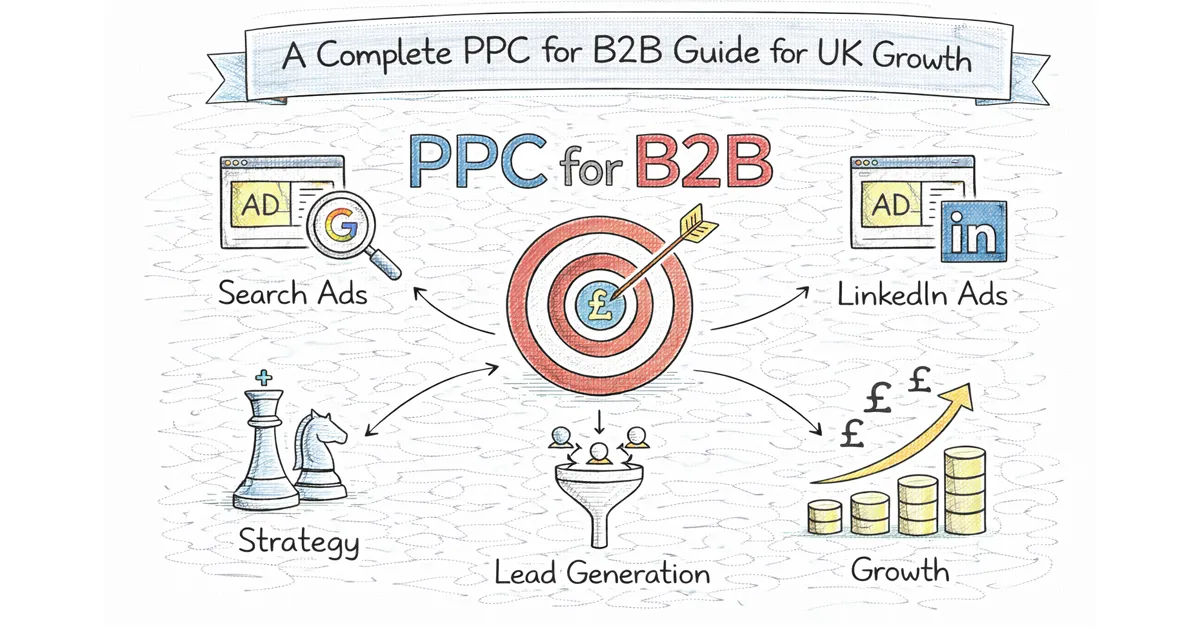
At its heart, PPC for B2B is a direct and measurable way to win high-value clients. It works by placing laser-focused ads on platforms like Google and LinkedIn where your ideal customers are already active. This is a move away from ‘hope-based’ marketing, giving you the power to pay for visibility right in front of decision-makers who are either actively hunting for solutions or fit a precise professional profile. The goal is simple: generate qualified leads that turn into real revenue.
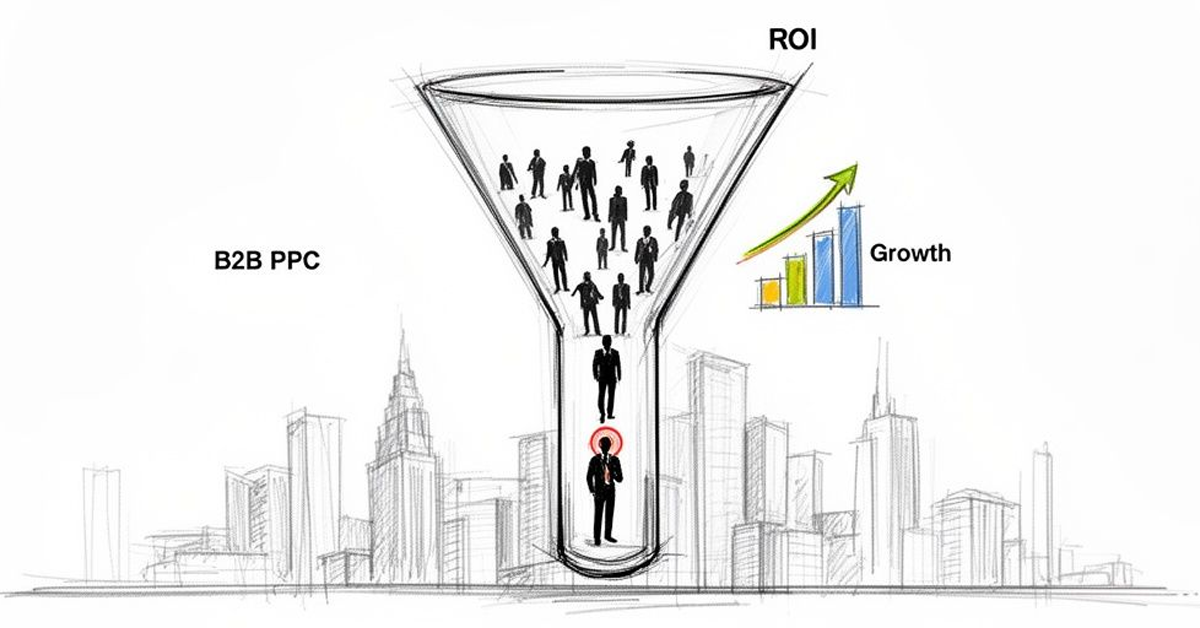
As a consultant who works directly with founders and leadership teams, I hear the same hesitation around pay-per-click (PPC) advertising all the time. The concerns are completely valid. Stories of torched ad budgets and a constant stream of tyre-kickers are far too common. But when it’s executed with strategic precision, PPC for B2B firms is not just another marketing channel; it’s a powerful and predictable engine for growth.
The key is to reframe your thinking. PPC is not about buying traffic. It is about buying access to your ideal customers at the exact moment they have a commercial need. This is a fundamental shift from other marketing activities that aim to build awareness over time. PPC delivers immediacy and, most importantly, hard data.
Unlike B2C advertising, which often chases impulsive buys, B2B campaigns operate in a much more complex world. There are a few core differences you have to get right:
This complexity is exactly why a hands-on, strategic approach is non-negotiable. A well-run B2B PPC campaign can bypass gatekeepers and put your solution directly in front of the people with real buying power.
At its core, B2B PPC is a tool for starting valuable conversations. It allows you to systematically generate interest from companies that fit your ideal customer profile, turning marketing spend into predictable sales opportunities.
The data speaks for itself. In the UK, a remarkable 67% of B2B marketers now see PPC as absolutely crucial for generating leads. This is backed up by the fact that 65% of all high-intent searches result in a click on a paid ad, proving just how powerful PPC is for capturing decision-makers when they’re ready to talk business. You can dive deeper into these figures and other digital marketing statistics from Koozai to see the bigger picture.
This ability to intercept active buyers is what makes PPC for B2B so effective. While SEO builds long-term authority, PPC delivers immediate visibility for commercial keywords that signal a clear intent to purchase. Think searches like "enterprise CRM solutions" or "commercial cybersecurity audit".
If you ignore paid search, you are willingly letting these high-value prospects walk straight to your competitors. My role is to make sure your investment targets these critical moments, turning clicks into clients and ad spend into measurable ROI.
Not all PPC platforms are created equal, especially in the B2B space. Your success depends on choosing the right channel for the right type of intent. Here’s a quick breakdown of where your budget is best spent.
| Platform | Primary Use Case | Best For |
|---|---|---|
| Google Ads | Capturing Active Buying Intent | High-intent keywords where prospects are actively searching for a solution. |
| LinkedIn Ads | Precise Professional Targeting | Reaching specific job titles, industries, and company sizes with account-based marketing (ABM). |
| Meta (Facebook & Instagram) | Building Awareness & Retargeting | Reaching audiences based on interests and behaviours; excellent for retargeting website visitors. |
| Microsoft Advertising (Bing) | Reaching an Older, Professional Audience | Similar to Google but often with less competition and lower CPCs. Strong in desktop and specific industries like finance. |
The most effective B2B strategies rarely rely on a single platform. Instead, they blend the intent-driven power of Google with the hyper-specific targeting of LinkedIn, creating a full-funnel system that captures and nurtures leads from first touch to final sale.
Successful PPC for B2B is decided long before you ever launch a single ad. Many businesses fall into the trap of diving straight into Google Ads, picking a few keywords they think will work, and hoping for the best. It’s a sure-fire recipe for a torched budget and a list of low-quality leads.
As a consultant, the first thing I do is establish a solid strategic foundation. This is the unsexy but critical work that ensures every pound you spend is targeted, accountable, and tied to a genuine business outcome. It is about moving past vague goals like ‘getting more traffic’ and defining specific, commercially-driven targets.
Your PPC campaign should never operate in a marketing silo. It must be directly connected to a commercial goal. Before we even think about keywords or ad copy, we must answer the most important question: what business result are we actually trying to achieve?
Generic objectives are the enemy of effective PPC. Forget "generating leads". We need to get specific. A strong B2B PPC objective sounds more like this:
These goals are specific, measurable, and time-bound. They give us clear targets to build the entire campaign around and a proper benchmark to measure success against. Without this clarity, you are just spending money in the dark.
Next, we need to define exactly who we are talking to. In B2B, you are not selling to a broad demographic; you are selling to a specific professional working within a specific type of company. This is your Ideal Customer Profile (ICP).
A weak ICP is the number one cause of poor lead quality. A strong one, on the other hand, is built on two key pillars:
A detailed ICP acts as a compass for your entire campaign. It dictates your keyword choices, ad messaging, and even platform selection, ensuring your budget is focused exclusively on prospects who can actually become high-value clients.
If construction is your specific focus, our guide to lead generation for construction firms goes into the sector-specific detail.
With a clear objective and a sharp ICP, we can finally turn our attention to keyword research. This is not just about finding high-volume search terms; it is about identifying the exact phrases your ideal buyer uses when they have a commercial problem they need to solve.
My entire approach is built on buyer intent. We need to know the difference between different types of searches:
While informational content has its place in a broader strategy, your core PPC budget must be aimed at commercial and transactional keywords. These high-intent phrases attract prospects who are much further down the buying funnel and closer to making a decision. This is where you will find the most valuable clicks.
This laser-focus on high-intent search is precisely why UK businesses are investing so heavily in paid search. A huge 76% now allocate more than half of their digital ad spend to Google Ads. While paid search might only drive around 10% of total website traffic, its real power lies in capturing users who are actively looking for solutions right now. You can explore more B2B PPC statistics from Lever Digital to get a fuller picture of its market dominance.
Finally, let's talk about money. A common mistake is to either underfund a campaign, starving it of the data it needs to get off the ground, or to overcommit a massive budget without any plan for managing risk. I always advocate for a tiered budget strategy.
| Tier | Monthly Budget (Example) | Objective |
|---|---|---|
| Tier 1: Data & Testing | £1,500 - £3,000 | Gather initial performance data, test keywords and ad concepts, and establish a baseline CPL. |
| Tier 2: Optimisation & Scaling | £3,000 - £7,500 | Scale spend on proven winners, cut out waste, and optimise landing pages to improve conversion rates. |
| Tier 3: Growth & Expansion | £7,500+ | Aggressively expand successful campaigns, test new channels (like LinkedIn), and maximise market share. |
This structured approach lets you start smart, prove the model with a controlled investment, and then scale your spending with confidence once you have data-backed evidence of what actually works. It turns your PPC budget from a risky expense into a strategic investment in predictable growth.
With your strategy locked down, it’s time to move into the practical side of things: targeting your ideal customers. This is where we take your Ideal Customer Profile (ICP) and turn it into live audiences on the two most critical platforms for PPC for B2B – Google Ads and LinkedIn.
Getting this right is the difference between casting a wide, expensive net and fishing with a spear.
This simple flow chart guides the whole process. First, you define the goal. Then the customer profile. Then the keywords, and finally, the budget.

Following this ensures every decision, from the audience you pick to the budget you set, is tied directly to your commercial objectives.
The average click-through rate for B2B search ads is just 2.41%, which is a lot lower than many other industries. This highlights the need for precise targeting; you simply cannot afford to waste impressions on irrelevant people. My approach is all about layering audience data over keyword searches to make sure your ads are only ever shown to the most relevant professionals.
Keywords are your starting point on Google, but for a truly effective B2B campaign, they are nowhere near enough. The real power comes from adding audience layers to your search campaigns. This ensures you’re not just reaching people who search for your terms, but people who search for your terms and perfectly fit your customer profile.
Here are a few powerful audience types I use constantly for my B2B clients:
These layers refine your targeting so you are not just bidding on a broad keyword like 'enterprise software'. Instead, you are bidding on searches for 'enterprise software' from users who have also recently visited Oracle’s or SAP’s website.
To really get this right, you need to go deep into effective Google Adwords strategies, including ad groups, negative keywords, and smart bidding.
While Google Ads is brilliant for capturing active demand, LinkedIn lets you proactively target and nurture high-value prospects who might not even be searching yet. Its professional dataset is second to none, and it’s the platform where you can really put your Ideal Customer Profile to work.
Your targeting strategy on LinkedIn should be built entirely around its unique professional filters. You can create hyper-specific audiences by combining attributes like:
The key is to run both platforms in tandem. Use Google to capture the low-hanging fruit: the people actively looking for a solution right now. Use LinkedIn to build awareness and create future demand among a perfectly curated list of your ideal clients.
This dual-platform strategy is the hallmark of a mature PPC for B2B programme. It creates a solid system that captures intent-driven leads today while building a pipeline of nurtured, high-value prospects for tomorrow.
A founder approves budget for Google, LinkedIn, and display at the same time, then asks why lead quality is inconsistent. The answer is usually simple. Each channel does a different job, reaches buyers at a different stage, and puts different pressure on sales follow-up and margin.
Channel choice is a commercial decision before it is a platform decision. SMEs get the best results when each channel has a clear role in the buying journey, a realistic cost ceiling, and a sales process that matches the quality of response it is likely to generate.
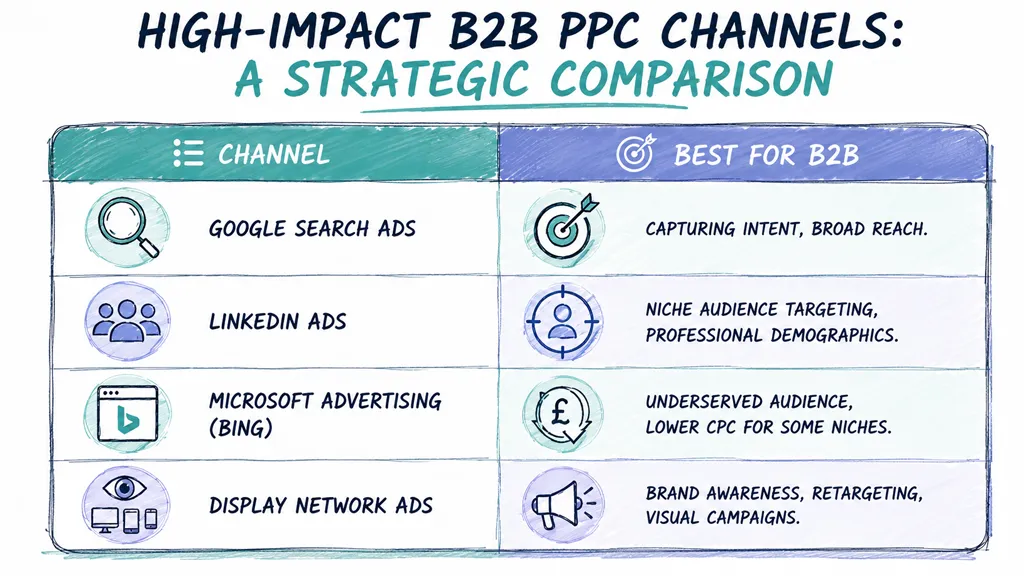
| Channel | Best For | Typical Audience | Relative Cost |
|---|---|---|---|
| Google Search Ads | Capturing active demand | Buyers already searching for a solution | Higher |
| LinkedIn Ads | Reaching specific roles and firms | Decision-makers filtered by job function, sector, company size | Higher |
| Microsoft Advertising | Extending search coverage efficiently | Office-based and corporate search users | Medium |
| Display Network Ads | Retargeting and selective awareness | Previous visitors and defined audience groups | Variable |
Google Search is usually the strongest starting point because it captures demand that already exists. Someone searching for a service, software category, or supplier with clear commercial intent is closer to a sales conversation than someone who passively sees an ad in a feed.
That said, search is only profitable if the economics hold. High CPCs are manageable when lead quality is strong, close rates are healthy, and the average deal value supports the spend. They are damaging when broad keywords, weak negatives, and generic landing pages turn expensive clicks into low-quality enquiries.
Google works best when:
For many SMEs, this is still the most reliable route to early pipeline. If you're weighing setup choices and budget expectations, this guide to Google Ads for small business gives a useful view of the practical trade-offs.
LinkedIn earns its place when precision matters more than volume. If you sell into a narrow sector, target specific seniority levels, or need to reach accounts that are unlikely to search today, LinkedIn can create opportunities search alone will miss.
The trade-off is cost. Clicks are often expensive, and low-intent form fills can give founders false confidence. I would rather see a smaller number of well-qualified conversations from LinkedIn than a larger batch of cheap leads that sales dismisses within a week.
LinkedIn tends to work better when the offer matches the audience's level of awareness. Cold prospects rarely want a demo on first touch. They respond better to a strong commercial problem, credible proof, and a next step that fits their buying stage. That might be a diagnostic call, a practical guide, or a focused webinar rather than a hard sales ask.
Microsoft Advertising deserves more attention than it gets. In many B2B accounts, it performs as a sensible extension of search rather than a replacement for Google.
The upside is often efficiency. You can reach professional users in corporate environments and pick up incremental search demand without paying Google rates for every click. The downside is scale. Volume is lower, and weak campaigns do not improve just because they are imported into another platform.
Use Microsoft after your core search structure is already working. If Google campaigns are not converting profitably, expanding to Microsoft usually spreads the problem rather than fixing it.
Display prospecting can absorb budget fast with little commercial return. Retargeting is a different proposition because it helps you stay visible during a buying cycle that often involves internal discussion, comparison, and delay.
The mistake is treating every returning visitor the same. A pricing-page visitor, a repeat visitor to a service page, and someone who bounced after ten seconds should not see identical ads or receive the same offer. Better audience design starts with behaviour, not just channel source. These behavioral segmentation strategies are a useful reference if you need a clearer structure for that work.
Retargeting works best when creative reflects what the buyer has already seen and what sales needs next. That could mean case studies for evaluators, trust signals for procurement-led buyers, or a direct consultation offer for people who have shown repeated intent.
The right mix depends on how buyers buy, how much a customer is worth, and how much friction sits between lead and sale.
A practical pattern often looks like this:
Founders often ask which channel is best. The better question is which channel fits the job you need done right now. Strong b2b ppc advertising comes from alignment. The targeting has to match the offer, the ads have to match buyer intent, the landing page has to match the click, and sales has to handle the response properly. Without that system, adding channels usually adds cost faster than revenue.
A founder approves more budget because lead volume looks healthy, then sales says half the enquiries were never a fit. That usually is not a keyword problem. It is a targeting system problem.
In B2B, keywords tell you what someone searched. They do not tell you whether the company fits your sales model, whether the buyer can influence a deal, or whether the offer matches their stage. Profitable b2b ppc advertising depends on those factors lining up before the click and after it.
"Fleet management software" and "fleet management software pricing" should not sit in the same bucket. One search often comes from early research. The other usually comes from a buyer trying to compare commercial options.
Treat those searches differently in the account, because they create different commercial outcomes. Early-stage traffic can still be useful if you want to build retargeting pools or capture demand before competitors do. It also tends to convert more slowly, needs different follow-up, and can flood sales with low-intent forms if you push too hard for a demo too early.
A practical setup looks like this:
This is also where conversion design matters. If your traffic lands on the wrong page, good targeting still underperforms. Improving the website conversion rate on your landing pages often does more for profit than adding another audience layer.
Platform targeting options are useful, but they should follow your commercial data, not replace it.
Look at closed-won deals first. Which sectors buy fastest? Which company sizes produce profitable accounts after onboarding and support costs? Which job titles become real opportunities, and which ones fill the CRM with dead ends? SMEs often skip this step and go straight to broad audience filters. The result is more leads, but weaker pipeline.
A stronger approach uses real business signals:
Retargeting works best when it reflects what the buyer did, and what sales needs next.
Someone who read a top-of-funnel article needs a different message from someone who visited the pricing page three times and left. Someone who started a form may need reassurance on implementation, procurement, or contract terms. Someone from an open opportunity may need proof that reduces perceived risk inside the buying committee.
Useful retargeting segments often include:
Targeting should not sit with media buyers alone.
Sales teams usually know which enquiry patterns waste time, which company types stall in procurement, and which titles can move a deal forward. That input should affect exclusions, audience tiers, form design, and what counts as a conversion. If it does not, the ad platform will keep optimising for the cheapest lead, not the most profitable one.
That is the trade-off founders need to watch. Broader targeting can reduce cost per lead and increase form volume. Tighter targeting usually reduces wasted sales effort and improves close rates. For many SMEs, the second outcome is worth far more.
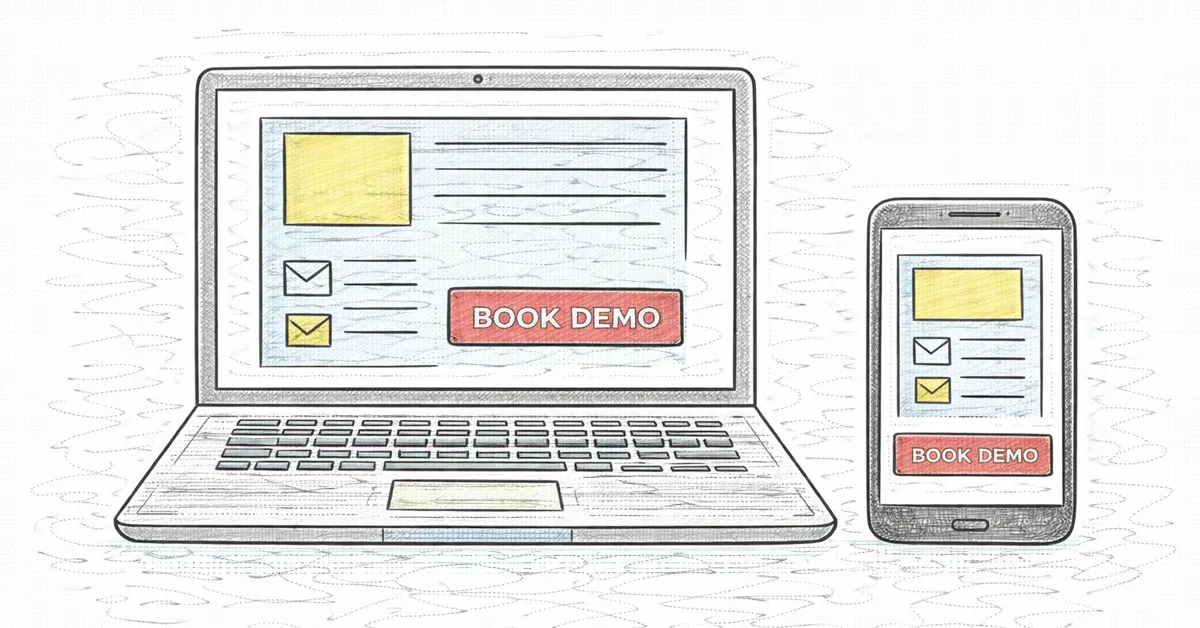
A click is worthless if it does not lead to a conversion. Once you’ve nailed your targeting, your focus must shift entirely to the two most critical assets in any PPC for B2B campaign: your ad copy and your landing page.
Getting these right is the difference between a positive Return on Ad Spend (ROAS) and a budget that simply evaporates.
The connection between your ad and landing page needs to be smooth. This is known as message match. If someone clicks an ad promising to "Cut project delivery times by 30%", the landing page they arrive on must immediately echo that same outcome-focused message. Any disconnect creates confusion and causes them to leave instantly.
Writing for B2B decision-makers is fundamentally different from writing for consumers. You need to be direct, professional, and focus relentlessly on business outcomes. Forget the fluff; your audience is time-poor and looking for solutions to expensive problems.
Effective B2B ad copy should always:
Your ad copy is a promise. It must set a clear expectation of the value a user will get by clicking. Focus on the 'what's in it for them' and articulate it in terms of efficiency, cost savings, or risk reduction.
When you're crafting your ad copy, it's crucial to focus on messaging that drives action and conversions. For more insight, it’s worth reading up on mastering performance ad copy to boost conversions. This knowledge is essential for turning clicks into genuine business opportunities.
Once you’ve earned the click, the landing page has one job: to convert that visitor into a lead. A landing page is not your homepage. It is a focused, distraction-free environment designed for a single purpose.
Here are the essential components of a landing page that converts:
The quality of these assets is everything. With average PPC conversion rates for B2B hovering between 2% and 5%, your ad copy and landing page are the main levers you can pull to turn ad spend into tangible leads. A truly compelling offer can dramatically outperform these benchmarks and deliver a far healthier ROI.
Ultimately, a strong landing page makes the decision to convert feel like the obvious next step for a qualified prospect. For more practical advice on this, you might be interested in our guide on how to improve your conversion rates.
Let’s be honest. Impressions, clicks, and even click-through rates are just noise. They feel productive, but they do not pay the bills. When we’re running PPC for B2B, the only numbers that truly count are the ones that draw a straight line between your ad spend and your bottom line.
This is where we move the conversation away from marketing activity and towards commercial impact. It’s about building a solid measurement framework that tracks everything from the first click all the way to a closed deal, giving you undeniable proof of your return on investment.
First things first: we must stop obsessing over vanity metrics. Instead, we need to focus on performance indicators that reflect genuine business value. These are the numbers that should dictate every single decision you make with your campaigns.
Here are the key metrics I live by for all my B2B clients:
Clicks and traffic are just inputs. Your goal is not to buy clicks; it's to buy qualified leads that your sales team can convert into revenue. Every optimisation should be aimed at improving these core performance metrics, not just boosting traffic volume.
You cannot manage what you do not measure. It is that simple. Before a single ad goes live, we have to put meticulous conversion tracking in place. This means setting up specific conversion actions in your ad platforms to record every valuable interaction a user takes after clicking an ad.
For most B2B outfits, these valuable actions include:
Getting this right from the start ensures your ad platforms get the data they need to optimise for what actually works. For example, the average Cost Per Action (CPA) for B2B on Google Search is around £96. Without accurate tracking, you have no way of knowing if your CPA is healthy or if you're just throwing money at low-quality clicks. For a deeper look at this, you can check out our guide on paid search analytics.
This is the final, game-changing step that many businesses miss. Integrating your ad platforms with your Customer Relationship Management (CRM) system is what closes the loop between your marketing spend and actual sales.
This integration lets you automatically pass lead data from your ads straight into your CRM. Each new prospect is tagged with its original source, like 'Google Ads - Enterprise Software Campaign'. This gives your sales team immediate context on where the lead came from and allows you to track that person through your entire sales pipeline.
Once this is set up, you can finally answer the most important questions:
This smooth flow of data connects your ad spend directly to revenue, turning your PPC campaigns from an isolated marketing expense into a fully accountable and transparent growth engine.
Getting your B2B PPC campaigns to deliver consistent results is a huge milestone, but it is really just the starting line. The real prize is sustainable growth, which only comes from methodical scaling and a relentless focus on optimisation. This is the part where you turn a campaign that works into a long-term, profitable growth engine for your business.
This is not about making huge, risky changes. It is a continuous cycle of small, data-driven improvements that compound over time. It is all about discipline, patience, and always hunting for ways to improve your core numbers.
Once a campaign is consistently hitting its target Cost per Lead (CPL) and sending good-quality prospects to your sales team, it's time to think about scaling. But hold on. Simply doubling your budget overnight is a classic recipe for disaster. A sudden, large budget increase can force ad platforms to chase less-qualified users, sending your CPL through the roof.
Instead, you need to scale methodically. My rule of thumb is to increase the budget on winning campaigns by 15-20% each week, but only if performance holds steady. This gradual increase gives the platform’s algorithm enough time to adjust and find new pockets of qualified users without trashing your efficiency.
Scaling is a test of discipline. You must monitor your CPL and lead quality daily. If performance dips after a budget increase, be ready to pull it back, figure out what went wrong, and fix it before pushing forward again.
As you scale, you have to get even more rigorous with your optimisation. At higher budgets, every pound of wasted ad spend becomes more significant. These are the core tactics I use to keep campaigns efficient and drive ever-improving returns.
Once your core campaigns are humming along and scaling effectively, you can start exploring expansion. This is not about starting from scratch. It is about using the data from your successful campaigns to make your next move an educated one.
Here’s a simple framework for thinking about expansion:
| Strategy | Description | Key Action |
|---|---|---|
| Service Expansion | Launch new campaigns for complementary services or products you offer. | Use what you have learned from your main campaigns to build keyword lists and ad copy for the new offering. |
| Platform Expansion | Introduce a new platform like LinkedIn Ads into the mix. | A great tactic is to retarget your high-intent Google search traffic with brand-building content on LinkedIn. |
| Geographic Expansion | Target new cities, regions, or even entire countries. | Clone your most successful campaigns and simply adjust the location targeting and any region-specific language. |
Optimisation is a continuous process, not a one-time task you can tick off a list. This commitment to ongoing refinement is absolutely essential, particularly for smaller firms where every single marketing pound must be accountable. If you're managing paid advertising in-house, our guide to PPC management for small business offers more practical insights to help you.
As a consultant, I end up answering the same handful of practical questions from business leaders weighing up PPC. They are great questions, so I wanted to share my direct, experience-based answers here.
There is no magic number here. Your starting budget really depends on your goals and just how competitive your industry is.
That said, for most B2B firms dipping their toes in the water, a test budget of £1,500 to £3,000 per month is a realistic starting point. Think of this initial investment as purely for buying data. It gives us enough runway to test different audiences, figure out which keywords are working, and establish a baseline Cost per Lead (CPL) before we start scaling.
You will see data like clicks and impressions almost immediately, but that is just noise. A meaningful business impact takes a bit longer.
Realistically, you are looking at 60 to 90 days to gather enough performance data to make smart decisions. This initial phase is all about learning. The months that follow are about turning those learnings into a consistent, predictable flow of high-quality leads and, ultimately, a positive ROI.
This is not an 'either/or' question. The most effective B2B PPC strategies do not pick one; they use both platforms in a coordinated way.
A blended approach lets you capture the low-hanging fruit on Google while simultaneously creating future demand among your ideal client profile on LinkedIn.
Managing PPC in-house is definitely an option, but it comes with a steep learning curve. It demands a significant amount of time, deep platform knowledge, and a commitment to continuous learning to avoid lighting your budget on fire.
Hiring an experienced specialist helps you bypass that painful learning phase. They can help you sidestep common pitfalls like wasted ad spend and deploy proven strategies from day one. The right expert does not just manage your ads; they accelerate your results and ensure your investment is handled with a sharp focus on commercial outcomes.
At Gilkes Media, we provide the hands-on expertise to design and execute practical, results-focused PPC strategies that drive measurable growth. If you’re ready for a clear plan that turns ad spend into revenue, book a free consultation.
