For far too long, social media for B2B marketing has been treated as little more than a corporate noticeboard for press releases and company news.
The reality is different. A commercially focused social media strategy is no longer a 'nice-to-have'. It is an essential asset for driving predictable growth, building authority, and opening a direct line to senior decision-makers long before they speak to a sales team.

There is a persistent myth that B2B buyers are purely rational beings who make decisions in a vacuum, completely immune to brand perception. This is not true.
Your buyers are professionals, but they are also people. People who spend, on average, over two hours a day on social media. They use these platforms to research solutions, follow industry leaders, and assess potential suppliers.
An effective B2B social media strategy gets you in front of them during these critical moments. It is not about broadcasting marketing messages. It is about building a powerful commercial framework.
The old game of chasing likes and follower counts is over. Those are vanity metrics that rarely connect to revenue. As a consultant managing millions in client ad spend, my focus is always on tangible, commercial results.
A modern B2B social strategy must be engineered to deliver specific business outcomes.
This means every post, comment, and campaign needs a clear purpose:
At Gilkes Media, we treat social media as an integral part of your sales and marketing engine. The goal is not just to be present. It is to be profitable, turning engagement into genuine commercial opportunities that hit your bottom line.
Success in B2B social media demands a strategic, consultant-led approach, not a scattergun agency one. It is about making deliberate choices about where to invest your time and budget for the greatest return.
It is understanding that a single, meaningful conversation with a target account’s CEO on LinkedIn is worth more than a thousand passive likes on a generic company update.
This guide is designed to give you that strategic mindset. We will move past theory and into practical, actionable frameworks that connect social media activity directly to measurable business growth. From picking the right channels to structuring paid campaigns that deliver a clear ROI, you will learn how to build a social presence that works as a powerful commercial asset for your business.
Choosing where to invest your finite time, energy, and budget is the first critical decision in any social media plan. It is far better to dominate one or two relevant platforms than to spread yourself thinly across five, making no real impact. For B2B companies, this decision must be driven by commercial logic, not by chasing the latest trend.
The core principle is simple: go where your buyers are actively learning and engaging. Your ideal platform is not just where your audience has a profile, but where they are in a professional mindset, open to discovering solutions for their business challenges. This means looking past generic user statistics and understanding why people are on each channel.
For the vast majority of B2B organisations, LinkedIn is the non-negotiable starting point. It is the only major platform built from the ground up for professional networking, industry discussion, and business development. Decision-makers, from the C-suite to senior managers, are there consuming industry content, vetting potential partners, and building their own professional brands.
Investing in a strong presence here is not just a "nice to have". It directly supports key business goals:
A well-executed LinkedIn strategy is not just about posting company updates. It is about systematically engaging with prospects, sharing high-value content that solves their problems, and positioning your company as the go-to expert in its niche. It is your digital storefront in the professional world.
While LinkedIn is the foundation, other platforms can play powerful supporting roles if you use them with a clear purpose. You must define the specific job you are hiring each platform to do. Are you building a community? Showcasing your company culture? Or something else entirely?
UK data reveals how different each channel’s strengths are. While Facebook is used by 76% of small businesses overall, a focused look at B2B strategy shows that LinkedIn is considered essential by 37% of B2B marketers. In contrast, only 6% see TikTok as vital, although its use for employer branding is on the rise. Meanwhile, community-focused platforms like Facebook Groups are used by 41% of B2B companies to nurture client relationships. You can explore more B2B content marketing statistics to understand these trends.
Here is a practical way to think about their strategic fit:
Ultimately, your channel selection must be a deliberate business decision. Start with LinkedIn as your anchor. Only expand to other platforms when you have a clear, commercially focused reason and the resources to execute properly.
In B2B, content is not about chasing trends. It is about demonstrating expertise and solving real-world business problems. Decision-makers are time-poor and have a finely tuned filter for anything that does not offer immediate, tangible value. Your social media content strategy must be built on this truth, turning your company’s knowledge into an asset that builds trust and starts conversations.
Effective social media for b2b marketing moves beyond broadcasting what you sell. Instead, it focuses on what your audience needs to know to do their jobs better. This means shifting from a product-first view to an audience-first one, where every post, article, or video is designed to educate, inform, or provide a unique perspective.
To consistently create content that connects, it helps to build your strategy around a few core pillars. These act as guardrails that keep your content focused on delivering value while reinforcing your company’s position as the expert.
This decision tree can help you visualise how to align your content goals with the right platform and approach.
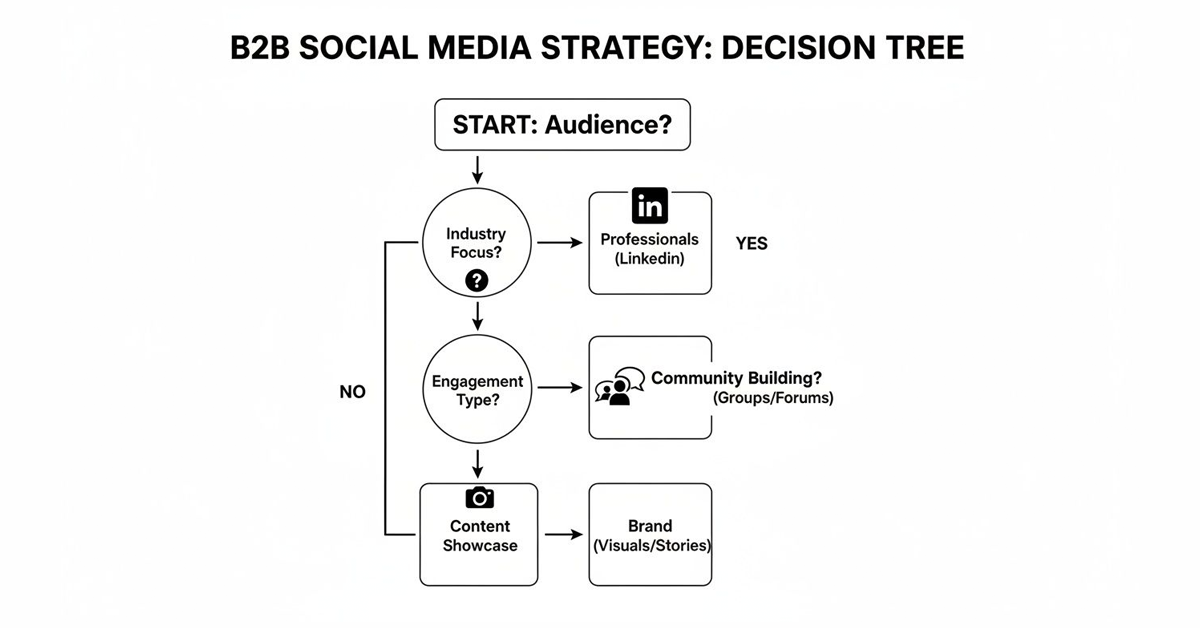
As the visual shows, whether you are targeting professionals, building a community, or focusing on brand, there is a clear path and platform choice to guide what you create.
Once you know what you want to say, the next question is how to say it. Different formats serve different purposes along the B2B buying journey. The key is to match the format to your content’s objective and the platform you are using.
Your content should function as an extension of your consulting expertise. Every piece should feel like a valuable consultation, freely given. This generosity builds the trust required for a prospect to eventually raise their hand and ask for a commercial conversation.
Ultimately, your content must connect back to your commercial goals. It has to attract the right people, build credibility, and create a clear path for them to engage further. Often, this means driving them to a high-converting website. For more on this, you can learn about designing a B2B website that turns visitors into leads.
Organic social media is brilliant for building authority and trust over the long term. It is the slow-burn effort that pays dividends down the line. But what if you need a predictable, scalable stream of high-quality leads now?
This is where paid social advertising comes in. It transforms your social presence from a brand-building exercise into a measurable lead generation engine.
For B2B marketing, this conversation almost always starts and ends with LinkedIn Ads. While other platforms have their place, nothing else offers the same surgical precision for reaching specific professional decision-makers. It is the difference between casting a wide net and using a spear to target the exact fish you want.
The power of LinkedIn is its data. Professionals willingly provide their entire career history: job titles, seniority levels, company names, industries, and specific skills. As an ads specialist, this data is gold. It allows us to bypass the noise and place your message directly in front of the people who sign purchase orders.
Its effectiveness in the UK is well-documented. LinkedIn is the dominant platform, with an impressive 85% success rate for UK B2B companies. With 45 million members, its ads can reach over 81% of the UK population aged 18 and above.
Crucially, 65% of B2B organisations report successfully acquiring new clients through LinkedIn ads, cementing its status as a core commercial channel. You can read more about the dominance of LinkedIn in UK B2B marketing to see how vital it is.
A successful paid social strategy is built on a clear structure. It is not about boosting a few posts and hoping for the best. As a consultant, every campaign I build is structured around a specific, measurable objective.
Here are the key decisions you need to make:
Paid social media is not an expense. It is a direct investment in acquiring customers. The goal is to build a system where putting £1 in consistently generates £5, £10, or more in return. That requires rigorous testing, meticulous optimisation, and a relentless focus on the cost-per-qualified-lead.
Paid social platforms are not all created equal, especially for B2B objectives. The table below breaks down the key strengths of each major player to help you decide where to focus your budget.
| Platform | Primary B2B Strength | Key Targeting Options | Best For |
|---|---|---|---|
| Professional Data Accuracy | Job Title, Seniority, Company Size, Industry, Skills, Group Membership | High-value lead generation, Account-Based Marketing (ABM), reaching specific decision-makers. | |
| Meta (Facebook/Instagram) | Scale & Retargeting | Interests, Behaviours, Lookalike Audiences, Custom Audiences (from website visitors/email lists) | Top-of-funnel brand awareness, retargeting website visitors, reaching SMBs, lower-cost lead magnets. |
| X (Twitter) | Real-time Engagement | Follower Look-alikes, Keyword Targeting, Conversation Targeting | Event promotion, engaging with industry conversations, targeting users based on real-time interests. |
| YouTube (Google Ads) | Search Intent & Visual Storytelling | In-market Audiences, Custom Intent, Placements on specific videos/channels, Remarketing | Product demos, educational content, building brand authority, targeting users actively researching solutions. |
While LinkedIn remains the primary B2B workhorse, a multi-channel approach using Meta for retargeting or YouTube for mid-funnel education can be incredibly effective when planned strategically.
Setting a realistic budget is crucial. For a serious B2B campaign on LinkedIn, a starting test budget might be anywhere from £1,500 to £5,000 per month. This provides enough data to properly test different audiences and creatives, allowing you to find what works before you scale.
Once your campaigns are live, the focus shifts entirely to performance. The key is to move beyond surface-level metrics like clicks and impressions and concentrate on the numbers that actually drive your business forward.
By continuously monitoring these metrics, you can make data-driven decisions to improve your campaigns. This might involve tweaking your ad copy, refining your audience targeting, or A/B testing different offers. This is the hands-on work that separates a successful paid social programme from a wasteful one.
If you are looking for expert guidance, it is worth considering the benefits explained in our guide on why you should hire a marketing consultant to manage this complex process.
There is an old saying: what gets measured gets managed. This is particularly true in B2B social media. Too many businesses get stuck chasing vanity metrics like follower counts and likes, which feel good but tell you nothing about the commercial impact of your efforts.
To have a proper, data-backed conversation with stakeholders, you must connect your social media activity directly to business outcomes. It is about proving that the time, effort, and money you are investing is generating a return. This means looking beyond platform dashboards and focusing on the numbers that truly matter to the business.
The goal is to draw a straight line from a click on a LinkedIn post all the way to a signed contract in your CRM. This requires a complete shift in focus, away from surface-level engagement and towards metrics that reflect real pipeline and revenue.
As a consultant, the first thing I do with any client is build a dashboard of commercially meaningful Key Performance Indicators (KPIs).
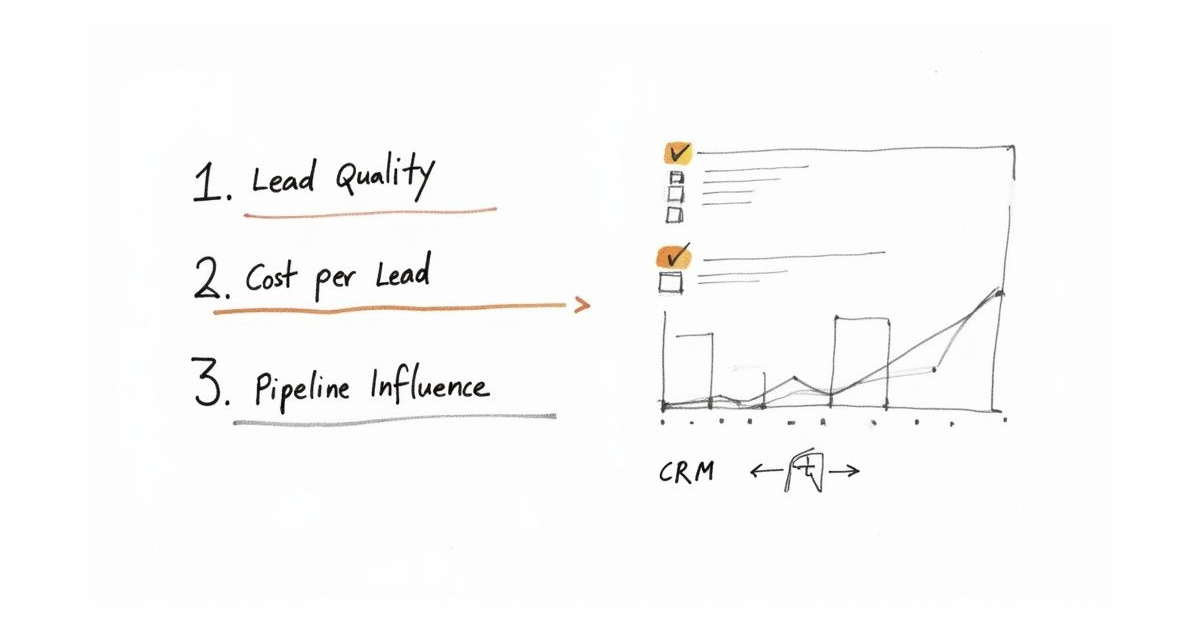
Here are the essential KPIs you should be tracking:
Tracking these numbers allows you to justify your budget and make smart decisions about where to invest more and what to cut back.
To track these KPIs properly, you need the right technical setup. This is not about glancing at LinkedIn Analytics. It is about connecting the dots across your entire marketing and sales technology stack.
You cannot prove ROI without connecting your social media efforts to your CRM. It is the only way to attribute actual revenue back to specific campaigns, justifying your spend and proving the commercial value of your strategy.
For a deeper dive into this, our guide to paid search analytics covers frameworks that are directly applicable to measuring social media performance.
Confidence in social media for B2B marketing is growing for one simple reason: its impact is becoming more measurable. Recent UK data shows that 71% of marketers report that social media delivers measurable ROI, a solid increase from 63% the previous year. This aligns with rising budgets, as businesses that invest over 25% of their marketing spend in social media report 32% faster revenue growth. You can discover more about these social media marketing statistics and what they mean for UK businesses.
When you report back to your leadership team, focus on outcomes, not activity. Present a simple, clear dashboard that answers their most important questions:
By framing your results in this commercial language, you transform social media from a perceived cost centre into a respected and well-funded growth engine for the business.
Even with the best strategy, it is natural to have questions. As a consultant, I have sat in countless boardrooms and see the same practical concerns come up time and again. This section tackles those head-on, giving you the straight, commercially focused answers you need to move forward with confidence.
Think of this as the final briefing before you commit. We will cut through the jargon and get realistic about investment, timelines, and how to make social media a genuine growth engine, even if you think your product is too technical or “boring.”
There is no magic number here. The right way to think about your budget is as an investment designed to hit a commercial target, not just another line on a spreadsheet. It needs to be sized to achieve something meaningful.
For a UK-based B2B company serious about growth, a sensible starting point for paid social on a platform like LinkedIn is often between £1,500 and £5,000 per month. This gives you enough runway to test campaigns, gather data, and figure out what works.
It is crucial to split this investment into two parts:
Here is the bottom line: your budget has to be tied to your expected return. If spending £3,000 a month generates qualified leads that turn into £30,000 of new business, the investment is a clear choice. Start with a test budget for three to six months, measure everything, and then scale up based on what the data tells you.
Patience is vital in B2B. You are not trying to drive a cheap impulse buy. You are building trust with professionals making considered, high-value decisions. Because of that, the timeline for seeing results looks very different for organic and paid efforts.
Think of it like this: paid social gets you immediate data and leads, while your organic presence builds the foundational trust that makes those paid campaigns more effective and profitable in the long run. The two work together.
Absolutely. In fact, some of the most successful B2B social strategies I have seen come from companies with highly technical or specialised products. The secret is realising your product is never “boring” to the person whose biggest headache it solves.
Stop talking about your product and start talking about your customer’s problems. Your audience does not care about your software’s feature list. They care about what those features help them achieve.
A company selling industrial compliance software, for instance, should not be posting pictures of its interface. Instead, its entire content strategy should revolve around the challenges its audience faces every day.
Here is how to reframe your thinking:
For complex B2B products, social media is about education and authority, not entertainment. When you consistently solve problems for your audience, you become their go-to resource. When it is time for them to buy, choosing your product becomes the logical, safe, and obvious decision.
At Gilkes Media, we partner directly with founders and leadership teams to build and execute practical, performance-driven marketing strategies that deliver measurable results. If you are ready to turn social media into a predictable engine for leads and revenue, I offer a free consultation to align on your objectives and set a focused plan for sustainable growth.
Book your free, no-obligation strategy call with Gilkes Media today.
