B2B email marketing is the process of sending targeted, valuable emails to other businesses. The goal is to generate leads, guide prospects through a long sales cycle, and retain existing clients. It is a direct line to the decision-makers you need to reach and consistently delivers one of the highest returns of any marketing channel.
While newer channels often get the attention, strategic B2B email marketing remains the bedrock of sustainable growth for UK businesses. This is not about sending generic newsletters. It is about building a powerful commercial engine that directly fuels your revenue goals. At Gilkes Media, we do not see email as just another tactic; we treat it as a strategic asset.
This guide moves beyond generic advice to give you a practical, hands-on roadmap. We will cover strategy, automation, and measurement, showing you exactly how to build an email programme that delivers tangible results.
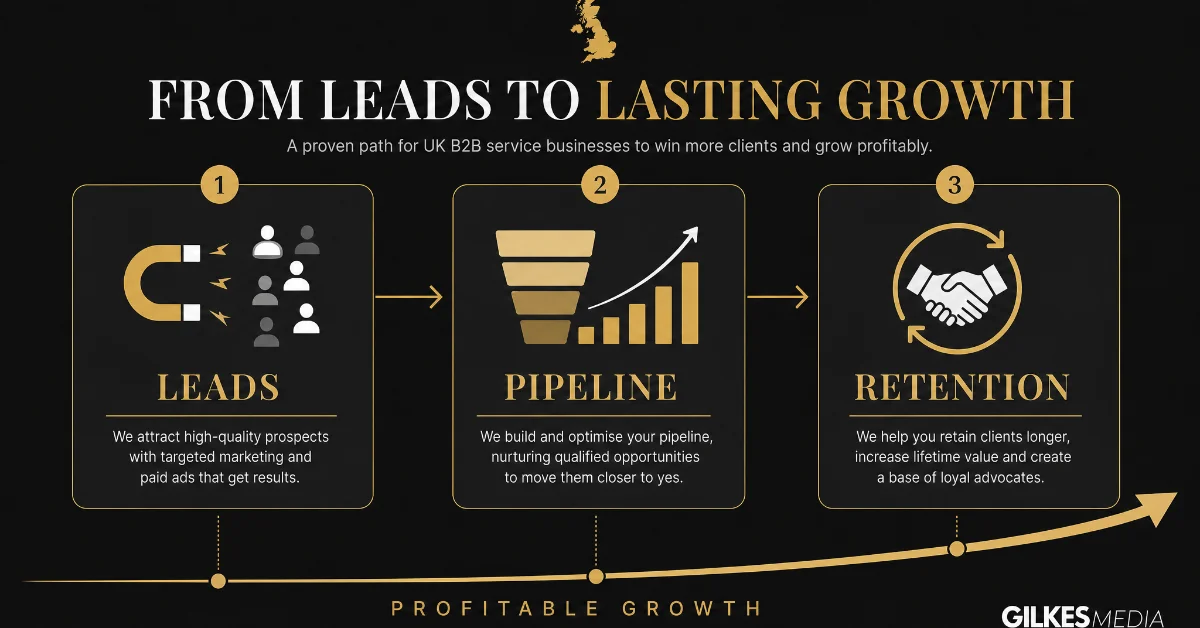
Unlike many marketing activities where the impact can feel vague, email delivers clear, measurable outcomes. You can track, analyse, and adjust every campaign to improve performance. This makes it a highly accountable channel that any leadership team focused on the bottom line can support.
The data speaks for itself. Email is still the backbone of B2B lead generation in the UK. In fact, 63% of UK businesses rated email prospecting as delivering an "excellent" or "very good" return on investment. The volume is significant, with over 832,000 email campaigns sent annually in the UK alone. You can explore these email marketing statistics and facts to see the full picture.
One of the biggest mistakes we see is businesses using email solely to generate new leads. While it is excellent for that, its real power lies in supporting the entire commercial journey. A well-executed email strategy achieves much more.
Before you write a single subject line, the success of your B2B email marketing is determined by the groundwork. Many businesses jump straight to crafting emails and choosing templates, skipping the foundational work of building a quality list, ensuring compliance, and selecting the right technology.
This setup phase is not glamorous, but as a hands-on consultant, I have seen that it is the single biggest factor separating high-ROI campaigns from those that fail. Companies spend thousands generating traffic and leads, only to see that value diminish due to a messy list and a generic, one-size-fits-all email strategy.
Getting these fundamentals right ensures every pound you spend on lead generation has the best possible chance of turning into revenue.
In B2B email, the rule is quality over quantity. I would choose a small, engaged list of 500 relevant decision-makers over a bloated list of 50,000 uninterested contacts every time. Your contact list is the fuel for your email marketing engine; if the fuel is poor, the engine will not perform.
Your list should only be built from legitimate sources where people have shown genuine interest. This means focusing on contacts from:
Do not forget list hygiene. Regularly cleaning out bounced emails and inactive subscribers is crucial for protecting your sender reputation and ensuring your emails reach the inbox.
Navigating data protection rules like GDPR should be seen as a framework for building trust. For B2B email marketing in the UK, the concept of "legitimate interest" is a key principle. It often allows you to contact corporate subscribers, provided your message is directly relevant to their job role and business needs.
Legitimate interest means you have a valid and proportionate reason for processing someone's data that they would reasonably expect. However, you must always provide a clear and easy way for them to opt out.
This is a commercial advantage. It forces you to be targeted, relevant, and respectful of people's inboxes. By doing so, you naturally build a more engaged and responsive audience, which is the objective of marketing.
Sending the same email to your entire database is a guaranteed way to achieve poor open rates and an increase in unsubscribes. The solution is segmentation: dividing your audience into smaller, specific groups. This allows you to send highly relevant, personalised content that speaks directly to their needs.
Effective B2B segmentation goes beyond just a name and company. You should group contacts by criteria like:
When you tailor your messaging to these distinct segments, you demonstrate that you understand their challenges. This simple act dramatically increases the chances of your email being opened, read, and acted upon.
Your email marketing platform is the central system for your entire operation. This decision is not just about sending emails; it is about automation capabilities, CRM integration, and whether the platform can scale with your business. Two popular choices for B2B are HubSpot and ActiveCampaign.
HubSpot is an all-in-one platform for marketing, sales, and service. It is ideal for businesses that want a single source of truth for all customer data but comes with a premium price. ActiveCampaign offers solid automation and email marketing features at a more accessible price, making it a strong option for SMEs looking to implement sophisticated nurture sequences.
Your choice should depend on your budget, your team's technical skills, and your long-term goals. Do not overspend, but ensure the platform has enough capability to support your growth. For a deeper dive into building a winning strategy, it is worth exploring these B2B email marketing best practices.
With the strategic foundations in place, it is time to move from planning to execution. A great B2B email list is useless if the emails you send are ignored or deleted.
This is where many businesses fail. They send generic, feature-focused messages that do not resonate. I see this constantly in my consulting work. The difference between an email that converts and one that is ignored is not complexity; it is clarity, relevance, and a focus on the recipient's needs.
Let's build a repeatable process for creating campaigns that deliver commercial results, whether that is booking a demo or delivering vital content to the right people.
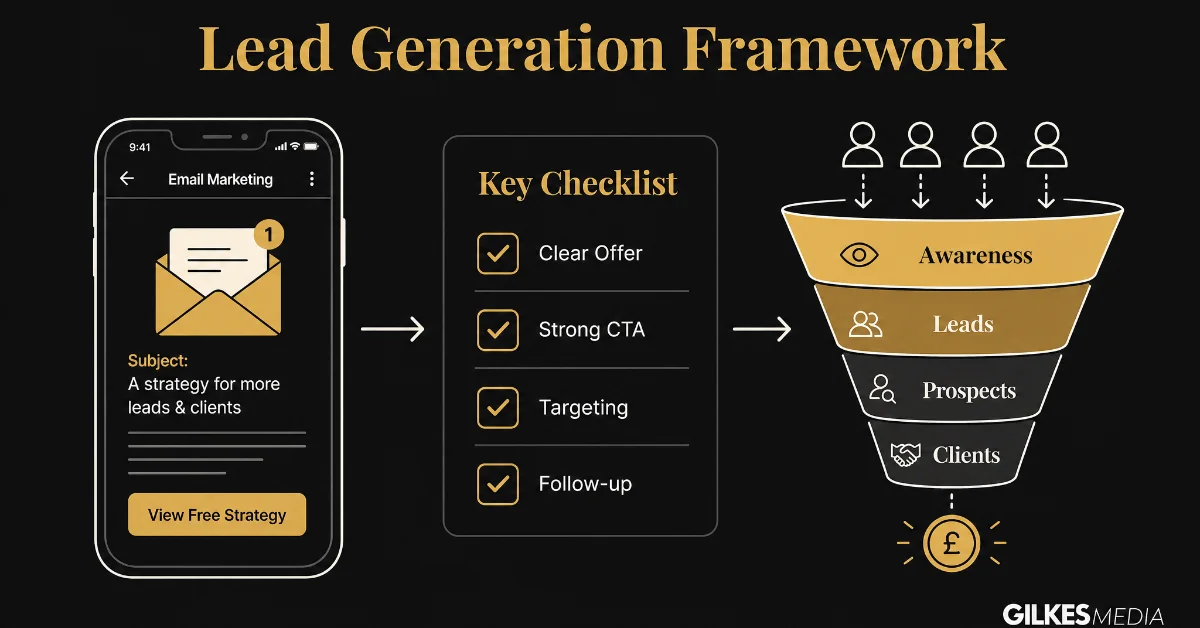
Every successful B2B email is built from the same core components. Master these, and you will be ahead of most of your competition.
First is the sender name. It needs to be instantly recognisable and trustworthy. Using a real person’s name, like "Jason at Gilkes Media," almost always outperforms a faceless company name because it feels more personal.
Next, the subject line. This is your only chance to make a first impression in a crowded inbox. It must be compelling, benefit-driven, and clear. Avoid vague clickbait; promise tangible value that matters to your reader’s job. Mastering this is a critical first step, and you can learn more about How to Improve Email Open Rates here.
Finally, the preview text. Do not waste the snippet you see after the subject line. Use it to support the subject line and add more context, giving them another reason to open the email.
Once they have opened your email, you have seconds to grab their attention. Your body copy must be concise, scannable, and focused on the reader's problems and goals. Avoid long paragraphs about your company history or product features.
Instead, structure your copy around this simple framework:
This structure shifts the focus from what you do to what you can do for them. It is a subtle change that makes a significant difference to engagement.
Every email must have one clear purpose, embodied in your call-to-action (CTA). Asking your reader to do multiple things is a recipe for them to do nothing. Your CTA should be the obvious next step that flows logically from the email’s content.
Your CTA is the final instruction you give your reader. It must be specific, action-oriented, and low-friction. "Book a 15-Minute Demo" is far more effective than a vague "Learn More."
Whether you want them to download a report, watch a video, or reply to the email, make the instruction impossible to misunderstand. Use strong action verbs and ensure the button or link stands out visually. This clarity turns a passive reader into an active lead.
Even small performance improvements can deliver significant results. In the UK, B2B benchmarks are always changing, but recent data shows average open rates as high as 36.7% in some sectors, with deliverability around 84.3%. A small uplift in these figures can have a huge impact on your sales pipeline.
You do not need to be a graphic designer to create professional B2B emails. For B2B, simpler is almost always better. A clean, uncluttered layout makes your message the focus.
Stick to these core design principles:
By focusing on these practical elements, you create a repeatable system for crafting B2B email marketing campaigns that consistently get opened and drive meaningful action.
Sending emails manually is manageable with a few leads, but it is not a scalable strategy. This is where automation and personalisation become your most powerful tools. When done correctly, they do not make your emails feel robotic; they make them feel more relevant and timely than you could achieve manually.
Automation handles repetitive, time-sensitive tasks, ensuring no lead slips through the cracks. It delivers the right message at the right moment, based on a prospect's behaviour. This frees up countless hours for your team while creating a professional experience for everyone you communicate with.
Combine that efficiency with smart personalisation, and you are no longer just sending emails. You are building a scalable engine that nurtures leads all the way to a sale.
You do not need dozens of complicated workflows to start. I always advise clients to master the fundamentals first. There are three core automated sequences that every B2B business should have running. Think of them as the workhorses of your email strategy.
These workflows act as your digital sales assistant, guiding prospects through the early and middle stages of their journey without manual intervention. I have broken down the three most critical sequences into a simple table to show how they work together.
| Workflow Type | Primary Goal | Typical Sequence (Example) | Key Metric |
|---|---|---|---|
| Welcome Series | Build trust & establish expertise | Email 1: Deliver asset & intro. Email 2: Share top case study. Email 3: Offer a related resource. | Open Rate & Click-Through Rate |
| Lead Nurturing | Turn interest into sales-readiness | Email 1: Address a specific pain point. Email 2: Share a customer success story. Email 3: Demo/consultation offer. | Reply Rate & Demo Requests |
| Re-engagement | Win back inactive contacts | Email 1: New research/report. Email 2: A simple check-in ("Still interested?"). Email 3: Final value offer. | Open Rate & Unsubscribe Rate |
Mastering these three flows provides a solid foundation, ensuring you capture and convert interest around the clock.
Using someone’s first name is now standard. True B2B personalisation goes much deeper. It is the key to cutting through the noise in a busy decision-maker’s inbox and showing you have done your research.
It is about using the data you already have to make every email feel like it was written specifically for the person reading it. Consider how much more powerful an email is when it speaks directly to a prospect’s unique situation.
The goal of personalisation is not just to show you know someone's name. It is to prove you understand their business, their role, and their specific challenges. In B2B, relevance is the ultimate form of respect.
You can achieve this by tailoring your content based on data points like:
This level of detail transforms a generic email into a valuable piece of communication. It builds credibility and drives action.
The business case for investing in these systems is solid. Automation is no longer a niche tactic for large companies; it is a core part of modern B2B marketing in the UK. Data for 2025 shows that automation, AI-driven personalisation, and data quality are top investment areas for UK B2B marketers.
The reason is clear from the numbers. Around 82% of B2B marketers already use email automation, with some reports showing that automated sequences can generate up to eight times more opens than manual campaigns. This is driven by using technology to tailor messages by role, sector, and behaviour. You can discover more insights about B2B email marketing benchmarks and statistics to get a fuller picture.
By automating the right processes, you free up your sales and marketing teams to focus on what humans do best. Instead of sending manual follow-ups, they can spend their time talking to qualified leads the system has already warmed up. The result is a dramatic improvement in efficiency and a shorter sales cycle.
Your B2B email marketing is only ever as good as the tech that powers it. Get this wrong, and you will hit a ceiling fast. Choosing the right platform is not just a tech decision; it is a commercial one that dictates how well you can scale, integrate with your CRM, and ultimately, drive revenue.
But even the world's best platform is useless if your emails land in the spam folder. Deliverability, the art and science of getting seen, is everything. A brilliant email that nobody opens is just a wasted investment.
Let's break down how to choose the right tools and master the fundamentals of landing in the inbox.
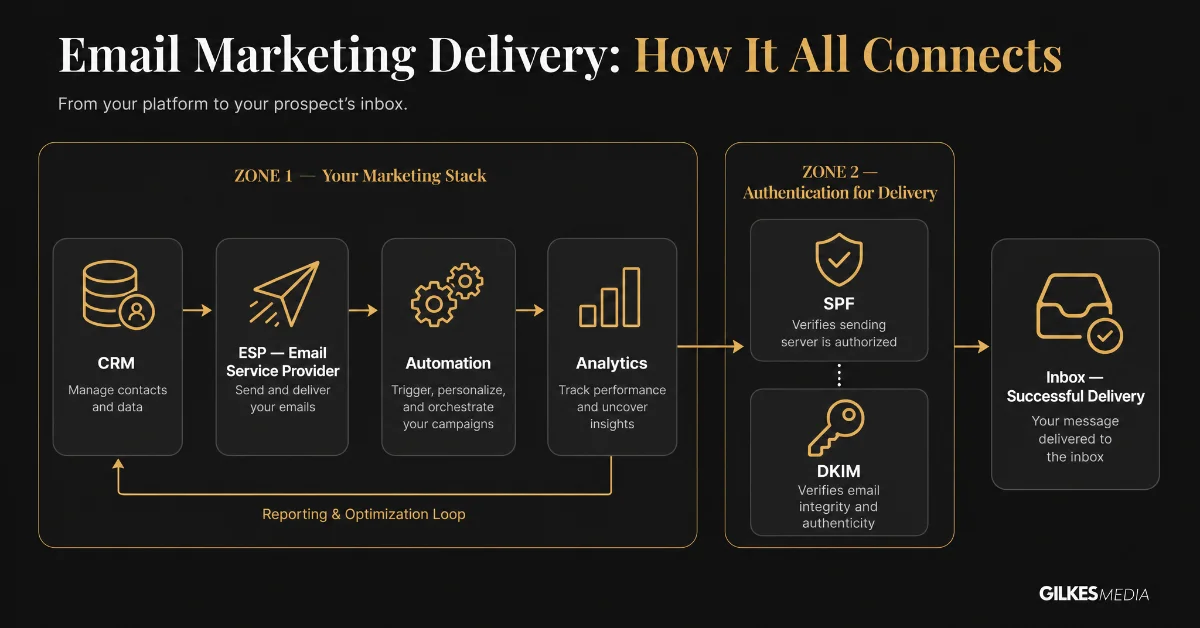
The market is flooded with options, but the right choice boils down to your business stage, budget, and how complex your needs are. A startup does not need an enterprise-level beast, but a scaling SME will quickly outgrow a basic tool.
The trick is to match the platform’s strengths to your commercial goals. Our guide to marketing automation for small business goes deeper, but here is a quick comparison to get you started.
This table offers a high-level look at a few popular platforms, showing how their strengths align with different business needs and budgets.
| Platform | Best For | Key Strength | Indicative Cost |
|---|---|---|---|
| Mailchimp | Startups & Solopreneurs | Ease of use and simple campaign building. | Starts free, then ~£15/month+ |
| ActiveCampaign | Growing SMEs | Powerful automation and CRM integration. | Starts at ~£40/month |
| Klaviyo | E-commerce B2B Models | Advanced segmentation based on purchase data. | Starts at ~£35/month |
| HubSpot | Integrated Sales & Marketing | All-in-one CRM, sales, and marketing platform. | Free tools, paid tiers from ~£15/month |
Choosing a platform is not a life sentence, but migrating later is a pain. Think about where you will be in 18-24 months and pick a tool that can grow with you, not hold you back.
Deliverability is simply the measure of how many of your emails actually reach an inbox. It is all governed by your sender reputation, which is like a credit score for your domain. Providers like Google and Microsoft use this score to decide if you are a legitimate sender or just another spammer.
Protecting this reputation is non-negotiable. One wrong move and your entire email marketing in B2B engine can grind to a halt.
First things first, you need to prove you are who you say you are. Domain authentication is the technical bedrock of good deliverability. It tells inbox providers that your emails are genuinely from you, not some scammer spoofing your address.
There are two non-negotiable records you need to set up:
Think of SPF and DKIM as the digital passport and visa for your emails. Without them, your messages are far more likely to be stopped at the border and denied entry to the inbox.
Beyond the initial tech setup, your day-to-day habits have the biggest impact on your sender score. If you consistently send emails to dead addresses or people who never open them, you are signalling to inbox providers that your list quality is poor.
Here are a few practical rules to live by:
To prove its value, your B2B email marketing must be measured by its commercial impact, not by vanity metrics. Open rates and click rates are useful health indicators, but they do not pay the bills. As a hands-on consultant, my focus is always on connecting marketing activity directly to revenue.
This means shifting your perspective from "how many people opened the email?" to "how much pipeline did this campaign influence?". This is the language that founders and leadership teams understand, and it is how email earns its place as a strategic tool.
A solid measurement framework ensures your email programme is always seen as a powerful, accountable driver of growth.
The first step is to focus on the metrics that matter to the business. While every email platform shows open rates and click-through rates (CTRs), these are only part of the story. A high open rate is meaningless if it does not lead to a tangible business outcome.
Instead, we need to concentrate on bottom-of-the-funnel key performance indicators (KPIs) that demonstrate commercial value. These are the numbers that show your email efforts are generating real opportunities for the sales team.
The most important metrics to track are:
This flow diagram shows a typical automated workflow, a key process that needs solid measurement to prove its worth.
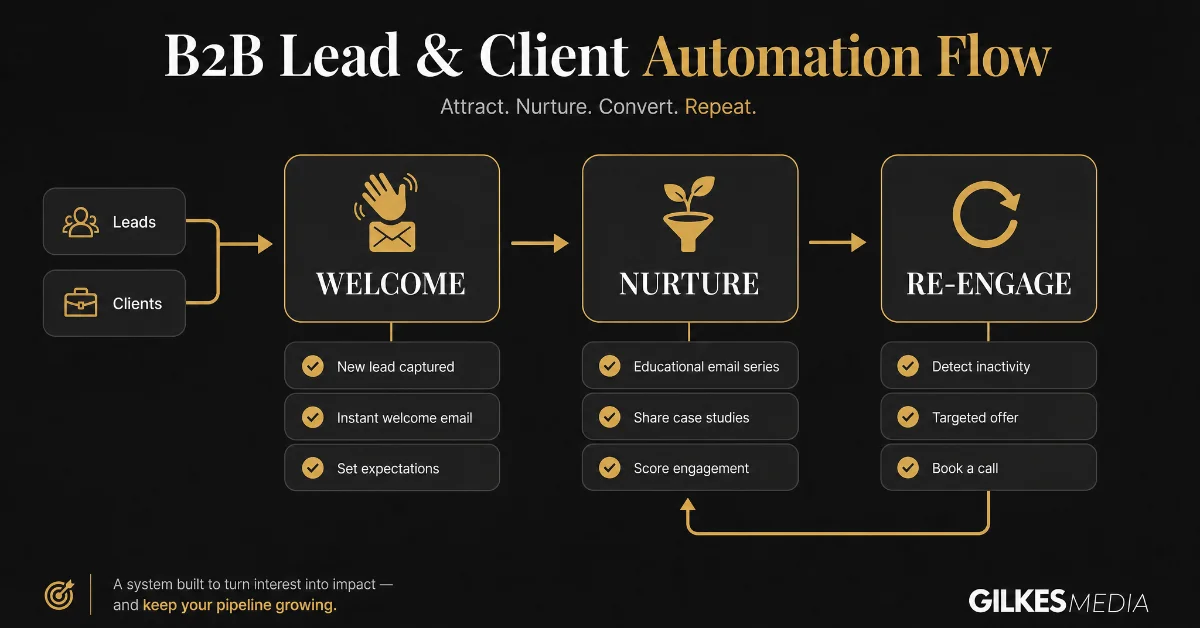
This visualisation highlights the key stages where leads are qualified and moved through the pipeline, from the initial welcome email to ongoing nurturing and re-engagement efforts.
To measure these KPIs accurately, you need to know exactly where your leads are coming from. This is where UTM tracking becomes essential. UTM parameters are small snippets of code added to your links that tell your analytics software how a visitor arrived on your site.
By using unique UTM tags for every link in your email campaigns, you can precisely attribute website traffic, conversions, and eventual revenue back to a specific email. This eliminates guesswork and provides concrete evidence of your email marketing's impact on the sales pipeline.
The ultimate measure of success is Return on Investment (ROI). This calculation tells you how much revenue your email marketing generates for every pound spent. While B2B sales cycles can be long, making direct attribution tricky, a simple model can still provide a clear picture.
The formula is straightforward:
(Revenue Generated from Email – Campaign Cost) / Campaign Cost
For example, if you spend £500 on a campaign that influences £5,000 in new business, your ROI is 900%. Tracking this figure over time is the most powerful way to demonstrate the commercial value of your work. The discipline of tying marketing spend directly to revenue is what performance marketing is all about. You can learn more by reading our guide on what is performance marketing.
A simple, clear reporting dashboard is your best tool for communicating value. It should focus on leads, pipeline, and ROI, presenting the data in a way that is immediately understandable to non-marketers.
By consistently measuring and reporting on these commercial outcomes, you move the conversation away from clicks and opens. You start talking about what really matters: generating qualified leads, creating sales opportunities, and driving measurable business growth.
Email marketing, when isolated, is just another channel. When woven into your entire commercial engine, its true power emerges. It becomes the connective tissue that amplifies every other investment you make.
From my experience, the fastest-growing businesses are those that treat email as a central hub for communication, not a siloed tactic. This approach creates a smarter, more cohesive customer journey. It smooths the pipeline for your sales team and builds a performance-driven machine where every part works together to drive revenue.
Paid advertising on platforms like LinkedIn or Google is excellent for generating initial interest. But that hard-won, expensive click is just the start. If you do not have a system to nurture that attention, you are leaving money on the table.
This is a key part of the work we do at Gilkes Media. Instead of letting a new lead from a paid ad go cold, we use email automation to pick up the conversation immediately and maintain it.
Here’s how that works in practice:
One of the oldest challenges in B2B is the handover from marketing to sales. A properly integrated email strategy is the perfect bridge, providing your sales team with the context and intelligence they need for more effective conversations.
Your email platform should not just be a marketing tool; it should be a source of priceless sales intelligence. Every open, click, and download is a buying signal that can inform and prioritise sales outreach.
This alignment transforms cold follow-ups into warm, relevant conversations. For example, your CRM could automatically flag a contact for a sales call the moment they click on the pricing page link in an email. This real-time data lets your team engage prospects at the peak of their interest, significantly increasing the chance of conversion. This is a core concept we build for clients, and you can learn more about this strategic thinking in our guide on what is marketing consultancy.
This strategic integration is what separates basic B2B email marketing from a sophisticated, revenue-focused programme. By ensuring email works together with your paid ads and sales efforts, you create a system where the whole is greater than the sum of its parts, driving consistent, predictable growth for your business.
Even with the best strategy, practical questions always arise. Let’s tackle some of the most common ones we hear from businesses starting their B2B email marketing.
There is no magic number. The right sending frequency is a balance between staying on your audience’s radar and delivering value. Too often, and you will burn out your list; too quiet, and you will lose momentum. A one-size-fits-all schedule is a mistake.
Instead, let your strategy be guided by common sense:
A good starting point is once a fortnight. From there, you can test increasing the frequency, but keep a close eye on your engagement metrics. If they remain strong, you are on the right track.
First, let's debunk the myth of the "perfect time to send". You will see studies claiming Tuesday at 10 am is the magic slot, but that advice is too generic to be useful. It ignores the most important factor: your audience.
The best time for a construction director will be different from a marketing manager at a tech startup. One might check emails at 6 am before heading to a site, while the other is most active after lunch.
The only way to know for sure is to test it yourself. Send your campaigns at different times and on different days, then analyse your open and click-through rates. Look for the patterns in your own data; that is your source of truth, not a global benchmark. Your email platform's analytics are your best friend here.
Yes, you can, but you must do it correctly. In the UK, GDPR allows for B2B communications under the legal basis of "legitimate interest." This means you can contact someone at their corporate email address as long as your product or service is genuinely relevant to their professional role and could benefit their business.
But legitimate interest is not a free pass to spam. Your outreach must be targeted, personalised, and relevant. Crucially, you must also provide a clear and simple way for them to opt out in every email.
Think of it as professional courtesy. Do your research, ensure your offer solves a real problem for their business, and always respect their right to say no.
At Gilkes Media, we build and execute practical, data-driven marketing strategies that deliver measurable results. If you need a senior marketing consultant to help design a growth plan focused on ROI, book a free consultation with us today.
