Lead generation is not a marketing buzzword; it is the engine that powers your entire sales pipeline. It is the process of identifying and cultivating potential customers, turning casual interest into qualified, tangible opportunities for your sales team.
Think of lead generation as a sophisticated filtration system for your business. You start with a broad audience who might see your marketing. Most of them are not ready or even a good fit to buy from you. Lead generation is the system that methodically filters this crowd, pinpointing individuals who have shown genuine interest and are a strong match for your services.
This is critical because it ensures your sales team spends its valuable time in meaningful conversations with people who have real buying potential, rather than chasing cold contacts. Without a solid lead generation process, your growth is unpredictable and inefficient, leaving you to rely on luck instead of a structured system.
Many businesses make the mistake of treating every email address or phone number as a 'lead'. This is a fundamental misunderstanding that leads to wasted time, frustrated sales teams, and missed opportunities.
A simple contact is just a piece of data. A qualified lead, however, represents a genuine revenue opportunity.
The real difference comes down to intent and qualification. Someone who subscribes to your newsletter is a contact; they have shown a flicker of interest. But someone who downloads your pricing guide, signs up for a product webinar, or requests a consultation has actively raised their hand and signalled commercial interest. They are now a qualified lead.
"A lead is not just a name on a list. It is an individual who has willingly exchanged their information for something of value, indicating a genuine interest in solving a problem that your business can address."
This focus on qualification transforms your marketing from a cost centre into a predictable revenue driver. To execute this correctly, understanding lead generation best practices is essential for building a system that delivers consistent results.
To make this distinction clear, it helps to see the two side-by-side. One is simply data; the other is a potential customer knocking on your door. Understanding this is the first step toward building a high-performing sales funnel.
| Attribute | Simple Contact | Qualified Lead |
|---|---|---|
| Interest Level | Unknown or unexpressed | Demonstrated interest in your company |
| Data Available | Basic details (e.g., name, email) | Contextual data (e.g., downloaded a guide) |
| Readiness to Buy | Low or not applicable | Potentially ready for a sales conversation |
| Commercial Value | Minimal until qualified | High potential revenue opportunity |
The value is in the qualification. Once you start focusing on generating leads instead of just collecting contacts, the efficiency and effectiveness of your entire sales process will improve dramatically.
Effective lead generation is not a single action. It is a structured process, a journey on which you guide potential customers from knowing nothing about you to becoming genuinely interested in what you sell. The best way to visualise this journey is as a funnel.
Thinking in terms of a funnel provides a framework to diagnose problems, allocate budget, and build a predictable engine for growth. Each stage has a clear goal, moving a prospect logically towards a decision. It is the difference between randomly collecting email addresses and systematically building a pipeline of future customers.
This diagram shows the fundamental flow: turning a broad audience into qualified leads.
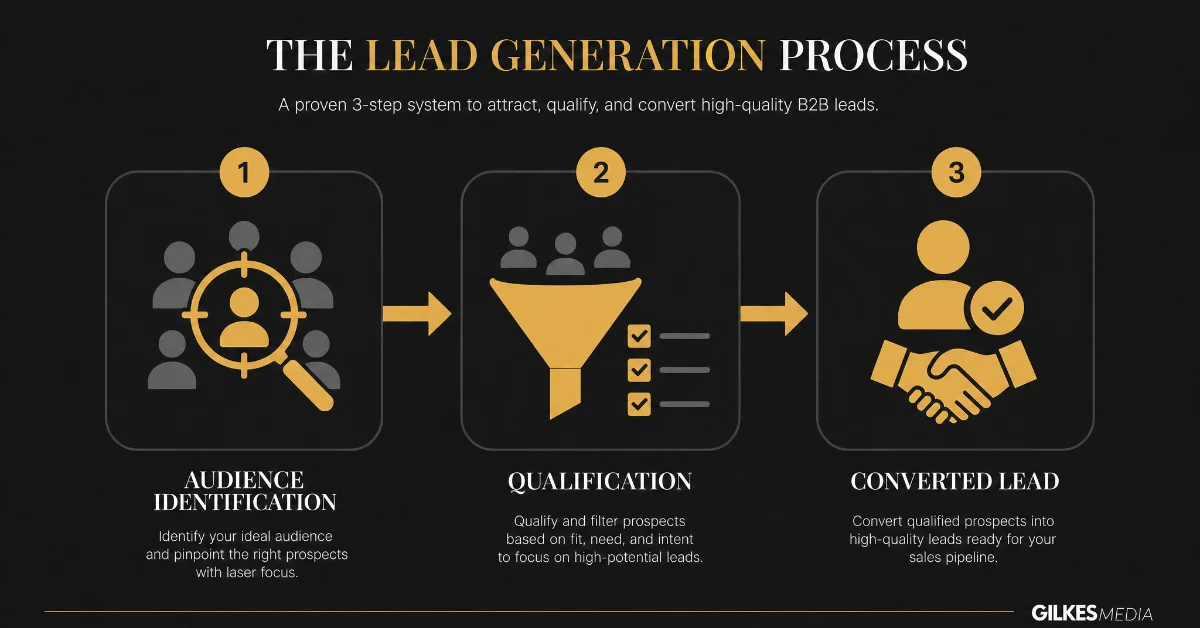
A large initial audience gets filtered through a qualification process. This moves the focus from quantity to quality, identifying the people with real potential.
The top of the funnel (ToFu) is about awareness. At this point, your potential customers are just starting to realise they have a problem or a need, and their research is beginning. They are strangers to your business. Your only job is to get on their radar by being helpful.
This is not the time for a hard sell. You need to be a valuable resource, attracting a wide but relevant audience by answering their early-stage questions and speaking to their pain points.
Common tactics for this stage include:
Success here is measured by generating relevant traffic and building an initial audience.
Once you have attracted visitors to your website, the next job is to convert them into leads. This is the middle of the funnel (MoFu), the point where a visitor raises their hand and shows they are interested enough to give you their contact information. They will only do this in exchange for something valuable.
This is a crucial transition. You are turning anonymous website traffic into identifiable potential customers. The key is to offer a compelling reason for them to make that trade, often called a 'lead magnet'.
A successful middle-funnel strategy is built on a fair value exchange. The perceived value of your offer must outweigh the visitor's hesitation to share their personal details. This builds trust and qualifies their interest.
Effective conversion tactics include:
This stage turns traffic into a tangible asset: a list of engaged contacts who have given you permission to talk to them directly.
The final stage, the bottom of the funnel (BoFu), is where you nurture the leads you have generated and identify who is ready for a sales conversation. Most leads will not be ready to buy immediately. This is where the real work, and the real money, is done.
The goal here is to build on that initial trust, providing more specific, targeted information that helps them evaluate your solution. Effective lead nurturing keeps your business top-of-mind and positions you as the obvious choice when the time is right. We explore this in our guide to lead nurturing best practices.
Bottom-of-funnel tactics focus on proving your unique value:
This is where marketing hands over a warm, qualified opportunity to the sales team, dramatically boosting the efficiency and success rate of your entire growth engine.
To build a reliable lead generation engine, you must first decide on your core strategy. Will you attract customers by drawing them in with genuinely useful content, or will you proactively go out and find them?
These two fundamental approaches are known as inbound and outbound lead generation.
Viewing this as an "either/or" choice is a common mistake. The most effective strategies almost always blend elements of both. The key is to understand the commercial implications of each so you can put your budget and resources where they will deliver the best possible return.
Inbound lead generation is a ‘pull’ strategy. It is the process of attracting potential customers by creating valuable content and experiences they are actively searching for. Instead of interrupting them, you provide solutions and answers, earning their trust and attention over time.
Think of it as setting up a powerful magnet. You publish helpful blog posts optimised for search engines, host insightful webinars, or create detailed guides. When a potential customer searches for a solution to their problem, they find you.
This approach is about building a long-term asset. The content you create today can keep generating leads for months or even years, making it an incredibly cost-effective strategy over time.
The core principle of inbound marketing is to add value before you ask for anything in return. By becoming a trusted resource, you ensure that when a prospect is ready to buy, your business is the first one they think of.
Outbound lead generation is a ‘push’ strategy. It involves proactively reaching out to a targeted audience to make them aware of your product or service. You are the one initiating the conversation.
This is a much more direct approach. Common outbound tactics include running targeted paid advertising campaigns on platforms like Google or LinkedIn, sending personalised email outreach to a curated list of prospects, or making strategic sales calls.
Outbound is often the fastest way to gain initial traction, test a new market, or get in front of a very specific type of decision-maker. While it needs ongoing investment to keep the momentum going, the results can be immediate and highly measurable.
Choosing the right blend of inbound and outbound is a commercial decision, not just a marketing one. The best mix for your business depends entirely on your specific goals, budget, sales cycle, and target market. Neither approach is inherently “better,” but one will likely be a better fit for your immediate needs while the other builds your future pipeline.
A deeper understanding of demand generation vs lead generation can also help clarify when to focus on broad awareness versus specific lead capture.
To help you decide, let's look at how each strategy stacks up against key business factors.
This table breaks down which approach aligns best with different commercial realities. Use it to gauge where your immediate priorities lie.
| Factor | Inbound Marketing (Pull) | Outbound Marketing (Push) |
|---|---|---|
| Primary Goal | Build long-term brand authority and attract qualified buyers | Generate immediate leads and conversations with specific targets |
| Time to Results | Slower initial build-up, but compounds over time | Faster, can generate leads within days or weeks |
| Cost Structure | Upfront investment in content and SEO, lower cost-per-lead over time | Direct cost per campaign (e.g., ad spend, list acquisition) |
| Best For | Complex sales, research-heavy buying processes, building a sustainable asset | Targeted B2B sales, launching new products, entering new markets quickly |
A balanced approach often yields the strongest results. You might use paid ads (outbound) to drive immediate traffic to a high-value piece of content (inbound), getting the best of both worlds.
As a consultant, my role is to analyse your business objectives and design a practical, performance-driven strategy that delivers both short-term wins and long-term, sustainable growth.
Once your strategy is defined, the next question is always the same: where do we actually find these leads?
An effective lead generation machine is never built on a single channel. It is a smart mix of platforms and tactics working together to create a reliable pipeline.
Some channels deliver results almost instantly, while others build long-term assets that generate returns for years. As a consultant, my job is to help businesses decide where to invest their budget to get the highest return, based on their specific goals, market, and resources.
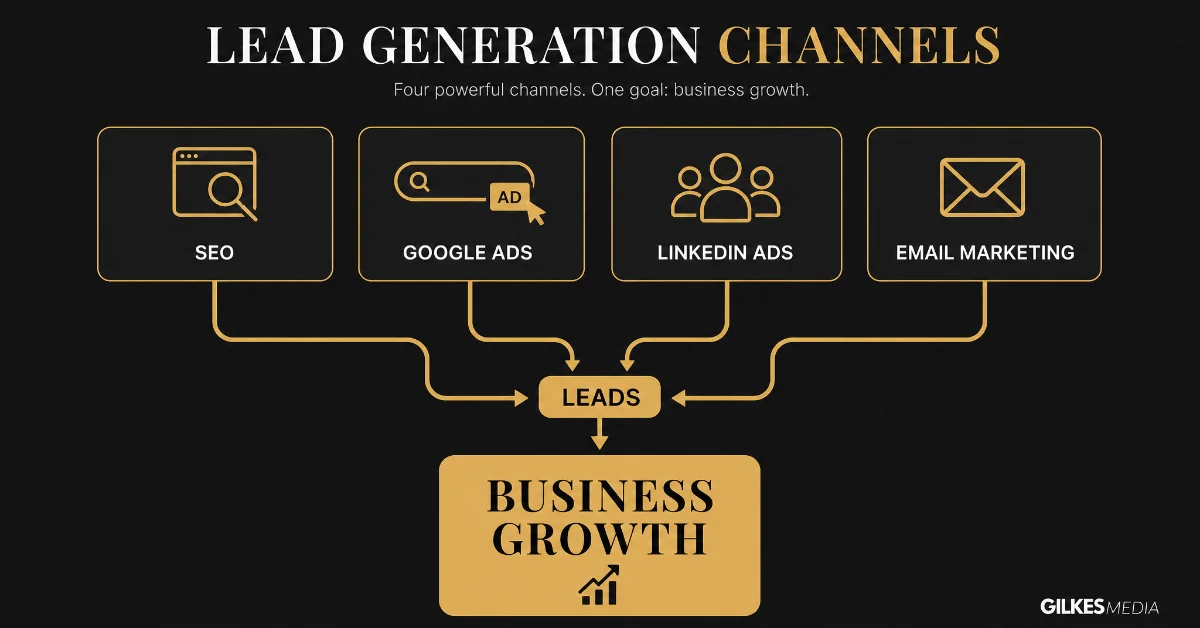
Paid advertising is the fastest way to get your message in front of a hyper-targeted audience. It is a direct, outbound tactic that can start generating leads from day one, making it ideal for businesses that need immediate results. For most UK businesses, the two powerhouses are Google Ads and LinkedIn Ads.
While paid ads rent attention, Search Engine Optimisation (SEO) builds an asset you own. It is the process of optimising your website to rank higher in search engine results for your most important keywords. Unlike ads, where you pay for every click, SEO traffic is organic and, once established, can deliver a steady stream of leads at a very low ongoing cost.
SEO is a long-term inbound strategy. It demands an upfront investment in creating helpful content and building your site's authority, often taking 6-12 months to deliver significant results. The effort compounds. A top-ranking blog post can become your business's most effective salesperson, working 24/7 to bring in leads for years.
The secret to successful SEO is not about gaming the system. It is about becoming the most helpful, authoritative, and trustworthy answer to your customers' questions. Do that consistently, and you will earn their trust and, eventually, their business.
Content marketing is the engine that powers both inbound and outbound activity. It involves creating and sharing valuable content like e-books, guides, case studies, and webinars to attract and engage your ideal audience.
This is much more than just writing blog posts. A single, powerful piece of content, like a detailed industry report, can be repurposed in dozens of ways:
Great content establishes your credibility, educates your prospects, and gives them a compelling reason to exchange their contact details for your expertise.
Even with all the new channels, email marketing remains one of the most commercially effective tools available. Its real strength lies in what happens after you have generated a lead. It is how you nurture those relationships, moving people systematically from mild interest to being ready to buy.
By sending targeted, personalised, and genuinely useful content, you build trust and keep your business top-of-mind. This is about helping, not spamming. UK market analysis consistently shows that a coordinated, multi-channel approach wins. For example, campaigns that combine email with LinkedIn outreach deliver 34% higher response rates than email alone. You can find more insights by exploring UK lead generation statistics on sendiq.co.uk.
The key is simple: deliver the right message at the right time, guiding your leads through their journey until they are ready to talk to your sales team.
Generating leads is only half the battle. If you cannot accurately measure the commercial impact of your efforts, you are spending money without knowing if it is delivering a positive return.
A successful lead generation strategy is not about vanity metrics like clicks or impressions; it is about driving profitable growth.
To achieve this, you must move beyond simply counting leads. You need a clear framework of key performance indicators (KPIs) that connect your marketing spend directly to revenue. These metrics form a simple but powerful dashboard that holds every pound you spend accountable to a commercial outcome.
For any business owner or marketing leader, three essential metrics tell the most important part of the story. Focusing on these will give you 80% of the insight you need with just 20% of the complexity.
These metrics do not work in isolation. Their real power comes from how they interact, giving you a complete picture of your return on investment (ROI).
Many business owners fixate on keeping their Cost Per Lead as low as possible, but this is often a strategic mistake.
A high CPL is not necessarily a bad thing. If a channel delivers high-quality leads that have a significantly higher conversion rate and Customer Lifetime Value, paying more for them is a highly profitable decision.
Let's illustrate with a clear example.
Imagine you are running two separate lead generation campaigns:
If you only looked at CPL, Campaign A seems four times more efficient. However, when you analyse the actual business impact, the story changes completely.
The "expensive" campaign is revealed to be 7.5 times more profitable. This is the kind of data-driven insight that transforms a marketing budget from an expense into a strategic investment. At Gilkes Media, our entire focus is building and measuring campaigns that are directly accountable to your bottom line.
The conversation around lead generation is changing, driven by advances in artificial intelligence (AI) and automation. For UK business owners, this is about gaining a commercial edge. Using these tools is no longer a luxury for large corporations; it is becoming essential for any business serious about efficient growth.
These technologies are not here to replace your skilled marketing and sales teams. Think of them as a force multiplier. They automate the repetitive, low-value tasks, freeing up your people to focus on what humans do best: building relationships, thinking strategically, and closing deals.
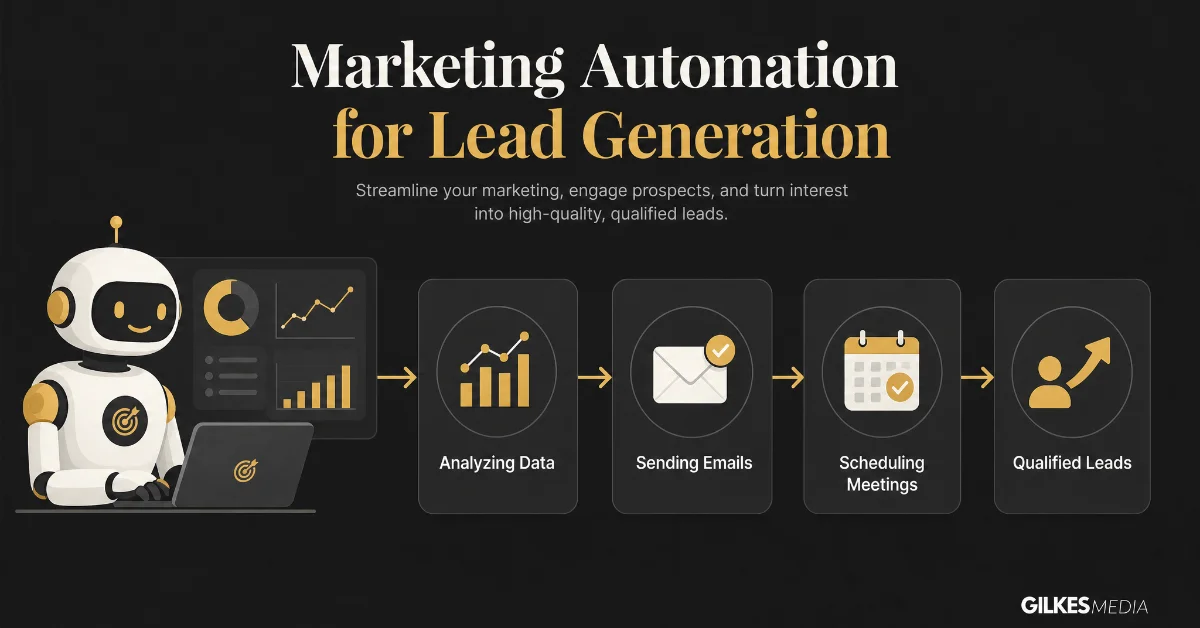
The real-world uses for AI and automation in lead generation are refreshingly simple, and they deliver measurable results. They allow you to operate with a speed and precision that was not possible before.
Here are some of the most powerful applications for a growing business:
The goal of automation is not to remove the human touch, but to ensure it is applied at the most critical moments in the buyer's journey. It handles the process, so your team can handle the people.
For UK SMEs, the results are compelling. UK market data from over 500 SMEs shows that businesses implementing AI for lead generation typically see a 2.8x increase in qualified leads within the first quarter. On top of that, their conversion rates improve by 35-45%. It has also become far more accessible, with some entry-level AI tools starting from just £50 per month, allowing smaller businesses to compete on lead quality, not just volume.
Bringing these tools into your business is a strategic move that directly impacts your bottom line. It cuts down on manual work, shortens the sales cycle, and delivers a significant return on investment. You can find more insights on how this technology is reshaping the sales process in this guide to AI-powered sales prospecting.
At Gilkes Media, we specialise in helping businesses implement practical, cost-effective automation strategies that drive real, measurable growth.
To round things off, let’s tackle some of the most common and practical questions we hear from business owners about lead generation. These queries come up time and again in strategy sessions, and clear answers are essential for making confident decisions.
There is no magic number. The right budget depends entirely on your industry, revenue targets, and Customer Lifetime Value (CLV).
For a growing business, a solid starting point is to allocate 7-12% of your target revenue to your entire marketing budget. A healthy portion of that should go directly into lead generation.
The most important rule is to focus on your Cost Per Acquisition (CPA) in relation to your CLV. If a typical customer is worth £5,000 to your business, paying £500 to acquire them is not an expense; it is a fantastic investment.
The smartest approach is to start with a test budget on one or two channels, track the return on investment closely, and then scale up what works. At Gilkes Media, we build a financial model based on your numbers to ensure every pound you spend is an investment in predictable growth.
The timeline for seeing tangible results depends entirely on the channels you choose. It is crucial to set the right expectations from the start so you do not abandon a great strategy too early.
The most powerful approach is nearly always a blend of both. Use paid ads for quick wins and predictable lead flow while you build your long-term organic engine in the background for sustainable, cost-effective growth.
Getting this distinction right is critical. It is the key to ensuring your marketing and sales teams work together smoothly. Misunderstanding this leads to friction, frustration, and wasted effort.
An MQL (Marketing Qualified Lead) has shown interest, but an SQL (Sales Qualified Lead) has shown intent. Understanding this difference is the secret to an efficient sales pipeline.
A Marketing Qualified Lead (MQL) is someone the marketing team has flagged as being more likely to become a customer based on their actions. They may have downloaded an e-book, attended a webinar, or signed up for your newsletter. They are interested and engaged, but not yet ready for a sales call.
A Sales Qualified Lead (SQL), on the other hand, is a lead who has been vetted and is showing clear signs they are ready to buy. They have taken an action that signals real intent, like requesting a demo, filling out a "contact sales" form, or asking a direct question about pricing. This is a lead the sales team can act on immediately.
By establishing clear, agreed-upon definitions for both MQLs and SQLs, you stop the sales team from wasting time on people who are still browsing. It frees them up to focus all their energy on closing deals with prospects who are genuinely ready to talk.
At Gilkes Media, we specialise in designing and executing practical, performance-driven lead generation strategies that are directly accountable to your commercial goals. If you are ready to build a predictable engine for growth, book a free consultation to set a focused plan. Find out more at https://gilkesmedia.co.uk.
