
Figuring out how to generate more leads is not about throwing more money at the problem. It starts with a simple, honest audit. The smartest move you can make is to first analyse your current performance, pinpoint exactly where potential customers are dropping off, and calculate your true acquisition costs. This foundational work ensures every pound you spend from here on is invested with purpose, not just hope.
Before you can build a better lead generation engine, you must understand how the current one is performing. Many businesses jump straight into launching new campaigns, hoping more activity will magically solve their lead problem. This is almost always a costly mistake. A clear, honest audit of what you are already doing is the most commercially astute place to start.
This is not about vanity metrics like website traffic or impressions. This is about understanding the commercial reality of your sales funnel. The goal is to establish a data-driven baseline that will inform every strategic decision you make. Without it, you are flying blind.
Your sales funnel is simply the journey a person takes from first hearing about you to becoming a paying customer. The first step is to map this path out and attach real numbers to each stage.
Start by asking a few critical questions:
Laying these numbers out will immediately show you where your process is efficient and where it is leaking. You might find you have tonnes of traffic but a tiny lead conversion rate, which points to a problem with your website's messaging or user experience.
Once you have mapped your funnel, the weaknesses, or bottlenecks, tend to become obvious. A bottleneck is any stage where you lose a disproportionately high number of potential customers. For instance, you might have hundreds of people adding a product to their basket but only a handful completing the purchase. That is a clear signal that something is broken in your checkout process.
The point of an audit is to find the point of maximum impact. Fixing a single bottleneck can often have a bigger impact on your lead volume than launching an entirely new marketing channel. It is about working smarter, not just harder.
The infographic below shows the core process for this initial audit.

This simple, three-stage flow gives you a clear framework for turning raw data into actionable commercial insights.
To help you get started, I have put together a quick checklist. Use this to run through your main channels and spot some of those easy-to-miss red flags.
Use this checklist to audit your current lead generation channels and identify immediate opportunities for improvement.
| Audit Area | Key Metric to Check | Red Flag Example | Actionable Insight |
|---|---|---|---|
| Website Performance | Landing Page Conversion Rate | <1% conversion on a high-traffic service page. | The page's messaging does not match visitor intent. Rewrite headlines and calls-to-action to be more direct. |
| Paid Advertising | Cost Per Lead (CPL) | CPL is higher than the average order value. | The campaign is unprofitable. Pause low-performing ad groups and reallocate budget to keywords with higher buying intent. |
| Content Marketing | Leads from Gated Content | A downloadable guide gets 500 views but only 5 downloads. | The sign-up form is too long or the perceived value is too low. A/B test a shorter form or a stronger offer. |
| Email Marketing | Click-Through Rate (CTR) | Your welcome email sequence has a <2% CTR. | The initial emails are not engaging enough. Add a stronger call-to-action or a more compelling offer to drive action. |
This checklist provides a solid framework for finding quick wins that can make an immediate difference while you plan your longer-term strategy.
Finally, you need to get real about the numbers. Understanding the financial reality of your lead generation comes down to two essential metrics:
Calculating these figures for each of your channels reveals which ones are genuinely profitable and which are just draining your budget. With this baseline established, you have the clarity to invest your resources with confidence and build a predictable growth strategy.
While auditing your existing channels gives you a solid foundation, paid acquisition is the fastest, most direct lever you can pull to generate more leads now.
This is not about aimlessly boosting posts on Facebook. It is about building a predictable, scalable system that delivers a measurable return on your investment. As a paid ads specialist who has managed over £3,000,000 in ad spend, I know that success comes from strategic precision, not just a bigger budget.
The goal is to move from an inconsistent trickle of enquiries to a reliable engine for growth. Paid channels give you a level of control over targeting, messaging, and volume that organic methods cannot match in the short term.
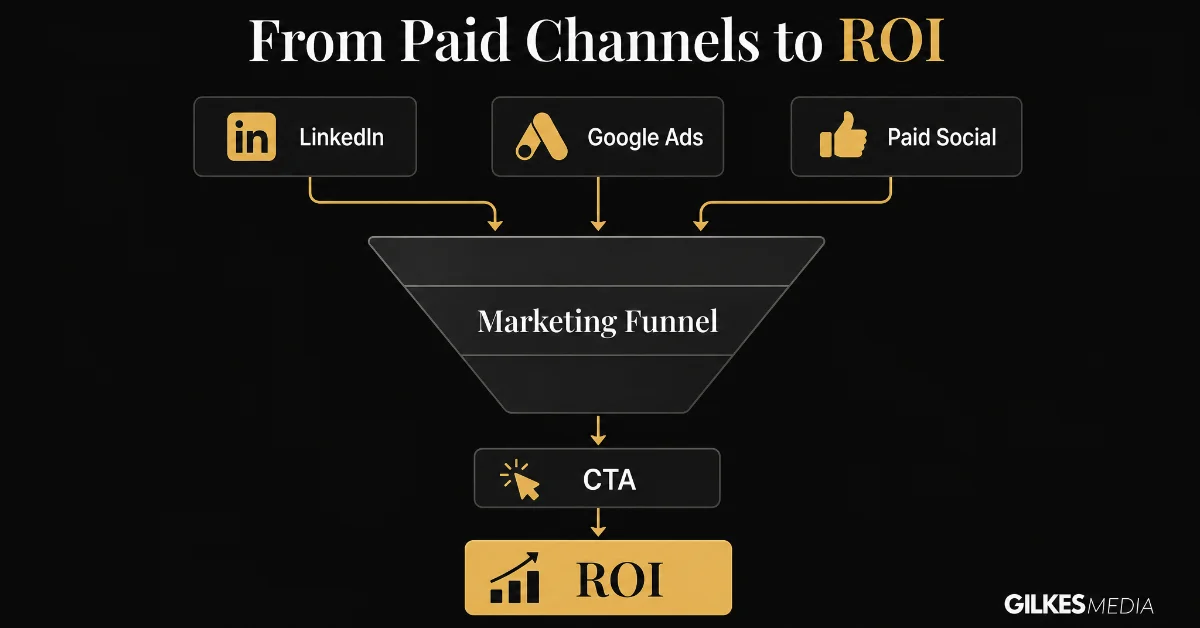
Your first decision is where to invest your money. There is no "best" platform, only the right platform for your business model, customer profile, and sales cycle.
A common mistake is spreading a small budget too thinly across multiple channels. This guarantees mediocre results everywhere. Instead, focus your resources where they will have the most impact.
Here is a simple framework for making that choice:
One of the first questions I am always asked is, "How much should I spend?" The honest answer is to start with a budget you can afford for testing, but ensure it is significant enough to gather meaningful data. Spending £100 over a month will not tell you anything useful.
Your initial focus should not be on profit, but on data.
The goal is to spend just enough to validate your chosen channel, targeting, and messaging. Once you find a combination that delivers leads at an acceptable Cost Per Lead (CPL), then you can scale the budget with confidence. This is the heart of a performance-focused, consultant-led approach.
A successful paid acquisition strategy is built on a simple feedback loop: Test, Measure, Scale. Invest a small budget to test an idea, measure the results against your target CPL, and only scale what is proven to work.
Ultimately, everything comes down to your numbers. If your CPL is £50 and you know that 1 in 10 leads becomes a customer (giving you a Customer Acquisition Cost of £500), you can instantly see if a campaign is profitable based on your average customer lifetime value.
This data-driven approach removes emotion and guesswork from your marketing. If you are looking for hands-on, specialist support, our PPC and paid ad services are designed to build exactly these kinds of profitable systems.
Paid ads get you results now, but a smart SEO and content strategy builds your business for the long term. This is not about paying for every single click. It is about creating a valuable asset that pulls in high-quality leads, 24/7, for years to come.
Many businesses treat their blog like a chore, posting company updates that nobody reads. That generates zero leads. A commercially-focused content strategy, however, treats every article as an asset designed to answer your prospects' biggest questions and meet them in their buying journey.
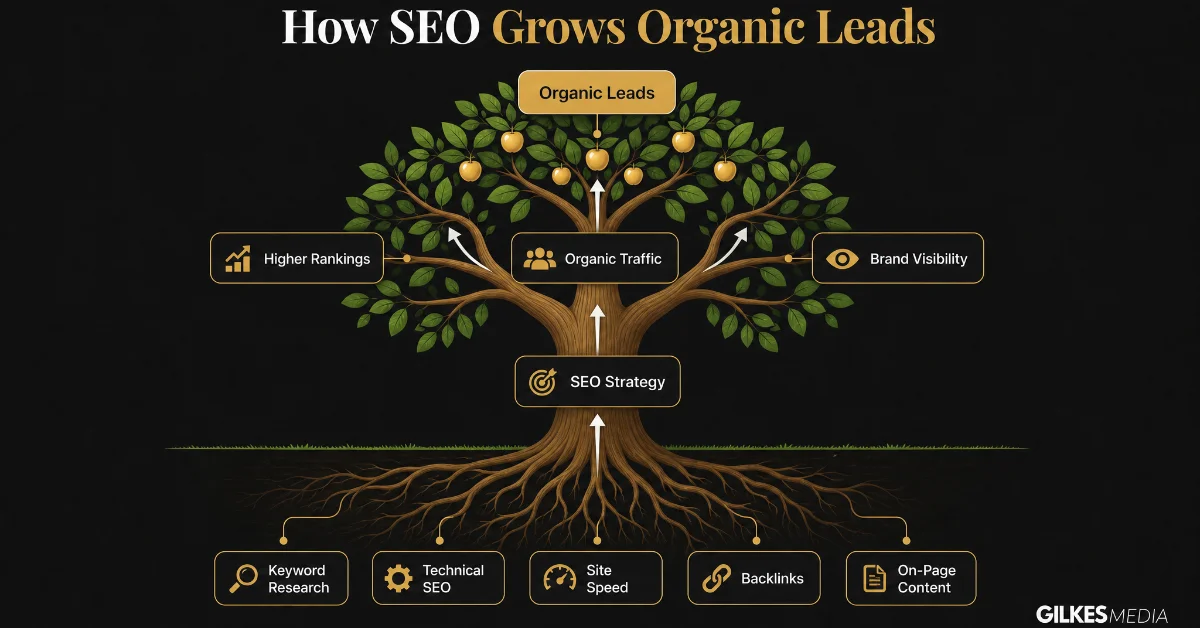
Effective content marketing starts by getting inside the head of your ideal customer. What are they typing into Google? This means moving beyond obvious keywords to focus on longer, more specific phrases that signal buying intent.
For example, a business trying to rank for "accountant" faces immense competition. But a business creating content for "fixed fee accounting for startups" speaks directly to a specific audience with a specific problem. That is where the commercial opportunity lies.
Your aim is to build a library of genuinely helpful content that solves the problems of your audience at every stage of their decision-making process.
Generating leads from SEO requires a complete system where technical health, on-page optimisation, and great content work together. If you neglect one pillar, the others will not perform.
A common mistake is treating SEO as a purely technical job. The best SEO strategy is always a customer-centric content strategy. When you create the most helpful resource for a search query, Google rewards you with traffic. It is that simple.
High-quality content is a powerful lead generation tool. First, every optimised blog post is another page for Google to index, creating one more digital doorway for people to find you. Research shows that websites with a blog generate 67% more leads on average than those without one.
Second, it builds trust and authority. When you consistently solve your audience's problems with valuable insights, you become the go-to expert. When they have a commercial need, you are the first business they think of. This is critical for generating inbound leads.
Finally, it gives you the perfect platform to place relevant calls-to-action (CTAs). An article on "The Best Candle Scents for Insomnia" can naturally lead to a CTA to browse your calming candle collection, capturing a lead at the precise moment of interest. You can learn more about this in our guide to SEO-friendly website development.
When you stop seeing content as a marketing expense and start treating it as a long-term commercial asset, you shift from renting attention with ads to owning a powerful lead generation machine.
Getting traffic to your website is only half the battle. If those visitors do not take action, your marketing spend is wasted. This is where a serious focus on Conversion Rate Optimisation (CRO) becomes a commercial necessity, transforming your website from a digital brochure into a relentless lead generation machine.
The goal is simple: get more value from every visitor. A small lift in your conversion rate from 1% to 2% literally doubles the output of your entire marketing engine without spending another penny on ads. It is the ultimate impact point for reducing your Cost Per Lead.
One of the most reliable levers for that lift is a genuinely useful gated offer. See lead magnets for B2B lead generation for what actually gets a B2B visitor to hand over their details.
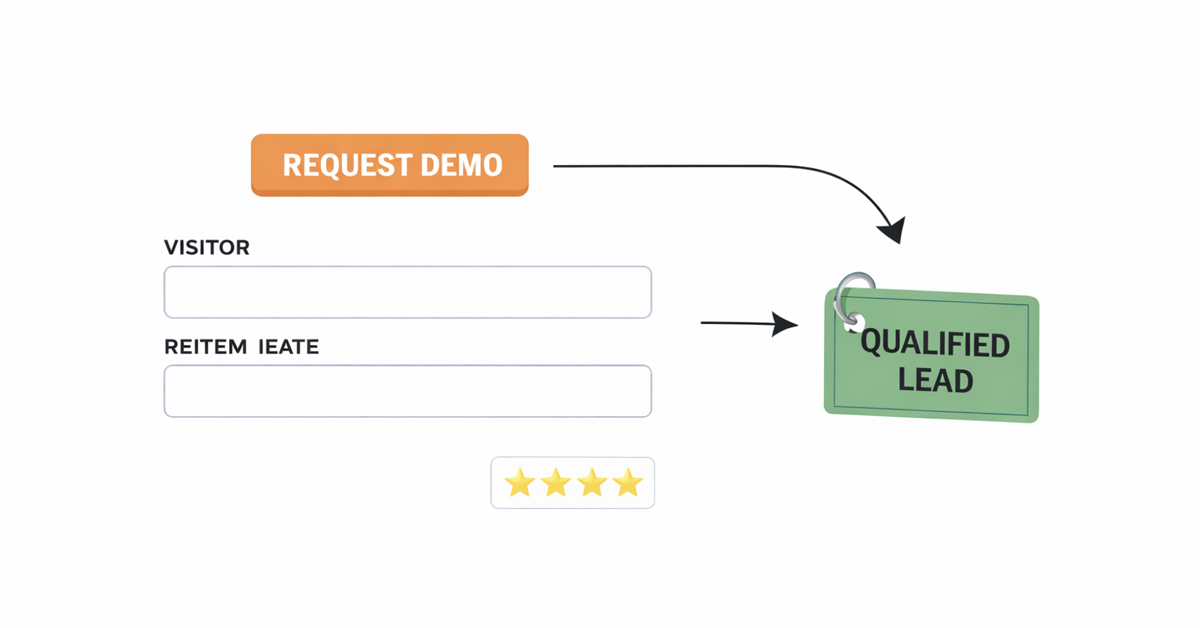
Before adjusting button colours, you need to get the foundations right. The best landing pages are built on core principles that build trust, create clarity, and guide visitors towards becoming a lead.
Your page must deliver on these fronts:
These are the essential building blocks of any page designed to turn traffic into tangible business opportunities.
Once your foundations are solid, you can start making smart, data-backed improvements through A/B testing. The process is straightforward: you create two versions of a page (Version A and Version B), show each to a segment of your audience, and measure which one drives more of your desired action.
The golden rule is to test one significant thing at a time. If you change the headline, the CTA, and the main image all at once, you will have no idea which change actually made the difference.
Your website is not a static document; it is a dynamic sales tool. The most successful businesses adopt a mindset of continuous improvement, using real user data to guide every decision.
Here is a simple framework to prioritise what to test first for the biggest impact.
| Element to Test | Why It Matters | Example A/B Test |
|---|---|---|
| Headline | It is the first thing visitors read. It has the biggest impact on whether they stay or leave. | Test a benefit-led headline vs. a feature-led one. E.g., "Save 10 Hours a Week" vs. "Advanced Automation Software". |
| Call-to-Action (CTA) | The CTA is the final hurdle. Its clarity and perceived value are make-or-break. | Test "Request a Demo" vs. "See It in Action". The second option often feels like a lower commitment. |
| Form Length | Friction kills conversions. The easier you make it to enquire, the more people will. | Test a 5-field form against a stripped-back 3-field version. Measure the uplift in submissions. |
This methodical approach removes guesswork. You make small, controlled changes, measure the real-world impact on your lead numbers, and implement the winner. Over time, these validated wins compound into a massive uplift in your overall lead generation performance.
An effective way to refine this process is through advanced lead qualification. This ensures your sales team focuses only on the most promising enquiries. You can learn more about boosting sales with AI lead qualification.
Finally, remember that getting the conversion is just the start. The next crucial step is turning that lead into a paying customer. For a deeper dive, check out our guide on lead nurturing best practices to maximise the value of every lead you generate.
In today's market, relying on a single channel to generate leads is ineffective. Your prospects are scattered across dozens of platforms. If your outreach does not appear where they are, you are leaving opportunity on the table.
Sticking to isolated tactics, like sending only cold emails or running only ads, is no longer sufficient. A cohesive, multi-channel approach is a commercial necessity for any business serious about growth. This means creating a persistent, coordinated presence across platforms like email, LinkedIn, and targeted advertising, making them work together as part of a single, intelligent campaign. When this synergy is right, the impact on your response and conversion rates is dramatic.
At the same time, practical AI tools offer a massive advantage. AI can supercharge these efforts by handling repetitive tasks, personalising communication at scale, and improving the quality of your outreach.
AI is not here to replace good sales and marketing professionals. It is here to make them smarter, faster, and more effective. Instead of spending hours manually finding prospects or writing hundreds of similar messages, you can use specific tools to automate this work. This frees you to focus on strategy, building relationships, and closing deals.
Here are a few practical ways to put AI to work:
Adopting AI is not a complex, expensive technical overhaul. It is about strategically picking simple, cost-effective tools that solve your biggest bottleneck, whether that is finding people, personalising messages, or managing follow-ups.
The key is to match the tool to the problem you are trying to solve. This table breaks down common lead generation challenges and the type of entry-level AI tools that can help.
| Business Challenge | Type of AI Tool | Example Functionality | Typical Starting Cost |
|---|---|---|---|
| Finding Quality Prospects | Sales Intelligence Platform | Filters companies by industry, size, and tech. Identifies key decision-makers. | £50 - £150 / month |
| Poor Email Response Rates | AI Writing Assistant | Generates personalised email copy based on a prospect's LinkedIn activity. | £20 - £50 / month |
| Inconsistent Follow-up | Sales Engagement Tool | Automates multi-step email and LinkedIn outreach sequences. | £40 - £100 / month |
| Manual Data Entry | CRM Data Enrichment | Automatically finds and adds missing contact details to records. | £15 - £40 / month |
Think of these tools as investments in efficiency. For a relatively small monthly outlay, you can reclaim hours of manual work and significantly lift the performance of your outreach.
An effective multi-channel strategy makes different platforms work together in a logical sequence. Your goal is to surround your ideal prospect with valuable, consistent messaging that builds familiarity and trust over time.
A classic B2B sequence might look like this:
This coordinated approach is far more effective than sending a single cold email. The data from multi-channel lead generation statistics on SendIQ.co.uk backs this up, showing that UK businesses using such strategies see conversion rates increase significantly.
By combining smart automation with a thoughtful outreach plan, you move beyond sporadic, hope-based marketing. You start building a predictable, scalable, and repeatable system for engaging high-value prospects and generating a consistent flow of qualified leads.
You cannot improve what you do not measure. In lead generation, this is the principle that separates predictable growth from expensive guesswork.
Once you have launched new channels and improved your conversion points, the final piece is a rigorous, data-driven feedback loop. This turns your marketing from a cost centre into a reliable revenue engine.
The best way to do this is with a simple but powerful Lead Generation Scorecard. This is not a complex analytics dashboard. It is a focused snapshot of the commercial metrics that truly matter. Review it consistently to keep your strategy honest and inform your next steps.
Vanity metrics like impressions or follower counts do not pay the bills. A proper scorecard ignores the fluff and focuses exclusively on Key Performance Indicators (KPIs) that have a direct impact on your pipeline and bottom line.
Your scorecard should be built around these essential metrics:
Tracking these numbers gives you a real-time view of what is happening. You can answer the most important strategic questions with data, not gut feeling.
You do not need fancy software. The scorecard can be a simple shared spreadsheet. What matters is the discipline of using it.
Update it weekly, or at least monthly. This lets you spot trends, celebrate what is working, and tackle underperformance before it becomes a major problem.
Here is a practical template.
| Metric | Last Month | This Month | % Change | Target |
|---|---|---|---|---|
| Total Leads | 50 | 65 | +30% | 60 |
| CPL (Google Ads) | £45 | £42 | -7% | < £50 |
| CPL (SEO) | £18 | £17 | -6% | < £20 |
| MQLs | 20 | 28 | +40% | 25 |
| Lead Velocity Rate | 8% | 12% | +4% | >10% |
This format instantly shows what is working. In this example, total leads and MQLs are exceeding targets, and both paid and organic channels are becoming more efficient. It is a clear signal that the current strategy is delivering.
Your Lead Generation Scorecard is your single source of truth. It removes emotion and opinion from strategic discussions, replacing them with hard data. It forces accountability and drives a culture of continuous, performance-led improvement.
With this clarity, you can make confident, commercially-sound decisions. Double down on the channels that are performing well. Pull budget from those that are lagging. Systematically refine your approach for an ever-improving ROI. This is the final step in building a sustainable and scalable lead generation machine.
Here are a few questions I am often asked when helping founders build their lead generation plans.
There is no single magic number, but a sensible starting point for most businesses is between 7% and 12% of total revenue.
If you are a new business or launching a new product, you will need to be more aggressive. In that case, pushing the budget closer to 15-20% is often necessary to gain initial traction.
A better way to think about it is to work backwards from your goals.
Figure out your revenue target. How many new customers do you need to hit it? What is your average lead-to-customer conversion rate? This simple calculation tells you how many leads you need to generate. From there, you can apply a realistic Cost Per Lead (CPL) for your chosen channels and build a budget tied to your commercial goals.
For immediate impact, nothing beats paid advertising.
Platforms like Google Ads or LinkedIn Ads can start sending targeted traffic to your site and generating leads within hours of a campaign going live. You are paying to put your message directly in front of an audience that is actively looking for what you sell.
On the other hand, SEO and content marketing are long-term investments. They deliver a much higher ROI over time by building a sustainable asset, but you need patience. It can easily take 6-12 months before you see significant, consistent results.
This depends on the path you choose.
With a well-structured paid advertising campaign, you should see your first leads within the first week. The first month is usually about gathering data and refining your targeting. From there, performance should steadily improve.
For SEO and content, you need to think in months, not days. You might see a trickle of leads within a few months, but the predictable flow of organic leads often kicks in after the six-month mark as your content builds authority and your rankings climb.
Ready to build a predictable, scalable lead generation engine for your business? At Gilkes Media, I work directly with founders as a senior marketing consultant to implement practical, performance-focused strategies that deliver measurable commercial results.
Book a free consultation to get started.
