
A lead fills in your form or calls your number. What happens in the next five minutes decides far more of the outcome than most businesses realise.
It is one of the least glamorous parts of running a marketing engine, and one of the most consistently underrated.
Most UK businesses do not have a speed problem with their marketing. They have a speed problem with what happens after the enquiry lands.
You can spend a fortune on Google Ads, Local Services Ads or SEO to generate a lead, and still lose it in the time it takes someone to check their inbox.
This guide covers what the research actually says about lead response time, why most businesses are slower than they think, and the practical steps to fix it.
Every figure here is drawn from published research, not a guess.
Most of it is US and international data, since no dedicated UK-specific study on this exact question appears to exist yet. The underlying behaviour still applies just as much to a UK buyer choosing between two local businesses, or two competing quotes.
Speed to lead is the time between a prospect submitting an enquiry and your business making genuine contact with them.
Genuine contact means a real conversation, not just an automated confirmation email landing in their inbox seconds later.
An automated "thanks for your enquiry" reply matters, but it is not the same thing. It buys you a little time, not a converted lead.
A new lead is at their most engaged the moment they submit an enquiry. That interest fades fast, and a competitor's response can arrive before yours.
Most buyers, especially for local services and time-sensitive B2B purchases, contact more than one provider at once. The first one to respond properly often wins the deal, regardless of who was actually the better fit.
Speed to lead is not about being pushy. It is about being present at the exact moment someone has already decided they want to talk to a business like yours.
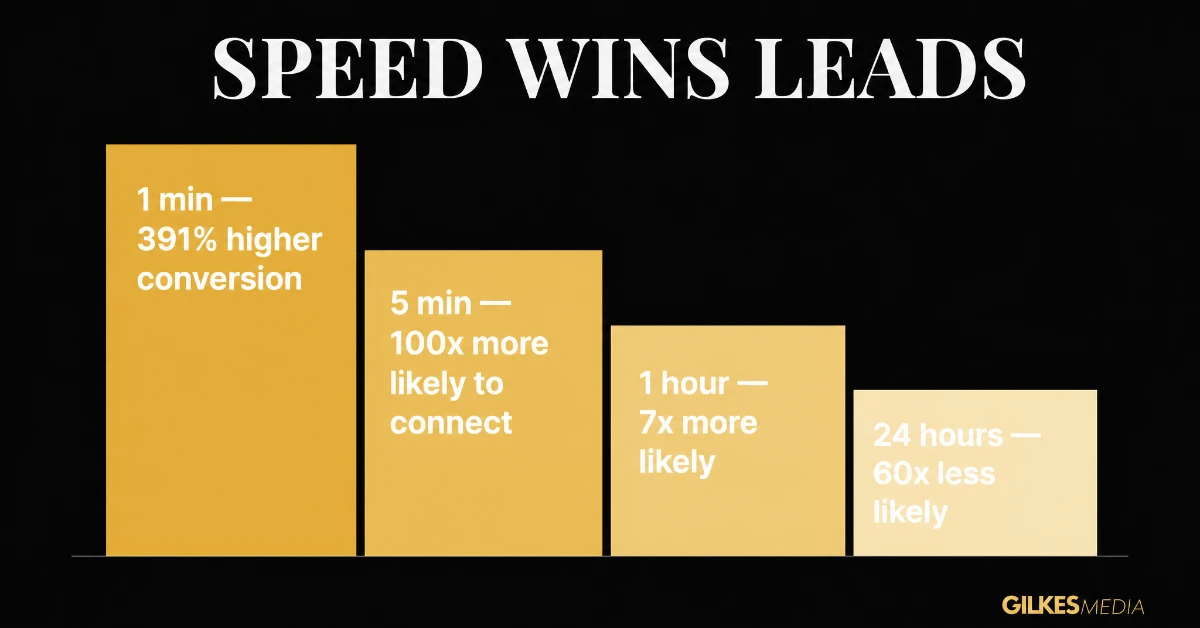
A widely cited study of over 2,000 US companies, often called the original lead response management research, looked at exactly this question.
It found that responding within an hour made a business seven times more likely to have a meaningful conversation with the lead than responding later.
The same research found that waiting 24 hours made a business roughly 60 times less likely to qualify that lead at all, compared with responding within the first hour.
Separate research from Velocify found that responding within one minute produced a 391% higher conversion rate than slower responses.
A widely cited Forbes analysis found that contacting a lead within five minutes made a business 100 times more likely to actually connect with them than waiting 30 minutes.
| Response window | Reported impact | Source |
|---|---|---|
| Within 1 minute | 391% higher conversion rate | Velocify |
| Within 5 minutes vs 30 minutes | 100x more likely to connect | Forbes |
| Within 1 hour | 7x more likely to have a meaningful conversation | Lead response management study |
| After 24 hours | 60x less likely to qualify the lead | Lead response management study |
Research from InsideSales found an 80% drop in lead qualification odds specifically between the 5 and 10 minute mark. That is not a gentle slope, it is a cliff edge.
The same research found that 51% of leads are never contacted at all by the business that generated them. Not slowly. Never.
The drop-off between five and ten minutes is not gradual. Every extra minute past the five-minute mark is measurably more expensive than the one before it.
Ask most business owners how fast they respond to leads and you will get an optimistic answer. The actual data tells a different story.
The original lead response management research put the average B2B response time at 42 hours. Nearly two full days, on average, across the companies studied.
A more recent 2026 benchmark study of 573 businesses found that 74% miss the five-minute response window entirely, even when they believe speed matters to them.
The same study found that among businesses that explicitly said a five-minute response was essential to them, only 62% actually delivered it in practice.
Most teams are not being lazy. Leads often land in a shared inbox, get triaged alongside everything else, and wait for whoever checks that inbox next.
Without an explicit target and someone clearly responsible for hitting it, "as soon as we can" quietly becomes the actual standard, even in businesses that would say speed matters to them.
A 2024 study testing 1,000 B2B companies with a genuine demo request found that 635 of them gave no visible response whatsoever. Only 172 offered anything close to an instant reply.
That is not a speed problem for most of those businesses. It is a process that has quietly broken down somewhere between the form and a human being.
An automated email confirming receipt is useful, but it is not a response in the sense the research measures. It does not answer a question or move the conversation forward.
A genuine response is a real person, or a genuinely conversational system, engaging with what that specific lead actually asked for.
The goal is acknowledgement within seconds, and a genuine conversation within minutes, not hours. The two are complementary, not interchangeable.
Different lead sources create different speed expectations, and treating every channel the same way wastes the fastest opportunities.
Someone who has just clicked a paid ad and filled in a form is actively shopping right now, often across more than one competitor's site in the same browsing session.
Paid leads are usually your most expensive leads per enquiry, which makes a slow response on them a doubly wasteful mistake: you paid for the click and then lost the customer anyway.
A missed call from a Local Services Ads campaign is about as close to a lost sale as it gets. The prospect is already dialling a competitor within minutes if nobody picks up.
Call tracking and a clear answering protocol matter more here than almost any other single fix available to a local service business.
Live chat sets an implicit expectation of an almost-instant reply. A form submission is more forgiving, but the research above shows that forgiveness runs out within minutes, not hours.
A chat widget nobody is actually monitoring is often worse than no chat widget at all, since it sets an expectation the business then fails to meet.
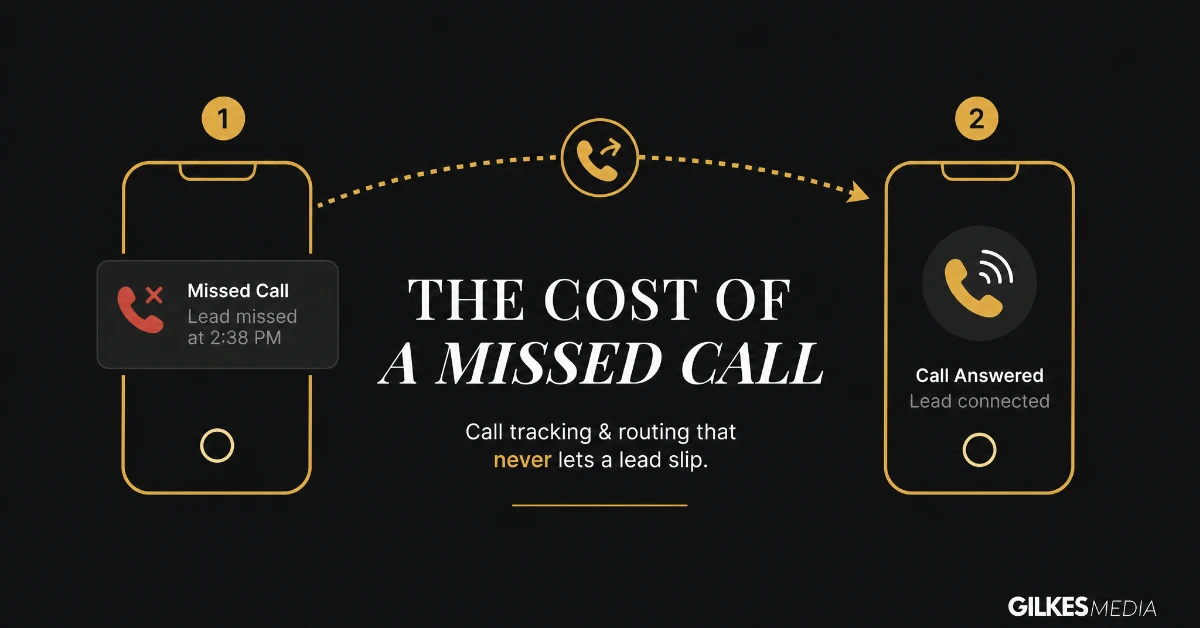
Phone leads deserve their own section, because a missed call behaves differently to a missed email. There is no queue, no inbox, just silence on the other end.
Someone calling a business has usually already decided they want to speak to a person right now, not exchange messages over the next hour.
A missed call does not sit patiently waiting for a callback the way an email does. Many callers simply move to the next search result and try someone else.
Industry reporting on Google Local Services Ads suggests the platform's own ranking system factors in response speed and missed calls, adjusting how often an ad is shown to future searchers based on how reliably a business answers.
If that reporting is accurate, a business missing calls is not only losing that individual lead. It may also be quietly losing visibility for every lead after it.
Call tracking numbers show exactly which campaigns generate calls and which of those calls actually get answered, rather than relying on guesswork or staff memory.
Simple call routing, forwarding an unanswered line to a second person or a mobile after a few rings, closes one of the most common and most fixable gaps in a local business's lead handling.
None of these require expensive new software. Most require a clear decision about who owns response time and holding to it.
None of this requires an expensive platform overhaul. Most businesses already own, or can cheaply add, everything needed to fix their speed to lead.
A written SLA on its own changes little if nobody is actually held to it. Speed to lead sticks when it becomes part of how a team measures its own performance.
A simple shared dashboard showing average response time, updated weekly, keeps the target front of mind without needing constant management intervention.
Teams that can see their own numbers tend to self-correct faster than teams waiting to be told there is a problem.
If commission or bonus structures reward closed deals but ignore response time, fast follow-up will always lose out to whatever task feels more urgent that day.
Even informal recognition, calling out the fastest responder in a weekly team update, signals that speed is genuinely valued, not just mentioned in a policy document nobody reopens.
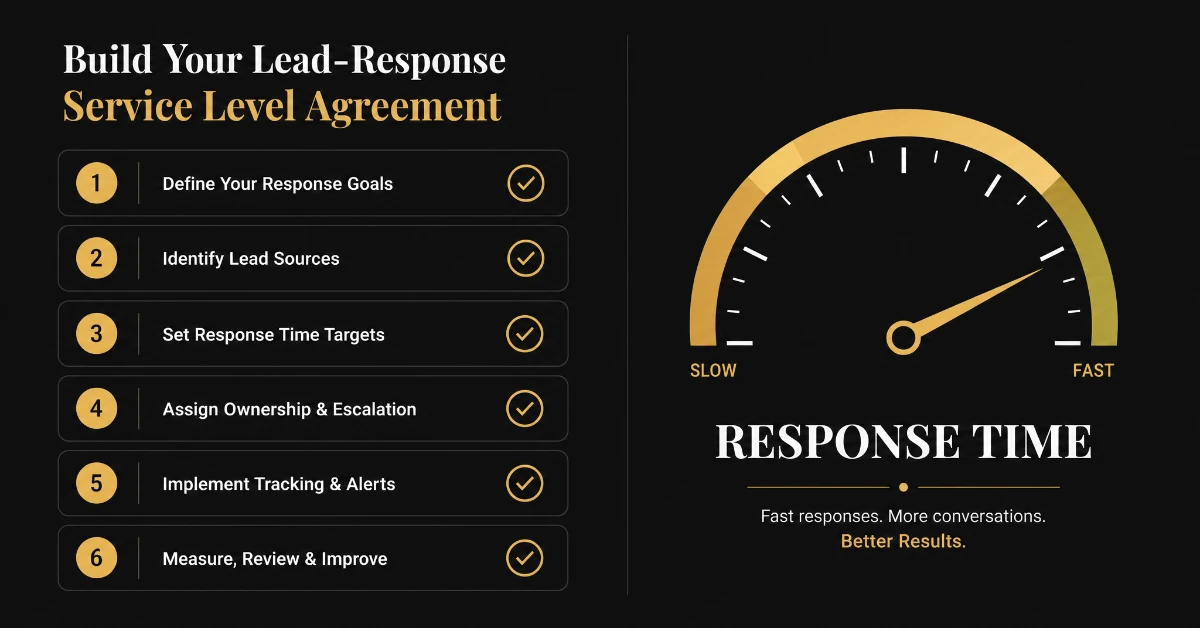
A service level agreement does not need to be complicated. It needs to exist, be specific, and be checked regularly.
This is exactly the gap AI lead nurturing systems are built to close: the moments between a lead arriving and a human being able to properly engage with it.
A well-built system replies within seconds, asks a genuine qualifying question, and flags the lead to the right person immediately, rather than leaving it sitting in a queue.
This does not replace a human conversation. It closes the gap between the enquiry and that conversation, which is exactly where the research above shows most value gets lost.
AI handles the instant, repeatable part well: acknowledgement, basic qualification, and routing. It should not be the only voice a serious prospect ever hears from your business.
The businesses that get the most from this combine fast automated first contact with a genuinely fast human follow-up, rather than using AI as a way to avoid speaking to leads at all.
The point of automating the first response is not to remove the human conversation. It is to make sure that conversation still has someone to have it with.
Most leads worth having are talking to more than one business at the same time, whether they say so or not.
Industry research into competitive B2B deals suggests the first business to respond properly wins roughly half of those competitive situations, often regardless of price or fit.
Being first does not guarantee the sale. It guarantees you get to make your case before a competitor has already framed the conversation.
The same 2026 benchmark study cited earlier found that businesses with a defined response-time service level agreement hit a 15-minute response target 54.9% of the time.
Businesses without a defined target managed the same 15-minute window only 29.5% of the time, despite presumably wanting to respond quickly too.
The gap between those two figures is not a technology gap. It is the difference between a stated intention and an actual measured standard.
A common worry is that chasing speed means chasing quantity over quality, contacting people before you understand what they actually need.
In practice, speed and qualification are not in conflict. A fast first response with one or two genuine qualifying questions moves a lead forward without slowing anything down meaningfully.
The trade-off to actually avoid is speed without relevance: firing off a generic reply so fast it clearly was not read. That damages trust rather than building it.
Take a UK business generating 100 leads a month at an average value of £500 per converted customer, currently converting at 20% with a same-day response habit.
That is 20 customers and £10,000 in monthly revenue from this lead flow. If a genuinely fast response process lifted conversion to 25%, a realistic figure given the research above, that becomes 25 customers and £12,500.
£2,500 a month, or £30,000 a year, recovered from leads you already paid to generate, without spending a single extra pound on advertising.
That is the real argument for fixing speed to lead before increasing ad spend: it is often the cheapest conversion improvement available to a business that already has enquiries coming in.
A boiler breakdown or a burst pipe is an urgent problem, and the caller is very likely dialling the next number on the list within minutes of no answer.
For these businesses, speed to lead is arguably the single most effective fix available, ahead of almost anything you could change in the marketing itself.
Longer sales cycles can create a false sense that speed matters less. In practice, being the first serious conversation a buyer has often shapes the entire evaluation that follows.
A slow first response can quietly rule you out of a shortlist before your actual proposal ever gets the chance to compete on merit.
Pre-sales questions submitted through a contact form behave similarly to any other lead: interest fades fast, and a competing site is one tab away.
A fast, genuinely helpful answer to a pre-purchase question converts noticeably better than the same answer delivered a day later.
A prospect enquiring about legal, financial or consultancy services is often comparing providers on trust as much as price, and a fast, considered first reply is itself a signal of how the engagement will feel.
A slow reply, by contrast, quietly suggests what working with that business might actually be like day to day.
Before fixing anything, it helps to know exactly where the delay actually happens. It is rarely the whole process, usually just one weak link in it.
If a lead could reasonably be answered by two or three different people, it often gets answered by none of them, each assuming someone else has it.
Some businesses insist a manager reviews every enquiry before a reply goes out. That extra step, however well-intentioned, adds exactly the delay the research above warns against.
A lead that lands in one system but only gets checked in another, less-monitored one, effectively vanishes for however long that gap lasts.
Leads generated by evening browsing or weekend searches are extremely common, and a business that only checks enquiries at 9am on Monday has already lost a full weekend's worth of momentum.
This is one of the clearest cases for at least a basic automated acknowledgement outside working hours, even if full human follow-up has to wait until the team is back.
You cannot improve what you are not tracking. Most CRMs and form tools log a timestamp for both the enquiry and the first genuine reply, if you look for it.
Pull this monthly alongside your usual marketing reporting, the same way you would already track cost per lead or conversion rate.
A simple average is a start, but also look at your worst cases specifically. A handful of very slow responses can drag down results far more than the average number suggests.
A few terms come up repeatedly once you start measuring this properly. Here is what they actually mean.
None of these need memorising. Recognising them in a CRM report or an agency's monthly update is enough to understand what is actually being measured.
Speed to lead sits right at the join between marketing and sales, which is exactly why it gets missed. Marketing generates the lead and sales handles the follow-up, and the gap between the two teams is where minutes quietly disappear.
Part of running effective lead generation is making sure the leads you generate are actually followed up fast enough to convert, not just generated cheaply.
If you already track cost per lead closely, response time is the natural next number to measure, since a cheap lead that never gets a fast reply was not actually cheap at all.
Pairing fast response with proper lead scoring means your fastest responses go to your best-fit leads first, rather than treating every enquiry identically.
Speed to lead is the time between a prospect submitting an enquiry and your business making genuine contact with them, meaning a real conversation rather than just an automated confirmation email.
Research points to five minutes as the critical window, with conversion odds dropping sharply between five and ten minutes. An instant automated acknowledgement followed by genuine human contact within minutes is the practical target.
Widely cited research puts the average B2B response time at around 42 hours, and a 2026 benchmark study found 74% of businesses miss the five-minute window entirely, even when they consider it important.
Yes. Multiple studies show significant gains: a 391% higher conversion rate for responses within one minute, and businesses responding within an hour being seven times more likely to have a meaningful conversation than those responding later.
An automated acknowledgement is useful and buys some time, but it is not a substitute for genuine engagement. A real response answers the specific question or need the lead raised.
Yes. Being the first serious conversation a buyer has often shapes their whole evaluation process, even on longer sales cycles, so a slow first response can rule a business out early.
A well-built AI lead nurturing system can acknowledge and begin qualifying a lead within seconds and flag it to the right person immediately, closing the gap between enquiry and human follow-up rather than replacing that follow-up.
Not if it is done well. A fast response with genuine qualifying questions moves things forward without sacrificing quality. The real risk is a generic reply sent so fast it clearly was not read.
Most CRMs and form tools log timestamps for both the enquiry and the first genuine reply. Pull this monthly, alongside your usual cost per lead and conversion rate reporting, and pay attention to your worst cases, not just the average.
Industry reporting on the platform's ranking factors suggests response speed and missed calls affect how often an ad is shown. This is third-party analysis, not a published Google formula, but treating fast response as important either way is the safer approach.
It is simply a specific, written response-time target with clear ownership. Businesses with one hit their target roughly twice as often as businesses without one, according to 2026 benchmark research, making it one of the cheapest fixes available.
If you would rather not build and monitor this process yourself, our AI lead nurturing systems handle instant acknowledgement and qualification for UK businesses as standard, with a fast human handover built in.
Get in touch for a free consultation and we will take it off your plate.
