
Ask three lead generation agencies what they charge and you will get three different answers, in three different currencies of thinking. One quotes a monthly retainer. Another quotes a price per qualified meeting.
A third wants to talk about your annual contract value before it will quote anything at all. None of them are lying to you.
Outsourced lead generation is genuinely priced across several different models. The "right" price depends entirely on which one you are being quoted, and what you are actually buying underneath it.
This guide sets out real 2026 UK figures for every pricing model in outsourced lead generation. It covers what drives a quote up or down, and what an in-house alternative actually costs once you add salary, National Insurance and tools.
It also covers how to spot a contract designed to protect the agency rather than get you meetings. We work on the marketing side of this equation rather than the outsourced telemarketing side, so we have no reason to talk the traditional model up or down.
What follows is simply what the market charges in 2026, cross-checked across several UK providers rather than taken from one agency's own price list.
"Lead generation services" is used loosely enough to cover three genuinely different things. Mixing them up is the single biggest reason people end up comparing quotes that are not actually comparable.
The first is outbound telemarketing and appointment setting. A team of callers works from a target list, qualifies prospects against a brief, and books meetings straight into your sales calendar.
This is the oldest model and still the most common one for higher-ticket B2B sales, particularly in construction, manufacturing, professional services and enterprise software. In these sectors, a genuine phone conversation still moves a deal forward faster than any digital channel.
The second is SDR-as-a-service. You effectively rent a sales development rep, or a small team of them, who work multi-channel outreach (email, LinkedIn, sometimes phone) against your own ideal customer profile under your brand.
It looks more like an outsourced hire than an agency campaign, and pricing tends to reflect that. You are largely paying for someone's time and attention, not a fixed volume of leads.
The third is digital lead generation: paid search, paid social and landing pages built to capture inbound interest at the moment someone is already looking. It produces a different kind of lead, usually cheaper per unit but often needing more nurturing before it is sales-ready.
That is because the prospect has expressed interest but has not yet had a real conversation with anyone at your business. Our cost per lead UK guide breaks down what these digital leads cost by channel and sector.
Almost no lead generation package includes the data or tool licences it depends on. Contact data subscriptions, the list-building and enrichment platforms, typically run to several thousand pounds a year on top of the service fee.
Most agencies either pass this cost through separately or expect you to hold your own subscription. Ask which applies before you compare two quotes side by side.
Nurturing what the campaign produces is usually excluded too. A booked meeting or a downloaded guide is the start of a sales process, not the end of one.
What happens to a lead in the days after it arrives often matters more than what it cost to generate. Our guide on speed to lead covers why response time has such an outsized effect on conversion.
Telemarketing and appointment setting generally suit a business with a high average deal value and a sales cycle measured in months rather than days. A single new client should easily justify the cost of a real conversation to get there.
SDR-as-a-service suits a business that wants the control and brand consistency of an in-house rep without committing to a full-time hire straight away. It often works as a bridge before making that hire permanent.
Digital lead generation suits a business with a lower average deal value or a shorter sales cycle. It also suits a product simple enough that a prospect can self-qualify from a landing page without needing a conversation first.
Most UK businesses we work with are not purely one or the other. The honest answer for a lot of service businesses is a blend, with paid advertising doing the volume work and a smaller, more targeted outbound effort reserved for the handful of accounts worth a bespoke approach.
"Lead generation services" covers three genuinely different models, telemarketing/appointment setting, SDR-as-a-service, and digital lead capture, and most quoted prices leave out the data subscriptions and nurturing work the campaign actually depends on.
Every outsourced lead generation quote you will see in the UK in 2026 falls into one of four structures. Here is what each one genuinely costs, based on current UK agency pricing rather than the headline "from £500 a month" figures some sites lead with to get you on a call.
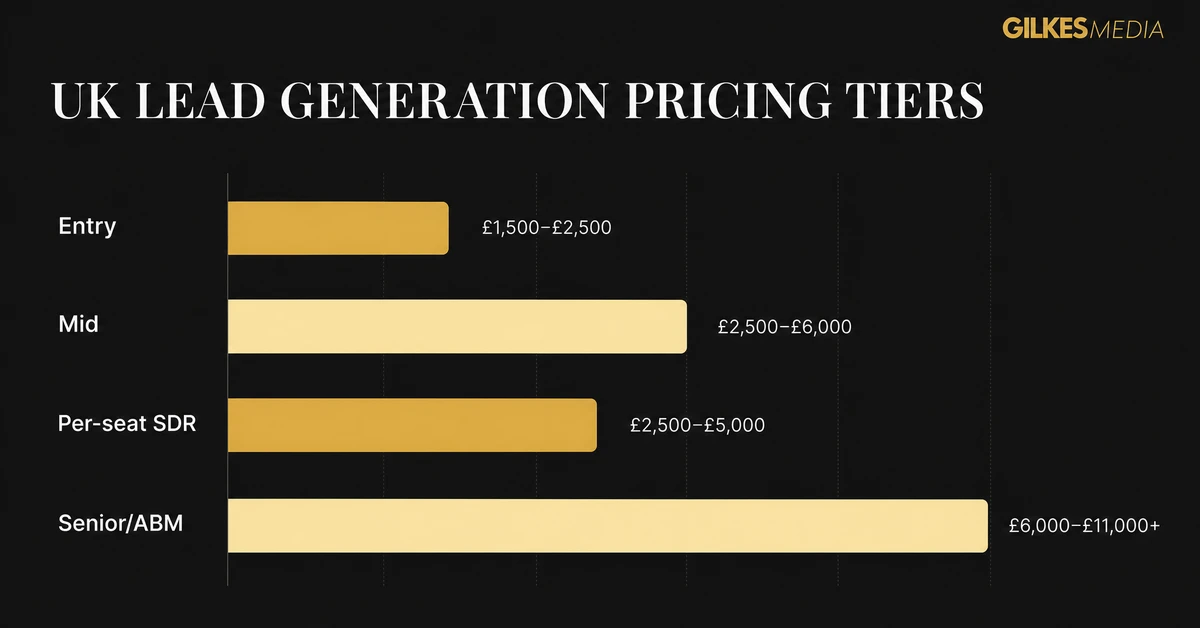
This is the most common structure for an ongoing campaign. You pay a fixed monthly fee regardless of exactly how many meetings land that month, in exchange for the agency carrying the campaign, the list, and the reporting.
Entry-level retainers, usually email and LinkedIn-led with a junior team, run roughly £1,500 to £2,500 a month. They typically deliver somewhere between 5 and 10 qualified meetings.
Mid-tier retainers, blending telemarketing, email and LinkedIn with dedicated campaign management, run £2,500 to £6,000 a month for 10 to 20 meetings. Senior-led or account-based campaigns, where experienced callers target named accounts and decision-makers, run £6,000 to £11,000 a month or more.
Here you only pay once a meeting matching your agreed criteria actually lands in your calendar. It looks lower-risk, and for a business that cannot forecast volume it can be.
The price per appointment reflects that the agency is carrying more of the risk. Simple, lower-qualification appointments run roughly £50 to £200 each.
Appointments with a stricter qualification bar, a named seniority such as director level or above, or a confirmed budget, run £150 to £500 each. The gap between those two numbers is almost always about how tightly "qualified" is defined in the contract.
This model prices a lead rather than a booked meeting. The prospect has shown interest and passed a qualification step, but has not necessarily agreed to a call yet.
For B2B services, qualified leads priced this way typically run £35 to £150. That's broadly in line with the B2B cost-per-lead figures in our cost per lead UK guide.
By channel, telemarketing-sourced leads tend to run £30 to £200, and email outreach £10 to £50. LinkedIn prospecting runs £30 to £100, and PPC-sourced leads £20 to £300 or more depending on how competitive the keywords are.
Some providers rent you a dedicated SDR, or a fraction of one, who works exclusively on your campaign under your brand guidelines rather than splitting time across several clients. This typically runs £2,500 to £5,000 per seat, per month, in the UK.
It sits closer to an outsourced hire than a traditional agency retainer. You are buying dedicated time, not a shared team working several accounts at once.
| Tier | Monthly cost | Typical output | What's included |
|---|---|---|---|
| Entry | £1,500–£2,500 | 5–10 qualified meetings | Email + LinkedIn outreach, junior team, basic reporting |
| Mid | £2,500–£6,000 | 10–20 qualified meetings | Blended telemarketing, email and LinkedIn, dedicated campaign manager |
| Senior / ABM | £6,000–£11,000+ | 20+ qualified meetings, named accounts | Senior callers, account-based targeting, weekly strategic reporting |
| Per-seat SDR | £2,500–£5,000 per seat | Varies by seat capacity | Dedicated rep working exclusively under your brand |
Retainers run roughly £1,500 to £11,000+ a month depending on seniority and scope, pay-per-appointment runs £50 to £500 depending on how strictly "qualified" is defined, and pay-per-lead for B2B services typically lands between £35 and £150.
The gap between the cheapest and most expensive quote you receive for what sounds like the same service almost always comes down to a handful of specific factors. It is rarely just an agency padding its margin.
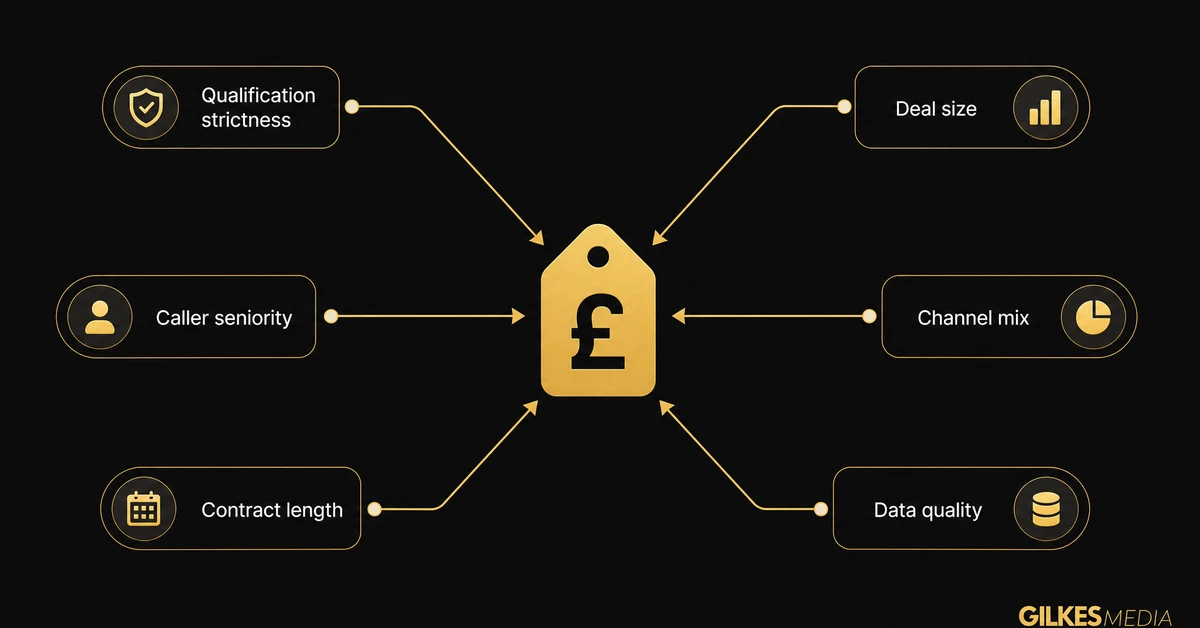
These factors compound rather than stack neatly. A senior-led, multi-channel campaign targeting named enterprise accounts in a regulated sector like financial services or healthcare will sit at the very top of the ranges above, not because the agency is overcharging.
Compliance sign-off adds extra steps to every conversation in those sectors, which genuinely adds cost. Conversely, a straightforward campaign targeting a well-defined local trade audience with a simple offer can be delivered well at the entry tier.
Worth flagging directly: the strictness of the qualification definition is where most disputes with lead generation agencies actually start. Get it written into the contract in plain, checkable terms, job title, company size, confirmed next step, rather than a vague phrase like "genuinely interested".
One of the most common reasons a business wrongly concludes an outsourced campaign "doesn't work" is judging it against the wrong timeline. A properly run campaign has distinct phases.
Volume in week one is not meant to look like volume in week ten, and a fair review needs to account for that.
The agency defines your ideal customer profile in detail, builds or buys the target contact list, and drafts the initial messaging or call script for your sign-off. Almost no meetings get booked in this phase.
That is normal, not a warning sign, provided you can see the list and messaging being built rather than just being told it is happening.
Outreach goes live and the first responses and meetings start to come in, usually at a lower rate than the eventual steady state. Messaging gets refined against what is actually landing.
This is the phase where reporting matters most. You want calls made, response rates and early meeting quality on a weekly basis, not just a running total.
That way a genuinely misfiring campaign gets caught and corrected, rather than discovered at the three-month review when the budget has already gone.
Volume should stabilise into the range promised at the outset. This is the point at which the campaign's real cost per meeting becomes visible and comparable to what was quoted.
Judging value before this point, particularly cancelling a contract in month one because volume looks thin, is one of the more expensive mistakes a business can make. Most of the setup cost has already been paid for and abandoned before it had a chance to earn it back.
Most agencies need four to eight weeks of setup and testing before volume stabilises. Judging a campaign, or cancelling one, in its first few weeks is one of the most expensive mistakes a business can make with a lead generation budget.
The obvious alternative to outsourcing is hiring your own business development representative. On paper the salary looks cheaper than an agency retainer.
In practice, the fully-loaded cost rarely is, once you add what a salary figure alone leaves out. Indeed's UK salary data, based on 1,100 reported salaries and last updated in July 2026, puts the average UK BDR salary at £33,853 a year.
Employer National Insurance for 2026/27 is 15% on earnings above the £5,000 secondary threshold, adding roughly £4,330 a year on that salary. A minimum 3% employer pension contribution adds a further £1,015 or so.
Before a single tool or data subscription is bought, you are already at approximately £39,200 a year, not £33,853. That gap alone is worth knowing before you compare a salary figure to an agency quote.
Add the tools a BDR actually needs. CRM seats typically run £50 to £150 a month per user, £600 to £1,800 a year, and B2B contact data subscriptions commonly run to several thousand pounds a year on their own.
Recruitment, onboarding and the ramp-up period before a new hire is fully productive, commonly three to six months of reduced output, add a real but harder-to-pin-down cost on top of that again.
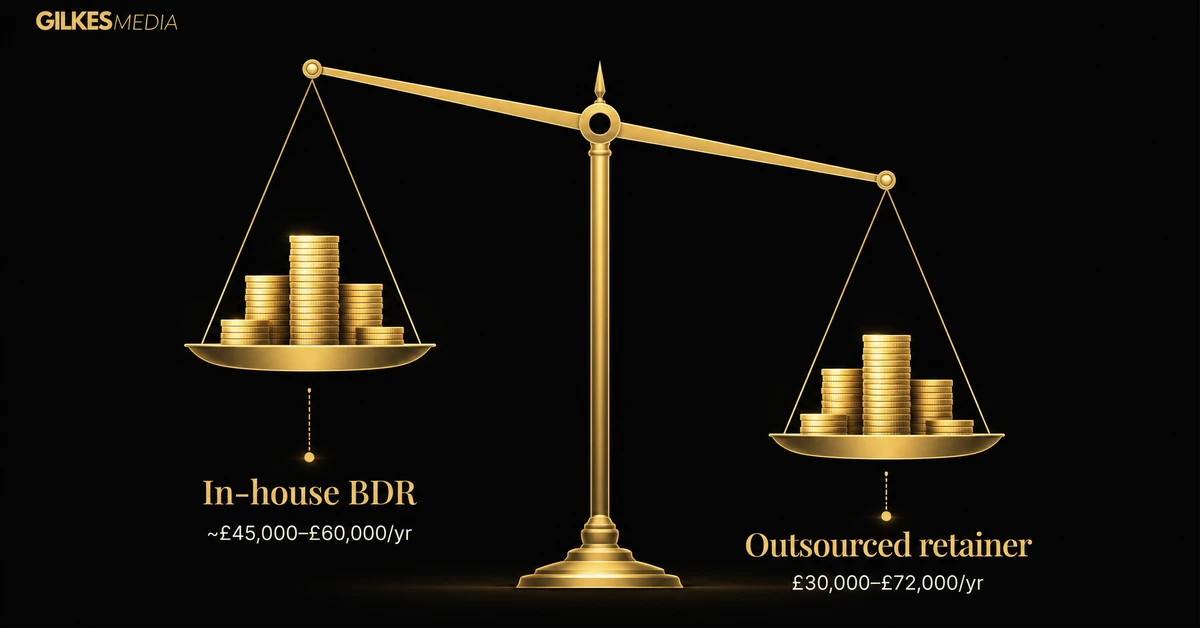
All told, a genuinely fully-loaded first-year cost for one in-house BDR in the UK commonly lands somewhere between £45,000 and £60,000. It can run higher still once recruitment and management time are counted properly.
Set against that, a mid-tier outsourced retainer at £2,500 to £6,000 a month works out to £30,000 to £72,000 a year. That covers the same tools and a team rather than one individual, so no single point of failure when someone is off sick or leaves.
The outsourced option is not automatically cheaper across a full year, especially at the top of that range. But it is very often cheaper and faster in the first year specifically, exactly when an early-stage business needs it to be.
The trade-off runs the other way over a longer horizon. An in-house hire builds product knowledge, relationships and pipeline history that stays with your business.
An agency relationship, however good, is renting that capability rather than owning it. The moment the contract ends, so does the campaign history and, often, the momentum.
A UK business development representative's true first-year cost, once National Insurance, pensions, tools and ramp-up are added to the £33,853 average salary, commonly lands between £45,000 and £60,000, not far from a senior outsourced retainer, but without the team redundancy an agency provides.
Lead generation is an easy service to sell badly, because results take weeks to show. A contract can trap you long before you find out the campaign was never going to work.
Run through this before signing anything.
A senior pitch followed by a junior delivery team is one of the most common gaps between quote and reality, so point four above is worth pressing on directly during the sales process itself.
Our guide to vetting B2B lead generation companies goes further into how to run this process properly, including the questions worth asking on the actual sales call rather than just the proposal document.
It is also worth asking whether a shorter initial trial period is available before committing to a six or twelve-month term. A confident agency with a genuinely repeatable process will often agree to a 90-day trial at a small premium on the monthly rate.
That is a reasonable price to pay for the option to walk away cleanly, once the campaign has had a fair run through the setup and testing phases described above.
The biggest risk in outsourced lead generation is rarely the headline price. It is a vague qualification definition, a long contract term, and a delivery team that turns out to be more junior than the one who pitched you.
Telemarketing and appointment-setting style lead generation earns its price for genuinely high-ticket, long-cycle B2B sales, where a real conversation with the right person is worth paying for directly.
For a lot of UK service businesses, though, it is solving a problem that a combination of managed paid advertising and proper follow-up on the leads already coming in solves more cheaply.
A well-run paid ads campaign across Google, Meta or LinkedIn produces leads at £10 to £150 depending on channel and sector, all data covered in our cost per lead guide.
Unlike an outsourced telemarketing team, you own the ad accounts, the audience data and the campaign history outright once the engagement ends. The genuine weak point of that approach is what happens after the lead arrives.
Digital leads convert on speed and consistency of follow-up far more than outbound-sourced ones do. That is exactly the gap AI lead nurturing is built to close.
It provides automated, instant first response and structured follow-up on every lead a campaign produces, without needing a headcount decision to do it consistently. Our AI lead nurturing cost guide sets out what that actually costs.
It is genuinely worth comparing against an outsourced telemarketing retainer before assuming the traditional route is the only one available. Neither approach is universally right.
Which one fits depends on deal size, sales cycle, and how much of the relationship-building work genuinely needs a human on the phone.
If you are building a marketing budget from scratch, our guide on how much a UK small business should budget for marketing covers the wider picture.
As a rule of thumb for lead generation specifically, businesses selling a lower-ticket product tend to get better value from digital lead generation. Volume and speed matter more than a bespoke conversation with every prospect.
Businesses selling a high-ticket, considered B2B purchase, where a single new client is worth tens of thousands of pounds, can usually justify a mid-to-senior outsourced retainer on cost-per-meeting economics alone. That's provided the qualification bar in the contract is genuinely strict.
A useful worked check before you commit budget either way: take your average customer lifetime value, and work out what you can realistically afford to pay to acquire one new customer.
Multiply that by your expected lead-to-customer conversion rate to get a ceiling cost per lead or per meeting. If an agency's quote sits comfortably under that ceiling, that is a genuine reason to trust the numbers.
If it sits right up against the ceiling, treat the quote as a best-case scenario, not a safe one.
As a worked example: a UK B2B services firm with an average customer lifetime value of £15,000 and a target customer acquisition cost of 15% of that figure can afford to spend roughly £2,250 to win one new customer.
If one in five booked meetings converts to a paying client, that firm can justify paying up to £450 for a single qualified meeting and still hit its acquisition-cost target. That's comfortably inside the £150 to £500 senior-tier appointment pricing set out earlier in this guide.
The same maths done against a £3,000 average customer value would rule the senior tier out almost immediately. It would point that business towards a lower-cost, higher-volume digital approach instead.
Work out what you can afford to pay for one new customer, multiply by your lead-to-customer conversion rate, and use that as your ceiling cost per lead or meeting before agreeing any quote, digital or outsourced.
Most UK outsourced lead generation retainers run from around £1,500 a month for an entry-level, email and LinkedIn-led campaign up to £11,000 or more a month for a senior-led, account-based campaign targeting named enterprise accounts. Mid-tier blended campaigns typically sit between £2,500 and £6,000 a month.
It depends on your risk tolerance and volume. Pay-per-lead or pay-per-appointment shifts more risk onto the agency and suits a business that cannot forecast demand confidently, but the per-unit price is usually higher to compensate. A retainer suits a business that wants predictable monthly cost and is confident in the agency's ability to deliver consistent volume.
For B2B services, a qualified lead typically costs £35 to £150, though this varies significantly by sector and deal size. The better benchmark is not an industry average but your own ceiling: what you can afford to pay based on customer lifetime value and conversion rate, covered in our cost per lead UK guide.
Not usually in the first year. The average UK BDR salary is £33,853, but once employer National Insurance, pension contributions, tools and recruitment or ramp-up time are added, the fully-loaded first-year cost commonly lands between £45,000 and £60,000, comparable to a senior outsourced retainer without the built-in team redundancy an agency provides.
A specific, checkable definition of what counts as a qualified lead or meeting, the minimum contract term and exit clause, confirmation of who will actually deliver the campaign day to day, where the target data comes from and its compliance basis, and the reporting cadence you will receive.
Most agencies need four to eight weeks to build and test the target list and messaging before volume stabilises. Judging a campaign on its first two to three weeks alone, before the targeting has been refined, is one of the most common reasons businesses wrongly conclude a good agency isn't working.
It can work for smaller businesses, but the economics need checking carefully. A high average deal value can justify the cost even at low volume, but a business with a lower-ticket product usually gets better value from digital lead generation and nurturing, where cost per lead is typically lower and volume matters more than a bespoke conversation with each prospect.
Managed paid advertising (Google, Meta, LinkedIn) paired with fast, automated AI lead nurturing on every lead that comes in. It suits businesses where digital intent-based leads convert well with prompt follow-up, and it leaves you owning the ad accounts, audience data and campaign history rather than renting access to an agency's calling team.
If you are weighing up an outsourced lead generation quote against building your own pipeline through paid advertising, SEO or AI-driven follow-up, we are happy to talk through the real numbers for your specific sector and deal size.
Book a free discovery call and we will give you a straight answer, including if outsourced telemarketing is genuinely the better fit for what you are selling.
