
Search "PPC agency UK" and you'll get thousands of results, most of them sounding identical. Every site promises "data-driven strategies" and "proven results", and almost none of them tell you what you'll actually pay or how they'll actually work.
That makes choosing one of the most consequential, least transparent decisions a business owner makes. Get it right and you get a genuine growth partner. Get it wrong and you lose months of budget to an account nobody is really watching.
Most UK businesses only go through this process once every few years, so there's no built-up instinct for spotting a weak agency versus a genuinely good one. This guide is built from the questions worth asking and the answers that should worry you.
This guide covers exactly how UK PPC agencies charge in 2026, the red flags worth walking away from, the questions to ask before you sign anything, and a straightforward process for making the final call.

Pay-per-click advertising is unforgiving of a bad manager in a way organic marketing isn't. A weak SEO strategy wastes time; a badly run Google Ads account burns real cash, every single day, whether it's converting or not.
The gap between a good PPC agency and a mediocre one usually isn't visible in a sales pitch. It shows up three months in, in wasted spend on broad match keywords, unchecked audience overlap, and campaigns nobody has touched since launch.
The cheapest agency on your shortlist is very rarely the cheapest option once you account for wasted ad spend. A £400-a-month agency mismanaging a £3,000 monthly budget can cost you more than a £1,500-a-month agency doing the job properly.
This is why the vetting process matters as much as the pitch. You're not just buying a service, you're handing someone the keys to your ad budget and, usually, your CRM data too.
"PPC agency" is a broad label. Some agencies run Google Ads exclusively, some cover the full paid social stack, and a growing number pitch themselves as full-funnel paid media specialists across every platform at once.
Knowing which platforms actually matter for your business narrows your search considerably, and stops you paying a generalist agency to learn a platform on your budget.
Still the default starting point for most B2B and service businesses, because it captures people already searching for what you sell. See our full breakdown in Google Ads Cost UK for what a click actually costs by industry.
Best suited to businesses that need to build demand rather than just capture it, with strong visual creative and broad audience reach. Our Meta Ads Cost UK guide covers current CPMs and budget bands.
The only platform of the four that reliably targets by job title, seniority, and company size, which matters enormously for B2B lead generation despite a higher cost per click. See LinkedIn Ads Cost UK.
Increasingly relevant even for B2B, though it demands a different creative approach entirely. Our TikTok Ads for B2B article covers whether it's genuinely worth testing for your sector.
Microsoft's Bing Ads platform is a smaller, cheaper pool of the same search intent as Google Ads, and worth a mention if an agency never raises it. Programmatic display buys are a different discipline again, better suited to brand awareness than direct response.
Neither needs to be part of your first campaign. An agency that mentions them as a genuine later-stage option, rather than an upsell on day one, is usually thinking about your account rather than their own invoice.
If you're still unsure which platform deserves your first pound of budget, our platform comparison guide walks through the decision in full.
A PPC agency's platform label matters less than whether they can prove real results on the specific platform your buyers actually use. Ask for proof on that platform, not a generic case study deck.
Pricing is where most confusion starts, because agencies quote fees in three completely different ways, and rarely explain which one they're actually using until the proposal lands.
The most common model for SME budgets: typically 10-20% of monthly ad spend, dropping to roughly 5-10% once spend reaches enterprise levels, where the fixed workload no longer scales with the budget.
This model is simple to understand, but ask what happens at low spend. A 15% fee on a £1,000 budget is only £150, well below what proper management costs.
That's why most agencies set a minimum monthly fee alongside a percentage model, so it's worth asking for the actual figure early rather than assuming your quoted percentage is the whole story.
Worked example: at £5,000 a month in ad spend, a 15% fee comes to £750. If a flat retainer quote for the same scope comes in at £1,200, ask exactly what extra you're getting for the difference before assuming the percentage model is cheaper.
A fixed management fee regardless of spend, sat on top of your actual ad budget. This is now the more common structure among UK agencies, since it removes any incentive for the agency to push your spend higher than it needs to be.
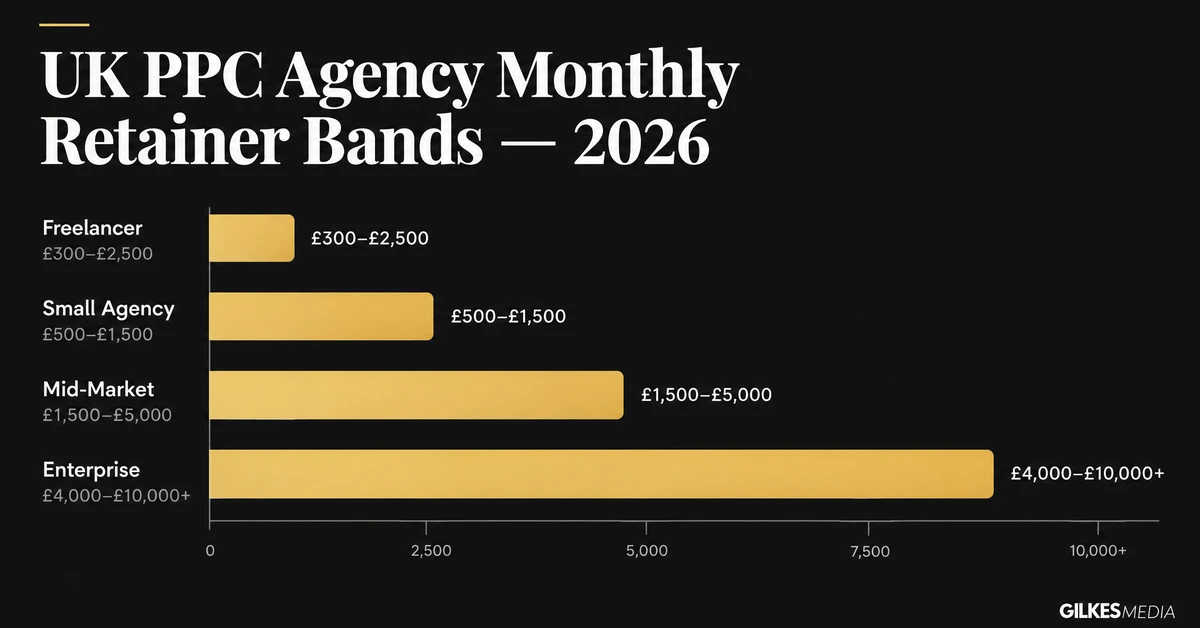
Retainers scale with business size and complexity rather than budget alone. The table below shows the ranges we see quoted consistently across UK agencies in 2026.
| Business size | Typical monthly retainer | What it usually includes |
|---|---|---|
| Freelancer / solo consultant | £300-£2,500 | Single-platform management, limited reporting depth |
| Small agency | £500-£1,500 | One to two platforms, shared account manager |
| Mid-market agency | £1,500-£5,000 | Multi-platform, dedicated strategist, monthly reporting calls |
| Enterprise / specialist | £4,000-£10,000+ | Full-funnel management, dedicated team, weekly optimisation |
Most UK small businesses land in the £800-£1,500 management fee band, on top of £1,500-£3,000 or more in actual ad spend, for a realistic combined monthly outlay of around £2,000-£4,000.
Less common for ongoing management, but sometimes used for audits or short, defined projects, typically billed at a senior specialist's day rate rather than a junior hourly figure.
A genuine hybrid, a smaller base fee plus a performance bonus tied to agreed outcomes, can align incentives well. Be wary if the "performance" element is tied to vanity metrics like clicks rather than leads or revenue.
A one-off setup fee for the initial account build, typically £250-£2,500 depending on how many campaigns and platforms are involved, is standard practice and worth budgeting for separately.
Many agencies also set a minimum ad spend, commonly £2,000-£5,000 a month, because smaller budgets simply don't generate enough data to optimise meaningfully. If your budget sits below that, say so upfront rather than discovering it during onboarding.
There's no single "correct" pricing model. What matters is whether the agency can explain theirs clearly, in one sentence, without you having to ask twice.
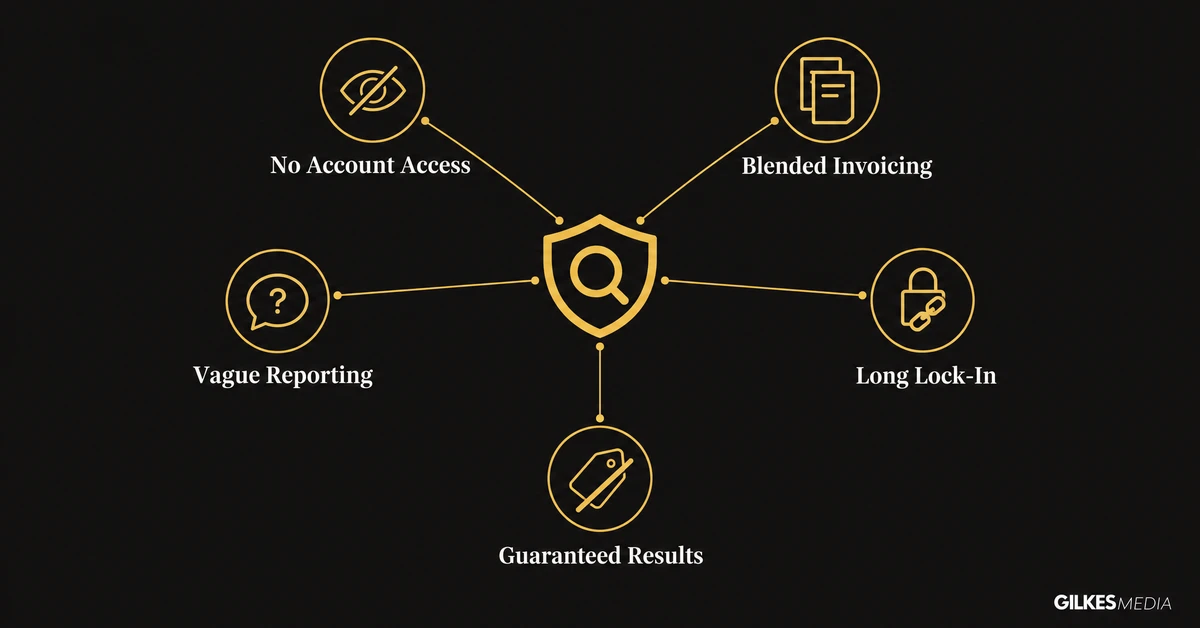
Most agencies that go on to disappoint a client show warning signs during the sales process itself. Ten come up consistently enough to be worth naming directly.
Any one of these alone might have an innocent explanation. Two or more together, especially account access and blended invoicing, are a genuine reason to walk away regardless of how good the pitch sounds.
Most of these are easy to test directly. Ask for account access on the first call, ask to see a real reporting dashboard rather than a screenshot, and ask what happens if you want to leave next month.
If you can't see your own ad account, you don't have an agency partner, you have a black box. Insist on full access before you sign, not after.
A genuine sales call feels like a two-way interview. These questions, asked directly across three areas, tend to separate agencies that know their craft from agencies reciting a script.
Who actually touches your account matters more than the agency's overall headcount or office address.
This is where a vague, generic proposal usually falls apart under direct questioning.
Leave these until you've decided you like the agency, but never skip them entirely.
Pay close attention to how specific the answers are. A confident agency answers the underperforming-campaign question with a real, slightly uncomfortable story. A weak one changes the subject.
You'll see the Google Partner badge on most PPC agency websites. It's a genuinely useful signal, but only if you understand what it's actually measuring.
Standard Google Partner status requires at least 50% of an agency's account strategists to hold current Google Ads certifications, plus a minimum, undisclosed level of managed ad spend over a rolling 90-day period.
Premier Partner status, the tier above it, requires ranking in the top 3% of all participating agencies in the country for client growth and retention, recertified annually against the previous year's actual performance data.
The badge confirms sustained competence and genuine client retention, both worth something. It does not confirm the agency is right for your specific industry, or that the certified strategist named on the badge will be the one working on your account.
Treat it as one useful data point among several, not a substitute for the vetting questions above. A Premier Partner badge combined with a vague answer on account ownership is still worth walking away from.
A Google Partner badge is evidence of competence, not a guarantee of fit. Verify it's current on Google's own directory, then keep asking your own questions regardless.
Every agency website has a case studies page, and almost every one of them is written to flatter the agency rather than inform you. It's still worth reading properly, just with the right filter on.
"300% increase in leads" means nothing without knowing the starting point. Three leads becoming twelve is a very different story to three hundred becoming twelve hundred, and a genuinely confident agency will show both numbers.
A written testimonial can be lightly edited or cherry-picked from a longer, less glowing conversation. A genuine agency will happily connect you with an existing client for a short call, ideally one in a similar sector or budget range to yours.
Google Business Profile and Clutch reviews are harder to curate than an agency's own testimonials page. Read a handful of the three-star reviews, not just the five-star ones, since that's usually where the honest detail about account access and communication actually surfaces.
A case study with no starting number and no willing reference contact is marketing copy, not evidence. Ask for both before you take any headline percentage at face value.
Beyond pricing and platform, one structural decision shapes everything else: do you want a specialist that does one thing exceptionally well, or a full-service agency that handles paid media alongside everything else?
A pure-play PPC specialist usually wins on depth. If you already have SEO, content, and design handled elsewhere and just need someone sharp on Google Ads or Meta, specialisation is usually worth the coordination overhead.
Full-service agencies suit SMEs consolidating several vendors into one relationship, and B2B businesses that need paid media, SEO, and landing pages working from the same attribution model rather than three disconnected reports.
There's a practical benefit too: when the same agency owns both your ad campaigns and your landing pages, a weak conversion rate gets fixed as one problem rather than becoming a dispute between two separate suppliers each blaming the other's work.
Neither option is objectively better. The honest question is whether your marketing already has enough moving parts that a single accountable partner, tracking everything against one shared goal, is worth more than raw platform depth.
Some sectors have rules that a generalist agency can genuinely get wrong, sometimes badly enough to get your account suspended.
Financial services, legal, and healthcare advertisers all face extra certification requirements from Google and Meta, plus CAP Code and ASA rules on the claims an ad can make. Ask directly whether the agency has run campaigns in a regulated sector before, and ask for proof.
Longer sales cycles and smaller total search volumes mean generic keyword strategies often waste spend fast. An agency with genuine experience in your specific vertical will already know which search terms convert and which just look impressive in a proposal.
If your sector is niche, weight sector experience more heavily than platform certifications when you're comparing shortlisted agencies. A generalist with no relevant experience usually has to learn your market on your budget.
Ecommerce accounts lean heavily on Shopping campaigns and product feed management, a genuinely different skill set to lead generation PPC. Multi-location businesses need an agency comfortable running location-specific budgets and reporting, not one campaign covering every branch at once.
Ask any shortlisted agency directly whether feed management or multi-location reporting sits within their existing skill set, or whether it would be new territory for them on your account.
Hiring an in-house PPC manager feels like the more "serious" option, and sometimes it is the right call. It's worth doing the actual maths before assuming it's cheaper than an agency.
The average UK PPC Manager salary sits at £38,560 a year, based on 327 reported salaries. Add the employer's 15% National Insurance above the £5,000 secondary threshold, and the on-cost alone is roughly £5,030 a year.
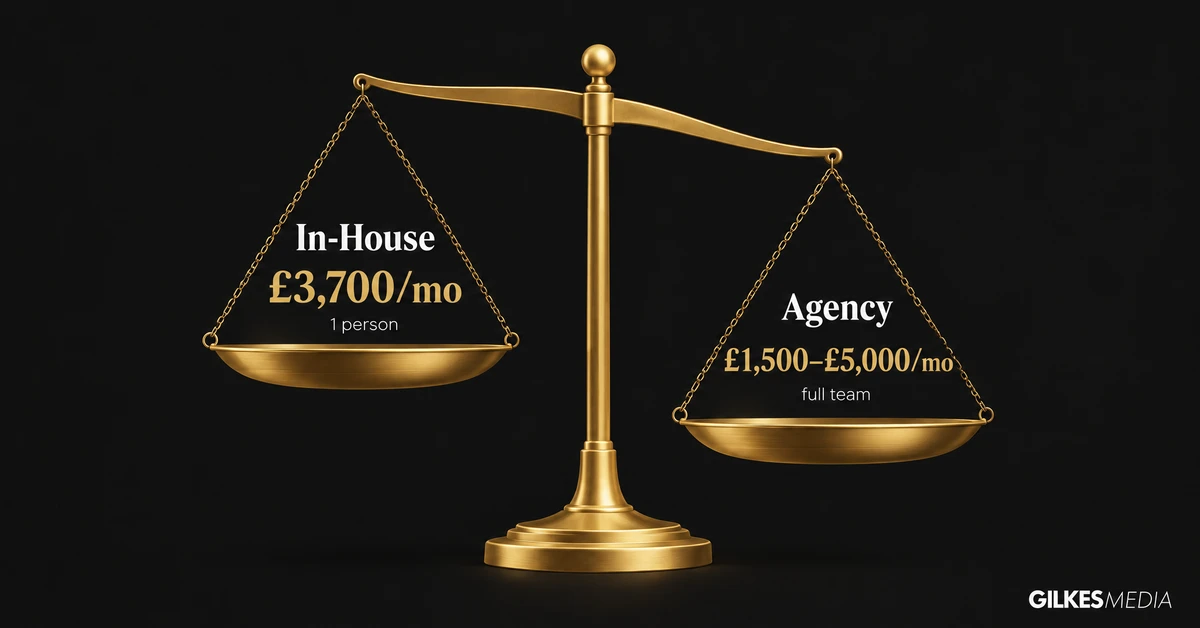
Add the statutory minimum 3% employer pension contribution on qualifying earnings, and you're looking at a fully-loaded cost of roughly £44,500 a year, or about £3,700 a month, before any software, training, or recruitment costs.
That £3,700 a month buys one person's time, working across whatever platforms your business needs, with no backup when they're on holiday or leave the role entirely. A mid-market agency retainer of £1,500-£5,000 typically buys a small team's collective expertise instead.
In-house makes most sense once your ad spend is large and stable enough to justify a dedicated hire, or your product is specialised enough that industry knowledge outweighs an agency's breadth. Below that threshold, the maths usually favours outsourcing.
A £3,700-a-month in-house hire buys one person's time and no cover for holidays or resignation. The same budget often buys a small agency team with built-in redundancy.
A proper onboarding process is one of the clearest early signals of how an agency will actually run your account once the sales process is over.
Expect account audits or builds, conversion tracking checks, and a kickoff call covering your goals, competitors, and past campaign history if you have any. Nothing meaningful should launch before tracking is verified working.
Campaigns should be gathering enough data for the platform's own learning phase to settle, with your first proper reporting call covering early trends rather than final conclusions. Be wary of an agency declaring victory or failure this early.
By now you should have a genuine, data-backed view of cost per lead and early return on ad spend, plus a clear plan for what changes next. This is a fair point to judge whether the agency is delivering what they promised at the pitch.
Judging a PPC agency on day 20 is like judging a marathon runner at the first mile marker. Give the process the full 90 days before drawing a real conclusion either way.
The contract itself deserves as much scrutiny as the pitch deck. Three clauses matter more than the rest of the document combined.
A three-month initial term is reasonable, since PPC genuinely needs that long to move past the platform's learning phase. Anything beyond six months with no easy exit is a real constraint worth negotiating down.
Thirty days' notice is standard and fair to both sides. Anything longer than sixty days starts to look like a deliberate barrier to leaving rather than a genuine handover period.
Confirm, in writing, that your Google Ads and Meta accounts are created under your own business's billing and admin access, not the agency's own manager account. Without this, changing agencies later can mean losing years of campaign history and conversion data overnight.
In practice, that means a three-month initial term, thirty days' rolling notice after that, your own accounts with the agency added as a user, and a clear, itemised breakdown of management fee versus ad spend on every invoice.
If an agency pushes back hard on any of these four points specifically, treat that pushback itself as useful information about how the relationship will actually run.
Put everything above together and the process is genuinely straightforward, even if it takes real time to do properly.
Follow this and you'll have already asked more questions than most of an agency's existing clients ever did, which is exactly the point.
None of this needs to feel adversarial. A genuinely good agency welcomes the scrutiny, because they already know the answers and have nothing to hide from a prospective client asking sensible questions.
A rushed one-hour sales call is not enough information to hand someone your ad budget. Give the process a proper week, and treat a pushy timeline as a red flag of its own.
If you'd rather skip the trial and error, we run this exact vetting standard against ourselves. Our Paid Ads Management service gives you full account access, transparent flat-fee retainers, and a dedicated strategist from day one, with no minimum contract lock-in.
If it's easier to talk it through first, book a free discovery call and we'll tell you honestly whether an agency is even the right fit for where your business is right now.
Most UK small businesses pay a management fee of £500-£1,500 a month on top of actual ad spend, or 10-20% of monthly spend as a percentage-based fee. Mid-market and enterprise retainers run from £1,500 up to £10,000 or more, depending on scope and platforms.
It's a genuine signal of sustained competence, since it requires ranking in the top 3% of agencies nationally for client retention. It doesn't guarantee the agency suits your industry, so use it alongside the vetting questions in this guide rather than instead of them.
A three-month initial term is standard and reasonable, since PPC platforms need that long to move past their learning phase. Be cautious of anything beyond six months with no straightforward exit clause.
A fully-loaded in-house PPC Manager typically costs around £44,500 a year, or roughly £3,700 a month, once National Insurance and pension contributions are included. Below that budget threshold, an agency retainer usually buys more collective expertise for the same money.
You should. Your accounts should sit under your own business's billing and admin access, with the agency granted user permissions rather than full ownership, so you keep your full campaign history if you ever switch providers.
Ask who specifically manages your account day to day, how success is defined before launch, what the exact fee structure includes, and what the process is to leave if the relationship isn't working. Vague answers on any of these are worth treating seriously.
A specialist usually offers more platform depth if you already have SEO, content, and design covered elsewhere. A full-service agency suits businesses consolidating several vendors into one accountable relationship with shared reporting and attribution.
Guaranteed results, no access to your own ad account, blended invoicing that hides ad spend inside the management fee, and reports built entirely around clicks and impressions rather than leads or revenue are the four most serious warning signs.
